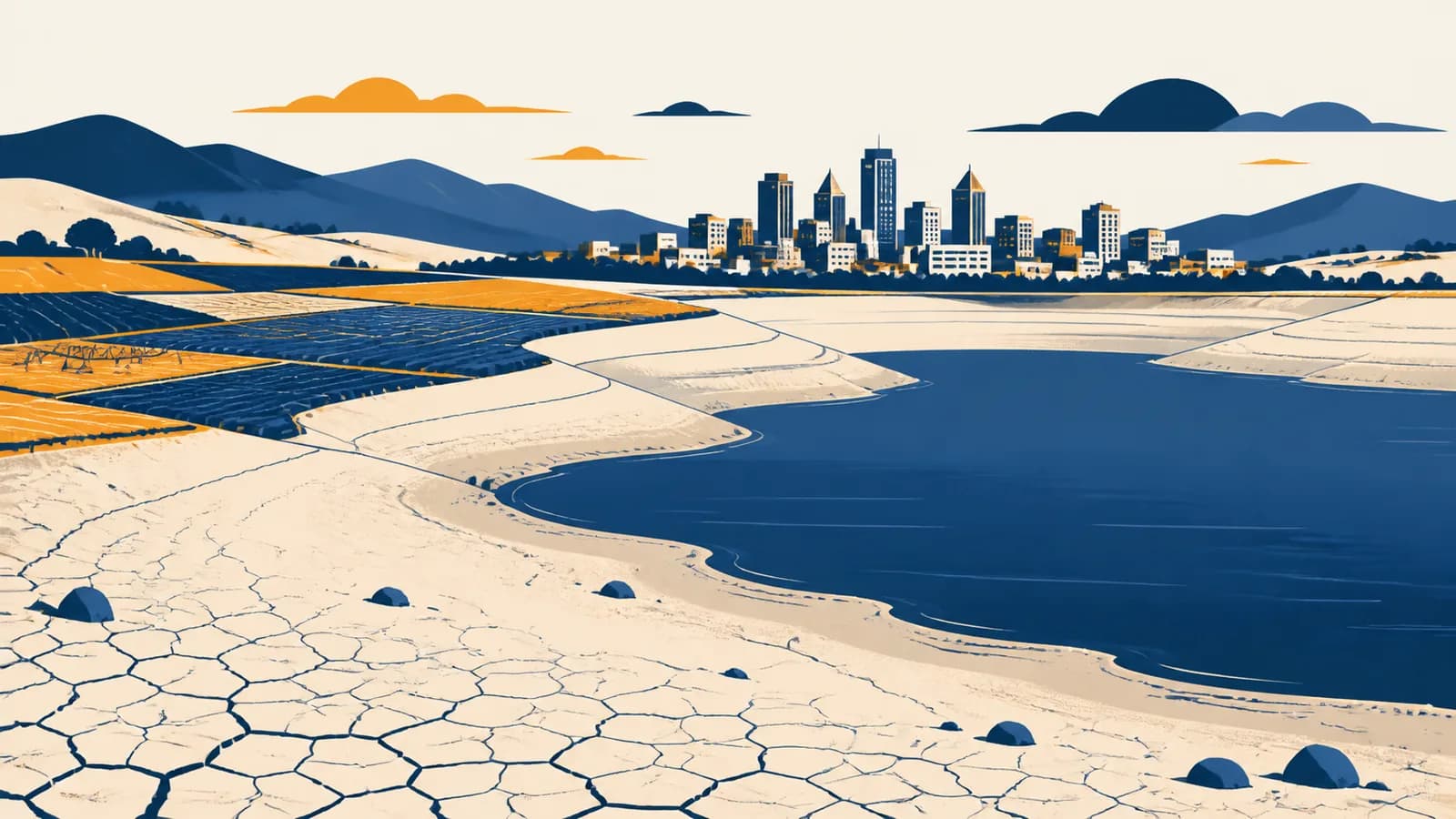
Water scarcity is a resource condition that limits reliable access to usable freshwater when demand exceeds available supply, in the context of environmental geography. It can result from low rainfall, heavy water use, pollution, weak infrastructure, unequal access, or several causes acting together. The difference between water scarcity and water stress is mainly one of measurement: scarcity describes the shortage people or ecosystems experience, while stress compares withdrawals with renewable supply. The idea exists because water is renewable but not unlimited in every place, season, or quality. Its causes, effects, and solutions all depend on how water moves and who can reach it.
What water scarcity actually is
Water scarcity is a mismatch between usable water and the demand for it in a defined place and period. The mismatch may come from a physical shortage, from systems that fail to deliver existing water, or from rules that exclude some users.
The words usable, place, and period do much of the work. Seawater beside a coastal town is not readily usable for drinking or irrigation. A river flood in January does not automatically supply farms in August. Water in a deep aquifer may exist, but a household without a well, pump, electricity, or legal right cannot use it.
Available rivers, lakes, soil moisture, and renewable groundwater cannot satisfy current demands without damaging the source or cutting supply to another user.
Water exists in the wider environment, but finance, pipes, treatment, storage, institutions, or political power do not provide safe and reliable access.
This distinction prevents a common error. A dry, wealthy city can reduce scarcity through reservoirs, reuse, careful pricing, and reliable pipes. A humid settlement can face scarcity when a contaminated river is its only nearby source. Climate sets opportunities and limits, but infrastructure and power decide who receives the water.
Scarcity is relational. A water supply becomes scarce relative to demand, water quality, timing, access, and the amount that must remain for ecosystems.
Scarcity can also be seasonal. A basin may have enough annual runoff on paper while experiencing a severe dry season. Annual totals hide this because they add wet months and dry months together. A useful diagnosis therefore states the area, time scale, source, water quality, and affected users.
How a water balance works
A water balance tracks water entering, leaving, and being stored in a system. Scarcity grows when withdrawals and other losses repeatedly exceed renewable inflows, or when pollution makes part of the stored or incoming water unsuitable for its intended use.
Change in storage equals precipitation, incoming flow, and managed returns, minus evaporation, outgoing flow, and withdrawals.
Here, is the change in water stored in reservoirs, soil, snow, wetlands, and aquifers. is precipitation, and are flows across the boundary, is returned water, is evaporation and plant transpiration, and is human withdrawal. The boundary could enclose a farm, city, river basin, or country.
Suppose a reservoir starts a month with 50 million cubic metres. Rain and river inflow add 12 million, while evaporation removes 2 million, releases downstream remove 8 million, and the city withdraws 7 million. The arithmetic is visible:
Storage ends at 45 million cubic metres. Repeating this loss for many months would make restrictions likely.
A withdrawal is not always the same as consumption. Cooling water taken by a power station may return to the river, although it may be warmer. Irrigation water can return as drainage or groundwater recharge, while another share leaves through crop transpiration. Returned water may be downstream, delayed, or polluted, so it cannot simply be counted as if it never left.
The balance also needs an ecological allowance. Fish, floodplain forests, wetlands, and estuaries require particular flows, temperatures, and seasonal pulses. Counting every drop in a river as available for withdrawal would define a dead river as fully allocated. The United Nations indicator for water stress therefore compares withdrawals with available renewable freshwater after accounting for environmental flow requirements.
Water scarcity versus drought
Drought is an unusually dry condition compared with the normal climate of a place, while water scarcity is a shortage relative to demand and access. Drought can trigger scarcity, but heavy use, pollution, broken infrastructure, or unequal allocation can create scarcity without drought.
A climatic or hydrological anomaly. Meteorologists compare rainfall, soil moisture, streamflow, or storage with the expected range for that location and season.
A relationship between supply, demand, quality, access, and environmental needs. It can be chronic, seasonal, or produced by a short shock.
An arid desert can receive its normal tiny amount of rain and have no meteorological drought. If a settlement there demands more water than local sources and imports can provide, it is water scarce. A usually wet region can enter drought after several rainless months yet avoid household scarcity if reservoirs are full, leaks are low, and demand is flexible.
The sequence often runs through several parts of the water cycle. Low precipitation first creates meteorological drought. Soil dries and crops become stressed. River flow and reservoir storage later decline, creating hydrological drought. If demand stays high, those physical changes become shortages, rationing, crop losses, higher costs, or ecosystem damage.
Two neighbouring towns receive the same drought. Town A repaired leaks, protected its upstream catchment, and kept reserve storage. Town B expanded demand without adding storage and allows untreated waste into its river. The weather hazard is shared, but the scarcity outcome is not.
Climate change alters parts of this chain rather than applying one simple global effect. The Intergovernmental Panel on Climate Change reports that warming raises evaporative demand over land and intensifies many very dry and very wet patterns, with large regional differences. Earlier snowmelt can also move water toward winter and spring, leaving less natural flow during the summer demand peak.
How scarcity develops in rivers, reservoirs, and aquifers
Scarcity develops when connected stores lose water, lose quality, or cannot release water at the required time. Rivers respond quickly to weather and withdrawals, reservoirs shift flow between seasons, and aquifers respond more slowly but can conceal long-term depletion.
Rain fails, snowpack shrinks, upstream users divert flow, or paved surfaces send water rapidly to drains instead of allowing infiltration.
Farms pump for irrigation, cities expand, factories take process water, and hot weather raises outdoor use and evaporation.
Reservoir levels and groundwater heads fall. This buffer prevents an immediate shortage but spends water saved during earlier wet periods.
Intakes sit above the falling water, pumps require more energy, wells fail, water quality worsens, and environmental flows become harder to maintain.
Surface water and groundwater are often one connected system. Groundwater naturally discharges into many streams and keeps them flowing between storms. Heavy pumping lowers the water table around a well into a cone of depression. According to the United States Geological Survey, that lowered zone can reduce discharge to a stream or even draw stream water into the aquifer.
This connection creates a time lag. A pumping decision today may reduce river flow later and farther away. A deep well can keep producing during a drought, giving the appearance of security, even while the aquifer loses stored water. If pumping exceeds recharge for long enough, wells must be deepened, pumping costs rise, shallow users lose access, and land can subside where sediments compact.
Land cover affects the routes water takes. Removing vegetation can alter infiltration, erosion, shade, and sediment delivery, although the direction and size of the water effect depend on soil, slope, climate, and scale. The guide to how forest removal changes environments explains why a land change upstream can become a water problem downstream.
How water scarcity shows up in food and farming
Water scarcity reaches food systems through crop water stress, unreliable irrigation, livestock needs, processing, and trade. Farmers respond by changing planting dates, crops, irrigation methods, or planted area, but each response has costs and may shift water use elsewhere.
A crop obtains water through its roots and releases much of it through stomata in its leaves. This transpiration supports nutrient movement and cools the plant. If soil cannot supply enough water, the plant closes its stomata, carbon uptake slows, growth declines, and heat stress can increase. The result depends on timing. A short deficit during a sensitive flowering stage may matter more than a longer deficit after harvest.
These global shares describe withdrawals, not a rule for every country. FAO notes large regional differences. Irrigated agriculture dominates withdrawals in many farming regions, while industry can dominate in some wealthy industrial regions. A global average cannot tell a local manager which canal, crop, or factory is causing stress.
Efficiency also needs careful interpretation. Drip irrigation can place water close to roots and reduce evaporation or runoff on a field. Yet if the farmer uses the saved water to expand the irrigated area, total basin consumption may stay level or rise. If old canal leakage recharged an aquifer used by nearby wells, lining the canal may save water for the canal operator while removing supply from another user.
Field efficiency is not basin savings. Track where the unused water went before the change, and what happens to the saved water afterward.
Food trade moves demand indirectly. A dry region can import water-intensive crops instead of growing all of them locally. This is sometimes called virtual water trade because the water is embedded in the production process, not physically shipped inside the grain in the same quantity. Trade can reduce local pressure, but it also exposes consumers to harvest failures, prices, transport disruptions, and water stress in exporting regions.
How water scarcity shows up in cities and work
In cities and workplaces, scarcity appears as intermittent taps, lower pressure, higher treatment costs, delivery queues, production limits, and competition between users. The effects follow networks and budgets, so neighbouring households or firms can experience the same shortage very differently.
An urban supply chain begins at a catchment, well field, river intake, or desalination plant. Water then needs treatment, pumping, storage, pressure management, distribution, sewer collection, and often wastewater treatment. Failure at any point reduces reliable supply. Electricity failure can stop pumps even when the reservoir holds water. A leaking pipe can lose treated water and allow contamination when pressure falls.
The World Health Organization and UNICEF define a safely managed drinking water service as an improved source that is on the premises, available when needed, and free from contamination. That definition shows why a pipe connection alone is an incomplete measure. A tap that runs twice a week or supplies unsafe water does not provide the same service as continuous safe supply.
Jobs expose the dependencies. A brewer needs water of consistent quality as an ingredient and for cleaning. A semiconductor plant requires highly purified process water. A hospital needs reliable water for hygiene, sterilisation, cooling, and sanitation. Builders need it for concrete and dust control. Power stations may depend on river water for cooling, while hydropower depends on flow and reservoir head.
Pressure returns for four hours. A family with a roof tank stores water and continues normal use. A renter without storage fills a few containers and misses paid work while waiting. Both appear as connected customers in a database, but access, time cost, and health risk differ.
Water quality and quantity interact. Low river flow provides less dilution for pollutants. Salty water can move into a coastal aquifer when pumping lowers freshwater pressure. A treatment plant may handle ordinary sediment but fail after an intense storm washes unusual loads into the intake. The page on how contaminants move through air, water, and soil gives the wider process behind these quality losses.
How governments allocate water that is scarce
Governments allocate scarce water through permits, service priorities, prices, quotas, reservoir rules, treaties, and emergency restrictions. A sound system defines who may take water, measures actual use, protects basic needs and ecosystems, and changes allocations when supply changes.
Allocation is not solved by finding one technically perfect order. Drinking, sanitation, food production, livelihoods, cultural uses, navigation, energy, and ecosystems can all have legitimate claims. Law decides which rights exist and how senior rights, customary access, and public duties interact. Geography determines which users share a river or aquifer and which decisions cross a border.
| Tool | What it changes | Main risk |
|---|---|---|
| Withdrawal permit | Sets who may take water, where, and how much | Paper rights can exceed real supply if permits ignore dry years |
| Tiered price | Raises the cost as use passes defined blocks | Large essential households may pay more unless the design accounts for need |
| Seasonal quota | Caps use during a scarce period | Unmetered or illegal withdrawals can undermine the cap |
| Reservoir rule | Schedules storage and releases among purposes | A rule based on old climate records may perform poorly under new conditions |
| Water market | Allows an entitlement to move between users | Third parties and ecosystems may lose return flows if transfers are poorly defined |
Measurement makes these tools real. River gauges estimate flow, observation wells record groundwater levels, meters track withdrawals, satellites observe changes in surface water and land, and laboratories test quality. Each has uncertainty. A decision-maker should know what was measured directly, what was modelled, how often the data were collected, and whether illegal or unregistered use is missing.
Prices can reduce discretionary demand and pay for maintenance, but price alone does not guarantee fairness. A low-income household may already use little and still struggle with a bill. A large commercial user may treat a higher tariff as a small operating cost. Lifeline quantities, targeted support, progressive blocks, and enforcement against waste can change who bears the burden.
Supply projects remain useful where their full effects make sense. Reservoirs shift water across time but flood land and lose some water to evaporation. Transfers move water across space but alter donor basins. Wastewater reuse creates a dependable local source but needs treatment suited to the intended use. Protecting catchments and repairing networks sit within the broader work of managing resources and habitats for continued use.
Four mistakes people make with water scarcity
Four recurring mistakes are treating rainfall as total supply, counting every withdrawal as permanent consumption, assuming efficiency always reduces basin use, and reading a regional average as every person’s experience. Each mistake hides a connection that changes the diagnosis or solution.
1. Rainfall is treated as water available for use
Rainfall is an input, not a delivered supply. Some evaporates quickly, some is used by vegetation, some runs to the sea during floods, and some recharges groundwater. Storage, timing, quality, topography, and infrastructure determine the usable share. A storm can cause a flood without ending a long groundwater deficit.
2. Withdrawal is confused with consumption
A withdrawal removes water from a source; consumption removes it from immediate reuse in that basin through evaporation, transpiration, incorporation into products, or transfer elsewhere. Both matter, but for different questions. A high withdrawal with clean return flow can affect timing and temperature, while a smaller consumptive use can reduce downstream quantity.
3. A more efficient device is assumed to save basin water
A low-flow fixture usually reduces household demand if behaviour stays similar. In irrigation, the accounting is more complicated because runoff and seepage may supply downstream users. The correct comparison traces return flows and any expansion after the efficiency gain. Technology changes an opportunity; rules and behaviour shape the final water balance.
4. One average is assumed to describe everyone
A citywide litres-per-person figure can combine homes with gardens and tanks, flats with intermittent taps, factories, visitors, and leakage. It says little about reliability or affordability. Break the data down by season, district, income, source, and use before deciding where scarcity is felt or where action will work.
This test also helps with maps. A country shaded one colour can contain a wet mountain basin, an overdrawn farming aquifer, and an informal settlement without pipes. The map scale may be useful for comparison, but it must match the claim being made.
Can desalination end water scarcity?
Desalination can add a reliable source for coastal users, but it does not end scarcity by itself. It requires energy, money, intake and discharge systems, skilled operation, and distribution pipes, while inland transport and concentrated brine create further limits.
Reverse osmosis plants push salty water through membranes that allow water molecules to pass more readily than dissolved salts. Pretreatment protects the membranes, pressure supplies the separating force, and post-treatment makes the product suitable for its intended use. The method turns an abundant source into usable water, but it does not make treatment or pumping free.
Desalination is strongest as one part of a portfolio where a coastal city has finance, energy, technical capacity, and a suitable marine site. It is a weaker answer for dispersed inland farms growing low-value crops. Demand management, leakage repair, reuse, storage, and source protection may provide cheaper water first, depending on local conditions.
Does saving water at home make a difference?
Household conservation can lower peak demand, postpone costly capacity, reduce energy used for heating and pumping, and preserve storage during shortages. Its basin effect depends on the local share of domestic use, network leakage, return flows, and what happens to saved water.
Actions with clear local value include fixing leaks, running full appliance loads, using efficient fixtures, choosing plants suited to the climate, and following drought restrictions. Outdoor watering often offers flexible cuts because it is less essential than drinking and sanitation. Renters and low-income households may control less of their building’s plumbing, so utilities and landlords also carry responsibility.
Personal action should not distract from larger withdrawals or failing systems. FAO’s global figures place agriculture far above municipal use in total freshwater withdrawals, though the proportions vary greatly by region. The best household action and the best basin policy can both be valid at the same time.
Can a wet place be water scarce?
A wet place can be water scarce when rainfall arrives in unusable bursts, water is polluted, storage is small, infrastructure fails, demand is concentrated, or access is unequal. High annual precipitation does not guarantee safe water at the needed location and time.
Imagine a tropical city with intense seasonal rain. Steep roofs and paved streets send much of it rapidly into drains. The river receives sewage, the treatment plant is undersized, and informal districts lack pressurised pipes. The city can face floods in the wet season and household shortages weeks later. The contradiction disappears once timing, quality, and access enter the account.
Wet places can also create their own scarcity through contamination and land change. More rain does not flush every pollutant safely away, and intense runoff can overwhelm sewers or carry soil into reservoirs. Supply is a property of a whole coupled system, not of rainfall alone.
Water scarcity makes geography visible in every water decision
Water scarcity shows how physical processes, infrastructure, economics, law, and unequal power meet in one place. A useful geographic explanation follows water through the catchment, identifies each user and constraint, compares seasons, and asks who gains or loses when the system changes.
The next time a reservoir level, drought restriction, food price, new housing project, or factory permit appears in the news, draw its water system. Mark the source, storage, treatment, users, return flows, and ecosystems. Then add the governing boundary. A river basin rarely matches a city, province, or national border, which is why coordination is difficult.
The takeaway: Water scarcity is not simply too little rain. It is a place-specific mismatch among renewable supply, stored water, quality, timing, demand, access, and ecological need. Change any one of those parts and the shortage can improve, worsen, or move to someone else.
This way of tracing connections is central to how geography explains places, environments, and human decisions. It turns a vague claim about “running out of water” into questions that can be measured: what is falling, flowing, stored, withdrawn, returned, polluted, priced, and protected?