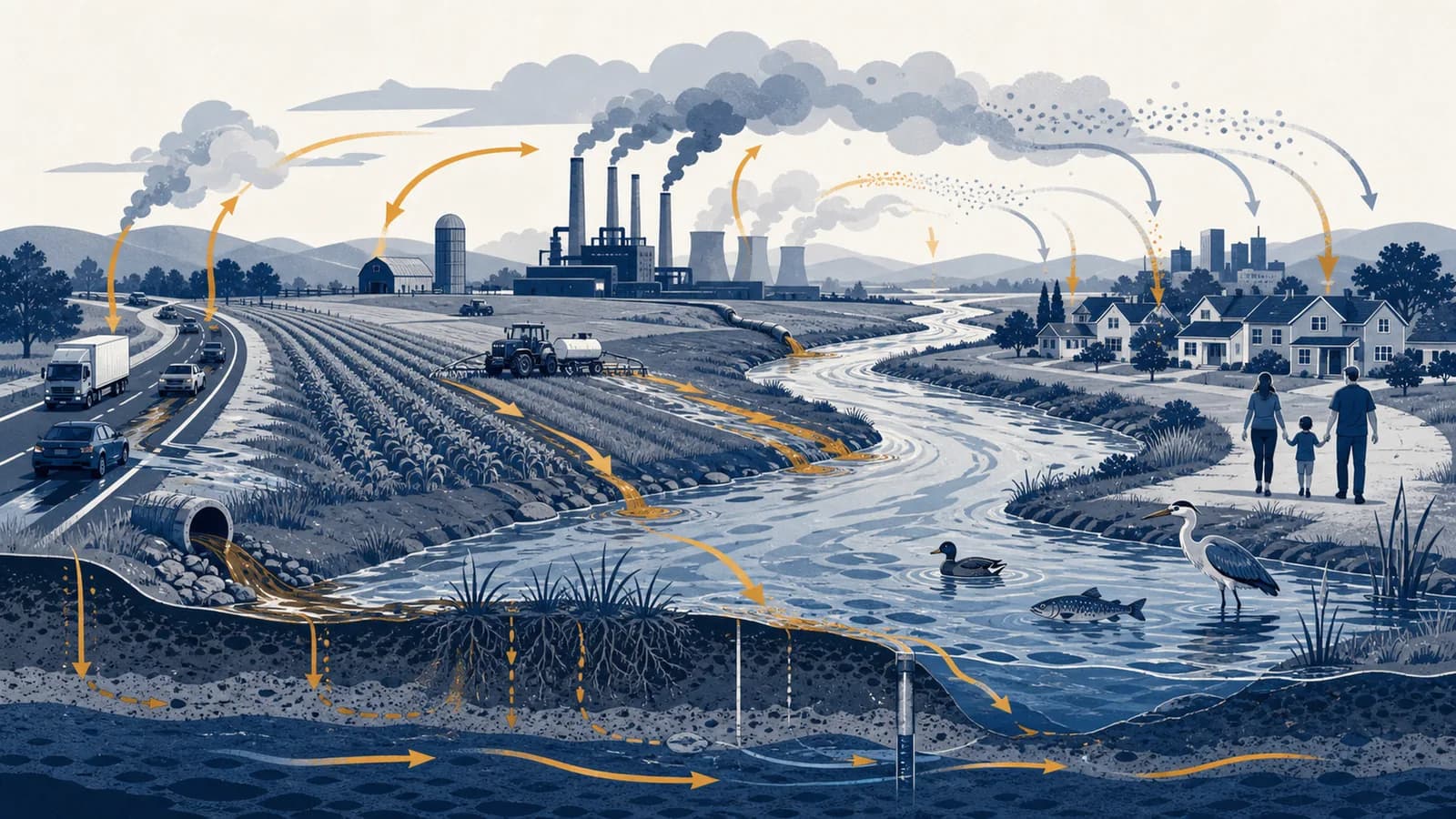
Pollution is an environmental change that introduces harmful substances or energy into air, water, soil, or living systems, in the context of human use of places and resources. A useful pollution definition therefore includes the source, the pollutant, the pathway, and the people or ecosystems exposed. The main types of pollution include air pollution, water pollution, land pollution, noise, light, and heat. Their causes and effects differ, but each begins when an emission or release exceeds what a receiving environment can safely absorb, break down, or carry away. The idea exists so societies can identify damage, trace responsibility, and choose effective controls.
A dark exhaust plume is easy to recognise, but pollution is not always visible. Clear water can contain dissolved lead. A quiet field can hold pesticide residues. An apparently clean street can have high concentrations of nitrogen dioxide beside moving traffic. Geography helps explain these cases because harm depends on location, movement, distance, land use, weather, and unequal exposure.
What pollution actually is
Pollution is the harmful alteration of an environment by matter or energy. Something becomes a pollutant when its amount, location, chemical form, or timing causes damage to health, ecosystems, property, comfort, or the uses people make of a place.
A pollutant is not defined only by what it is. Salt belongs naturally in seawater, yet salt leaking from a storage pile can damage a freshwater stream. Light is useful inside a building, yet poorly aimed light can brighten the night sky and disturb animals. Warm water is not poisonous, but a hot discharge can lower the amount of oxygen available to fish.
Four connected parts turn a release into a pollution problem:
The source might be a vehicle, farm, factory, landfill, fireplace, leaking pipe, or natural event. The pollutant is the matter or energy released. The pathway is the route through air, water, soil, food, or direct contact. The receptor is what receives the dose, such as a child, a wetland, a crop, or a stone building.
Breaking any link can reduce harm. A factory can substitute a less toxic chemical at the source. A filter can capture particles before release. A protective barrier can block a pathway. Moving a playground away from a busy road can reduce exposure, although it does not remove the emission.
Presence is not enough. Detecting a substance does not by itself show serious pollution. Its concentration, toxicity, duration, pathway, and the sensitivity of the receptor determine the likely harm.
How pollutants move and change
Pollutants move by flowing with air or water, spreading from concentrated areas, attaching to particles, entering organisms, or settling onto surfaces. During transport they may react, decay, accumulate, or change into substances that are more or less harmful.
A release rarely stays where it began. Geography links a source to downwind neighbourhoods, downstream reservoirs, coastal currents, soils, and food webs. The route depends on the pollutant's physical and chemical properties as well as the surrounding terrain and weather.
Matter or energy leaves a source. Examples include smoke entering the atmosphere, fertiliser washing off a field, and sound spreading from a road.
Wind, flowing water, groundwater, vehicles, animals, and moving sediment carry the pollutant. Turbulence and mixing usually spread it through a larger volume.
Sunlight, oxygen, water, microbes, and other chemicals can alter it. Some reactions reduce toxicity, while others create secondary pollutants.
Particles settle, dissolved substances bind to soil, and persistent chemicals can build up in sediment or organisms.
A receptor inhales, drinks, eats, absorbs, hears, or otherwise receives the pollutant. The resulting dose can produce a biological or physical response.
Primary pollutants are emitted directly, such as soot or sulfur dioxide. Secondary pollutants form after release. Ground level ozone, for example, forms through sunlight driven reactions involving nitrogen oxides and volatile organic compounds. That means an ozone hotspot can occur away from the largest original emissions.
Topography changes the route. A valley can restrict air circulation. A steep paved catchment sends runoff into drains quickly. Permeable soil may let dissolved pollutants enter groundwater, where movement can be slow and cleanup difficult. A river carries material downstream, but bends, floodplains, reservoirs, and sediment can store it along the way.
How concentration, dose, and risk work
Concentration measures how much pollutant is present in a given amount of air, water, or soil; dose measures how much reaches an organism; risk combines the pollutant's harmful properties with the amount and pattern of exposure.
Concentration answers a question about the environment. Dose answers a question about contact. Two people beside the same polluted road may receive different doses if one remains there for eight hours and the other passes through in five minutes. Age, breathing rate, body size, and health can also change the effect of a dose.
If 5 g of a substance is evenly mixed into 1,000 L of water, then 5,000 mg divided by 1,000 L gives 5 mg/L.
Dilution lowers concentration because the same mass is mixed through a larger volume. It does not destroy the pollutant. If that five grams later collects in sediment or is taken up by organisms, the mass is still present even though the earlier water sample looked dilute.
Pollution managers also calculate load, the total mass carried past a point over time. Concentration alone can mislead because a small stream with a high concentration may carry less total material than a large river with a lower concentration.
Water at 2 mg/L flowing at 500,000 L per day carries 1,000,000 mg per day, which equals 1 kg per day.
A hazard is the capacity to cause harm. Exposure is actual contact with that hazard. Risk rises when either becomes more serious. A sealed container of toxic liquid presents a hazard, but exposure stays low while the container remains intact. A spill opens a pathway and changes the risk.
A school is considering two sites. One is nearer a high traffic road; the other is farther away but beside land with contaminated soil. Planners need different evidence for each site: time based air measurements for the first, soil sampling and pathway analysis for the second. The word pollution alone cannot decide between them.
Pollution versus contamination
Contamination means an unwanted substance or agent is present, while pollution means the change causes harm or unacceptable interference. The terms overlap in everyday use, but contamination describes presence and pollution adds an effect, threshold, or loss of environmental quality.
A laboratory detects a trace chemical in river water. The finding establishes that the chemical is present, but more evidence is needed to judge its source, dose, and effects.
The chemical occurs at a concentration and for a duration that harms river life, threatens water use, or breaches a legally defined environmental standard.
The distinction prevents two mistakes. First, it stops a detection from being treated automatically as a disaster. Modern instruments can detect very small amounts. Second, it stops invisible harm from being dismissed because no stain, smell, or dead animal is obvious.
Waste is also different from pollution. Waste is material its holder discards or intends to discard. It becomes a pollution source when storage, handling, burning, leakage, or disposal creates a harmful pathway. The choices that prevent this transition are part of how waste collection, treatment, and disposal work.
Natural origin does not guarantee safety. Volcanic ash, smoke from wildfires, radon from rocks, and excess sediment can all harm health or ecosystems. Laws often distinguish natural events from human emissions when assigning responsibility, but receptors respond to the dose rather than the legal category.
How types of pollution differ
Types of pollution differ by receiving environment, transport pathway, exposure route, and method of control. Air, water, and soil pollution carry matter, while noise, excess light, and heat transfer energy that can still alter health, behaviour, or ecosystems.
Air pollution travels with weather
Air pollution consists of harmful gases, liquid droplets, and solid particles in the atmosphere. Wind direction moves a plume, wind speed affects dilution, rain removes some pollutants, and atmospheric stability controls vertical mixing. Street shape and building height can create pockets where traffic emissions disperse slowly.
Particle size matters because it affects how long particles remain airborne and where they deposit in the respiratory system. Gas chemistry matters too. Some gases dissolve in water droplets, some react on surfaces, and some help form secondary particles or ozone.
Water pollution follows catchments
Water pollution is a harmful change in the physical, chemical, or biological quality of surface water or groundwater. A catchment gathers rain and runoff into a shared outlet, so activity across the whole drainage area can affect one river reach, lake, estuary, or water intake.
Nutrients illustrate a chain reaction. Extra nitrogen or phosphorus can stimulate algal growth. When algae and other organic matter die, microbes decompose them and consume dissolved oxygen. If oxygen falls far enough, fish and bottom dwelling animals struggle or die. The nutrient does not need to poison the fish directly.
Pollution can also reduce usable supply. A region may contain water yet lack enough water of acceptable quality at the needed place and time. This connects pollution to the causes and consequences of water scarcity.
Soil pollution can become a long term reservoir
Soil pollution occurs when harmful substances alter soil functions or create exposure through dust, crops, skin contact, surface runoff, or groundwater. Clay and organic matter can bind chemicals, which may slow movement but keep contamination stored for later release.
Soil conditions control chemical form. Acidity, oxygen, moisture, microbes, and organic matter can make a substance more mobile or more available to organisms. Cleanup therefore requires more than removing visibly stained earth. Investigators must map depth, identify pathways, and check what lies down slope or down gradient.
Noise, light, and heat are energy pollution
Noise pollution is unwanted or harmful sound. Its effect depends on loudness, pitch, duration, timing, and the listener. Light pollution includes glare, light entering unwanted spaces, excessive brightness, and skyglow. Thermal pollution changes environmental temperature, often through heated water or altered surfaces.
These forms leave no pile of waste, but they still have sources and pathways. A barrier can interrupt sound. Shielding can aim outdoor lighting downward. Cooling systems can reduce heat before water is discharged. Their geography is often sharply local, although skyglow and heated rivers can extend beyond the property that produced them.
How pollution monitoring works
Pollution monitoring uses planned measurements to estimate what is present, where it moves, how it changes over time, and who is exposed. A sound monitoring design matches the sampling place, interval, instrument, and detection limit to a specific decision.
A single measurement is a snapshot. It may miss rush hour peaks, a storm runoff event, a nighttime discharge, or a seasonal change in river flow. Continuous sensors reveal patterns through time, while laboratory samples can identify substances that field instruments cannot measure accurately. Good investigations often use both.
A map is only as good as its sampling design. Empty areas may mean no samples were taken, not that no pollution exists. A smooth colour surface between distant monitoring stations is an estimate rather than a direct measurement.
Investigators begin with a question. To test whether a pipe affects a river, they can compare samples upstream and downstream, repeat them under different flows, and measure the pipe itself. To estimate roadside exposure, they place monitors at relevant heights and distances, record weather, and compare busy periods with quieter ones.
Remote sensing extends coverage. Satellites can observe features such as smoke plumes, changes in water colour, land surface temperature, and some atmospheric gases. Aircraft and drones can add finer detail. These observations still need ground measurements because a sensor records reflected or emitted energy, not every pollutant directly.
Quality control makes results checkable. Field teams use clean containers, labelled locations, calibration checks, duplicate samples, blank samples, and a recorded chain of custody. Laboratories report units and detection limits. Analysts retain uncertainty instead of turning every small difference into a firm conclusion.
How pollution shows up in jobs, law, and daily decisions
Pollution becomes practical whenever someone chooses a site, designs a process, grants a permit, treats water, investigates illness, values land, or buys and uses a product. Each decision connects environmental evidence with cost, law, engineering, and public priorities.
Environmental scientists trace sources and pathways
Field scientists collect air, water, soil, sediment, or biological samples. Laboratory scientists identify substances and concentrations. Hydrologists model water movement, meteorologists interpret atmospheric conditions, and geographic information system analysts combine measurements with roads, land use, elevation, population, and drainage networks.
The task is often forensic. A plume in groundwater has a shape and direction. A metal mixture in sediment can carry a chemical signature. A sudden drop in river oxygen may line up with flow, temperature, and discharge records. Each clue narrows the possible sources, but investigators must test alternatives.
Engineers control pollution before and after release
Engineers redesign processes to use less hazardous material, enclose equipment, capture gases, filter particles, treat wastewater, contain runoff, and restore contaminated land. Prevention generally avoids moving pollution between media. A filter that catches air particles still produces collected material that must be handled safely.
Planning links pollution control with how present choices affect future environmental capacity. A treatment plant may clean a discharge, but its energy use, chemical inputs, sludge, maintenance, and resilience during floods also belong in the decision.
Law turns evidence into duties and limits
Environmental law may set ambient quality standards, emission limits, technology requirements, monitoring duties, and cleanup responsibilities. An emission limit controls what leaves a source. An ambient standard concerns the quality of the surrounding environment after emissions mix with all other sources.
Permits commonly specify where and how a source may discharge, what must be measured, and what records must be kept. Inspectors compare actual operation with those conditions. Courts and regulators may then need evidence about causation, foreseeable harm, compliance, and responsibility for historic releases.
Households meet pollution through ordinary choices
Daily exposure changes with ventilation, heating and cooking fuels, traffic routes, workplace conditions, water sources, and product use. Labels and local advice matter because safe handling depends on the substance. Mixing household chemicals can cause dangerous reactions, and pouring paint, oil, or medicine into a drain can send it toward water treatment systems not designed for that input.
You smell a strong chemical odour near a stream. Record the place, time, weather, colour, and visible source from a safe location. Do not touch or collect an unknown substance. Report it through the local environmental or emergency authority appropriate to the apparent danger. Specific observations help responders locate a short lived release.
3 mistakes people make with pollution
Three common errors are treating all pollution as visible, confusing a source with actual exposure, and assuming cleanup makes material disappear. Each mistake hides part of the source, pathway, receptor chain and can lead to an ineffective response.
1. If you cannot see or smell it, it is harmless
Many pollutants have no useful warning smell or colour at harmful concentrations. Other substances smell unpleasant before they become dangerous. Human senses are not calibrated instruments, and becoming used to an odour can reduce awareness without reducing exposure.
Measurements must target the suspected agent. A particle sensor cannot identify every gas. A basic water clarity test cannot reveal every dissolved chemical or microbe. The right conclusion is limited to what the method actually measures.
2. The nearest source caused the exposure
Distance matters, but movement can make the nearest source the wrong suspect. Wind direction, river flow, underground geology, stack height, chemical reactions, and operating schedules all affect where pollution arrives. A large source can also contribute less at one location than several smaller sources combined.
Source inventories show what is emitted. Concentration maps show what is present. Exposure estimates add where people spend time. Health records show outcomes influenced by many factors. Placing these layers on one map does not prove that one caused another, but it can guide a better investigation.
3. Pollution disappears when it is cleaned up
Treatment often separates, transforms, or transfers pollutants. A wastewater plant may concentrate contaminants into sludge. An air filter moves particles from a gas stream into a solid waste. Excavation moves polluted soil to another site. Incineration changes material chemically and creates gases and ash.
Did the treatment remove the pollutant from the water?
What did the pollutant become, where did it go, how stable is it there, and what new exposure pathways remain?
Some treatment does destroy a pollutant or convert it to a much less harmful form. The process must be demonstrated through chemistry and monitoring, not assumed from a cleaner looking output.
How long does pollution last?
Pollution lasts until physical removal, chemical transformation, radioactive decay, biological breakdown, or permanent isolation reduces the harmful exposure. Persistence ranges widely because sunlight, temperature, oxygen, water, microbes, and the pollutant's molecular structure control the rate of change.
Biodegradable does not mean instant or harmless. Organic waste can break down, yet its decomposition may consume oxygen in water. Oil components differ in volatility and decay rate. Metals do not biodegrade into nothing because they are elements, though their chemical form and mobility can change.
Storage can delay rather than end a problem. Polluted sediment may remain buried until a flood, dredging project, or change in water chemistry releases it. Contaminated groundwater can move slowly through rock pores and fractures. A site can therefore keep producing exposure long after the original activity stops.
How can one place's pollution reach another?
Pollution crosses boundaries when winds, rivers, ocean currents, groundwater, trade, or moving organisms carry it beyond the source area. Political borders do not stop physical transport, so monitoring and control often require cooperation between upstream and downstream places.
A city can receive smoke produced in another region. A country downstream can receive nutrients or industrial chemicals released upstream. Products can shift pollution through trade when extraction and manufacturing emissions occur far from the consumer. Waste shipments can move direct risks as well as responsibility.
Scale changes the best response. A noisy machine may need an enclosure. A polluted urban river may require action across its catchment. Air pollutants that travel between countries need compatible measurement and shared agreements. Studying how places, environments, and human systems connect across geography makes these scale choices easier to see.
Does dilution solve pollution?
Dilution can lower a local concentration, but it does not remove pollutant mass and cannot be assumed to prevent harm. The result depends on mixing, total load, persistence, repeated releases, background conditions, and whether the pollutant later accumulates in organisms or sediment.
Consider a treated discharge entering a river. Faster river flow may reduce the concentration immediately below the outfall. Farther downstream, however, the substance may settle in a slow reach, enter an irrigation intake, or combine with releases from other sources. During drought, less water may be available for the same discharge, raising concentration.
Dilution is most defensible when scientists know the pollutant's fate, the receiving environment has measured capacity, harmful thresholds are respected, and monitoring confirms the prediction. It is weakest as an excuse for uncontrolled release, especially for persistent substances that build up over time.
The takeaway: Always follow the mass as well as the concentration. Ask what entered, what changed chemically, where it travelled, what stored it, and which receptors received a dose.
Pollution is geography made measurable
Pollution reveals how human activity connects places through flows of matter and energy. Its pattern is never only chemical: distance, terrain, weather, water, land use, infrastructure, law, and inequality shape who creates emissions and who receives the consequences.
Effective control follows a clear order. Prevent a harmful release where possible. Reduce what cannot yet be prevented. Capture or treat the remainder. Monitor the receiving environment, and revise the control when evidence shows it is failing. Cleanup comes after these choices because repairing dispersed damage is usually harder than stopping it at the source.
Look at one familiar place, such as a road, stream, school, workshop, or shopping area. Identify a possible source, the pollutant or energy it releases, the pathway it could follow, and the receptor it might reach. Then ask what measurement would distinguish a real exposure from a guess. That sequence turns pollution from a vague label into a geographic explanation that can guide action.