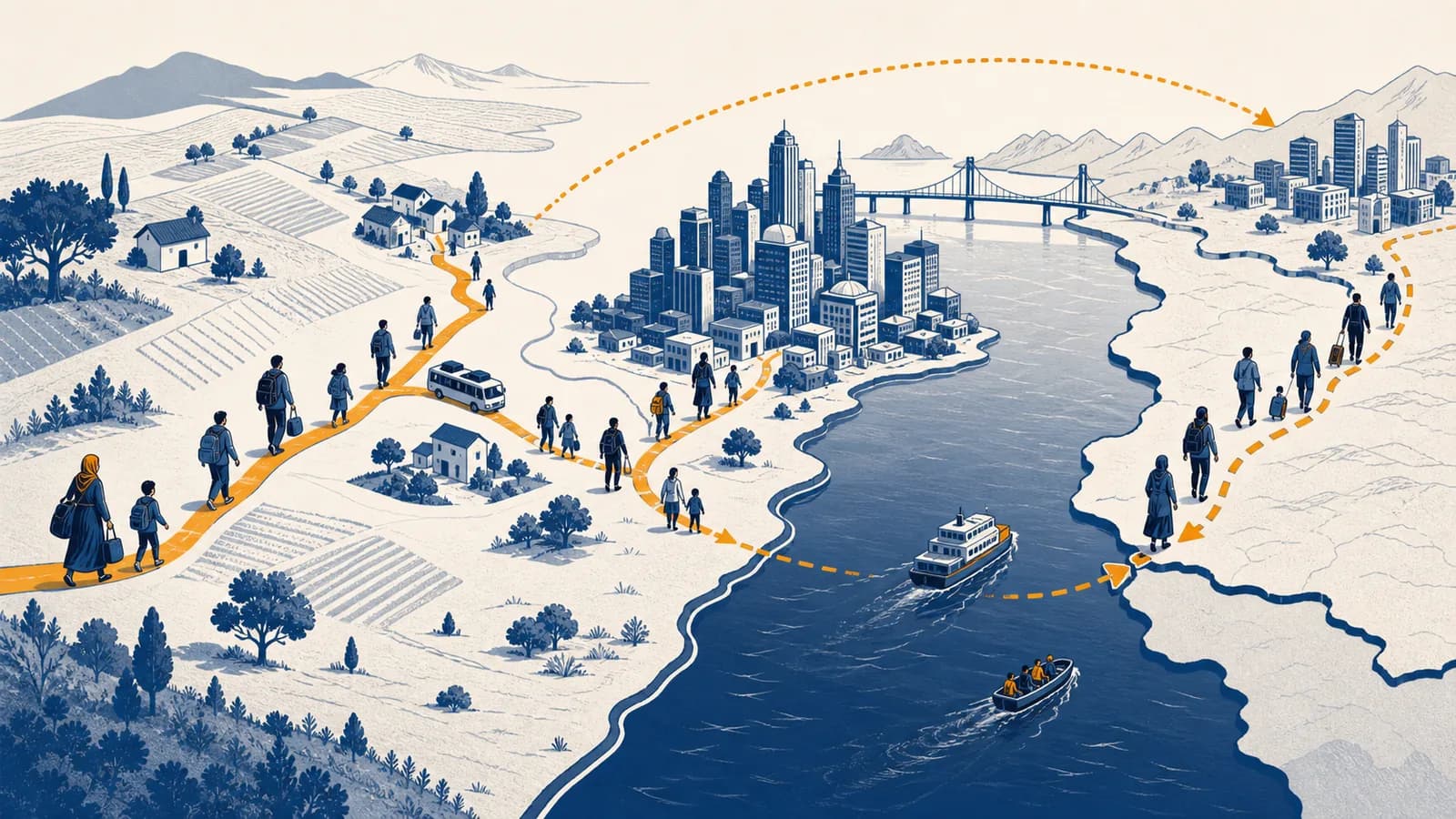
Migration is a form of human movement that changes a person's usual place of residence, in the context of human geography. Human migration can occur within one country or across an international border, for work, family, safety, study, or other reasons. An immigrant enters a place, while an emigrant leaves one. Migration exists because people, opportunities, risks, and resources are unevenly distributed across space. It connects an origin, a destination, a route, and often a later return.
One move, two descriptions: a person who leaves Brazil to live in Portugal is an emigrant from Brazil and an immigrant to Portugal. The event is the same; the viewpoint changes.
What migration actually is
Migration is a lasting or intended change in usual residence, rather than every movement a person makes. Geographers classify it by distance, borders crossed, duration, motive, legal position, and direction so that different movements can be compared without treating them as identical.
The phrase usual residence does much of the work in this definition. A trip to a shop, a daily train ride to work, and a two week holiday involve movement, but they do not normally change where a person lives. Moving to another city for a new job usually does. The exact duration used by a census or statistical agency can differ, so a careful analysis states the definition before counting migrants.
Origin, destination, route, and duration describe the move
The origin is the place a migrant leaves, and the destination is the place where the migrant settles. The route links them. It may be direct, or it may include temporary stops, border crossings, transit camps, rented rooms, or repeated seasonal trips. Duration separates permanent settlement from temporary, seasonal, and circular migration.
These parts matter because two people who arrive in the same town may have very different migrations. One may have moved forty kilometres from a nearby village for a permanent nursing job. Another may have crossed several states, stayed in two temporary settlements, and still hope to return home. A single arrival count hides those paths.
Scale changes what the movement means
Internal migration stays within a country's borders. International migration crosses at least one national border. A move can also be described at several scales, such as movement between neighbourhoods, municipalities, regions, or continents. The scale chosen should match the question being asked.
Geographers also distinguish immigration from emigration. Immigration is arrival into a study area; emigration is departure from it. A city planner may study arrivals into a district, while a national government records entry into a country. Both use the same basic ideas but draw the boundary in different places.
How migration works
Migration works through a sequence of pressure, information, choice or compulsion, movement, and settlement. Conditions at the origin and destination shape the decision, while money, law, transport, social networks, and personal circumstances determine whether movement is possible and where it leads.
A textbook often calls unfavourable conditions at the origin push factors and attractive conditions at the destination pull factors. The terms are useful if they are treated as relationships, not as switches. Low wages do not automatically push everyone out, and high wages do not pull everyone in. People need knowledge of the destination, a route they can use, and enough legal, financial, or social access to make the move.
A closed factory, a university place, family separation, violence, a housing shortage, or a new contract changes the costs and benefits of staying.
People learn about jobs, rents, rules, schools, and routes through relatives, employers, media, recruiters, officials, and previous experience.
Travel cost, health, caring duties, documents, border controls, discrimination, and danger can stop movement or redirect it.
The origin loses a resident for a time or permanently. The destination gains a resident who needs housing and services and may supply work, skills, taxes, care, and new connections.
A migrant may settle, move onward, bring family members, return, or circulate between places. Migration is often a chain of decisions rather than one final trip.
Social networks help explain why a route can continue after the first reason for it weakens. Earlier migrants can share information, offer a room, recommend a worker, translate a form, or send money for a ticket. Each connection can reduce the risk and cost for the next person. This is called chain migration, though the term does not mean that every later move is automatic.
Internal migration versus international migration
Internal migration crosses an administrative boundary within a country, while international migration crosses a national border. Both redistribute people, but international movement usually adds immigration law, passports, visas, border enforcement, and different citizenship rights to the practical problems of moving and settling.
A resident moves from one region, city, or district to another within the same state. National citizenship usually remains unchanged, though registration and access to local services can still matter.
A resident crosses a state border to establish a usual residence elsewhere. Entry permission, length of stay, work rights, and routes to permanent status depend on the destination's law.
A move does not have to cover a great distance to be international. Crossing a nearby border can qualify, while moving thousands of kilometres within a large country remains internal. Political boundaries, not kilometres, make that classification.
Internal migration often directs growth toward cities, coasts, mining areas, transport corridors, or regions with expanding industries. It can also run in the other direction. High housing costs, remote work, retirement, or a search for land may encourage movement from large cities to smaller settlements. The patterns become clearer alongside how rural and urban places develop, because migration is both a cause and a result of changing jobs and services.
Step migration breaks one long move into shorter ones
Step migration occurs when a person reaches a later destination through a series of moves. Someone might leave a village for a regional town, then move to a capital, then cross a national border. Each stage supplies money, contacts, qualifications, or information for the next.
Counterurbanisation is a more specific internal pattern in which people move away from large urban areas toward smaller towns or rural areas. Suburbanisation shifts residents from central areas toward the urban edge. These terms describe spatial directions, not a person's motive, so they should not be used as complete explanations.
Forced migration versus voluntary migration
Forced migration occurs when remaining is unsafe or effectively impossible, while voluntary migration involves a meaningful choice among alternatives. The boundary is often a spectrum because threats, poverty, family duties, state policy, and environmental damage can narrow choice without removing every option.
A person fleeing targeted persecution may have no safe choice to remain. A graduate comparing two job offers has much more control over timing and destination. Between them are families leaving after repeated crop failures, workers whose local industry has collapsed, and residents displaced by a government project. Calling all of these moves either fully forced or fully voluntary erases important differences.
A river flood destroys a family's house. The family stays with relatives nearby, then rents a home in another province when rebuilding fails. The immediate displacement was forced. The later destination involved choice, but money, damaged land, school access, and available relatives sharply limited the options.
Displacement means being forced to leave a home or usual residence. An internally displaced person remains inside their country. A refugee, in the legal sense established by the 1951 Refugee Convention and its later protocol, is outside their country and meets specific criteria involving a well founded fear of persecution. An asylum seeker is asking a state to recognize a claim for protection and has not necessarily received a final decision.
Do not use refugee as a synonym for every migrant. Refugee status has a specific legal meaning. Migrant is the broader geographic term, while displaced person, asylum seeker, and refugee describe different situations.
Environmental change rarely acts alone. Drought can reduce farm income, but the result depends on land rights, savings, insurance, food prices, government help, conflict, and access to another livelihood. Some households send one member away temporarily. Some move together. Others lack the resources to leave and become trapped in a dangerous place.
How migration changes population distribution
Migration changes population distribution by subtracting residents from origins and adding them to destinations. Its effects depend on migrants' ages, skills, household structures, and length of stay, so the same net change can produce different demands for schools, housing, health care, and work.
Geographers separate gross flows from net migration. Gross immigration counts everyone arriving in an area during a period. Gross emigration counts everyone leaving. Net migration is the difference between the two.
Worked example: if 1,200 people arrive and 900 leave during one year, net migration is 300, because .
The worked example does not mean only 300 people moved. A total of 2,100 moves crossed the boundary, but the population balance gained 300 residents through migration. This distinction matters to transport planners, landlords, schools, and employers because turnover can be high even where net change is small.
Population change also includes births and deaths. A place can have net emigration and still grow if births exceed deaths by more than the migration loss. It can have net immigration and still shrink if deaths exceed births by a larger amount.
If births are 800, deaths are 600, immigrants are 500, and emigrants are 700, then . The population stays level even though every component changed.
Age composition can change faster than the total. Working age adults are often more able to move than children or older people, although family migration and retirement migration are both common. An origin may lose workers and gain remittances, while a destination gains labour and must expand housing. Maps of how population distribution and density are mapped show where these additions and losses accumulate.
How migration shows up in jobs, housing, and services
Migration appears in everyday life through changing labour supply, housing demand, school enrolment, transport use, languages, shops, and care networks. The effect is local and uneven because new residents cluster where jobs, affordable rooms, relatives, routes, and welcoming institutions are available.
Employers can recruit migrants when local workers are scarce, when a project needs specialist skills, or when seasonal demand rises. Migrants may also create businesses and connect suppliers or customers across places. At the same time, work permits, qualification recognition, language, discrimination, and insecure contracts can restrict which jobs a person can take.
Housing is often the first visible pressure point
New residents need somewhere to live immediately, but homes take time to plan and build. If construction is slow and vacant housing is scarce, rents and crowding can rise. Blaming migrants alone misses the mechanism. Zoning, land prices, building capacity, public housing, empty properties, household size, and existing shortages all affect the outcome.
A food processing plant hires 200 workers for a town where rental homes are already full. The plant gains labour quickly, but housing supply cannot adjust at the same speed. A useful response requires the employer, transport provider, council, builders, and worker representatives to compare shift times, available land, rents, and safe commuting routes.
Public services face a similar timing problem. Funding and staffing may be based on older population counts, while arrivals can occur between censuses. A school may need language support and extra places. A clinic may need interpreters or knowledge of conditions common in a new patient group. Good planning responds to actual local needs rather than assuming every migrant uses the same services.
Origins change too. A household may receive remittances, which are money or goods sent home by a migrant. These transfers can pay for food, housing, education, health care, or investment. The household may also lose daily care and labour. If many trained workers leave one sector, the origin can face a skills shortage, though return migrants may later bring savings, contacts, and experience.
How migration shows up in culture and identity
Migration changes culture by carrying languages, food, religion, music, skills, memories, and social practices between places. Migrants also adapt to local institutions and neighbours, so cultural change is usually an exchange shaped by power, acceptance, discrimination, and contact across generations.
A cultural feature does not move unchanged like a sealed parcel. A recipe may use a locally available ingredient. A festival may shift date to fit work schedules. Children may speak one language at school and another at home. These adaptations create connections between origin and destination without making the two places identical.
Diaspora describes a population dispersed from an ancestral homeland while maintaining some shared identity or connection. Those links can include family visits, business, media, political activity, religion, and remittances. Members of a diaspora do not all think or live alike, and later generations may relate to the homeland differently from recent arrivals.
Place names, religious buildings, grocery streets, bilingual signs, and community centres provide visible evidence of settlement. Less visible evidence includes family networks, online communication, voting patterns, and professional associations. The study of how culture gives places meaning helps explain why belonging may stretch across several locations at once.
How migration shows up in law and public policy
Migration becomes a legal and political issue because states decide who may enter, remain, work, study, seek protection, reunite with family, or become a citizen. Local authorities then manage many practical effects through housing, education, transport, health services, and registration.
A visa is permission connected to a stated purpose and set of conditions. It may allow study, employment, family reunion, or a temporary visit. A residence permit concerns the right to live in a country for a defined period or permanently. Citizenship is a fuller legal membership that commonly includes political rights and a secure right to remain. The exact rules vary by country.
Border policy changes routes as well as totals. If one crossing closes, movement may shift to a longer or more dangerous route. If a destination recognizes a qualification or offers a work programme, it may attract applicants with particular skills. Policy therefore selects among potential migrants by income, education, nationality, family ties, occupation, or protection need.
The total can show the broad direction and scale of movement across a country's border, but it hides where people settle and what services they need.
A neighbourhood count can reveal pressure on homes or classrooms, but it cannot by itself explain the national labour market, border rules, or movement between regions.
Debates often mix these scales. A national policy may be discussed using one crowded district as if it represents the whole country. A local council may be blamed for visa rules it does not control. Sound geographic reasoning identifies the responsible level of government and the boundary used for each figure.
How migration is measured
Migration is measured by combining censuses, population registers, border records, visas, surveys, school or health records, and estimates. No source captures every move, so geographers check the definition, time period, geographic boundary, uncertainty, and missing groups before comparing figures.
A census can ask where a person usually lives now and where they lived one year or several years earlier. The difference identifies many moves, but it may miss people who arrived and left between those dates. A population register can record changes more continuously where residents are required and able to register. Surveys provide detail about motives and experiences, but their samples are smaller.
Border crossings are not the same as migration. One migrant can cross a border many times, and many travellers cross without changing residence. Visa records show permissions granted, not always actual arrival, length of stay, or departure. Irregular migration is especially hard to count because people may avoid official systems.
Rates allow fairer comparison than raw totals
A migration rate relates a flow or net balance to the population exposed to it. This makes a small town and a large city more comparable. A net gain of 1,000 people has a different local meaning in a settlement of 20,000 than in a metropolis of several million.
If a town of 20,000 gains 600 immigrants and loses 200 emigrants, its net migration rate is per 1,000 residents for that period.
A rate needs a clearly named period and denominator. The population may be measured at the start, middle, or average of the period, depending on the statistical system. Comparisons are trustworthy only when definitions match. A neat decimal does not repair incompatible data.
Four mistakes people make with migration
Four common errors are treating all movement as migration, confusing gross and net figures, assuming one cause explains every move, and reading correlation as proof. Each mistake removes part of the mechanism and can turn a true observation into a false conclusion.
1. Counting commuters and tourists as migrants
A commuter changes location during the day but normally returns to the same usual residence. A tourist visits temporarily. Both groups can affect transport, shops, and public space, but counting them as residents would distort housing and population measures. The test is not movement alone; it is a change in usual residence under the definition being used.
2. Reporting net migration as if it were total movement
Net migration can be zero while many people arrive and leave. If 5,000 arrive and 5,000 leave, the net balance is zero and the gross flow is 10,000. A service may still face high turnover, and workplaces may still recruit and lose many staff.
3. Giving every migrant the same motive
A destination may receive students, refugees, seasonal workers, returning citizens, retirees, and family members during the same month. Even people in one legal category can have different reasons. Classification helps analysis, but a label never contains a whole biography.
4. Assuming that two changing trends prove causation
If migration and rent both rise, migration may add demand, but it is not automatically the complete cause. Construction rates, household size, wages, interest costs, vacant homes, short term rentals, and planning rules may also change. Test the timing, compare places, examine supply, and look for a plausible pathway before claiming cause.
How climate change influences migration
Climate change influences migration by altering hazards and livelihoods, but it rarely supplies a single direct cause. Heat, water stress, sea level rise, storms, and changing growing conditions interact with wealth, conflict, public policy, insurance, family networks, and the ability to move.
Sudden disasters often produce short distance, temporary displacement first. People may stay with relatives, enter a shelter, or rent nearby while assessing damage. Slow changes such as repeated crop loss or salt entering groundwater can alter livelihoods over years. A household may adapt in place, send one earner elsewhere, relocate together, or become unable to finance a move.
The phrase climate refugee is widely used in public discussion, but it is not a general legal category under the 1951 Refugee Convention. A person displaced across a border may qualify for protection under other laws or circumstances, yet climate exposure alone does not automatically establish Convention refugee status. Legal terms and causal descriptions must stay separate.
How families experience migration across generations
Families experience migration as a redistribution of care, income, authority, language, and belonging across places. One member may move first, children may join later, relatives may remain separated, and later generations may keep connections to an origin they have never lived in.
Household decisions are not always individual decisions. A family may pool money to send one member to work or study, expecting future remittances. Grandparents may provide childcare at the origin. A parent abroad may make daily decisions through video calls while being absent from physical care. Gains in income can coexist with stress, loneliness, or unequal control of money.
Family reunion policies affect who can live together and when. Requirements involving income, housing, age, relationship evidence, or legal status can delay or prevent reunion. Children who arrive at different ages may have different experiences of language and school. The phrase second generation commonly refers to children born in the destination to immigrant parents, though official definitions vary.
Return does not simply reverse the first move. A returning migrant may find that jobs, prices, relationships, and personal expectations have changed. Children may see the parents' origin as unfamiliar. Return migration is therefore another adaptation between person and place, not a rewind to an earlier life.
Migration makes geography visible in ordinary decisions
Migration makes human geography visible because every move links unequal places through distance, borders, labour, housing, law, culture, and family. Following those links explains both personal choices and large population patterns, while keeping origins, routes, destinations, and people in the same analysis.
Notice the evidence around you. A bus route aligned with shift work, a multilingual notice in a clinic, a shop importing familiar ingredients, or an empty house in a town losing jobs can each reveal part of a migration system. Ask who moved, across which boundary, for how long, under what constraints, and with what effects on both places.
Then test any public claim with the same questions. Check if the figure counts people, entries, visas, or changes of address. Separate gross flows from net balance. Compare the time period and geographic scale. Look for the mechanism joining cause to outcome. The wider set of lessons on how human and physical processes fit together across geography provides more ways to connect evidence, scale, and place.
The takeaway: migration is not simply people in motion. It is a change of residence produced through unequal conditions and filtered by resources, networks, borders, and law. Map the whole system, including those who stay, and the pattern becomes explainable.