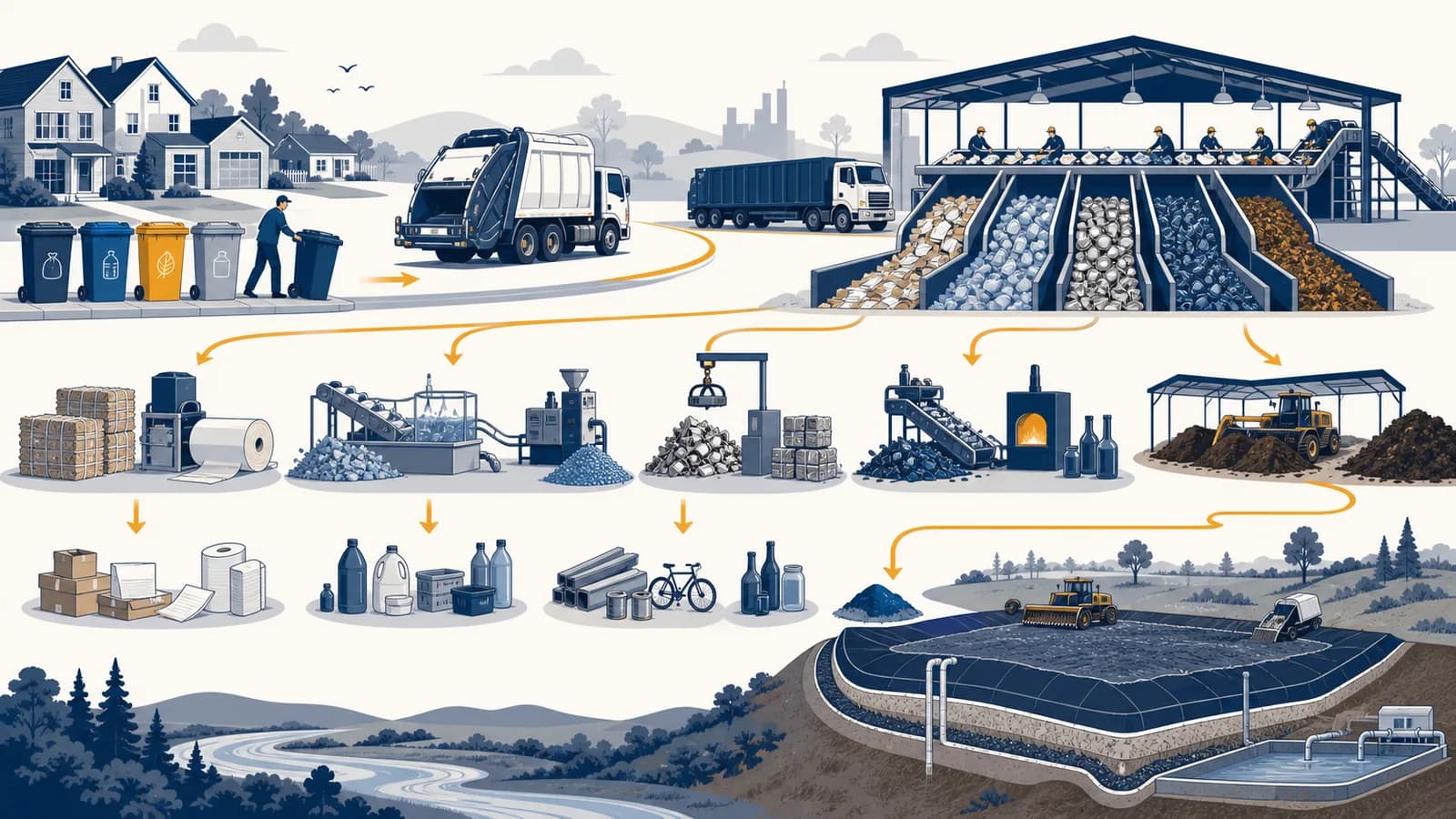
Waste management is a public service system that controls how discarded materials are collected, treated, recovered, and finally contained, in the context of environmental geography.
It includes solid waste management, rubbish collection, recycling, composting, incineration, landfill, hazardous waste disposal, and the rules that connect them. The system exists because unmanaged waste can spread disease, block drains, pollute soil and water, release greenhouse gases, waste usable materials, and shift harm onto people with less power. A bin is only the visible entrance. Behind it sits a chain of vehicles, workers, contracts, sorting equipment, treatment plants, markets, laws, and land.
That chain makes waste a geographical subject. Materials move between neighbourhoods, industrial districts, rural landfills, ports, and sometimes countries. Each movement changes who receives the value, who carries the risk, and which landscape bears the physical result.
What waste actually is
Waste is material that its current holder discards, intends to discard, or must discard, but the same material may remain a resource to another user. Its status depends on condition, location, law, available technology, and the existence of a buyer or treatment route.
A clean glass bottle beside a refill station can be a reusable container. The same bottle, shattered and mixed with food, may be a costly contaminant. Copper wire in a working appliance is a component; after disposal it becomes part of an electronic waste stream, although a recycler may recover its metal value. Geography changes the answer because recovery is practical only when material can reach suitable infrastructure at an acceptable cost.
Waste is usually classified by both source and properties. Municipal waste comes mainly from homes and similar premises. Commercial and industrial waste comes from shops, offices, factories, construction sites, and other workplaces. Organic waste contains material such as food scraps and garden cuttings that microbes can break down. Hazardous waste has properties such as toxicity, corrosiveness, flammability, or reactivity that demand tighter control.
| Waste stream | Typical contents | Main management problem |
|---|---|---|
| Mixed household waste | Food, packaging, broken goods, small amounts of many materials | Separation is difficult after materials are crushed or contaminated |
| Construction waste | Concrete, timber, metals, plasterboard, soil | Heavy loads make transport important; some fractions can be reused on site |
| Organic waste | Food scraps, leaves, grass, food processing residues | Moist material decomposes quickly and can produce odour, leachate, and methane |
| Electronic waste | Phones, computers, cables, batteries, circuit boards | Valuable metals occur beside hazardous substances and difficult composites |
| Hazardous waste | Solvents, some paints, pesticides, contaminated clinical materials | Small amounts can cause disproportionate harm if mixed into ordinary waste |
A legal definition matters because it assigns duties. Once an object counts as controlled waste, its holder may have to store it safely, use an authorised carrier, keep transfer records, or send it only to a permitted facility. Calling something “second-hand goods” does not make those duties disappear if the shipment is really unusable material being dumped elsewhere.
How the waste hierarchy works
The waste hierarchy ranks management choices by their usual environmental preference: prevent waste first, then prepare items for reuse, recycle materials, recover other value such as energy, and use disposal last. It guides decisions, but local evidence still determines the best workable route.
Prevention changes the system before an item becomes waste. A restaurant can measure uneaten food and alter purchasing. A builder can order cut lengths that reduce offcuts. A manufacturer can design a product with replaceable parts. These actions avoid the material, energy, transport, and labour that later treatment would require.
Reuse keeps an object in service with little reprocessing. Repairing a chair preserves more of its original form and embedded work than shredding it for fibre. Recycling breaks waste back into material for manufacturing. It can save virgin resources, but collection, cleaning, sorting, and remanufacture still consume energy and can lose material.
Anything recyclable should be recycled, regardless of distance, contamination, or the product made from it.
Compare the whole route: material quality, transport, treatment inputs, avoided extraction, local pollution controls, and a real market for the output.
Recovery captures value without returning the material to the same kind of product. Anaerobic digestion can recover biogas from food waste. Incineration can recover heat and electricity from combustible residual waste. Disposal places remaining waste in a landfill or another final facility designed to isolate it. The hierarchy puts disposal last because the material leaves productive use and needs long-term control.
The hierarchy connects directly with how long-term resource limits shape sustainability. It asks an upstream question before choosing a downstream machine: could a product, business process, or purchasing rule prevent this waste in the first place?
How collection and transfer work
Collection moves separated or mixed waste from many small sources into a controlled transport network. Crews empty containers on planned routes, vehicles consolidate loads, and transfer stations move waste into larger vehicles when the treatment site is too distant for efficient local collection trips.
Homes and businesses place materials in containers chosen for weight, hygiene, fire risk, pests, and the collection method.
A crew or automated vehicle visits many sources. Route density, street width, traffic, slopes, and collection frequency affect fuel use and cost.
At a depot or transfer station, operators identify unsafe loads, compact suitable waste, and combine small collections into larger shipments.
Vehicles carry each stream to sorting, composting, digestion, recycling, thermal treatment, or landfill, with records that show its origin and destination.
Source separation is a design choice, not a matter of personal virtue alone. A household can separate food perfectly, but the effort achieves little if the collection vehicle mixes it with residual waste. A city can supply several containers, yet participation may fall if instructions differ between neighbouring districts or storage is impossible in small flats.
Transfer stations solve a distance problem. Collection vehicles are built for frequent stops and container lifting, not long highway trips. By unloading near the collection area and filling a larger vehicle, the system returns local crews to their routes sooner. The transfer station also concentrates noise, traffic, dust, and odour, so its location and operating controls matter to nearby residents.
A mountain town has narrow roads and a treatment plant far down the valley. Small collection trucks can reach homes, then unload into sealed containers at a local transfer point. A larger vehicle moves full containers to the plant. The design matches vehicle size to terrain and trip length.
Collection plans must also cope with disruption. Floods can cut access roads, storms can scatter light packaging, heat can accelerate food decay, and a vehicle breakdown can leave containers overflowing. Managers therefore need spare capacity, alternative routes, safe temporary storage, and clear public instructions.
How sorting and recycling work
Sorting separates a mixed flow into material grades that manufacturers can use, while recycling turns those grades into feedstock for new products. The process succeeds only when the recovered material meets a buyer's specifications for composition, cleanliness, colour, size, and moisture.
At a materials recovery facility, bag openers and screens first spread the load and separate objects by size and shape. Magnets lift steel. Eddy current separators repel non-ferrous metals such as aluminium. Optical sorters identify selected plastics or paper using reflected light, then air jets push chosen objects into a different path. Workers inspect streams and remove items that machines miss.
Each device answers a physical question. Is the object magnetic? Does it roll or stay flat? How does its surface reflect light? The plant combines answers because no single test identifies every package. A steel food can and an aluminium drink can may look similar to a camera, but a magnet treats them differently.
If a community generates 1,000 kg, collects 360 kg in recycling bins, and sorting rejects 60 kg, usable feedstock is 300 kg. The recovery rate is , not 36%.
This calculation exposes the difference between collection and recycling. Material placed in a recycling bin has only entered a route. Food residue, plastic film tangled around equipment, objects made from bonded layers, and items with no buyer may become rejects. Reporting both collected mass and usable output makes performance easier to judge.
Recycling markets also have a geography. A bale of sorted paper has value only if a mill can use its fibre and the transport does not overwhelm that value. Prices change with demand, energy costs, virgin material prices, and contamination. Contracts can distribute this risk between a council, collection company, sorting plant, and buyer.
How organic waste treatment works
Organic waste treatment controls microbial decomposition so that food and garden material becomes compost, biogas, or both. Composting uses oxygen and produces a soil-improving material; anaerobic digestion excludes oxygen, captures methane-rich biogas, and leaves a nutrient-containing digestate that needs careful use.
Composting controls an aerobic process
Composting is managed decomposition in the presence of oxygen. Operators mix wetter nitrogen-rich food or grass with drier carbon-rich materials such as woody cuttings. Pore spaces let air pass through. Microbial activity releases heat, and turning or forced aeration prevents the pile from becoming oxygen-poor.
Moisture, particle size, temperature, oxygen, and time interact. A saturated pile loses air spaces and can smell. A very dry pile slows microbial activity. Large branches create structure but break down slowly; very fine particles can pack together. Finished compost must be stable enough that rapid decomposition does not restart during storage or use.
Anaerobic digestion captures gas
Anaerobic digestion is decomposition inside a sealed vessel without oxygen. Groups of microbes break complex organic matter into smaller compounds and finally produce biogas containing methane and carbon dioxide. The biogas can fuel an engine, supply heat, or be cleaned for use in a gas network or vehicle.
Digestate is not automatically harmless or useful. Its nutrient content, contaminants, pathogens, storage, transport distance, soil need, and application rate all matter. Applying too much can move nitrogen or phosphorus into water. This connection is easier to see through the geography of limited and polluted water supplies, where water quality can restrict usable supply as surely as low rainfall.
Separate food collection changes the chemistry. Keeping food away from mixed residual waste gives composting or digestion a cleaner input and keeps wet material out of processes designed mainly for dry combustible waste.
If food waste enters a landfill, oxygen is soon limited and anaerobic decomposition can generate methane. Engineered landfills collect some gas through wells and pipes, but capture cannot be perfect across every place and time. Preventing surplus food, redistributing edible food, and separately treating unavoidable scraps act earlier in the chain.
Landfill versus waste-to-energy incineration
Landfill isolates residual waste in an engineered site, while waste-to-energy incineration burns combustible waste under controlled conditions and captures useful heat or electricity. Neither makes waste disappear: landfill needs long-term containment, and incineration leaves ash plus air-pollution-control residues.
Waste is compacted into cells above lining and drainage systems. Operators collect contaminated liquid and landfill gas, cover active areas, control pests and litter, then monitor the closed site.
Waste burns in a furnace. Heat produces steam for power or district heating. Filters and chemical treatment remove pollutants from flue gas, while bottom ash and hazardous treatment residues need separate destinations.
A landfill cell commonly includes a low-permeability barrier, drainage material, pipes for leachate, compacted waste, and a cover. Leachate is contaminated liquid formed when water passes through waste and when wet waste releases liquid. It must be collected and treated. Gas wells draw landfill gas toward a flare or energy system.
Site selection examines geology, groundwater, flood risk, slope stability, airport safety, road access, protected habitats, nearby settlements, and future land use. A cheap parcel can create expensive engineering problems if water moves easily through fractured rock or if trucks must cross a crowded town.
In an incinerator, controlled combustion reduces the volume of combustible residual waste and destroys many organic contaminants. Heat may produce electricity, supply nearby buildings, or serve industry. The plant needs steady input, skilled operation, continuous monitoring, and equipment that removes dust, acidic gases, metals, and other pollutants from exhaust.
Bottom ash can contain recoverable metals, but its remaining mineral fraction must meet rules for any proposed use. Air-pollution-control residues concentrate captured contaminants and usually need more restrictive handling. The location of a heat customer matters too: electricity can travel through a grid, but useful heat is harder to move far without infrastructure and losses.
The climate comparison depends on waste composition and the system being displaced. Landfilled organic matter can generate methane. Burning fossil-based plastics releases fossil carbon dioxide. Energy recovery may avoid some fuel use, while recycling a material may avoid extraction and manufacturing. The linked guide to how greenhouse gases connect places and policy explains why the location of an emission does not contain its climatic effect.
How waste management shows up in cities and work
Waste management appears in street design, public health, building plans, business costs, industrial supply chains, and specialised jobs. Its performance is visible through reliable collection, clean public space, safe facilities, clear records, and the absence of illegal dumping or uncontrolled burning.
Urban form sets physical constraints. A detached house may store several wheeled bins; a tower block needs shared containers, fire-safe storage, lifts or chutes, and space for collection vehicles. A market creates wet organic waste quickly. A hospital produces ordinary waste alongside sharply controlled clinical streams. A construction site generates heavy material in short bursts.
Planning decisions fix many later outcomes. Architects decide whether a building has enough accessible storage for separated materials. Highway designers decide whether a collection truck can turn safely. Procurement teams decide if offices can repair furniture or buy products with replaceable parts. Festival organisers decide how containers, signs, food vendors, and cleanup crews work together.
Operators turn plans into controlled movements
Drivers, loaders, weighbridge staff, sorters, plant technicians, mechanics, laboratory analysts, and site managers keep material moving. Their work includes inspecting loads, isolating fires, sampling outputs, maintaining filters, controlling pests, recording weights, and refusing material a facility cannot safely accept.
Analysts measure flows and find losses
A waste audit sorts and weighs a representative sample. The analyst asks how much is avoidable food, recyclable paper, reusable equipment, hazardous material, or true residue. Businesses use the result to change purchasing, container placement, staff instructions, supplier contracts, and collection frequency.
Regulators follow responsibility through the chain
Environmental officers inspect sites, check permits, investigate dumping, trace transfer records, and require corrective work. Policy designers may place responsibility on producers for products such as packaging, batteries, or electronics. This shifts some end-of-life cost toward the businesses that choose materials and product design.
A facilities manager sees half-empty general-waste bins collected every day and overflowing cardboard cages twice a week. The useful response is not a poster alone. The manager can measure each stream, flatten boxes, resize containers, move collection times, train tenants, and renegotiate the service around actual volumes.
Public participation still matters, but systems shape participation. Labels must match the items a local plant accepts. Containers must be near the point where waste arises. Instructions must work for people with different languages, vision, mobility, and housing conditions. Feedback should explain what changed, not simply accuse residents of using a bin incorrectly.
How hazardous and electronic waste are controlled
Hazardous and electronic wastes are controlled by identifying dangerous properties, keeping incompatible materials apart, preserving records, and using specialist treatment. The aim is to prevent fires, poisoning, corrosive reactions, persistent pollution, and worker exposure during storage, transport, recovery, and disposal.
Segregation begins at the source. A leaking solvent container should not enter a compactor with ordinary rubbish. Lithium-ion batteries can be damaged by crushing and may start intense fires in collection vehicles or sorting plants. Sharps need puncture-resistant containers. Labels, secure storage, trained staff, and an emergency plan are working controls, not paperwork added after the risk.
Electronic equipment illustrates a difficult material mix. A device can contain steel, aluminium, copper, glass, several plastics, circuit boards, adhesives, and a battery. Repair or reuse may preserve the most value if the device is safe and functional. If not, controlled dismantling can remove hazardous parts and concentrate useful materials for specialised recovery.
Never use an ordinary bin for an item simply because it is small. Batteries, chemicals, gas cylinders, sharps, and some electrical equipment can create risks far larger than their mass suggests. Local collection rules determine the safe route.
Traceability follows the material between holders. A record can identify the producer, carrier, description, quantity, date, and destination. If an illegal load is found, investigators can work backwards. Accurate description also protects the receiving plant, which must know what treatment and personal protective equipment are required.
How waste crosses borders
Waste crosses borders when recovery or disposal capacity, labour costs, commodity markets, and regulation differ between places. Legal shipments can supply specialist recyclers, but false descriptions and weak enforcement can turn trade into dumping, so consent, documentation, inspection, and final treatment all matter.
A shipment of tested working computers for direct reuse differs from a container of broken devices labelled as donations. The first may extend product life. The second can shift dismantling costs and toxic exposure to a place with fewer safe facilities. Inspectors therefore look beyond the label to condition, packaging, function, contracts, and the receiving operation.
The Basel Convention provides an international framework for controlling transboundary movements of hazardous wastes and other covered wastes. Its operation rests on ideas such as prior informed consent and environmentally sound management. National rules and specific waste categories determine which controls apply to a particular shipment.
Trade data alone do not reveal good or bad management. A border crossing may be reasonable if a nearby facility across the border is safer and closer than a domestic alternative. A long trip may still support high-quality recovery of a rare material. The test is the complete chain: what moved, why it moved, who agreed, and what actually happened at the destination.
How household decisions change the system
Household decisions affect waste before purchase, during use, and at disposal. The strongest actions are to avoid unnecessary products, keep useful items working, separate materials according to local instructions, and use specialist collection for anything unsafe in normal bins.
Before buying, compare durability, repair access, refill options, packaging, and the amount likely to be used. A larger food pack is not less wasteful if part of it spoils. During use, storage and maintenance matter: a sealed food container, cleaned filter, software update, or replaced cable can delay disposal without any new treatment facility.
At the bin, follow the actual local service. Rinsing a container lightly may prevent contamination, but using large amounts of hot water can add an unnecessary cost. Keep paper dry. Do not place plastic bags into a collection that forbids film. Do not “wish-cycle” an uncertain item, because one wrong material can obstruct equipment or lower a whole output grade.
Repair, refill, share, sell, or donate only when the next user can genuinely use the item.
Check for batteries, chemicals, pressurised contents, personal data, or contamination before choosing a route.
Use the council, collector, retailer, or product take-back information that applies at the place of disposal.
Empty, separate, secure, or package the item only as instructed, then place it at the named collection point.
Good donation is also a waste decision. Giving away a broken, dirty, incomplete, or unsafe object transfers a disposal bill to a charity or another household. Describe condition honestly and confirm that the recipient wants it. Reuse works when the object displaces another purchase, not when it merely waits in a different store room.
Four mistakes people make with waste management
Four common mistakes are treating all discarded material as equivalent, confusing collection with recovery, assuming technology removes the need for prevention, and ignoring where facilities are placed. Each mistake hides a different part of the material chain and leads to weaker decisions.
1. Treating every kilogram as equal
A kilogram records mass, not hazard, scarcity, volume, or climate effect. A small battery may create a fire risk. A bulky foam package can fill vehicle space while weighing little. Food and clean metal of equal mass behave differently in landfill, a furnace, and a recycling plant. Managers need composition data as well as total tonnage.
2. Calling everything collected for recycling “recycled”
A collection total measures entry into a process. Actual recycling requires usable output that enters manufacturing. Moisture, contamination, sorting losses, and lack of buyers can reduce that output. A credible report states the measurement boundary and records rejects instead of hiding them inside an impressive collection figure.
3. Expecting one facility to solve an upstream design problem
No sorting plant can easily separate materials that a manufacturer permanently bonded together. No composter can create good compost from a stream full of plastic fragments. Treatment technology matters, but product design, purchasing, repair, and source separation decide what reaches the machine.
4. Choosing a site as if the map were empty
A facility occupies land, draws truck traffic, connects to water and energy networks, and creates some combination of noise, odour, litter, emissions, and risk. Existing pollution and political power affect who is asked to accept it. Fair planning compares sites openly, includes cumulative burdens, and gives affected communities usable information before decisions harden.
The takeaway: Judge waste management as a complete system. Start with prevention, follow each material through collection and treatment, count usable outputs and rejects, then identify where costs, hazards, and benefits finally land.
Waste management reveals how places share costs
Waste management turns consumption into a map of material flows, infrastructure, labour, environmental risk, and political choice. Studying that map shows how one place can enjoy a product while another place supplies resources, processes the discard, or lives beside the final facility.
This is why the topic belongs inside the wider guides to geographical systems and places. Physical geography explains water movement, soils, climate, and land stability around facilities. Human geography explains cities, trade, inequality, regulation, and behaviour. Waste management joins those processes through routes that can be observed and measured.
Choose one object you discard this week and trace it. Identify its materials, the local collection rule, the vehicle route, the receiving facility, the useful output, the reject, and the final destination. Then move one step upstream and ask what design or decision could have prevented that discard. That small investigation is geographical thinking in practice: follow the flow, locate the consequences, and compare the alternatives.