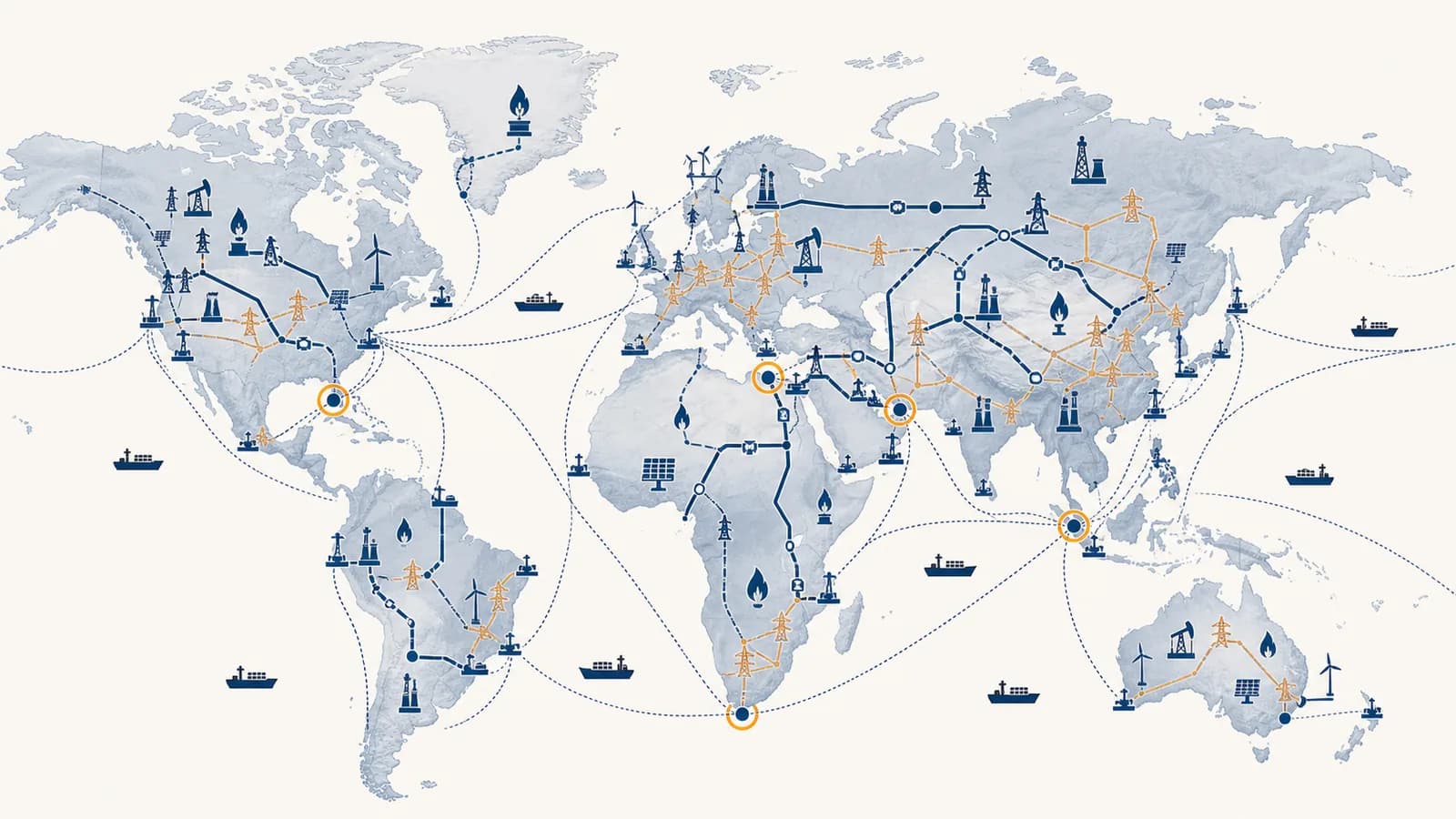
Geopolitics of energy is a field of political geography that explains how control over energy sources, transport routes, technologies, and markets shapes power, in the context of relations among states and regions. Also called energy geopolitics, it connects energy security to oil and gas pipelines, electricity grids, renewable energy, trade, conflict, and diplomacy. The idea exists because every society needs reliable energy, but fuels, minerals, infrastructure, and technical knowledge are distributed unevenly. A country that consumes energy in one place often depends on decisions made far away.
A power station may sit beside a city, yet its fuel can cross a mine, railway, port, sea lane, refinery, and border before producing electricity. Each connection creates a relationship. Some relationships support cooperation through contracts and shared infrastructure. Others create bargaining power, exposure to disruption, or pressure to find another supplier.
What geopolitics of energy actually is
Geopolitics of energy is the study of how the location and movement of usable energy affect political choices. It examines who controls resources and infrastructure, who depends on them, which routes connect producers to consumers, and how those relationships alter power.
The subject begins with a map, but it does not end with deposits marked on that map. A crude oil field has little political value unless companies can extract its oil, transport it, refine it into useful products, and sell those products to customers. A windy coast has limited influence without turbines, cables, finance, grid connections, and industries that can use the electricity. Energy power comes from an entire system.
Five parts of that system matter repeatedly:
- Resources: oil, natural gas, coal, uranium, sunlight, wind, moving water, biomass, and the minerals used in energy equipment.
- Conversion: refineries, power stations, reactors, batteries, electrolysers, and other facilities that turn a resource into useful energy.
- Networks: pipelines, tankers, railways, ports, electricity grids, storage sites, and digital control systems.
- Institutions: governments, regulators, state-owned firms, private companies, military forces, banks, and international organisations.
- Demand: households, vehicles, factories, farms, data centres, and public services that pay for and depend on energy.
The political effect depends on how these parts fit together. A producer with several customers can redirect exports more easily than a producer tied to one pipeline. An importer with several ports and suppliers can resist pressure better than an importer served by one cross-border line. Geography sets possibilities, while technology, contracts, and policy determine which possibilities become real.
Energy dependence is a relationship, not a label. A buyer depends on a seller for supply, while the seller may depend on the buyer for revenue. The balance rests on which side can replace the other faster and at lower cost.
How energy turns geography into political power
Energy becomes political power through control of a hard-to-replace link in the supply system. A government or company gains influence when others need its fuel, route, equipment, finance, or market and cannot obtain a substitute quickly without paying a high cost.
The mechanism can be followed step by step. Physical geography creates an opportunity, investment turns that opportunity into capacity, trade creates dependence, and limited alternatives give one actor bargaining power. The influence lasts only while the dependency remains difficult to replace.
A basin contains oil or gas, a river can support hydropower, a sunny region can produce low-cost solar electricity, or a narrow strait connects two large seas.
Wells, power stations, refineries, ports, transmission lines, skilled workers, and legal rules turn physical potential into deliverable energy.
Buyers design factories, heating systems, vehicles, or power plants around a particular fuel and route. Long-lived equipment makes rapid switching expensive.
The controlling actor can negotiate prices, demand political concessions, restrict access, or promise reliable supply. Other actors respond with alliances, reserves, alternative routes, and new technology.
Consider two imaginary gas exporters. State A sells through one pipeline to one neighbouring buyer. State B can send gas through pipelines to several countries and can also ship liquefied natural gas from a port. State B has more options, even if both states produce the same amount. Its strength comes from network flexibility rather than the size of the underground reserve alone.
Power also changes over time. A new port can weaken a pipeline monopoly. A new transmission cable can connect an isolated electricity market to its neighbours. Efficiency standards can reduce demand. Sanctions can close financial and technical channels even when oil remains in the ground. A resource map is therefore a starting point, not a final answer.
This sentence is a useful test, not a universal law. Sometimes the hard link is a mineral deposit. Sometimes it is a refinery that can process an unusual grade of crude oil. It can also be a shipping insurer, a grid interconnector, a patent, or a large consumer market whose purchases finance the whole system.
How chokepoints and pipelines work
Chokepoints and pipelines concentrate energy flows into limited corridors. They lower transport costs in normal conditions, but they also create places where an accident, attack, closure, sanction, or political dispute can interrupt supply and force traffic onto slower or more expensive routes.
A maritime chokepoint is a narrow passage used by a large shipping network. The Strait of Hormuz links the Persian Gulf with the Gulf of Oman. The Strait of Malacca connects the Indian Ocean side of Asia with the South China Sea. Canals such as Suez shorten voyages by joining bodies of water that would otherwise require a long diversion. Their importance comes from network position, not simply narrow width.
A disruption at one node can spread along the chain. If ships wait or take a longer route, delivery times rise. Traders may bid up cargoes expected to arrive sooner. Refineries can draw down inventories, but those stocks are finite. Governments may release emergency reserves or temporarily reduce demand. The physical shortage and the price reaction are related, yet they are not identical: prices can move as people revise expectations before any tank runs dry.
Pipelines create a different geography. They offer continuous, high-volume transport, but their fixed path binds particular producers and consumers. Reversing a flow may require new compressors and connections. Sending the same gas by sea requires liquefaction at the exporting end, specialised ships, and regasification at the receiving end. A pipeline shown as one line on a map therefore represents years of engineering, contracts, and political consent.
You work for a shipping company after a canal closes temporarily. The cargo still exists, but the normal route does not. Your team compares a longer voyage, a delayed passage, or a cargo swap with another trader. Geography has changed the cost and timing before it has changed the amount of fuel produced.
Studying how trade corridors connect producers and markets helps explain why naval patrols, port access, canal rules, and shipping insurance appear in energy policy. Control does not always mean legal ownership. An actor can influence a route by policing it, financing it, regulating access, or making passage too risky.
Energy security versus energy independence
Energy security means having energy services available at acceptable cost despite disruption, while energy independence means reducing or eliminating reliance on foreign supply. A country can be secure while importing energy, and it can produce abundant energy at home yet remain exposed to failures.
The main question is origin: how much energy or fuel comes from inside the country? Policy often favours domestic extraction, generation, manufacturing, or substitution for imports.
The main question is resilience: can essential services continue through price shocks, equipment failures, extreme weather, conflict, or supplier loss? Diversity, storage, efficiency, and recovery speed all count.
Imagine Island North generates all its electricity from one domestic hydroelectric dam. It imports no electricity, so it appears independent. A severe drought, damaged transformer, or blocked maintenance part could still cause a national shortage. Island South imports power through three cables from two neighbours, owns backup generation, and can reduce industrial demand under contract. It is less independent but may be more secure.
Security has several dimensions. Availability asks if enough energy can physically arrive. Affordability asks if households and firms can pay for it. Reliability asks if supply is steady enough for the machines that use it. Recoverability asks how quickly the system can resume after failure. A policy can improve one dimension while harming another. Extra storage costs money, while a cheap single supplier may increase exposure to a cutoff.
Imports are not automatically weaknesses. Trade can connect regions with different seasons, resources, and patterns of demand. The danger comes from concentrated dependence with poor alternatives. Analysts therefore examine supplier diversity, spare capacity, storage, interconnections, demand flexibility, and the time required to replace damaged infrastructure.
How energy markets transmit political shocks
Energy markets transmit political shocks through expectations, bids, contracts, and substitution. News that threatens future supply can change today’s price because buyers compete for available cargoes, sellers hold inventory, transport costs shift, and firms seek alternative fuels or routes.
Oil is traded through linked regional and global markets. A refinery does not need to buy crude from the disrupted country to feel an effect. If other buyers switch to the refinery’s usual supplier, competition for that substitute can raise its price. Natural gas markets are connected too, but pipeline limits and the specialised infrastructure for liquefied natural gas can make regional differences larger. Electricity is even more constrained by the capacity of grids and cables.
A simple delivered-cost calculation shows why routes matter:
If supply costs 50 units, transport 4, insurance 1, and disruption risk adds 5, delivered cost is units.
The risk term is not a fee printed on every invoice. It represents costs that can appear through higher insurance, protective measures, expected delay, or the price a buyer accepts to avoid an uncertain route. The example is imaginary, and its arithmetic is shown so that the mechanism can be checked.
Price does more than record scarcity. It prompts responses. High prices can make producers increase output if spare capacity and infrastructure exist. Consumers may use less, switch fuels, postpone travel, or invest in efficient equipment. Governments may cut taxes, cap retail bills, subsidise users, release stored fuel, or restrict exports. Each response moves costs between consumers, taxpayers, companies, and future budgets.
These effects spread beyond the energy sector because energy is an input to transport, heating, fertiliser production, mining, and manufacturing. Global supply chains follow the same logic across components and finished goods. An energy shock can raise the cost of producing an item and the cost of moving it.
How governments use energy in diplomacy and conflict
Governments use energy policy to reward partners, pressure opponents, protect revenue, and reduce their own exposure. Their tools include export limits, sanctions, price rules, infrastructure finance, military protection, strategic reserves, and agreements that coordinate supply or demand.
An exporter may offer a long-term contract to strengthen a political relationship. An importer may finance a pipeline or port to secure access. Several states may coordinate sanctions that limit a target’s ability to sell fuel, receive payment, insure ships, or obtain drilling technology. The target can respond by finding new buyers, using intermediaries, offering discounts, or developing domestic substitutes. Enforcement geography matters because cargoes, payments, and ownership records move through many jurisdictions.
Energy can finance state power as well as provide bargaining power. Export revenue can pay public salaries, infrastructure, social programmes, or armed forces. Heavy reliance on one commodity also creates vulnerability: a fall in price or loss of customers can cut government income. Importing governments face the opposite fiscal risk when prices rise and consumer subsidies become expensive.
Arab members of the Organization of Arab Petroleum Exporting Countries imposed an embargo against selected states during the Arab-Israeli war. The episode showed how concentrated oil dependence could affect prices, diplomacy, and domestic policy.
Oil-importing states formed the agency within the OECD framework to coordinate responses to major supply disruption and improve energy cooperation.
War, sanctions, Russian supply reductions, and European policy accelerated efforts to obtain gas from other sources, expand import capacity, save energy, and build non-fossil generation.
Conflict does not follow automatically from a valuable resource. Ownership rules, local rights, state capacity, revenue sharing, environmental damage, and outside intervention shape the outcome. The guide to how resource disputes become political conflicts examines those pathways directly. Energy projects can also create cooperation when neighbouring states share costs and both gain from stable operation.
How the energy transition changes geopolitical power
The energy transition changes geopolitical power by replacing some fuel dependencies with new dependencies on minerals, manufacturing, grids, software, and finance. Renewable energy can reduce repeated fuel imports, but the equipment that captures, stores, and moves energy has its own geography.
A coal or gas power station requires continuing fuel deliveries. A wind turbine or solar panel uses a flow that does not need to be purchased from another country, but building the equipment requires materials, factories, transport, technical standards, and capital. Batteries require processed materials and manufacturing. Electricity systems need transmission lines, transformers, power electronics, storage, flexible demand, or other generation to match supply and use.
Fuel is extracted, transported, and paid for repeatedly. A blocked route or export cutoff can reduce the next delivery, so stocks and alternative suppliers matter immediately.
Much of the exposure occurs while mines, factories, solar panels, turbines, batteries, cables, and grids are being built or replaced. Once installed, many assets can produce without imported fuel.
This difference changes the timing of risk. A fuel cutoff can affect operation today. A shortage of battery cells or transformers may slow construction and repair rather than stop every installed machine. Yet cyberattacks, unavailable spare parts, or control software failures can threaten operation. Analysts must ask what is dependent, how often it must be supplied, and how quickly it can be substituted.
Electricity also creates more regional interdependence. Neighbouring grids can exchange power when demand, wind, rainfall, or solar output differs. Interconnection can lower costs and provide backup, but a state may worry about relying on a neighbour during a political dispute. Common technical rules and trusted market arrangements become instruments of foreign policy.
Mineral concentration is not the same as oil dependence. A mineral can sometimes be recycled, replaced with another material, or stored before manufacturing. New mines take time to permit and build, and refining may be more geographically concentrated than extraction. A serious assessment separates mining, processing, component production, final assembly, and operation instead of calling them one supply chain.
These are not world statistics. They are a planning example that shows what diversification means: add suppliers, add routes, and avoid placing every alternative behind the same vulnerable chokepoint. The quality of the options matters more than simply counting them.
Four mistakes people make with energy geopolitics
Four common mistakes are treating reserves as immediate power, confusing self-sufficiency with security, assuming every energy relationship benefits only the seller, and treating the transition as the end of geopolitics. Each mistake ignores infrastructure, time, substitution, or mutual dependence.
1. Large reserves guarantee political influence
Reserves are estimated quantities that may be recoverable under stated technical and economic conditions. They do not guarantee production or exports. A landlocked deposit may lack a pipeline. A field may require foreign equipment or large investment. Domestic demand may absorb output. Political instability can stop work. Influence depends on deliverable supply and viable customers, not a large number in a reserve table.
2. Domestic production guarantees energy security
A country can produce plenty of crude oil yet lack enough suitable refinery capacity. It can generate ample electricity overall yet have weak transmission to a particular region. It can mine uranium yet rely on foreign conversion, enrichment, or fuel fabrication. Security analysis follows each stage to the service people need.
3. The seller always controls the buyer
Exporters need revenue, infrastructure, and customers. A buyer with a large market, storage, and alternative suppliers may hold substantial bargaining power. A pipeline seller may be especially tied to its destination because redirecting gas is physically difficult. The right question is which side can absorb a break in the relationship for longer.
4. Renewable energy removes geopolitics
Renewables change the objects of competition and cooperation. They reduce the need for recurring imports of some fuels, while increasing attention to equipment supply, mineral processing, grid connections, industrial policy, technical standards, and patents. Power shifts rather than disappearing.
Do not infer causation from a resource map alone. Oil, gas, sunlight, wind, rivers, or minerals can shape choices, but institutions and infrastructure determine how. Similar physical resources can produce very different political outcomes.
How energy geopolitics shows up in household bills
Energy geopolitics reaches household bills when international fuel costs, exchange rates, taxes, subsidies, network charges, and supplier contracts pass through to retail prices. The size and timing of the effect depend on the local energy mix and the rules used to set prices.
A household may use no natural gas directly yet still feel a gas shock if gas-fired generators help set the wholesale electricity price. A bus fare may rise after diesel becomes more expensive. Food can cost more when fuel raises transport costs or natural gas affects fertiliser production. These links are why energy news often appears beside inflation, public spending, and interest-rate debates.
A country imports gas for electricity generation. A supply interruption elsewhere pushes buyers toward the same replacement cargoes. The utility pays more, and the regulator later allows part of that cost into tariffs. The route is distant, but the contract and pricing system connect it to the household meter.
Governments can soften a shock with subsidies or price caps, but the underlying cost does not vanish. It may move to taxpayers, public debt, energy suppliers, or future bills. Support aimed at low-income households costs less than holding down every unit of energy, while broad price suppression can weaken the incentive to conserve scarce supply.
The effect on farming and food can be traced through the geography of reliable food access. Energy powers irrigation, machinery, refrigeration, processing, and transport, so an energy shock can affect both the cost and availability of food.
Can renewable energy eliminate geopolitical risk?
Renewable energy cannot eliminate geopolitical risk, but it can reduce exposure to imported fuels and create more local production options. It also introduces strategic questions about equipment factories, processed minerals, transmission networks, storage, software, finance, and the rules governing cross-border electricity.
The answer depends on the technology and location. Rooftop solar can reduce a household’s grid purchases during sunny hours, but continued service may still depend on an inverter, a battery, backup power, and the distribution network. A large offshore wind project needs ports, specialised vessels, cables, maintenance teams, and access to finance. No technology operates outside a material and political system.
Diversity remains useful. A mix of generation types, storage durations, flexible demand, transmission links, and emergency plans can prevent one failure from disabling the whole system. Local production helps only if the equipment can be maintained and the system can balance supply with demand.
Who controls an energy chokepoint?
Control of an energy chokepoint is usually divided among the coastal state, transit authorities, shipping companies, naval forces, insurers, port operators, and international law. Legal sovereignty matters, but practical control also depends on surveillance, safety, enforcement, and the ability to keep traffic moving.
A state beside a strait may regulate nearby waters, while international navigation rules limit what it can lawfully prevent. A canal authority can schedule passages and collect fees. Insurers can make a route costly by raising premiums. Naval forces can deter attacks, but military activity can also increase perceived danger. Control is therefore layered rather than absolute.
To evaluate a chokepoint, identify the normal flow, possible causes of closure, bypass routes, spare capacity on those routes, inventories at each end, and the likely duration of disruption. A dramatic map of a narrow passage reveals exposure, but only this operational information estimates consequences.
Energy geography reveals choices, not destiny
Energy geography reveals where dependence and bargaining power can form, but it does not dictate a single political outcome. Governments, firms, and households change the map through investment, conservation, trade agreements, regulation, innovation, and decisions about which risks they will accept.
The most useful habit is to trace a specific energy service backward. For a light, ask which grid supplies it, which generators feed that grid, what fuels or weather they depend on, who owns the connections, and what alternative exists if one link fails. For a trip by car, trace the fuel or electricity through its refining, generation, storage, and transport system.
This way of thinking connects physical location with economics, politics, and human decisions. It also shows how places, networks, and power fit into geography as a whole. Maps become explanations when they show flows, constraints, and alternatives rather than only borders and resources.
The takeaway: Follow the energy from source to service, then find the link that is slowest or most expensive to replace. That link explains who is exposed, who can bargain, and which investment could change the relationship.