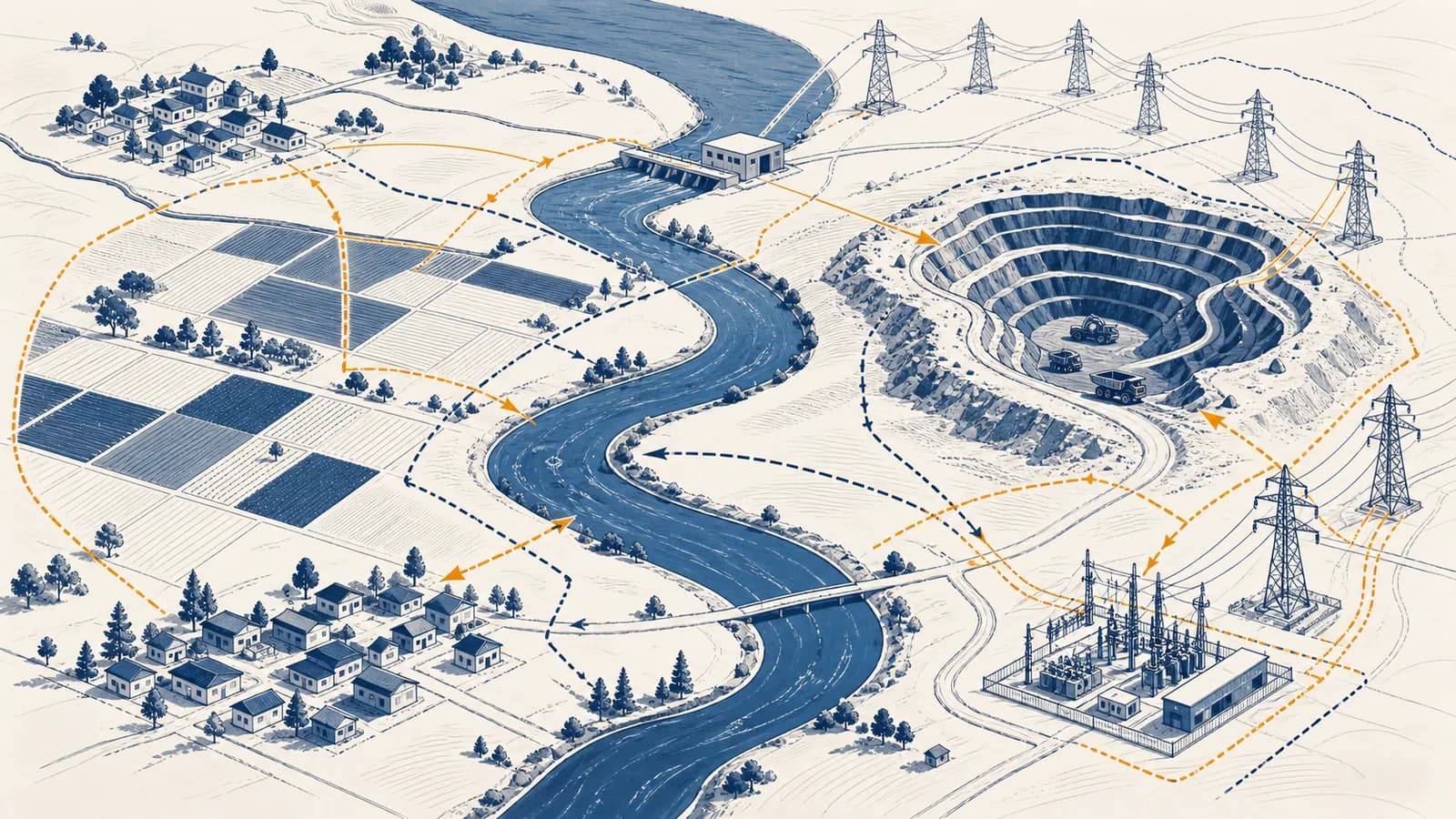
Natural resource conflict is a political and geographic struggle that determines who can use, control, profit from, or protect scarce land, water, minerals, forests, fisheries, and energy resources. Natural resource conflicts arise because useful materials are unevenly distributed, while borders, ownership rules, human needs, and environmental limits rarely line up neatly. A water dispute, mining conflict, land conflict, or oil conflict therefore concerns more than physical scarcity. It also concerns access, power, law, and the distribution of costs. The idea exists because societies need ways to allocate resources without turning competition into dispossession, ecological damage, or violence.
What a natural resource conflict actually is
A natural resource conflict is a disagreement in which at least two groups make incompatible claims about a resource, the territory containing it, or the effects of using it. The groups may dispute access, ownership, revenue, working conditions, pollution, or the authority to decide.
The resource can be a stock, such as a copper deposit, or a flow, such as river water. It can also be a living system that renews itself only under certain conditions, such as a forest or fish population. Conflict begins when one claim interferes with another. A dam may supply electricity to a city while reducing seasonal water downstream. A mine may create paid work while contaminating farmland. A protected forest may conserve habitat while restricting customary gathering rights.
Four questions reveal the structure of most cases:
- What is being claimed? The claim might concern the resource itself, the land above it, a share of the income, or protection from harm.
- Who has a claim? Governments, companies, residents, Indigenous peoples, farmers, fishers, workers, and future users may all have different grounds for a claim.
- Where do the effects fall? Benefits can appear at a national scale while damage is concentrated near an extraction site.
- Who can enforce a decision? A written right matters less if courts, regulators, or local authorities cannot make others respect it.
Scarcity is relational. A resource is scarce when available supply is insufficient for the claims placed on it at a particular place, time, price, and level of quality. Physical absence is only one cause.
A city can sit beside a river and still face water scarcity if the water is polluted, treatment is too expensive, pipes do not reach poor districts, or upstream users control the flow. This is why a map of rainfall alone cannot explain a water conflict.
How resource pressure becomes conflict
Resource pressure becomes conflict through a chain: demand or environmental change tightens competition, institutions allocate the burden, affected groups judge the result, and organized action follows. Violence is one possible outcome, but lawsuits, strikes, blockades, elections, and treaty negotiations are also forms of conflict.
The first stage can be a drought, a price increase, population growth, a new mine, or a change in technology. The second stage is political. Someone decides which well can pump, which company receives a permit, or which village must move. The third stage concerns distribution. People compare gains and losses, and they also compare the process with their idea of a fair process. The fourth stage depends on organization. A household with a complaint has limited influence, but a farmers' union, a municipal government, or an armed group can impose costs on opponents.
If inflow is 100 units, ecosystem needs are 20, upstream withdrawals are 45, and evaporation plus leakage takes 10, then 25 units remain downstream.
The arithmetic can show that claims exceed supply, but it cannot decide whose claim should change. Should farms receive less water, should a city repair leaks, or should a wetland be allowed to shrink? Each choice transfers a cost. That transfer is where resource management becomes politics.
How power and rules shape the outcome
Power and rules shape a resource conflict by deciding whose knowledge counts, whose title is recognized, who enters negotiations, and who can delay or enforce a result. Geography supplies the resource and its connections, but institutions convert those physical facts into permissions, duties, and exclusions.
A legal title is one source of authority, but it is not the only one. Communities may hold customary rights based on long use. A national government may claim underground minerals even where families own the surface. A company may hold a concession issued in the capital. Each rule describes the same place differently, so overlapping claims are common.
Officials decide what is counted, where the permit applies, and which upstream, downstream, or underground connections are included.
Law and procedure determine who owns property, who has customary use rights, and who has standing to object.
A license sets access, taxes, royalties, employment duties, pollution limits, and compensation.
Inspectors, courts, community observers, and public records test whether the written settlement changes conduct.
Unequal bargaining power can appear at every step. Technical reports may be available only in a language local residents do not read. A consultation may occur after the main decision has already been made. Compensation may cover a house but not access to grazing, fishing, or sacred sites. Examining how land use decisions shape cities shows the same principle at a different scale: a boundary on a plan changes who can build, travel, or remain.
Resource conflict versus resource war
Resource conflict includes any organized clash of claims over natural resources, while a resource war is armed violence in which control, revenue, or denial of a resource plays a substantial role. Most resource conflicts never become wars, and most wars have several causes besides resources.
A fishing quota appeal, a protest against a pipeline, a court case over Indigenous land, or a negotiation about a shared aquifer can all qualify. The defining feature is incompatible claims.
Armed groups may seize mines, tax extraction, attack supply routes, or deny water and fuel to opponents. The resource can finance fighting without being its original cause.
Calling a war an oil war or a water war can hide decisions made by leaders, armies, companies, and outside states. A valuable deposit does not fire a weapon. It may increase the reward for holding territory, supply money for armed groups, or attract foreign intervention. Those mechanisms must be shown, not assumed.
The reverse error is also possible. Treating a blockade or forced eviction as a minor disagreement can conceal coercion simply because no formal war has been declared. A useful analysis names the actors, their methods, and the resource connection rather than choosing a dramatic label first.
How conflict shows up in shared water
Shared water creates conflict because rivers and aquifers cross political borders while withdrawals, dams, pollution, and flood controls alter conditions elsewhere. Upstream users often control timing and storage, while downstream users depend on flows they cannot directly command. Cooperation therefore requires shared rules and measurements.
A river basin is a connected drainage system. A dam in one country can hold wet season water and release it during dry months. That may reduce floods and generate electricity, but it can also change sediment movement, fish migration, irrigation schedules, and the volume reaching a delta. The same structure appears inside a country when one province diverts water toward farms or cities.
Three districts share a reservoir during a dry year. The city claims priority for drinking water, farmers need irrigation before a short planting window closes, and downstream residents need enough flow to prevent salt water moving into wells. A percentage split alone cannot solve the timing and water quality problems.
Effective water agreements usually need more than a fixed volume. They need a method for drought years, common measuring stations, notice before major construction, a process for exchanging data, and a way to settle disagreements. The 1960 Indus Waters Treaty between India and Pakistan is a well documented example of states creating river allocation and dispute procedures despite a wider hostile relationship. It demonstrates cooperation, not the disappearance of conflict.
Groundwater is harder to govern because it is hidden. Wells that appear separate may draw from the same aquifer. Pumping can lower the water table beyond a property boundary, and pollutants can travel slowly underground. Maps, monitoring wells, and shared models make the connection visible enough to regulate.
How conflict shows up around minerals and oil
Mineral and oil conflicts form when control of a deposit brings concentrated revenue while extraction imposes local costs and creates competition over territory. Disputes commonly concern licenses, land acquisition, jobs, taxation, pollution, revenue sharing, corruption, security, and responsibility after a site closes.
Extraction has a distinct geography. The ore body or oil field is fixed in place, but the processing plant, road, port, waste site, and workforce settlement may spread its effects across a region. Profits can travel to a distant headquarters. Dust, damaged roads, or contaminated water remain near the project. This separation between the location of benefit and the location of harm often drives opposition.
| Stage | Typical claim | Geographic question |
|---|---|---|
| Exploration | Who may enter and survey land? | Does the license overlap homes, farms, or customary territory? |
| Construction | Who moves, works, or receives compensation? | Where will roads, pits, pipelines, and waste facilities go? |
| Production | Who receives revenue and bears pollution? | Where do money, materials, and environmental effects flow? |
| Closure | Who pays for cleanup and lost employment? | Can the land and water support another use? |
High commodity prices can make control of a deposit more valuable. Falling prices can also cause conflict if companies dismiss workers, abandon cleanup obligations, or reduce payments promised to local authorities. The relevant price is connected to distant demand through the routes that turn raw materials into finished goods. A battery mineral may be dug in one country, refined in another, assembled elsewhere, and sold worldwide.
Oil creates an additional problem because governments may depend heavily on a single revenue stream. Control of the state then brings control of export income, which raises the reward for capturing political office. Yet the outcome is not automatic. Transparent budgets, independent auditing, local revenue rules, and courts can change how income is distributed and challenged.
How conflict shows up in land, forests, fisheries, and energy
Land, forests, fisheries, and renewable energy produce conflicts when several uses occupy the same space or depend on the same ecosystem. Farming, conservation, housing, grazing, logging, fishing, tourism, wind generation, and cultural practice can support different groups while interfering with one another.
Land is more than soil. It carries access to water, roads, minerals, housing, political membership, burial places, and memory. A land title records one kind of claim, while seasonal grazing or forest gathering may rely on movement across several titled parcels. Governments that register only fixed plots can erase mobile uses from the official map.
Renewable resources can be depleted. A forest regrows only if harvesting stays within its capacity to recover and habitat conditions remain suitable. A fish population can decline when catches remove breeding adults faster than reproduction replaces them. Users may then race to take the resource before others do, especially when access rules are unclear or enforcement is weak.
Renewable does not mean impact free. A wind farm needs land, transmission lines, minerals, and access roads. A hydroelectric reservoir changes a river. Low carbon energy can still create local conflicts over consent, habitat, and benefit sharing.
The energy transition changes demand for lithium, cobalt, copper, nickel, and other materials used in electrical systems and storage. It can shift pressure away from fossil fuel regions and toward new mining areas. Planning a lower carbon system therefore requires attention to extraction as well as emissions.
Polar regions make these overlaps especially visible. Sea ice, shipping access, fisheries, wildlife habitat, Indigenous livelihoods, and mineral interest change across the same area. The physical processes explained in how polar environments shape human activity help distinguish real access changes from simple claims that an entire region is suddenly open.
Three mistakes people make with resource conflict
Three common mistakes are treating scarcity as a complete cause, assuming abundance guarantees prosperity, and counting only national totals. Each mistake removes the institutions or spatial differences that explain why similar resources produce cooperation in one place and dispossession or violence in another.
1. Scarcity automatically causes violence
Scarcity creates pressure, not a predetermined outcome. Two regions can face the same dry season and respond differently because one has trusted allocation rules, storage, public data, and a working appeal process. The other may have secret permits or enforcement that favors politically connected users.
Less water means more fighting because users have no alternative.
Less water raises the cost of existing claims. Rules, infrastructure, prices, trust, and power determine who adjusts and how disputes are expressed.
Scarcity can even encourage cooperation when all parties recognize that unilateral use would damage the shared resource. Joint monitoring becomes useful because no party can manage the whole river, aquifer, or fishery alone.
2. Resource abundance makes a place rich
A valuable resource creates possible income, not guaranteed public welfare. The result depends on contracts, tax collection, ownership, spending, exchange rates, corruption controls, environmental management, and the ability of citizens to examine government decisions. Gross export earnings say little about who receives the benefit.
A mine can raise national exports while a nearby settlement loses farmland. Both statements can be true because they refer to different scales and measures. Good analysis keeps employment, public revenue, private profit, unpaid care, health costs, and environmental loss separate instead of compressing them into one claim of success or failure.
3. National supply tells everyone’s experience
A country can have enough food, electricity, or water in total while particular regions and households lack access. Networks determine delivery. Income determines purchasing power. Discrimination, distance, conflict, and damaged infrastructure determine who is connected and who is cut off.
Change the map scale and the pattern changes. National averages hide a dry district, a polluted well, or a village beside a power line that is not connected to it. Resource geography is therefore concerned with distribution across space, not only totals.
Who owns a natural resource?
Ownership depends on the resource and the legal system: surface land may be private, underground minerals may belong to the state, water may be publicly managed, and customary rights may exist without formal title. Ownership also differs from a temporary license to use or extract.
Several rights can exist at once. One person might own land, another might lease grazing access, a company might hold a mineral concession, and the public might retain a right to clean water. Asking only who owns the place misses these separate rights and duties.
Ownership can also change over time. A government may nationalize an industry, return land after a successful claim, cancel a license for breaking its terms, or recognize rights that earlier law ignored. These changes can settle one dispute while creating another, especially if equipment, debts, employment, and cleanup duties remain. A complete account therefore records both the present rule and the history that produced it. People often resist a decision because an earlier seizure or broken promise shapes what they expect the new decision to mean.
International borders add another layer. A state generally controls resources within its territory, but shared rivers, migrating fish, pollution, and underground formations cross borders. International law and treaties set duties between states, while domestic law governs many claims within each state. Indigenous rights can involve both legal orders, especially where customary territory predates the modern boundary.
Does climate change cause resource conflict?
Climate change can increase resource conflict risk by altering water supply, crop conditions, coastlines, hazards, and migration, but it does not produce a single automatic path to violence. Existing inequality, government response, livelihoods, infrastructure, and conflict history shape what follows from physical change.
Consider drought. Lower rainfall may reduce harvests. The next effects depend on irrigation access, crop choice, savings, food prices, credit, transport, and public relief. If officials distribute emergency water through favored groups, the response can deepen political grievance. If insurance and transparent allocation spread the loss, the same weather shock may be managed without violent conflict.
Sea level rise shows another chain. Salt water can enter coastal aquifers, erosion can remove land, and relocation can create disputes over compensation and destination sites. The conflict is mediated by planning decisions and property rules. Climate acts as a risk multiplier when it intensifies pressures that institutions already handle badly.
Can trade reduce resource conflict?
Trade can reduce local pressure by moving food, fuel, water intensive goods, and raw materials from places with available supply to places with demand. It can also shift extraction damage elsewhere, create dependence on transport corridors, and transmit price shocks across borders.
Importing grain can conserve water in an arid country because the water used to grow that grain was consumed abroad. Yet dependence on imports creates exposure to port closures, export restrictions, currency changes, and conflict along shipping routes. The gain is real, but so is the new vulnerability.
Certification and traceability systems try to separate materials linked to abuse from lawful production. Their effectiveness depends on reliable records, inspections, chain of custody, and consequences for false declarations. Informal producers can be excluded if compliance costs are too high, so a rule designed to protect people may also remove their income unless alternatives exist.
This comparison is a constructed example, not a universal rule. Diversification can spread supply risk, but three suppliers using the same port may still share one bottleneck. A geographic analysis follows the actual mines, farms, factories, roads, finance, and borders rather than counting supplier names.
Resource conflicts reveal how geography organizes power
Natural resource conflicts reveal how physical systems, territorial boundaries, economic networks, and political authority meet in particular places. Studying them well means tracing material flows, mapping affected groups, testing claims at several scales, and separating physical limits from human choices about distribution.
When a resource dispute appears in the news, begin with a map and a ledger. Mark the deposit, watershed, grazing route, pipeline, port, settlement, and border. Then list each claimant, the right asserted, the benefit sought, the cost imposed, and the institution able to decide. Check who supplied the measurements and whose use is absent from the official record.
The takeaway: A resource does not become a conflict by existing or becoming scarce. Conflict develops through competing claims, connected places, unequal effects, and rules that people accept, challenge, or cannot enforce.
This method connects the topic to the wider study of places, environments, and human systems. Notice the next time a headline describes a fight over water, land, minerals, or energy. Replace the vague word “resource” with its exact location, movement, users, and governing rule. The conflict will become easier to explain, and proposed solutions will become easier to test.