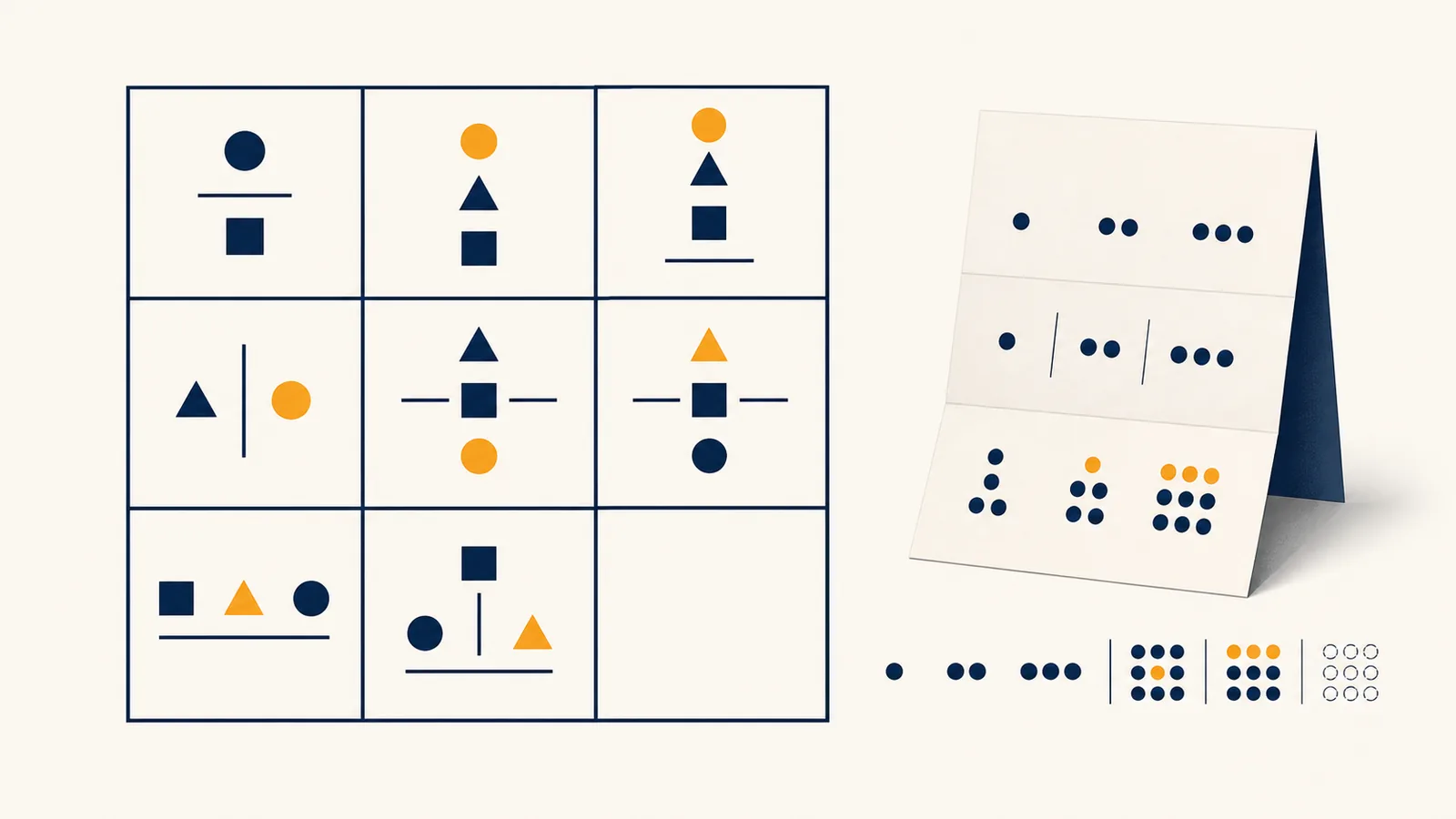
Four Kinds of Reasoning
The test has four sections with eight questions each. Number series test how well you detect changing numerical rules. Letter and logical deduction questions test whether you can follow relationships and draw a necessary conclusion. Abstract 3 by 3 matrices ask you to find the visual rule connecting rows and columns. Spatial questions cover mental rotation, mirror images and paper folding, testing how well you can transform shapes in your mind.
The test is culture-fair and language-light. It does not ask about vocabulary, general knowledge or memorised facts. Logic questions use invented words or plain comparisons, which keeps reading level from deciding the score. This does not make the test free from every possible influence. Familiarity with puzzles, concentration, sleep and testing conditions can still affect performance. It does mean the questions focus on reasoning rather than what you have learned in school or absorbed from a particular language or culture.
Abstract Matrices
Complete three by three grids by tracking dot counts and arrow directions across rows and columns. Matrix items are widely regarded as a strong single indicator of general reasoning.
Number Series
Find the next number in a series by spotting arithmetic, geometric, second difference, Fibonacci style, multiply then add, or interleaved rules. All calculations can be done mentally.
Spatial Reasoning
Picture flags as they rotate or reflect, then identify the mirror image. For folded paper, work out where punched holes will appear after the sheet unfolds.
Logical Deduction
Continue letter sequences, solve height rankings, and choose the conclusion that must follow from two premises. Invented words keep the categorical question free from vocabulary and general knowledge.
How the Score Is Estimated
Your score is not a percentage correct. Every question has a difficulty threshold: the ability level at which a solver has an even chance of answering it correctly. The scoring method considers your full pattern of answers and finds the ability estimate most likely to produce that pattern. A correct answer to a hard question moves the estimate more than a correct answer to an easy one. Missing an item also matters in relation to its difficulty.
The result includes a standard error and an 80 percent confidence band. The estimate is the best fit to your answers, while the band shows the uncertainty around it. A narrower band means the answers locate your ability more precisely within this test. You also receive a percentile based on a scale with a mean of 100 and a standard deviation of 15. Scores are reported only from 60 to 145 because a 32 item short form cannot credibly distinguish ability beyond those limits.
IQ score ranges explained
IQ scores follow a bell curve centred on 100. About 68 percent of people score between 85 and 115, and roughly 95 percent fall between 70 and 130. Here is how the common bands break down.
| IQ range | Classification | How common |
|---|---|---|
| 130 and above | Very high | Top 2 percent |
| 120 to 129 | Superior | Top 9 percent |
| 110 to 119 | High average | |
| 90 to 109 | Average | About half of people |
| 80 to 89 | Low average | |
| 70 to 79 | Borderline |
How Accurate Is It?
This test can give you a reasoned estimate of performance across its four question types. Its scoring uses item difficulty and the whole answer pattern, and the standard error and 80 percent confidence band show that the result is an estimate, not an exact measurement. Every question was checked by a program, so the stated answer is provably the only answer produced by its rule.
It is still a short online test, not a clinical or diagnostic instrument. A credible norm requires a reference sample of thousands of people, which this test does not have. Scores can also shift with concentration, fatigue, interruptions, puzzle familiarity and testing conditions. Treat the result as an informative snapshot from these 32 questions. Do not use it for Mensa, a diagnosis, school or workplace decisions, or any official purpose. A qualified professional using validated tools is the right source for a formal assessment.
Frequently asked questions
Is this IQ test free?
Yes, the test is free. You can answer all 32 questions and view your estimated score, percentile, standard error and confidence band without paying. The full test and result are available with no signup, email or account.
Do I need to sign up or give my email?
No, you do not need to sign up or give an email address. There is no account to create. The test runs in your browser, and your answers and score are never sent to or stored on the server.
How accurate is this IQ test?
It provides an estimate, not an exact or clinical measurement. The scoring accounts for question difficulty and reports a standard error with an 80 percent confidence band. A 32 item online test cannot replace a professionally administered, validated assessment or a norm based on thousands of people.
What is the average IQ score?
The scale used here has a mean of 100 and a standard deviation of 15. Your result also includes a percentile, which describes where the estimate falls on that scale. This test does not claim its own test-taker sample is a formal norm.
What counts as a good IQ score?
There is no single score that counts as good for every purpose. The scale is centred on a mean of 100, and the percentile gives useful context for your estimate. Read it alongside the confidence band, not as a fixed label or a judgment of your potential.
How long does the test take?
The test has a hard limit of 30 minutes. Most people finish within that time. You will answer 32 questions, so work steadily and avoid getting stuck on one item for too long. Choose a quiet setting where interruptions are unlikely.
What kinds of questions are included?
The test includes four question types, with eight questions of each type. They are number series, letter and logical deduction, abstract 3 by 3 matrices, and spatial reasoning. Spatial items include mental rotation, mirror images and paper folding.
What does culture-fair mean here?
Culture-fair means the questions avoid vocabulary, general knowledge and memorised facts. The logic items use invented words or plain comparisons, so reading level does not decide the score. Background, puzzle experience and testing conditions can still influence how someone performs.
Can I use this score for Mensa or a diagnosis?
No, this score cannot be used for Mensa, a diagnosis or any official purpose. The test is not a clinical or diagnostic instrument, and it does not have a norm based on thousands of people. Formal assessment requires an appropriate validated test administered under suitable conditions.
How to use your result
Read your score as a range, not a verdict. It is a snapshot of reasoning on one day, useful for self-insight and curiosity. It cannot be used for Mensa, gifted programs, school accommodations, or any clinical decision. To go deeper into the ideas behind the test, explore our guides on statistics and the normal distribution, mental models for clearer thinking, and study habits that sharpen performance.