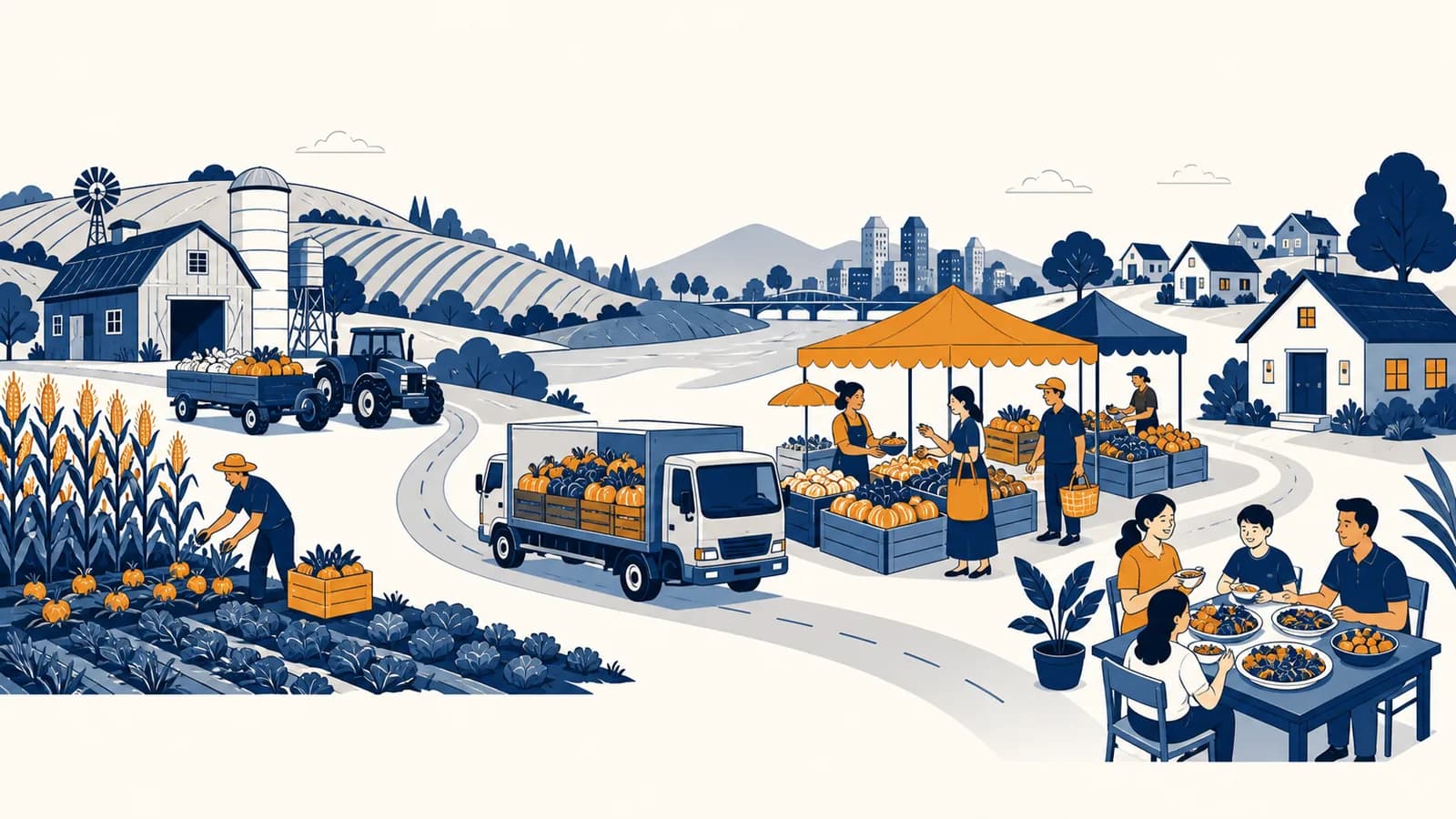
Food security is a condition that ensures every person can reliably obtain enough safe, nutritious and acceptable food, in the context of households, economies and food systems. A clear food security definition therefore covers more than food production or hunger: it includes food availability, physical and economic access, proper use and stability over time. The idea exists because a full warehouse cannot feed someone who cannot afford its contents, reach the market or safely use the food.
What food security actually is
Food security exists when all people, at all times, can physically, socially and economically obtain enough safe, nutritious food for an active, healthy life. It applies at several scales, but it is finally tested by what each person can eat.
This meaning follows the definition adopted at the 1996 World Food Summit. Each word does work. All people prevents a national average from hiding excluded groups. At all times rules out a system that works only after harvest or before prices rise. Safe and nutritious rules out a diet that supplies calories but also carries disease or lacks essential nutrients.
Geographers study food security because food connects land, water, climate, population, transport, trade, work and political power. The same country can export crops while some residents miss meals. The same household can live beside a market yet lack money to buy what it sells. Scale changes the answer.
A supply of food is not proof of food security. Security exists only if people can obtain, use and keep obtaining suitable food.
Food insecurity is the opposite condition. It ranges from uncertainty about the next food purchase to a severe lack of food that threatens health or life. It may be chronic, because low income or insecure land rights persist, or temporary, because a flood, conflict, job loss or price shock interrupts a previously workable system.
How the four dimensions of food security work
The standard framework tests four connected dimensions: availability asks if suitable food is present, access asks who can obtain it, utilization asks whether people can safely consume and absorb it, and stability asks if the other three will continue through time.
The arrows show a useful testing order, not a guarantee. Passing one stage does not automatically pass the next. Stability also acts across the whole chain, because production, purchasing power and safe use can each fail at different times.
Availability concerns the physical supply
Food availability is the amount and variety of food physically present in an area through local production, stocks, imports and food assistance. A wheat harvest adds to availability. So does grain released from storage or brought through a port. Seed, soil, rain, irrigation, labour, fuel, fertilizer, refrigeration and roads all affect what reaches the usable supply.
Access concerns a person’s command over food
Food access is a person’s practical ability to obtain suitable food. Economic access depends on income, prices, savings, credit and entitlements such as benefits or rations. Physical access depends on distance, transport, disability, safety, opening hours and barriers such as a closed bridge or military checkpoint. Social access can be limited by discrimination or household rules about who eats first.
Utilization connects food with health
Food utilization is the process through which a person stores, prepares, eats and biologically uses food. It requires a suitable diet, safe water, sanitation, cooking fuel, food knowledge and health care. Diarrhoeal disease can prevent the body from absorbing nutrients. Contaminated water can turn an adequate food ration into a health risk.
Stability adds the time test
Food stability means dependable availability, access and utilization over days, seasons and years. A family may eat adequately after harvest but struggle during the lean season. A city may have full shops until a port closes. Stability depends on reserves, varied sources, reliable incomes, public services and the capacity to respond to shocks.
This is why the four dimensions work as a system. Extra production may solve an availability problem, but it will not repair a collapsed income, a contaminated water supply or an unsafe road to market. The response must match the failed connection.
How geographers measure food insecurity
Geographers measure food insecurity by combining evidence about supplies, prices, travel, diets, health and people’s lived experience. No single indicator captures the whole condition, so analysts compare several measures across locations, social groups and periods of time.
At national scale, analysts examine crop output, livestock conditions, imports, exports, stocks and transport capacity. At market scale, they track whether staple foods are present and affordable. At household scale, surveys can record dietary variety, spending, coping actions and experiences such as worrying about food or reducing meal size. Health measures may reveal undernutrition, but they need careful interpretation because disease and care also affect nutritional status.
| Question | Possible evidence | What the evidence cannot prove alone |
|---|---|---|
| Is food available? | Harvest estimates, market stocks, imports, road access | That every household can afford it |
| Can people access it? | Food prices, wages, travel time, benefit coverage | That diets are safe or nutritionally adequate |
| Can people use it well? | Diet diversity, water quality, sanitation, illness | That access will continue next month |
| Is the system stable? | Seasonal records, price swings, hazard exposure, income security | Which household member receives enough food |
Averages require particular care. Suppose a district has 1,000 households and its markets hold enough staple food for all of them. If 200 households cannot afford the market price, the district may look secure in a supply balance while one household in five lacks economic access. The arithmetic is visible:
The example is constructed: 200 affected households divided by 1,000 total households gives 20 percent.
Mapping can expose patterns hidden in a total. An analyst might layer rainfall, crop conditions, road closures, travel time to markets, staple prices and household income. The overlap identifies places where several risks reinforce one another. Ground surveys are still needed, because a map of roads cannot reveal who has bus fare or who is unsafe while travelling.
Food security versus food self-sufficiency
Food security means reliable access to adequate food, while food self-sufficiency means producing most or all required food within a household, region or country. They can support each other, but neither condition automatically creates the other.
Focuses on where food is produced. A country may try to meet domestic needs mainly through its own farms, fisheries and livestock systems.
Focuses on people’s dependable ability to obtain and use adequate food, regardless of the workable mix of domestic supply, trade and reserves.
A country can import much of its food and remain food secure if it has reliable suppliers, foreign exchange, ports, transport and household purchasing power. It can also produce a national surplus while some people remain food insecure because land, income or food distribution is unequal. The location of production and the distribution of access are separate questions.
Dependence on one import route creates exposure to shipping disruption or export controls. Dependence on one domestic crop creates exposure to drought, pests or disease. Diversification can spread risk across foods, regions and suppliers. The best balance depends on ecology, infrastructure, public finances and political relationships.
How food security shows up on farms and supply chains
On farms and supply chains, food security depends on turning soil, water, seed, labour and knowledge into food, then preserving and moving that food to buyers. A failure before harvest or anywhere after it can reduce supply, access or stability.
Production begins with land and biological conditions, but farmers also need inputs and institutions. Seed must arrive before planting. Water must come at the right stage of growth. Credit can determine whether fertilizer, machinery or hired labour is available. Secure land rights affect whether a farmer can plan beyond one season. Extension services and weather forecasts help decisions, but only when the information is timely and usable.
Farmers, fishers and livestock keepers combine ecosystems, inputs, labour and skill to create a harvest or catch.
Drying, cooling, milling, packaging and pest control keep food edible and convert it into forms people can use.
Roads, railways, ports, warehouses and contracts connect areas of surplus with areas of demand.
Wholesalers, shops, markets, kitchens, water and energy complete the route from producer to meal.
Loss at one stage changes later stages. If moisture spoils grain in storage, the quantity for sale falls and the farmer loses income. If fuel becomes expensive, transport and refrigeration costs can rise. If a bridge washes out, food may exist nearby but become physically inaccessible. The page on how global supply chains connect producers with consumers follows these links across borders.
A farming district harvests tomatoes, but the only paved road to the regional city is blocked for several days. Tomatoes remain available at the farms, yet their short shelf life limits storage. Urban buyers face reduced supply and higher prices. Farmers may lose both produce and income. One road failure has affected availability, access and stability in different places.
Resilience comes from alternatives that actually function. These may include several crop varieties, water storage, soil protection, local processing, more than one road, distributed warehouses, insurance, savings and buyers in different markets. Each measure covers a particular failure. A second road does little against crop disease, while a disease-resistant variety does little when households lack cash.
How food security shows up in cities and household budgets
In cities and household budgets, food security is mainly an access problem shaped by income, prices, housing costs, transport and time. Shops may be full while households reduce food quality or quantity because other essential expenses claim their money.
Urban residents usually purchase rather than grow most of their food. This makes wages, informal work, social protection and consumer prices central. A household’s nominal income can stay unchanged while its real food access falls if rent, electricity or staple prices rise. Distance matters too. A cheaper market may not be cheaper after adding bus fare, travel time and the difficulty of carrying food home.
Consider a weekly household budget of 240 currency units. Rent and utilities take 120, transport takes 36, and medicine takes 24. That leaves 60 for food and everything else. If necessary food costs rise from 48 to 58, the remaining margin falls from 12 to 2. The food bill rose by 10 units, but the flexible margin fell by five sixths:
This constructed example shows why a modest price change can cause a large loss of security for a household with little spare income. Coping responses often appear before outright meal skipping. People may buy cheaper and less varied foods, use savings, borrow, delay health care or send a family member to seek work elsewhere. These actions protect food consumption briefly but can weaken future access.
City design also changes the practical food map. Zoning affects where shops and markets can operate. Public transport affects who can reach them. Safe pavements matter to older people and those with disabilities. Cold storage and electricity affect what vendors can sell without spoilage. These connections make how urban planning organizes services and access directly relevant to food security.
How climate, conflict and trade reshape food security
Climate hazards, conflict and trade shocks reshape food security by changing production, movement, prices, income and public services at the same time. Their effects spread through connected systems, so the place experiencing hunger may be far from the original disruption.
A drought can reduce yields and grazing, lower farm wages, force livestock sales and reduce river transport. A flood can damage crops, wells, roads, warehouses and homes in one event. Climate change alters the probability and character of some hazards, but exposure and vulnerability determine the human result. Irrigation without fair water rules may protect one farm while reducing supply downstream.
Conflict can remove farmers from land, make roads unsafe, interrupt markets, damage water systems and divert public money. It can also change control over fields, wells, ports and aid routes. Food may become a tool of coercion when armed actors block supplies or restrict movement. These disputes often overlap with the land, minerals and water pressures examined in how resource competition turns into conflict.
Trade can increase security by moving food from surplus areas to deficit areas and by widening consumer choice. It also transmits shocks. A poor harvest in a major exporting region can affect buyers elsewhere through prices. Currency depreciation can make imports costlier even if the world price is unchanged. Export restrictions can protect one domestic market while tightening supply for importers.
Hazard is not destiny. The same drought can produce different outcomes where irrigation, savings, insurance, roads, public services and political responses differ.
Geographers therefore trace chains of cause rather than treating hunger as a simple result of bad weather. They ask which groups lost crops, wages or transport, how markets responded, who controlled relief and what options remained. This turns a vague crisis into a set of testable mechanisms.
How governments and communities improve food security
Governments and communities improve food security by matching action to the failing dimension while protecting people immediately and reducing future risk. Effective policy combines reliable information, accountable institutions and several tools rather than assuming that more production solves every problem.
Availability measures include agricultural research, irrigation, soil conservation, storage, veterinary services, transport infrastructure and carefully managed reserves. Access measures include jobs, school meals, cash transfers, food vouchers and fair market rules. Utilization measures include safe water, sanitation, health care, food safety inspection and nutrition education. Stability measures include early warning, emergency plans, insurance and diversified sources.
Policy design has trade-offs. A fixed consumer price may make food affordable but discourage supply if sellers cannot cover costs. A cash transfer lets households choose what they need, but it cannot buy food from an empty market. Direct food distribution can work where markets have failed, yet transport, storage and fair targeting become difficult. Local procurement may support nearby farmers if their harvest and logistics can meet the requirement.
Food, cash, water, health care and safe shelter prevent a current shock from causing further harm.
Secure livelihoods, functioning services, ecosystem care, storage and political accountability reduce repeated exposure.
Community knowledge can show which well fails first, which road floods, which crops suit local soils and which households face exclusion. Public agencies can supply larger budgets, legal authority, technical services and coordination across regions. Neither level replaces the other. Participation is meaningful only if people can influence decisions, not simply attend a meeting after plans are fixed.
A good intervention also checks for harm displaced elsewhere. Pumping groundwater may raise yields now while lowering the water table. Converting woodland may expand cropland while reducing wild foods, fuel and flood protection. Security achieved by exhausting soil or excluding another group cannot remain stable.
Four mistakes people make with food security
Four common mistakes are treating food supply as food access, using national averages as household evidence, confusing calories with a healthy diet and blaming a single hazard for a complex crisis. Each mistake hides the mechanism that policy must repair.
1. “There is enough food, so nobody should be hungry”
Enough food at national scale says little about its price, location or distribution. People need command over food through production, income, exchange, public support or shared resources. The correct follow-up is: enough food for whom, available where, at what price, and under whose control?
2. “A national average describes everyone”
Averages compress unequal places and households into one value. An export region can contain landless workers with weak access. Food allocation may also differ within one home by age, gender, health or status. Evidence should be separated by location and relevant social group whenever the data allow it.
3. “Enough calories means good nutrition”
Energy is necessary, but a repetitive diet can lack protein quality, vitamins, minerals or culturally acceptable foods. Food safety and disease affect what the body can use. Analysts must examine diet quality, water, sanitation, care and health rather than equating a filled stomach with nutritional well-being.
4. “A drought causes famine by itself”
Drought is a hazard that can reduce water and harvests. Severe human outcomes depend on exposure, access, markets, public action, conflict and the options people retain. Blaming weather alone can conceal preventable failures such as blocked movement, unsafe aid delivery or the loss of household income.
Use the four-dimension check. For any proposed cause or solution, ask what it changes in availability, access, utilization and stability, and for which people.
How seasonality creates a hidden food gap
Seasonal food insecurity is a predictable period when household stocks and income fall before the next harvest while food prices, farm labour needs or disease risks may rise. An annual total can hide this recurring gap between adequate and inadequate access.
A farming household might sell part of its crop after harvest to pay debts and school costs. Months later, its stored food runs low, paid work is scarce and market prices are higher. The household may then buy back the same type of crop under worse terms. Rain can also increase waterborne disease just when farm labour demand peaks, weakening utilization and income together.
Seasonal calendars place rainfall, planting, harvest, prices, work, disease and household expenses on the same timeline. That makes timing visible. A programme that delivers seed after planting time has missed its function. A cash payment before the lean season may prevent distress sales of livestock or tools that would otherwise damage next year’s livelihood.
How food loss and waste affect food security
Food loss and waste reduce the useful food obtained from land, water, energy and labour, but preventing them improves food security only when the saved food becomes available, accessible and safe for people who need it. Location, timing and ownership still matter.
Loss usually describes food leaving the supply chain during production, storage, transport or processing. Waste often describes edible food discarded by retailers, food services or consumers. The boundary varies by measurement system, but the mechanism is clear: bruising, pests, poor temperature control, rejected appearance, oversized portions and confusing date labels can all remove food from use.
Reducing loss near farms may raise saleable supply and farmer income through better drying, sealed storage, crates, cooling or road access. Reducing household waste may save money and resources through meal planning, suitable portions and safe use of leftovers. Yet food recovered in one wealthy district does not automatically reach a distant community, and unsafe redistribution can harm utilization.
Food security makes geography visible at the dinner table
Food security turns a meal into evidence about geography: ecosystems produced it, labour and infrastructure moved it, markets priced it, institutions shaped access, and water and health affected its use. Studying those connections shows where a food system works and where it breaks.
The next time food appears in a shop, canteen or kitchen, trace one item backwards. Identify where it was produced, what water and energy it required, which routes carried it, who earned income from it, what kept it safe and what could interrupt access. Then ask who might face a different outcome in the same place.
That habit links local observation with regional and global patterns. It also shows why food security belongs within the wider study of geography and connected places: the subject explains how environmental processes, human decisions and spatial inequalities meet in ordinary life.
The takeaway: Do not ask only how much food exists. Ask who can obtain suitable food, use it safely and keep doing so when seasons, prices, routes or political conditions change.