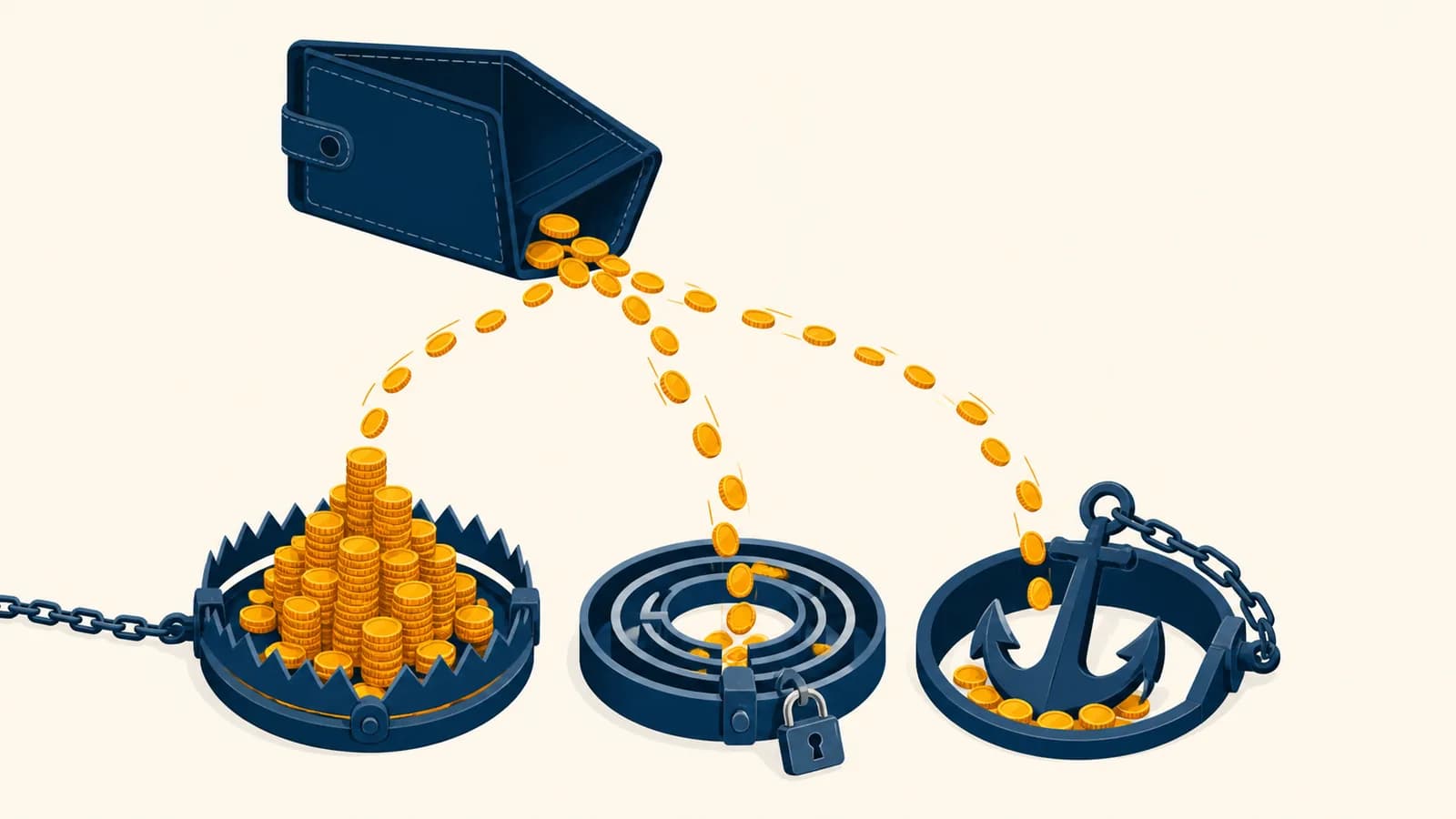
Three predictable biases can drain your bank account
Sunk cost bias, status quo bias, and anchoring bias can keep you paying for choices that no longer serve you. These three money biases affect subscriptions, shopping, investing, insurance, and everyday spending. By learning the mechanism behind each one, you can spot the pressure, compare the real options, and make a better financial decision before money leaves your account.
A bias is a consistent tendency in judgment, not proof that someone is foolish. Human attention is limited. The brain uses shortcuts to make ordinary decisions quickly, and those shortcuts often work well enough. Trouble starts when a shortcut gives weight to information that should not control the choice.
The three biases pull on different parts of a decision. Sunk cost bias looks backward. Status quo bias favors what is already happening. Anchoring bias makes an early number feel like a meaningful reference point. They can also work together. A person may keep an expensive service because they paid an installation fee, have always used it, and compare every new offer with its inflated list price.
The useful response is not to distrust every instinct. It is to separate facts that change future results from facts that merely feel important. This is an economic way of thinking, grounded in the cost of the next best alternative. Every pound, dollar, or euro committed to one option cannot be used for another.
What makes a sunk cost irrelevant to the next decision?
A sunk cost is money, time, or effort that has already been spent and cannot be recovered. It should not determine the next choice because every available option now begins after that cost. Only future costs and future benefits can differ.
Suppose you pay 30 for a nonrefundable event ticket. On the day, you feel ill. Staying home gives you rest; attending gives you a tiring evening. The 30 is gone in both cases. Going does not recover it. The live decision is between the future experience of attending and the future experience of staying home.
Go and avoid “wasting” the 30, or stay home and lose the 30.
Starting now, is the event better than rest after including travel, food, time, and how you feel?
The biased comparison contains an accounting error. It places the same lost 30 on only one side, although the loss exists under both options. A clean comparison places shared facts outside the decision and compares only what changes.
If cancelling a plan avoids 40 of future spending but gives up 15 of future value, cancelling improves your position by 25. The old payment does not enter the calculation.
This bias appears in more serious choices too. Someone keeps repairing an unreliable car because previous repairs were expensive. A business continues a failing project because a team has worked on it for months. An investor holds a weak asset until it “gets back” to the purchase price. In each case, the past expense creates a desire to justify itself, but another payment cannot rewrite the past.
Past spending can provide evidence. A repair history may show that a car is unreliable. Use that evidence to estimate future costs, but do not treat the amount already paid as a reason to pay again.
The distinction is subtle and useful. Past information may improve a forecast. Past sacrifice does not create a debt that the future must repay. Ask, “If I had not made the earlier purchase, what would I choose now?” The answer exposes how much of the decision is an attempt to defend the old one.
Why does doing nothing feel safer than changing?
Status quo bias is the tendency to prefer the current or default option simply because it is current or default. Staying put can feel like neutral inaction, but it is still a choice with costs, risks, and missed alternatives.
Change demands attention. You may need to compare prices, learn unfamiliar terms, move an automatic payment, or risk choosing badly. The current option has another advantage: its flaws are familiar. A new option has uncertain flaws, and uncertainty often feels larger than a known monthly charge.
Automatic renewal turns a one-time choice into a repeated financial result. The payment may continue even when your needs, the price, and the alternatives have changed. The mechanism resembles a default setting in software that manages resources in the background: once configured, the system keeps acting without requesting a new decision every month.
Status quo bias does not mean keeping the current option is always wrong. Switching has real costs. A new bank may have weaker support. A cheaper phone plan may have poor coverage where you live. Cancelling insurance can expose you to a loss that would be hard to absorb. The error is giving the current option a free pass while forcing every alternative to prove itself.
Your internet bill rises at renewal. You dislike the increase but leave the payment untouched because comparing providers sounds tedious. Doing nothing feels free. It is not: the price difference multiplied by the remaining months is the cost of keeping the default.
Give inaction a visible price. If the current plan costs 12 more per month than a suitable alternative and switching takes one hour, straightforward multiplication shows the first-year difference: 12 times 12 equals 144. You can then ask if one hour plus any switching risk is worth 144. The arithmetic does not decide for you, but it makes the trade visible.
How does an anchor bend the price you are willing to pay?
Anchoring bias occurs when an initial number influences a later estimate or decision more than its relevance deserves. A list price, first offer, previous salary, or purchase price can become a mental starting point even when it says little about value.
Imagine a jacket displayed at 200 and marked down to 120. The 200 makes 120 feel cheap because the mind measures a discount of 80. Yet the decision is not “120 instead of 200” unless 200 was a realistic alternative you would have paid. The useful questions are what the jacket is worth to you and what comparable jackets cost.
These bars show a worked example, not market data. If comparable quality is available for 90, paying 120 still costs 30 more than your evidence-based reference. A large discount can coexist with a bad purchase. Saving is the difference between two valid options, not the distance between a price and any larger number printed beside it.
Anchors can come from your own history. If you bought a share at 50, that price may dominate your thoughts after the market price falls. But the asset does not know what you paid. The decision to hold should depend on expected future return, risk, fees, taxes, and what else the money could do. Your purchase price matters for records and possible tax calculations, but it does not guarantee fair value.
Negotiations make the mechanism especially clear. A first offer can define the range of the conversation. Rather than replying with a small movement from that offer, build your own figure from evidence such as comparable prices, condition, contract terms, and your best alternative if the deal fails.
How do the three biases combine in one bad purchase?
The biases often reinforce one another. An anchor makes the original price seem attractive, status quo bias keeps the resulting payment running, and sunk cost bias resists cancellation because stopping would force you to admit that earlier payments produced little value.
A fitness app advertises an annual plan beside a much higher monthly total. You anchor on the claimed saving and subscribe. Months later, you rarely use it, but automatic renewal is the default. You then keep it because cancelling would make the first year's payment feel wasted.
The business does not need to deceive you for this pattern to occur. The prices can be clearly displayed and the cancellation button can work. The biases operate inside the comparison: the high reference price shapes perceived value, the renewal becomes normal, and prior spending becomes an emotional argument for future spending.
A clean review interrupts the chain at each stage. Replace the seller's anchor with an independent budget. Replace the default with a calendar reminder. Replace “I have already paid so much” with “What will the next payment buy?” These moves do not require perfect self-control. They change the information presented at the moment of choice.
The same pattern can affect a car loan, a long contract, or a renovation. A buyer focuses on a dealer's first monthly figure, continues because changing course is awkward, then approves extra spending to protect what has already gone into the deal. Larger choices deserve written comparisons because memory can quietly reshape the original reasons.
What calculation reveals the real cost?
Calculate each option from today forward, using total future cost rather than the most noticeable payment. Include recurring charges, fees, likely maintenance, switching costs, and the value you expect to receive. Exclude payments that are unrecoverable under every option.
Monthly prices are easy to process and easy to underestimate. Convert them to the period that matches the commitment. A 15 monthly service costs 180 over 12 months before any price changes or fees. If three unused services each cost 15 per month, the combined annual outflow is 540. Those figures are examples produced by visible arithmetic, not claims about typical households.
At 15 per month for 12 months, with a 20 fee and 10 expected extra cost, the future cost is .
For money that grows or debt that compounds, repeated percentage changes require powers rather than simple multiplication. The relation expresses how a starting amount changes across repeated periods at rate . The ideas behind repeated growth using exponents help explain why a small recurring expense or interest rate can matter more over a long period.
Precision should match the decision. You do not need a spreadsheet to cancel a service you never use. You may need one to compare mortgages, energy contracts, or cars. Use ranges for uncertain costs. If repairs could plausibly cost between 300 and 700 next year, test both ends. A choice that works only under the most cheerful estimate deserves more scrutiny.
Compare totals on the same basis. Use the same time period, currency, included services, and assumptions for every option. A monthly price and an annual price are not ready to compare until one is converted.
Money is not the only input. Time, reliability, convenience, health, and risk have value. Write them beside the totals instead of pretending they do not exist. The goal is not to choose the lowest number in every case. It is to stop an irrelevant number, an automatic default, or a past loss from making the choice for you.
Which questions stop each bias before you pay?
Use one diagnostic question for each mechanism: would I choose this today without the past payment, what does keeping the default cost, and what would I value this at before seeing the offered price? Written answers slow the shortcut enough to inspect it.
Cross out every amount that cannot be recovered and appears under all remaining options. Keep any lesson it provides about future reliability or value.
Calculate what happens if you take no action. Include renewals, likely increases, time, risk, and the alternative use of the money.
Decide your budget or estimate value before reading the list price, discount, first offer, or previous purchase price.
Compare future benefits minus future costs. Record the reason and set a review date if the decision will keep charging you.
A review date is especially helpful for recurring spending. Put annual renewals on a calendar several weeks before payment. Keep a short list of subscriptions and contracts with price, renewal date, cancellation route, and actual use. This turns a vague intention to “check later” into a specific prompt.
For purchases made under pressure, create a waiting rule that fits the size of the expense. During the pause, search comparable products and write your maximum price. A seller's countdown may still be real, but missing one deal is often cheaper than buying something whose value you have not assessed.
Use the checklist without turning it into a new burden. A small routine can handle most cases: total the future cost, identify the default, name the anchor, and compare one credible alternative. For bigger commitments, the wider study of economic choices and incentives gives you more tools for separating scarcity, tradeoffs, risk, and value.
Better money decisions begin with a clean comparison
Sunk cost bias, status quo bias, and anchoring bias lose much of their force when every option starts at the present moment. Past payments become history, inaction receives a price, and the first number is replaced by independent evidence.
This method will not make every financial choice obvious. Future benefits can be uncertain, switching can be costly, and value can be personal. It does make the disagreement honest. You are choosing between real future outcomes instead of defending a past expense, accepting an unnoticed default, or negotiating against a number someone else selected.
The takeaway: Before the next payment, remove unrecoverable costs, calculate the price of doing nothing, and estimate value without the seller's anchor. Then compare only the future costs and benefits that actually change.
Start with one recurring charge. Ask what the next payment will buy, what happens if you cancel, and what a suitable alternative costs. Keep it if the future value wins. Change it if another option wins. The aim is not regret about old choices. It is a bank account shaped by decisions you would still make today.