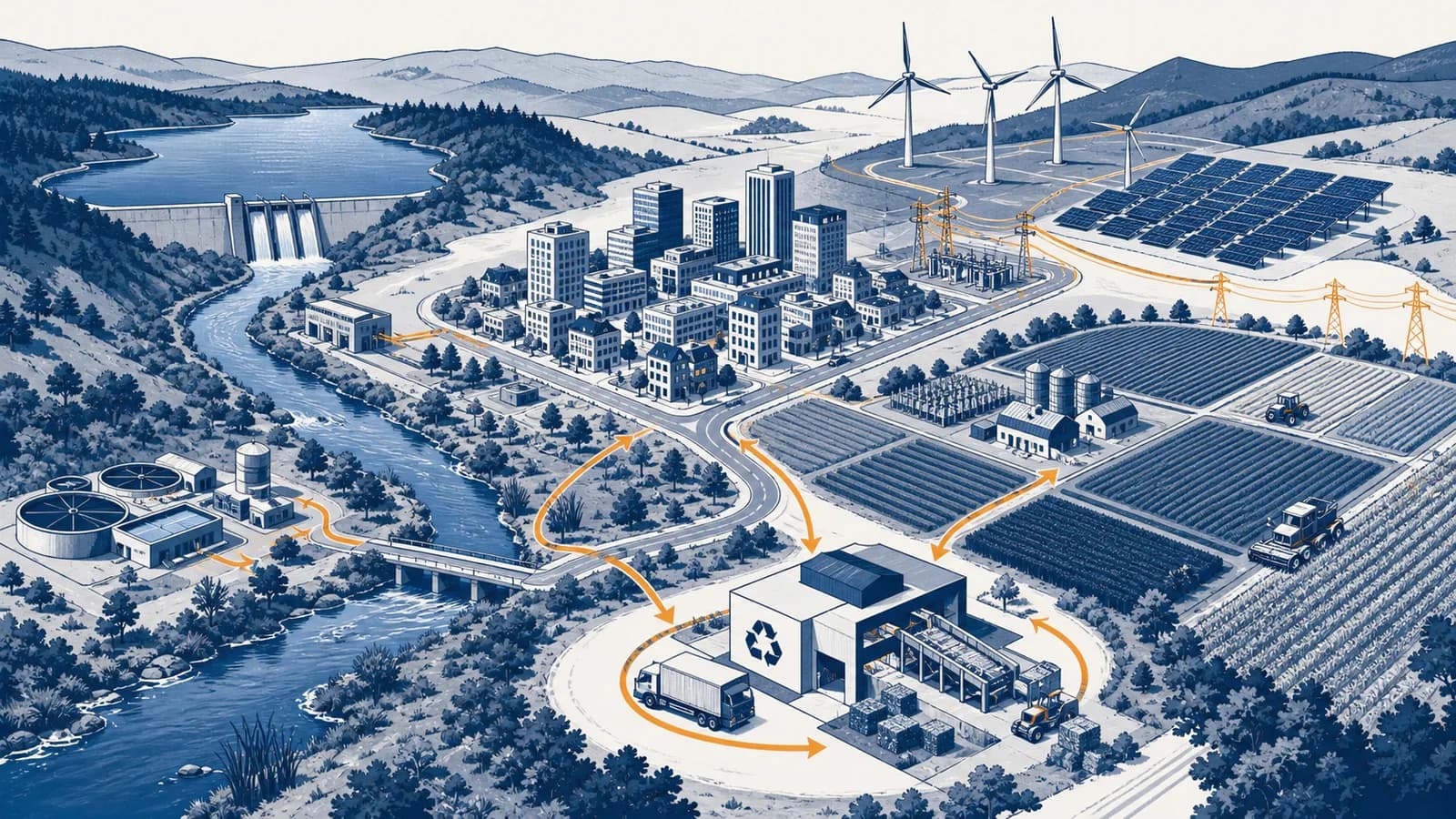
Sustainability is a way of organising human activity that meets present needs while keeping environmental systems, resources, and social conditions able to support life in the future, in the context of geography. In plain terms, sustainable development asks how people can live well without exhausting water, soil, energy, ecosystems, or one another's options. It exists because every settlement and economy depends on flows of materials and energy that have limits, costs, and locations.
A place can look successful while shifting damage elsewhere. A city may have clean streets because its rubbish travels to a distant landfill. A country may report lower industrial emissions after importing goods made in another country. Sustainability follows those connections across space and time. It asks who receives the benefit, who carries the cost, and whether the system can keep working.
What sustainability actually is
Sustainability is the capacity of a linked environmental and human system to continue without destroying the conditions on which it depends. It joins three concerns: ecological limits, human wellbeing, and fair access to resources within and between generations.
The familiar idea of meeting present needs without damaging future generations' ability to meet theirs comes from the 1987 report Our Common Future, produced by the United Nations World Commission on Environment and Development. The wording matters because it does not demand that nothing change. It asks whether change preserves real options for people who come later.
Geographers treat sustainability as a spatial problem. Rainfall, fertile soil, mineral deposits, ports, populations, and pollution are unevenly distributed. A decision in one location can alter forests, rivers, jobs, or prices in another. Scale matters too. A reusable cotton bag may last for years, but growing its fibre still uses land and water. A hydropower dam produces electricity without burning fuel at the turbine, but it can flood habitats and displace communities.
A sustainable result is not the same as a harmless result. Every material system has impacts. The test is whether damage stays within recoverable limits, essential needs are met, and burdens are not simply transferred to another group, place, or generation.
Three forms of capital help make the definition concrete. Natural capital includes soils, forests, fisheries, clean air, and other environmental assets. Human capital includes health, knowledge, and skills. Produced capital includes buildings, machines, and infrastructure. A mine can turn natural capital into money and roads, but the exchange is not automatically sustainable. Lost groundwater or an extinct species cannot simply be replaced by a larger bank balance.
How sustainability works as a system
Sustainability works by tracing inputs, transformations, outputs, and feedback, then changing the system so resource use and waste remain within environmental limits while people can meet their needs. The analysis covers the whole chain, not one attractive stage.
Take a smartphone. Its system begins with ores, energy, water, chemical processing, factory labour, packaging, and transport. During use, it draws electricity and depends on communication infrastructure. At the end, it may be repaired, resold, stripped for metals, stored in a drawer, or discarded. Judging only the charging electricity misses most of the chain.
State the place, period, population, and activity being studied. A school building, a food supply chain, and a national economy need different boundaries.
A stock is stored quantity, such as water in a reservoir. A flow is a rate of movement, such as litres entering or leaving each day.
Identify the conditions that cannot be ignored, such as recharge rate, soil formation, habitat, safe working conditions, or an affordable minimum supply.
Check how one change affects another. Irrigation can raise harvests, then falling groundwater can make later harvests harder and more expensive.
Measure the same outcomes before and after a change, and look for displaced costs. A lower local total can conceal a larger imported impact.
Feedback explains why some pressures accelerate. Removing vegetation can reduce infiltration, increase runoff, strip soil, and make new plants harder to establish. Other feedback stabilises a system. A rising water price can reduce demand, which slows reservoir depletion, although price alone may harm households with low incomes. Good policy notices both the environmental response and the human response.
Sustainability versus environmental protection
Environmental protection focuses on preventing or repairing damage to nature, while sustainability asks whether an entire human and environmental system can continue fairly over time. Protection is one necessary part of sustainability, but it does not cover every social and economic dependency.
A wetland is fenced off, polluted discharge is restricted, or an endangered habitat is restored. The direct goal is to reduce ecological harm.
The wetland is protected while flood safety, local livelihoods, housing pressure, water quality, public access, and long term management are considered together.
Sustainability is also different from conservation alone. Conservation usually means careful protection and management of a resource or ecosystem. Sustainable use may include consumption, provided renewal and recovery can keep pace. Timber harvesting, for example, needs more than replanting. The replacement forest must survive, protect soil and water, retain suitable habitat, and be managed through the decades between planting and harvest.
The word green is looser. It may describe one feature, such as recyclable packaging, without revealing the full product system. Sustainable development is broader again. It concerns deliberate improvement in living conditions while keeping environmental support systems functional. A project can be green in one respect and still fail a sustainability test because it is inaccessible, short lived, or dependent on damage elsewhere.
How sustainability is measured
Sustainability is measured with a set of indicators rather than one universal score. Useful indicators track resource demand, environmental condition, human wellbeing, distribution, and change over time, using boundaries that make comparisons honest and repeatable.
An indicator turns a broad question into observable evidence. Water use per resident, air pollution concentration, habitat area, household energy burden, travel time, and material recovered after use each reveal something different. No single value can substitute for the set because a place can improve one outcome while worsening another.
If a reservoir receives 800 units and loses 950 units during a month, its stored water changes by units.
The balance equation is simple, but the boundary needs care. Reservoir inflow may include rainfall and river water. Outflow may include household supply, irrigation, evaporation, leakage, and releases needed by downstream ecosystems. Leaving out one large flow makes a precise calculation misleading.
Rates must be compared with rates. A forest is a stock of trees and carbon. Annual growth, harvest, fire, and decay are flows. A large forest can still be shrinking if losses exceed growth. A small forest can be expanding while remaining too fragmented to support some species. Quantity and condition must both appear in the assessment.
The arithmetic above is checkable: , then . It does not prove that the household is sustainable. The electricity source, building conditions, number of occupants, necessary heating or cooling, and any rebound in use still matter. Measurement supports judgement; it does not remove it.
How trade-offs and thresholds shape decisions
Sustainability decisions compare gains, losses, thresholds, and their distribution across people and places. A trade-off is an exchange between outcomes; a threshold is a boundary beyond which a system may change sharply or fail to recover on a useful timescale.
Consider a proposed reservoir. It could store water, generate power, and reduce some flood peaks. It could also interrupt fish movement, trap sediment, flood homes, and reduce water available downstream. Listing effects is only the start. Decision-makers must ask how large each effect is, who experiences it, what alternatives exist, and which losses cannot be repaired.
Some trade-offs can be reduced through design. A building can use external shade to lower summer heat gain while keeping daylight. A bus lane can carry more people through limited street space and reduce the need for parking. Other conflicts remain. Protecting a floodplain from construction limits where developers can build, because the same land cannot be fully occupied and left open for floodwater at once.
A council has funds to plant street trees in only one district first. The hottest district has little shade, many paved surfaces, and residents with limited access to private gardens. Measuring heat exposure and vulnerability together gives a stronger reason for priority than dividing trees equally among districts.
Fairness changes the answer because equal treatment and equitable treatment are not identical. Giving every household the same water allowance may look equal, yet household size and medical need differ. Charging the same flat fee can consume a larger share of a low income. Sustainability includes minimum living conditions and meaningful participation, not only the total volume saved.
Thresholds require caution. If pumping stays below an aquifer's recharge over the relevant period, storage may remain stable. If pumping repeatedly exceeds recharge, wells can deepen, springs can weaken, and pumping energy can rise. Once salt water enters a coastal aquifer, restoring fresh conditions can be slow and difficult. Waiting for visible collapse is a poor test of safety.
How sustainability shows up in jobs, law, and money
Sustainability appears in work whenever people locate risks, manage resources, design infrastructure, enforce standards, price long term costs, or report impacts. It affects practical choices in planning offices, farms, factories, banks, laboratories, courts, and supply chains.
Jobs turn broad goals into operating decisions
A transport planner compares street capacity, access to jobs, collision risk, emissions, and the needs of people who cannot drive. An ecologist surveys habitats before construction. A building engineer calculates heating and cooling demand. A procurement officer asks how products are made, repaired, and disposed of. A farmer monitors soil cover, moisture, pests, yields, and input costs rather than treating harvest volume as the only outcome.
Geographic information system analysts place layers of evidence on a map. Flood zones can be compared with homes, hospitals, roads, and income data. The overlap shows exposure and vulnerability, which are different. A field can flood without creating a disaster; the same water around a hospital can interrupt care far beyond the flooded site.
Law sets floors, duties, and procedures
Environmental law can limit pollution, require impact assessment, protect habitats, allocate water, and establish responsibility for cleanup. Planning law controls what may be built and where. Building rules can set minimum performance. Public procedures also matter, because access to evidence and a chance to object affect whose knowledge enters a decision.
A legal limit is not proof that every permitted activity is sustainable. Limits may address one pollutant, one site, or one reporting period. Several individually permitted activities can create a cumulative burden in the same river basin or neighbourhood. Geographic analysis connects those permissions to the combined pattern.
Money can reveal or hide future costs
Budgets often favour low purchase prices even when maintenance, fuel, replacement, and disposal cost more later. Life cycle costing compares those stages over the expected period of use. An efficient pump may cost more to buy but less to power. A cheap road surface may require frequent repair. The useful comparison is total service delivered, not the sticker price alone.
Markets also miss costs that fall on people outside a transaction. If smoke damages neighbours' health but the seller and buyer do not pay for that harm, the price does not contain the full social cost. Taxes, standards, liability rules, or direct public provision can bring some of that missing cost into the decision.
How sustainability shows up in daily decisions
Daily sustainability means choosing and maintaining systems that reduce total resource demand and harm without sacrificing essential needs. The largest effect often comes from housing, transport, food, and durable goods, not from perfect sorting of minor purchases.
Context decides what is possible. Cycling can replace a short car trip where streets are safe and destinations are close. It cannot replace every trip for every body or job. A tenant may be unable to insulate a rented home. Someone working nights may have no useful bus service. Personal choice sits inside infrastructure, prices, rules, and time constraints.
A good household sequence is to avoid unnecessary demand, improve efficiency, then supply the remaining service with lower impact. For winter warmth, that can mean closing gaps, insulating, choosing efficient equipment, and then considering the energy source. Buying new equipment before reducing heat loss may lock in a larger system than the home needs.
Durability changes the geography of consumption. Repairing a laptop can delay another round of mining, manufacturing, and freight. Sharing an infrequently used tool raises the service obtained from one object. Correct sorting helps materials return to production, but the local rules matter because collection and processing facilities differ. The guide to how waste systems collect, treat, and recover materials follows what happens after an item leaves the bin.
Claims on labels deserve specific questions. What measured impact is lower? Compared with what baseline? Does the claim cover the whole product or only its packaging? Is it verified by an independent standard? Vague green language gives no boundary, quantity, or method, so it cannot support a serious comparison.
3 mistakes people make with sustainability
Common mistakes treat sustainability as a mood, a single product feature, or a promise about the distant future. Better reasoning uses explicit boundaries, comparable evidence, distributional questions, and the physical chain connecting consumption with land, water, energy, labour, and waste.
1. Measuring efficiency while ignoring total use
Efficiency means getting more service from each unit of input. It can reduce demand, but not if the amount of service grows faster. If a device uses 25% less electricity per hour but is used for twice as many hours, its energy use becomes times the original. That is a 50% increase in total use.
2. Moving the impact outside the boundary
A company may reduce its on-site waste by asking a supplier to perform the waste-producing stage. A city may close a landfill and send refuse farther away. A national emissions inventory may fall as carbon-intensive goods are imported. The local indicator improves, but the physical impact may persist or grow. Trace the supply chain before declaring success.
3. Treating every problem as a personal choice
Households make real decisions, yet options are produced collectively. Land use controls the distance between homes and services. Electricity networks determine available sources. Product design determines repairability. Work schedules affect travel. Individual action can cut demand and build support, while policy and infrastructure change the menu of choices for millions of decisions.
This test prevents many false solutions. It also keeps analysis practical. The task is not to demand a life without effects. It is to find which changes reduce total pressure, protect basic needs, and avoid exporting costs to people with less power to refuse them.
How do energy, water, food, and land connect?
Energy, water, food, and land form an interdependent system because producing or moving each one usually consumes the others. Changing one sector can therefore solve a problem, transfer it, or create a new constraint somewhere else.
Water is pumped, treated, heated, and moved with energy. Energy production may need water for cooling, extraction, processing, or growing fuel crops. Food needs land, water, energy, nutrients, labour, storage, and transport. Land used for housing or fuel crops cannot simultaneously provide the same food harvest or habitat.
Suppose a dry region expands irrigated crops. Food output may rise, but pumping can lower groundwater and raise electricity use. Solar powered pumps reduce fuel demand, yet cheaper pumping can encourage more water extraction unless withdrawal is governed. The physical water limit remains. The page on how water scarcity develops from supply, demand, access, and timing explains why a dry climate is only part of the problem.
Electricity choices also depend on place. Wind and sunlight vary across time and space, power lines connect generators to users, and storage or flexible demand helps match supply with use. Fuel extraction creates its own transport routes and environmental risks. Studying where energy resources, networks, and consumers are located makes the spatial pattern visible.
Can a city become sustainable?
A city can become more sustainable by reducing material and energy demand, protecting environmental functions, widening access to essential services, and measuring impacts beyond its boundary. It cannot become independent of its surrounding region or erase every impact.
Density can shorten travel distances and make public transport, district heating, and shared services more practical. Poorly designed density can also remove shade, worsen overheating, or crowd people into unhealthy housing. The outcome depends on street design, building quality, green space, affordability, and connections, not density alone.
Urban metabolism is a useful model. It treats the city as a system with incoming food, water, fuel, electricity, construction materials, and goods, followed by outgoing products, wastewater, heat, air pollution, and solid waste. Mapping those flows shows where prevention, reuse, repair, and recovery can reduce demand upstream.
City boundaries can hide imported impacts. Concrete, steel, food, electronics, and fuel may be produced far away. A serious urban strategy counts the infrastructure residents use and the supply chains their consumption activates. It also prepares for floods, heat, drought, and economic shocks, since a low impact system that fails during stress cannot protect wellbeing.
Can economic growth be sustainable?
Economic growth can support sustainability when added value comes with falling total environmental pressure and wider human wellbeing, but growth is not sustainable merely because each unit becomes cleaner. Absolute resource use, ecological thresholds, distribution, and the purpose of production still decide the result.
Relative decoupling occurs when environmental pressure grows more slowly than the economy. Absolute decoupling occurs when the economy grows while total measured pressure falls. The second is the stronger test, but its credibility depends on the boundary. Outsourced production and omitted impacts can make a national result appear better than the global chain.
Growth is usually reported through gross domestic product, which measures the market value of final goods and services produced in a period. It does not directly measure health, ecosystem condition, unpaid care, security, or how income is shared. Repair after a damaging flood can add economic activity even though the community has suffered a loss. GDP can describe production without settling whether development is sustainable.
The practical question is more precise than choosing between growth and no growth. Which activities should expand because they meet needs with low pressure? Which harmful or wasteful flows should contract? Health care, repair, insulation, public transport, and ecosystem restoration can add useful work. Repeated disposal, avoidable energy loss, and planned short product lives consume resources without matching social benefit.
Sustainability changes how geography reads a place
Sustainability turns geography into an account of dependencies, limits, power, and change. It connects physical processes with settlements and economies, showing that the quality of one place often depends on decisions and environments far beyond its visible boundary.
When examining a farm, neighbourhood, factory, or policy, start with five observations. Mark the boundary. Trace the main material and energy flows. Identify the environmental systems that renew or absorb them. Ask who gains and who bears risk. Then compare the rate of use with the rate of recovery over a stated period.
This method works at several scales. A household can track electricity and repair. A town can map heat exposure and bus access. A river basin can compare withdrawals with seasonal flows. A country can examine imported materials as well as domestic pollution. The questions stay consistent even as the evidence changes.
The takeaway: Sustainability is not a badge attached to a product or place. It is a test of whether linked human and environmental systems can keep meeting needs, within real limits, without transferring intolerable costs across space, society, or time.
The next time a project is described as sustainable, look for its boundary, timescale, indicators, and missing voices. Then follow one input back to its source and one output to its destination. That habit connects the concept to how physical and human systems fit together across geography, and it turns a broad claim into a question that evidence can answer.