Small teams punch up by automating repetition, not judgment
Small teams use AI effectively when they automate repetitive work while keeping goals, judgment, and accountability in human hands. That division lets fewer people research, draft, code, and serve customers faster without pretending that software can decide what deserves to exist. By the end, you can map a workflow, choose safe tasks for AI, measure the gain, and build checks that protect quality.
The useful question is not, “What can AI do?” A text model can produce an answer for almost any prompt. The useful question is, “Which part of this job is predictable enough to specify and cheap enough to check?” A small team gains capacity when it gives machines the repeatable middle of a task and keeps people at both ends: setting the target and approving the result.
“Write our marketing strategy.” The system receives a vague goal, makes hidden assumptions, and returns polished language that can conceal weak reasoning.
“Group these approved customer comments by complaint, quote the source line, and flag uncertain cases.” The task has boundaries and a checkable output.
This distinction explains why a tiny company can sometimes match the output of a larger one without matching its headcount. It is not replacing every specialist. It is reducing the minutes specialists spend copying fields, reformatting notes, searching familiar sources, writing routine variants, and checking predictable conditions. The recovered time goes to choices that require context.
What work should a small team give to AI?
Give AI tasks with clear inputs, explicit output rules, frequent repetition, and fast verification. Keep tasks that involve irreversible decisions, disputed facts, private data, or responsibility for another person under direct human control. The boundary depends on the cost of a wrong answer.
A good candidate often sounds boring when described precisely. Turn meeting notes into action items. Compare a draft with a style checklist. Suggest test cases for a function. Extract product names from support messages. Rewrite an approved paragraph for three reading levels. None of these jobs asks the system to decide the company’s direction.
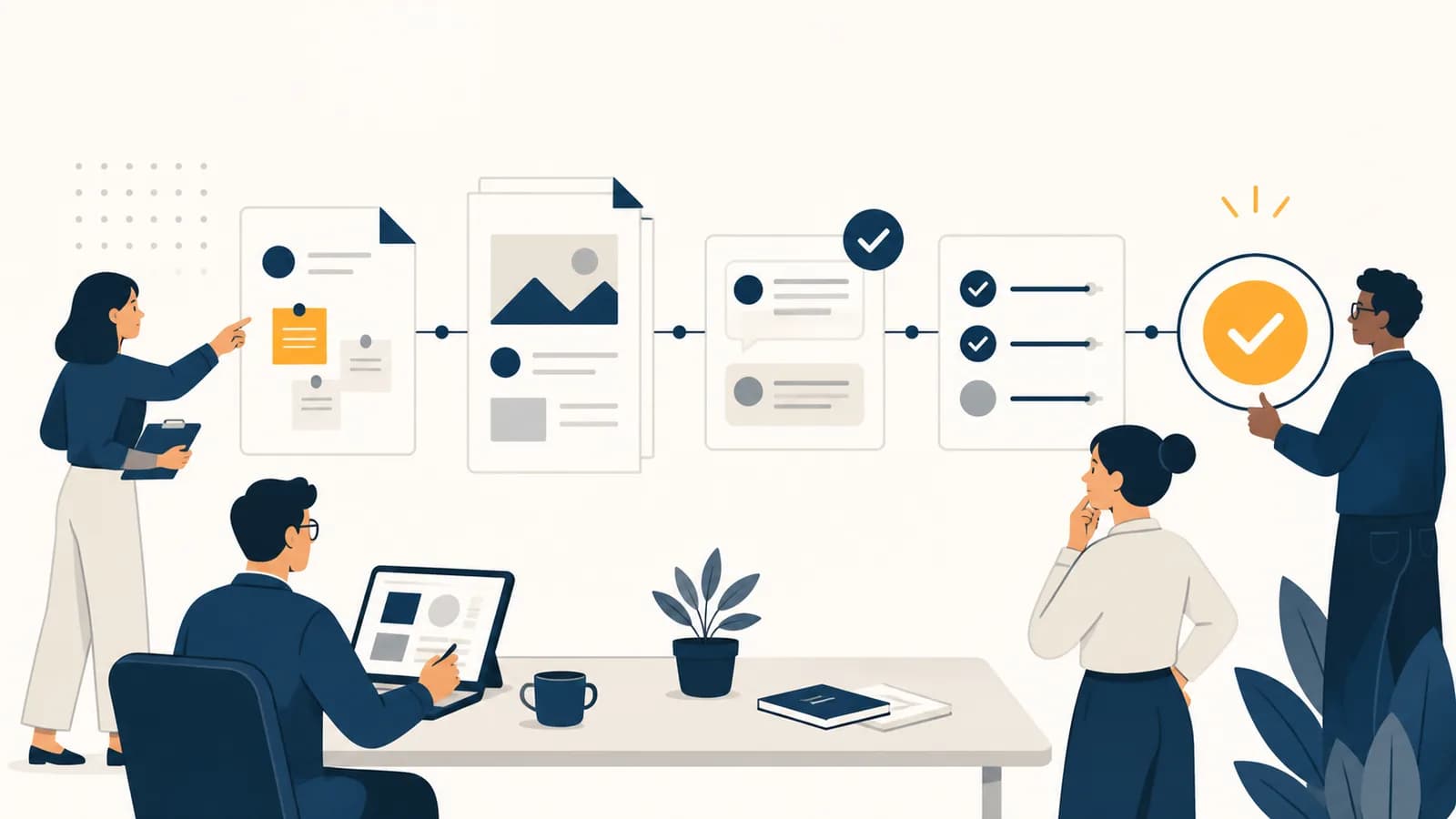
Notice where action appears in this pipeline. The model proposes; an accountable person approves. That pattern is especially useful for work involving public claims, payments, hiring, health, safety, legal rights, or deletion of data. A mistake in a private brainstorm is cheap. A mistaken invoice sent to a customer is not.
Software work offers a clear example. An assistant can explain an unfamiliar function, draft a unit test, or suggest a refactor. A developer still needs to understand the requirement, inspect the change, run the tests, and decide if the design belongs in the product. The subject page on how AI coding assistants generate and suggest code explains the machinery and limits behind that collaboration.
Do not automate a task you cannot evaluate. If nobody on the team can recognize a bad result, faster production only creates a larger pile of unchecked risk.
Why does task design matter more than prompt cleverness?
Task design determines what evidence the model receives, what choices it may make, and how a person can test the result. Prompt wording helps, but a beautifully phrased request cannot repair missing source material, an undefined audience, or an output with no acceptance test.
Suppose a two-person shop wants help answering support email. “Reply to this customer” leaves too much unstated. The model must guess the refund policy, the desired tone, the facts of the order, and what it is allowed to promise. A stronger task supplies the customer message, the relevant policy paragraph, approved account facts, a response template, and an instruction to mark missing information rather than invent it.
A customer says a parcel arrived damaged. The AI drafts a reply using the shop’s approved returns policy and the order record. It may explain the next step, but it cannot issue money, alter the policy, or claim that a refund has happened. A person checks the draft and authorizes any account change.
The structure works because it converts an open-ended performance into a bounded transformation. The model receives evidence and turns it into a proposed artifact. You can then compare that artifact with the source. This is the same habit used in good science and careful reporting: separate the observation from the conclusion, and keep a path back to the evidence.
Instructions also need an escape hatch. Tell the system what to do when the source is incomplete or two rules conflict. “State what is missing and stop” is often more valuable than another paragraph about tone. Without that option, a model is pushed toward producing something even when the honest output is uncertainty.
How do you turn a messy job into a safe workflow?
Break the job into observable steps, mark where information enters and decisions occur, then automate one low-risk step at a time. Define the expected output before choosing a tool. A workflow is safe only when failures are visible and a person can intervene.
Record the actual sequence, including copying, waiting, checking, and correcting. The official procedure often omits the parts that consume the most time.
Pick a step such as turning notes into a fixed template. Avoid starting with the final decision or a chain that can publish, pay, or delete by itself.
List required fields, forbidden claims, source rules, and the conditions that require human review. Include examples of acceptable and unacceptable output.
Process a sample with and without AI. Count total human minutes, corrections, and serious misses. Do not judge only by how quickly the first draft appears.
Route unusual, sensitive, or uncertain cases to a person. Keep source material beside the output so review does not become a scavenger hunt.
The method is deliberately modest. A team learns more from automating one stable step than from connecting five uncertain ones. Each added stage can pass its error to the next stage, where the language may become smoother even as the facts become worse.
This is an opportunity allocation problem. An hour spent building a workflow cannot also be spent interviewing customers or improving the product. The economics lesson on comparing the next best use of scarce time gives the formal idea behind that choice. Automation is sensible only when its total benefit exceeds the work displaced by building and maintaining it.
How can a team tell if automation actually saves time?
Measure the whole process, including preparation, review, correction, tool failures, and maintenance. Compare it with the old process over similar cases. A fast draft is not a saving if people spend longer finding subtle errors than they once spent writing the work themselves.
A simple model makes the accounting visible. Let the old process take 18 human minutes per case. Suppose the assisted process needs 4 minutes to prepare the input, 5 minutes to review the output, and 2 minutes on average for corrections. The visible arithmetic gives 11 minutes of human work, so the estimated saving is 7 minutes per case.
Worked example: minutes saved per case.
That estimate is incomplete until the team includes fixed costs. If setup, testing, and staff training require 420 minutes, and each completed case saves 7 minutes, the workflow breaks even after 60 comparable cases because . If the task happens only 20 times before the process changes, the automation has not repaid its setup time.
Track quality beside time. Useful measures include the share of outputs accepted without correction, the number of missing required fields, the number of unsupported claims, and the severity of the worst miss. These are local measurements, not universal benchmarks. A team should define them around the damage errors could cause in its own setting.
Where do AI errors come from?
AI errors usually come from incomplete inputs, ambiguous instructions, weak source control, model limitations, or automation that acts beyond its evidence. Fluent wording makes these errors harder to notice because the output can sound settled while names, dates, calculations, and causal claims remain wrong.
A language model predicts sequences that fit patterns in its training and current context. It does not consult a private store of verified truth before every sentence. If asked for a fact without a supplied source or a connected database, it may produce a plausible completion. If given conflicting documents, it may quietly blend them. If asked to calculate inside a long verbal task, it may lose track of a condition.
Tool access changes what a system can do, but it also creates more failure routes. Search can retrieve an outdated page. A database lookup can use the wrong customer identifier. Code can run with an unexpected unit. An automated agent can repeat an action after a timeout even though the first action succeeded. Good design records inputs, tool results, and approvals so a person can reconstruct what happened.
Basic ideas from computer science as a study of information and algorithms help here. Inputs have types, programs have state, and procedures need defined behavior for exceptional cases. Treat an AI step as a fallible software component with an unusual interface, not as an invisible coworker who somehow knows the office.
Confidence is not evidence. Ask for source locations, preserve the original material, and check important claims directly. A model’s statement that it checked its work is still model output.
Which decisions must people continue to own?
People must own decisions that set goals, weigh competing values, accept legal or moral responsibility, or create serious consequences for others. AI can organize evidence and draft options, but the accountable person must understand the basis of the choice and remain able to reject it.
A hiring system might summarize applications against published requirements. It should not quietly define what “promising” means, infer protected traits, or make the final choice. A finance assistant might categorize expenses. It should not decide that a doubtful payment is safe because its description resembles earlier transactions. Similarity is useful evidence, but it is not permission.
Ownership also includes selecting the objective. An optimizer produces different behavior depending on what it is told to maximize. If a support team rewards only shorter handling time, an automated system may favor quick closure over actual resolution. If a publisher rewards only clicks, generated headlines may become misleading. Humans choose the measure and must inspect the behavior it creates.
Market structure matters too. A small team may depend on one model provider, cloud host, or marketplace for a central workflow. Prices, access rules, and product behavior can change outside the team’s control. The economics of markets dominated by one or a few powerful sellers explains why supplier concentration affects bargaining power. Exportable data, documented procedures, and a manual fallback reduce dependence.
What does a sensible first month look like?
A sensible first month produces one measured workflow, a written review rule, and evidence about where the tool fails. Start with internal drafts and reversible work. Expand only after the team can show that review catches important errors and that total human time actually falls.
During the first week, list recurring tasks and choose one with stable inputs. In the second, gather real examples and write an acceptance checklist. In the third, run the old and assisted methods side by side. In the fourth, review the misses, revise the boundaries, and decide whether to continue.
Keep a small failure log. Record the input category, the wrong output, why review caught or missed it, and the change made afterward. Avoid filling it with every awkward sentence. Focus on failures that could mislead a customer, corrupt data, waste material, expose private information, or trigger an unauthorized action.
The takeaway: A small team gains an advantage by making repetitive work cheaper while making responsibility more visible. Specify the task, preserve the evidence, measure total human effort, and require approval wherever an error would be hard to reverse.
The best result is not a company that produces the most machine-written material. It is a company where people spend less attention on predictable transformations and more on understanding customers, testing ideas, and making choices they can defend. The automation should make human thinking easier to see, not easier to avoid.
Small teams win by keeping judgment close to the work
AI gives small teams more useful capacity when it shortens repeatable steps without separating decisions from the people responsible for them. The durable advantage is a clear operating system: evidence goes in, drafts come out, checks happen, and accountable people decide what reaches the world.
That system can begin with a single template, a checklist, and a stopwatch. Map one task. State what a correct result contains. Give the model only the access it needs. Review real cases, including failures. Calculate the saving with all human time included. Then keep, change, or remove the automation based on what the evidence shows.
Small teams do not need to imitate large companies by producing more of everything. They need to choose carefully what deserves scarce attention. Machines are good at producing candidates and repeating specified transformations. People remain responsible for deciding which problems matter, which evidence counts, and which consequences are acceptable. Automate the boring work, then own the thinking that remains.