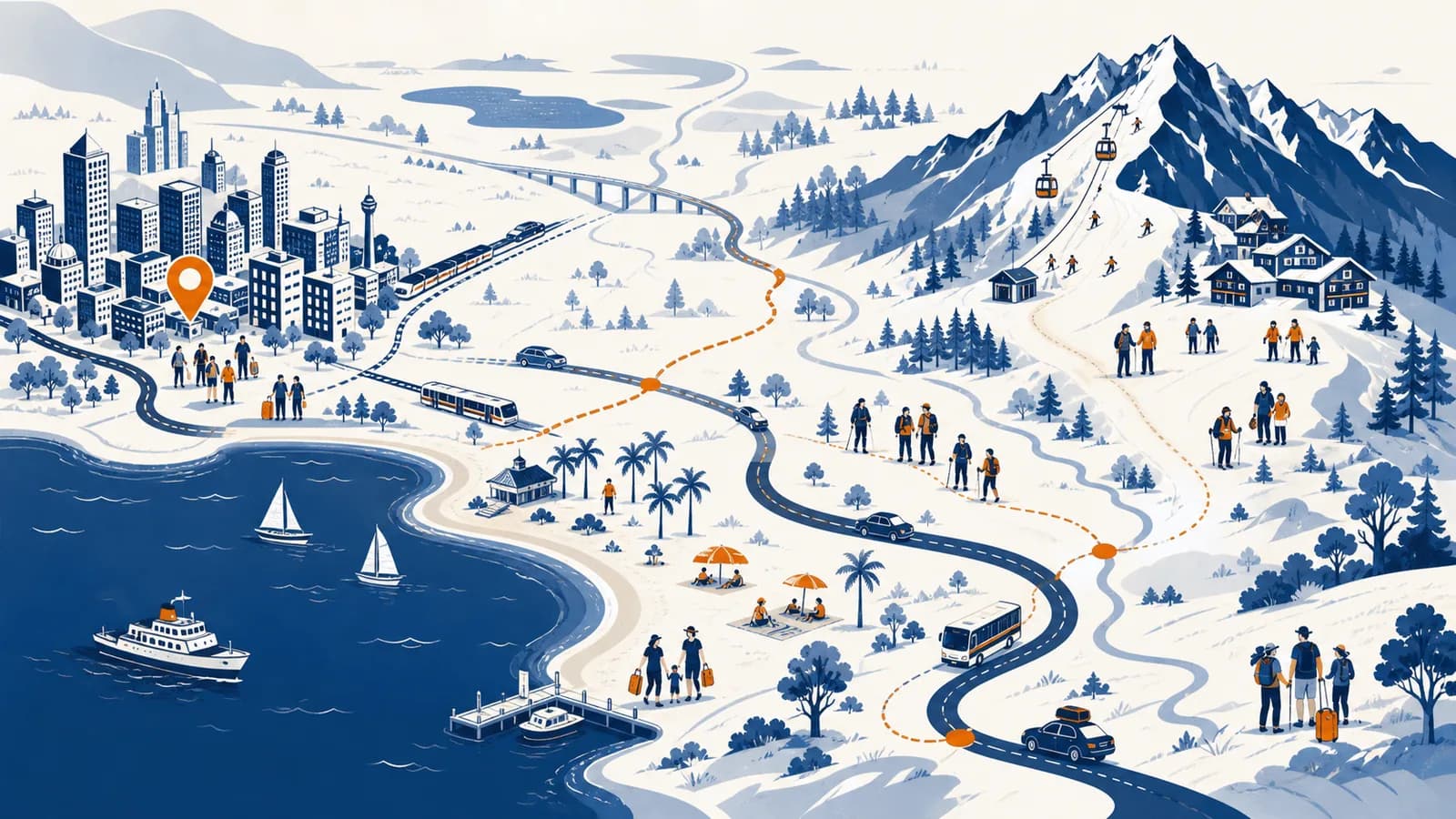
Tourism geography is a branch of human geography that explains where tourism develops, how visitors move, and how travel changes places, in the context of spatial relationships between origins, routes, destinations, people, economies, and environments. It studies tourist flows, attractions, transport, seasonality, destination development, and the economic, social, and environmental impacts of tourism. The field exists because travel is never distributed evenly: particular landscapes attract visitors, particular routes carry them, and particular communities absorb the benefits and costs. Tourism geography therefore asks what makes a place accessible, desirable, and able to receive visitors without losing the qualities that drew them there.
What tourism geography actually is
Tourism geography is the study of tourism as a spatial system, connecting the places where trips begin, the routes people take, the destinations they enter, and the changes produced by their presence. It explains patterns at local, national, and global scales.
A holiday may look like a personal choice, but millions of personal choices create visible patterns. Warm coasts attract seasonal concentrations. Capital cities draw visitors through airports and rail hubs. National parks pull people toward particular gateways because roads, parking, trails, and accommodation are concentrated there. A geographer maps those concentrations and investigates the processes behind them.
The subject has five main parts. Origins are the places tourists normally live. Destinations are the places they visit. Routes connect the two. Tourism services make the trip possible through transport, rooms, food, information, and activities. Impacts are the changes the trip produces in economies, communities, and environments.
This simple flow hides feedback. A good visitor experience can produce recommendations, repeat trips, investment, and new transport links. Congestion, habitat damage, or hostility from residents can weaken a destination's image. The system changes as information, prices, policies, hazards, and fashions change.
Scale changes the answer. At global scale, a researcher might compare major aviation corridors. At national scale, the question might be why visitors cluster in one region. At street scale, it might be why restaurants and souvenir shops gather near a station or landmark. The same trip can be studied at every scale, but each view reveals a different mechanism. The wider ideas of location, scale, and connection appear across the geography guides that connect people, places, and environments.
Tourism is a system, not a dot on a map. A destination depends on an origin market, a route, services, information, and a place capable of receiving visitors.
How tourist flows work
Tourist flows form when motivation at an origin meets an attractive and accessible destination. Income, free time, information, price, distance, border rules, and transport links filter the possible trips, producing corridors, clusters, seasons, and gaps on the map.
A person may want a beach holiday, but desire alone does not create a trip. They also need enough disposable income, time away from work or school, usable transport, acceptable travel documents, and confidence that the destination suits them. Geographers call the features that encourage departure push factors. These include escaping cold weather, resting, seeing family, or seeking novelty. Features that attract a person to a destination are pull factors, such as a warm climate, a festival, wildlife, heritage, or a famous landscape.
A household wants rest, recreation, family contact, education, business, or another experience away from its usual environment.
Budget, available time, health needs, distance, visas, risk, and transport schedules reduce the set of realistic destinations.
Maps, search results, advertising, films, reviews, relatives, and news influence what the traveller expects before leaving home.
Direct flights, railways, roads, ferry ports, and border crossings concentrate people along particular lines and at transfer hubs.
Businesses adjust rooms, staffing, food, and activities. Public agencies manage water, waste, safety, streets, and protected sites.
Distance usually creates friction because longer trips tend to require more time, money, and organization. Yet distance is not measured only in kilometres. A city reached by a direct two hour flight may feel closer than a rural site only 200 kilometres away that requires several transfers. Travel time, cost, reliability, border procedures, and physical accessibility all affect effective distance.
Routes matter because they direct spending as well as people. A motorway bypass can move visitors past a town without stopping. A rail terminus can create demand for hotels and restaurants around the station. The same corridor logic also appears in the geography of routes that channel goods between markets, although tourists move themselves and make choices during the trip.
How tourism demand becomes seasonal
Tourism becomes seasonal when climate, school calendars, public holidays, wildlife cycles, events, and workplace leave concentrate demand into part of the year. Capacity remains in place all year, so peaks create crowding while low seasons leave rooms, vehicles, and workers underused.
Seasonality has both physical and human causes. Snow conditions shape a ski season. Rainfall and temperature affect beach visits and hiking. Animal migration creates short wildlife viewing periods. School holidays synchronize millions of family trips. Festivals and sports fixtures produce sharp event peaks even when the weather changes little.
Consider a fictional guesthouse with ten rooms and a 30 day month. Its monthly capacity is calculated in room nights.
If 240 of 300 available room nights are sold, occupancy is .
Suppose the same guesthouse sells 270 room nights in its busiest month and 60 in its quietest. The building, insurance, and much of the maintenance continue through both months. In the peak, staff may face long shifts and guests may compete for parking. In the low season, income may not cover fixed costs. This is why businesses vary prices, close temporarily, seek conferences, or promote activities that are less dependent on weather.
A season also moves pressure through space. On a hot weekend, people may cluster on beaches near car parks while a more distant stretch stays quiet. During a festival, the busiest zone may shift toward a town centre. Managers can spread demand with timed tickets, alternative trails, off-season events, shuttle buses, or information about less crowded places. Each measure changes where or when people move rather than simply changing the total number.
How geographers measure tourism and its impacts
Geographers measure tourism by combining counts of visitors, nights, spending, transport movements, land use, employment, resident experience, and environmental conditions. No single measure gives the full picture because a short day visit and a long hotel stay affect places differently.
An arrival is an entry recorded under a chosen definition, not necessarily one unique person. One traveller taking several trips can create several arrivals. A visitor night records one visitor staying for one night. Length of stay therefore changes the relationship between arrivals and nights. Day visitors can create spending and congestion without appearing in accommodation records.
Methods include border records, accommodation reports, passenger counts, household surveys, business surveys, pedestrian sensors, traffic counts, mobile location data, land use mapping, water testing, and interviews with residents. Each source has limits. Hotel data misses stays with relatives. Surveys depend on who responds. Phone data may omit people without tracked devices and must be handled with privacy safeguards. A careful study states what was counted, where, when, and under which definition.
| Measure | What it reveals | What it can miss |
|---|---|---|
| Visitor arrivals | Volume of recorded entries | Repeat trips and length of stay |
| Visitor nights | Demand for overnight capacity | Day trips and informal stays |
| Visitor spending | Direct purchases by visitors | Where the revenue later goes |
| Tourism employment | Jobs linked to visitor demand | Seasonal hours and job quality |
| Resident survey | Local experience and attitudes | People not reached by the survey |
| Environmental indicator | Change in water, soil, habitat, or waste | Causes unrelated to tourism |
Comparison needs a denominator. Ten thousand visitors may overwhelm a small settlement but barely register in a large city. Analysts compare visitors with resident population, available beds, site area, water supply, road capacity, or time. They also establish a baseline, because change can only be attributed carefully when earlier conditions and other causes are known.
A class counts pedestrians at three entrances to a waterfront for ten minutes every hour, on one weekday and one weekend day. It maps litter at fixed points and interviews shopkeepers using the same questions. The result does not prove the pattern for the whole year, but it can show where use concentrates, how Saturday differs from Tuesday, and which further data are needed.
Economic analysis also follows where money travels after the first purchase. A hotel may buy food from a nearby farm, pay local wages, or import supplies through a distant company. Ownership, sourcing, taxation, and workers' spending determine how much visitor money circulates locally. This is the difference between counting a sale and tracing its geographical effect.
Tourism geography versus the tourism industry
Tourism geography explains spatial patterns and consequences, while the tourism industry supplies and sells transport, accommodation, food, attractions, and services. The first is a way of studying tourism; the second is a network of organizations involved in providing it.
How can a hotel attract guests, set prices, organize staff, and earn enough revenue?
Why are hotels clustered here, which origins supply their guests, and how does that concentration affect land, work, housing, and transport?
The two overlap because businesses act in space. An airline selects routes between particular airports. A resort developer chooses land with access, views, water, and planning permission. A tour company assembles a sequence of places within a limited travel time. Geographical evidence can guide those decisions, but it can also expose costs that a business account does not record.
Tourism is also broader than leisure. Standard statistical definitions generally focus on visitors travelling outside their usual environment for limited periods and purposes that can include holidays, business, education, health, religion, or visiting friends and relatives. Exact definitions vary between data systems, which is why comparisons must use matching categories.
Recreation differs because it can happen within a person's usual environment. A resident walking in a neighbourhood park is engaged in recreation but would not normally be counted as a tourist. Migration differs because it involves a change in usual residence. Commuting is regular movement between home and work or study. The boundaries matter when a government counts demand or plans services.
A visitor count is not automatically a tourist count. Check if the data include day visitors, business travellers, transit passengers, cruise passengers, or residents using the same site.
How tourism shows up in coasts, cities, mountains, and protected areas
Tourism takes a different spatial form in each environment because attractions, access, hazards, land ownership, and capacity differ. Coasts often develop in strips, cities around nodes and districts, mountains along valleys, and protected areas around entrances and trails.
Coastal tourism often forms a narrow strip
Coastal tourism concentrates where beaches, views, safe water access, transport, and buildable land meet. Hotels and restaurants may line the shore because proximity carries value. This creates competition for land and can restrict public access if development blocks routes to the water.
The coast is dynamic. Waves move sediment, storms flood low ground, and dunes protect land while also providing habitat. Building a seawall to defend tourism property can interrupt sediment movement and shift erosion along the coast. Water use and sewage treatment also become harder during peak months when the temporary population rises sharply.
Urban tourism gathers around connected nodes
Urban tourism clusters near historic centres, cultural venues, shopping streets, nightlife districts, convention sites, and transport hubs. Visitors share streets and services with residents, so the main geographical question is often how intense short term demand changes housing, mobility, noise, and public space.
A new museum can draw foot traffic toward surrounding cafes. A pedestrian zone can make a district more attractive while rerouting vehicles. Short term visitor accommodation can bring income to owners but may also compete with residential use in places where housing supply is tight. These choices connect directly with how urban planning assigns land and transport capacity.
Mountain tourism follows valleys and vertical zones
Mountain tourism is channelled by slope, altitude, weather, avalanche risk, roads, lifts, and passes. Development often gathers on valley floors where construction and access are easier, while activities occur higher up. A small number of roads can create bottlenecks and make communities dependent on reliable links.
Altitude creates vertical seasonality. Snow sports need suitable conditions at particular elevations, while summer walking may use the same lifts and accommodation. Farming, forestry, water storage, conservation, and tourism can compete for space. The broader relationship is examined through how mountain environments support resources and livelihoods.
Protected areas concentrate use at gateways
Protected area tourism often gathers at visitor centres, viewpoints, car parks, and famous trails. Concentration can protect quieter zones, but heavily used sites may suffer soil compaction, path widening, wildlife disturbance, litter, and traffic. Managers use zoning, permits, boardwalks, closures, guides, and visitor education to control where activity occurs.
Capacity is not a single permanent number. A trail may handle more walkers in dry conditions than after rain. A site may have ecological room but lack toilets or safe parking. Residents may accept crowds at a festival but oppose the same pressure every weekend. Useful capacity limits specify the place, season, activity, standard, and type of impact being managed.
How tourism changes local economies and communities
Tourism changes places by redirecting labour, land, investment, public services, prices, and cultural activity toward visitor demand. It can widen employment and fund facilities, but gains and costs are distributed unevenly between owners, workers, neighbourhoods, and seasons.
The direct economic effect begins when visitors buy rooms, meals, tickets, transport, guiding, or goods. An indirect effect appears when those businesses buy inputs. An induced effect appears when workers spend earnings. Yet some money leaves the destination through imported supplies, booking fees, debt payments, profit transfers, or wages paid to workers who live elsewhere. This outflow is called leakage.
These values are an arithmetic illustration, not measured data. If ten visitors each spend $100, total direct spending is $1,000. If businesses send $350 outside the area for imported food, external booking fees, and profit, $650 remains before later rounds of spending. A local purchasing policy could change that share without changing visitor numbers.
Jobs also need more than a headcount. Geographers ask where workers live, how they travel, which months provide work, how many hours are offered, and who reaches management or ownership. A seasonal job may fit a student but leave another worker without stable annual income. Tourism can also revive a craft or performance, while pressure to satisfy visitor expectations can simplify or commercialize it.
Land use reveals distributional conflict. A waterfront apartment converted to short term stays benefits its owner and visitors, but it no longer houses a permanent resident. A new resort may improve a road used by local people, yet occupy land formerly used for farming or access. Geography identifies who is close enough to gain, who bears congestion or higher prices, and who participates in the decision.
This sentence is a geographical claim about distribution, not an argument that tourism is always harmful. Outcomes depend on ownership, planning, taxation, worker conditions, housing supply, environmental rules, and the ability of residents to shape development. Two destinations with similar visitor totals can experience very different results.
Four mistakes people make with tourism geography
Common errors come from treating visitor totals as a complete verdict, assuming all local people experience tourism alike, confusing promotion with explanation, or declaring an activity sustainable without checking evidence across place and time. Each mistake hides a different spatial relationship.
1. More visitors always mean more benefit
Visitor volume is an input, not a final measure of success. A place can receive many low spending day visitors who create traffic and waste, while another receives fewer guests who stay longer and buy locally. Revenue, leakage, public costs, job conditions, ecological change, and resident priorities all affect the result.
2. The local community has one opinion
A community contains people with different locations, incomes, jobs, property, ages, and attachments to place. A restaurant owner near a landmark may gain from foot traffic. A renter on the same street may face noise or housing pressure. Interviews should therefore record who is speaking and how that person's position shapes the answer.
3. A beautiful attraction automatically creates tourism
An attraction needs access, information, services, safety, and a viable relationship with an origin market. A remarkable waterfall without a passable road may receive few visitors. Improving access could create income, but it could also introduce erosion or danger. Attraction quality and destination readiness are separate variables.
4. A green label proves sustainability
Words such as eco, natural, and responsible do not prove a result. Check energy and water sources, waste, habitat disturbance, transport emissions, ownership, wages, group size, and monitoring. Then ask which boundary was used. An efficient lodge can still depend on a high impact trip to reach it.
Tourism is good because spending rose, or bad because traffic rose.
State the scale, groups, time period, measured changes, trade-offs, and evidence limits before judging the outcome.
What overtourism actually is
Overtourism is a condition in which the concentration or behaviour of visitors produces unacceptable pressure on a place or on the people who live there. It concerns intensity, timing, location, conduct, and capacity, rather than a universal visitor number.
The problem can occur across a city, but it often concentrates in a few streets, beaches, trails, or hours. A cruise arrival can create a short pulse. A famous viewpoint can become crowded while nearby sites remain quiet. Mapping the pressure makes targeted responses possible.
Possible tools include timed entry, reservation systems, traffic restrictions, tourist taxes, limits on accommodation, dispersal routes, seasonal pricing, and codes of conduct. Each tool changes a different part of the system. Dispersal may relieve a centre but export pressure to a quieter neighbourhood, so managers must observe effects after intervention.
How ecotourism works
Ecotourism is nature based tourism designed to support conservation, limit environmental harm, educate visitors, and benefit host communities. It works only when those aims are built into ownership, operations, visitor behaviour, revenue flows, and monitoring, rather than added as advertising language.
A credible project can employ local guides, purchase locally, keep groups within ecological limits, fund habitat protection, explain wildlife rules, and publish what it measures. Trade-offs remain. Visitors need transport. Lodges use land, water, materials, and energy. Conservation funding can help a habitat while access still disturbs animals.
A wetland boat tour claims to support conservation. Ask who owns the boats, how guides are paid, where fuel and food come from, how close boats approach nesting sites, how waste is handled, what share of the fee reaches wetland management, and which ecological indicators are tracked. The answers reveal the mechanism behind the claim.
Ecotourism and sustainable tourism are related but not identical. Ecotourism focuses on nature based experiences and conservation. Sustainable tourism is a wider goal that can apply to a city hotel, a business conference, or a beach resort. Both require evidence about environmental, social, and economic effects.
How climate change alters tourism geography
Climate change alters tourism geography by changing the suitability, safety, season, and cost of destinations and routes. Heat, changing snow conditions, wildfire risk, water stress, coastal flooding, and ecosystem change can shift demand and force places to adapt.
The effect is not simply that warm places become warmer. A longer warm season may attract visitors during former shoulder months, while extreme heat reduces comfort in the peak. Less reliable snow can move ski activity to higher elevations, shorten operating periods, or increase snowmaking demand where conditions allow. Coastal erosion and higher flood risk can threaten beaches, roads, and buildings.
Tourism also contributes to climate change through transport, accommodation energy, construction, food, and other consumption. Measuring only activity inside a destination misses the trip used to reach it. A complete assessment defines its boundary and avoids claiming that one efficient building makes the whole holiday low emission.
Adaptation changes the map. Shade, water planning, fire closures, restored dunes, revised seasons, and new insurance costs can affect which sites operate, when people visit, and who can afford the trip.
Adaptation choices can create new inequalities. A wealthy resort may finance cooling, flood protection, or alternative water supplies. A small community may lack capital even when its economy depends heavily on visitors. Moving activity to a new season can help businesses but clash with farming, wildlife breeding, or school calendars.
Tourism geography connects personal trips to place
Tourism geography shows that every trip links a choice at an origin to infrastructure, labour, land, and environmental change elsewhere. Reading those links helps travellers, planners, businesses, and residents make decisions using evidence at the right scale.
Outside school, the subject appears when a council debates short term rentals, a park introduces reservations, an airline changes a route, a hotel plans staffing, or residents question a waterfront development. Destination managers map flows. Transport planners test access. Conservation officers monitor sites. Market researchers locate demand. Journalists compare claims with evidence.
A useful habit is to examine the next place promoted to you. Locate the origin markets and routes. Identify the attraction and the services that make access possible. Ask when demand peaks, where spending remains, which resources face pressure, and whose view is absent. Then look for data definitions before accepting a visitor total.
The takeaway: Tourism is movement organized through space. To understand it, trace the complete system, compare benefits with costs, and keep asking where, when, at what scale, and for whom.