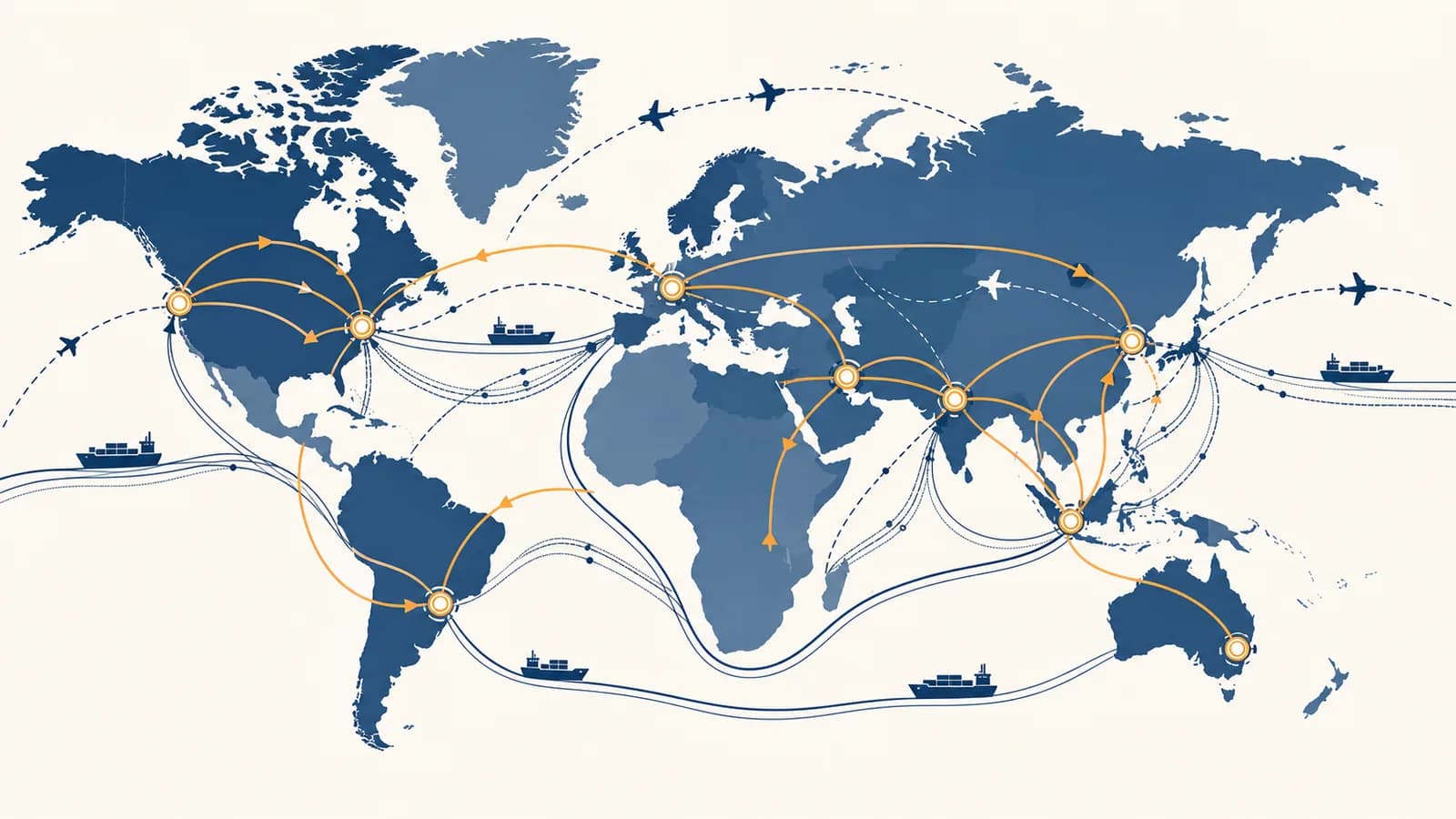
Globalization is a geographic process that links places through growing flows of goods, services, money, people, information, and culture, in the context of an interconnected world economy and society. A clear globalization definition must explain how distant decisions become local effects. Globalization in geography exists because people, firms, and governments gain advantages by exchanging resources, skills, ideas, and products across borders, even though those exchanges also create costs and unequal power. It works through transport routes, digital communication, trade rules, migration, finance, and organizations that coordinate activity across several countries.
A phone gives the process a physical shape. Its minerals may be mined in several countries, its chips designed somewhere else, its parts assembled near a major port, and its software maintained by teams spread across time zones. Money, technical instructions, components, and legal responsibility move along different routes. The finished phone looks like one object, but it records a network of places.
A useful geographic rule: globalization changes distance from a fixed obstacle into a cost that technology, organization, and power can reduce.
What globalization actually is
Globalization is the increasing connection and interdependence of places at a worldwide scale. Connection means that flows cross borders; interdependence means that a change in one place can alter jobs, prices, choices, or environments somewhere else.
The word describes a process, not a single event and not a claim that every place is becoming identical. A country can trade more with the world while protecting parts of its culture. A firm can operate globally while most of its workers and customers remain in a few regions. A family can use a global messaging service and still depend on a local school, road, and water supply.
Geographers study globalization by asking four linked questions. What is moving? Along which route? Who controls the movement? Where do the benefits and costs arrive? These questions turn a vague idea about a connected planet into evidence that can be mapped and compared.
- Flows: goods, money, people, data, and ideas that move.
- Networks: routes and connections that carry those flows.
- Nodes: ports, cities, firms, and platforms where flows meet.
- Power: the ability to set terms, collect gains, or shift costs.
Scale matters. A local bakery buying imported cocoa participates in a global commodity chain, but its sales may remain local. A streaming platform can distribute the same program in many countries, yet licensing rules and language preferences divide its market. Globalization therefore connects scales rather than erasing them. Household choices link to company strategies, national laws, and worldwide networks.
How globalization works
Globalization works when lower movement costs, shared rules, and coordinating organizations make long distance exchange practical. A flow begins at an origin, passes through a network and its checkpoints, and reaches a destination where it produces new economic, social, or environmental effects.
Places differ in wages, skills, resources, laws, demand, climate, and access to capital. A firm or person sees a possible gain in connecting those differences.
Ships, aircraft, roads, cables, banks, payment systems, and media platforms move the product, person, payment, or message.
Contracts, product standards, customs procedures, visas, taxes, and data rules decide what may cross a border and on what terms.
Companies, governments, unions, aid groups, and international bodies schedule work, settle disputes, share information, and manage risk.
A new order can create factory shifts, port traffic, tax revenue, energy use, and waste. A delay can spread through the same network in reverse.
Consider a shop that orders 600 shirts from an overseas supplier. Each shirt costs 8 units of currency at the factory. Sea freight, insurance, customs charges, inland transport, and storage add 3 units per shirt. The shop's landed cost is therefore currency units. The low factory price alone does not determine the decision. The complete route and every border cost matter.
Worked example: 8 + 1.40 + 0.20 + 0.80 + 0.60 = 11 currency units per shirt.
Time is also a cost. A slower shipment ties up money in goods that cannot yet be sold. A missed connection may leave a factory without one small component, stopping production of a much more valuable item. The study of how transport routes connect places explains why a canal, rail terminal, airport, or narrow strait can influence activity far beyond its immediate area.
Global networks carry material flows such as food and machinery, human flows such as workers and tourists, and less visible flows such as payments, designs, entertainment, and instructions. These flows often travel together, but they face different speeds and controls.
Goods move through supply chains
A supply chain is the sequence of places and tasks used to make and deliver a product. Raw materials travel to processors, parts travel to assembly plants, and finished goods travel through warehouses to buyers. Each stage can be placed where a company finds useful skills, suitable infrastructure, acceptable risk, or lower total cost.
This division of production is called a global division of labor. It does not mean that one country simply makes an entire category of goods. A country, region, or city may specialize in one narrow stage, such as chip design, fabric dyeing, accounting, or container handling. The most profitable stages are not always the stages employing the most people.
Services and money can cross borders without a shipment
A service is an activity provided for a customer. Software support, insurance, design, tutoring, and payroll processing can be supplied across borders through digital networks. Financial flows include investment, loans, payments for trade, and money sent home by migrants. These movements can change faster than factories or ports because electronic instructions travel quickly.
People move, but their rights do not move automatically
Migration, tourism, study, and business travel connect labor markets and households. A migrant may earn income in one country, care for relatives in another, and communicate daily through a platform based in a third. Borders remain powerful because passports, visas, qualifications, and employment law decide who can enter and what that person may do.
Movement is selective. Money may cross a border in seconds while a worker waits for permission. A product may receive tariff free access while the people who made it cannot visit its buyers. The geography of why people move and where they settle helps reveal this difference between connected markets and controlled mobility.
Ideas travel by copying and adaptation
Music, recipes, religious practices, scientific findings, slang, fashion, and political arguments circulate through people and media. They rarely arrive unchanged. Audiences translate, remix, reject, or combine them with existing practices. Cultural globalization is therefore a process of diffusion and adaptation, not a machine that produces one uniform culture.
Globalization versus international trade
International trade is the buying and selling of goods and services across national borders, while globalization is the wider process that connects production, finance, culture, communication, politics, and people. Trade is one mechanism of globalization, but the two terms are not interchangeable.
A coffee importer buys beans from a producer in another country. The main evidence is an exchange across a border, recorded as an import and an export.
The beans, investment, shipping data, certification rules, brand image, migrant knowledge, and café culture connect many places through several kinds of flow.
A place can trade internationally without being deeply integrated into every global network. A government might export one mineral while restricting foreign media, investment, or migration. Another economy may host globally connected design and financial services even though fewer physical goods cross its border. The kind and depth of connection matter more than a simple yes or no label.
Globalization also differs from westernization. Westernization means the adoption of practices associated with western Europe or North America. Some global flows have spread western brands and institutions, but influence runs in many directions. Foods, films, technologies, and social practices originating elsewhere also reach worldwide audiences. Treating every cross-border influence as westernization hides those routes.
How distance, technology, and borders shape globalization
Distance still affects cost, time, trust, and environmental impact, but technology and infrastructure change how strongly it affects each flow. Borders also filter connections through law, so globalization reorganizes geographic barriers rather than making location irrelevant.
Geographers sometimes describe time space compression, the feeling and practical effect that travel and communication make distant places seem closer. A live video call reduces communication time, but it does not move medicine, grain, or a repair technician. Container shipping makes standardized cargo easier to transfer between ship, rail, and truck, but the cargo still needs ports, fuel, labor, security, and time.
Digital does not mean placeless. A video, payment, or message depends on data centers, undersea and land cables, electricity grids, software, devices, and laws in specific territories.
Some places have stronger connections because they are accessible and well equipped. Deep water ports, reliable electricity, skilled workers, finance, and predictable institutions attract network activity. Once a place becomes a busy node, firms may cluster nearby to reach suppliers and customers. This can reinforce its position, while places outside the main routes receive fewer opportunities.
Borders act as filters rather than solid walls. Customs officers inspect goods, immigration agencies assess people, financial regulators monitor payments, and governments can block data or require local storage. A border may be open to tourists but restrictive toward workers. It may welcome foreign investment in manufacturing while limiting it in broadcasting or defense.
How globalization creates gains and unequal outcomes
Globalization can expand markets, spread knowledge, lower some costs, and widen consumer choice, but its gains and losses are distributed unevenly. Bargaining power, ownership, skills, location, law, and the ability to absorb risk shape who benefits from each connection.
Specialization can raise output when places concentrate on tasks they perform at lower opportunity cost and exchange the results. Competition can push firms to improve products or cut prices. Larger markets can support expensive research or highly specialized services. Migrants can gain access to jobs and send part of their income to households elsewhere. Researchers can share findings across borders.
None of those mechanisms guarantees a fair outcome. A firm that owns a brand, patent, platform, or retail network may capture more value than a supplier facing many competitors. Workers may gain jobs but have little ability to bargain over wages or safety. Consumers may receive low prices while pollution remains near a distant mine, factory, or disposal site.
A clothing brand can switch orders between several factories, but a factory town cannot quickly replace its main customer. That difference in options gives the brand greater bargaining power. A low retail price may therefore reflect efficient production, weak wages, environmental damage, or some combination. The price tag alone cannot tell you which mechanism is operating.
Risk also travels through networks. A crop disease can affect food processors abroad. A financial failure can make lenders in other countries cautious. A factory closure can remove orders from suppliers and income from workers' families. Networks spread opportunity because they connect places, and they spread disruption for the same reason.
Uneven development means that economic activity and living conditions differ across space. Globalization can reduce some gaps when investment, skills, and infrastructure spread. It can widen others when valuable functions concentrate in already connected cities or when profits leave the production region. The relevant question is not whether globalization is simply good or bad. The better question identifies a flow, a group, a place, a time period, and an outcome.
How globalization shows up in jobs, prices, and daily decisions
Globalization appears in workplaces, shopping baskets, news alerts, entertainment, and household budgets whenever a distant input or decision changes a local option. Tracing origin, ownership, route, labor, and rules reveals the connection behind an ordinary product or service.
Jobs are connected through tasks, not only finished products
A local engineer may design a component made abroad. A warehouse worker may handle imported goods using software maintained in another country. A nurse may use equipment containing globally sourced parts. An accountant may serve clients across borders. In each case, the job belongs to a network of tasks whose locations can change separately.
Firms choose locations using more than wage differences. They consider worker skills, supplier access, electricity, political risk, taxes, delivery time, language, and the protection of contracts and intellectual property. Moving a task to a lower wage location can save money, but only if coordination and transport do not erase the saving.
Prices contain a chain of geographic events
The shelf price of imported fruit may reflect weather in the growing region, fuel costs, exchange rates, port delays, seasonal demand, and border inspections. A stronger currency can make imports cheaper for domestic buyers, while a weaker one can raise their local price. Retail competition then affects how much of any cost change reaches the customer.
Suppose a retailer pays 20 foreign currency units for a product. At an exchange rate of 2 foreign units per domestic unit, the product costs 10 domestic units before shipping. If the rate changes to 1.6 foreign units per domestic unit, the same foreign price costs domestic units. The product did not change, but the financial connection did.
Media choices connect culture and commercial power
A video platform can introduce viewers to creators across the planet, but its recommendation system decides which material receives attention. Translation, advertising rules, copyright, and local taste shape what travels. The page on how culture forms and changes across places gives the tools to separate cultural exchange, cultural adaptation, and cultural dominance.
News becomes geographic evidence
A report about a blocked port, new tariff, drought, data restriction, labor dispute, or currency movement often describes one part of a global network. To read it geographically, locate the affected node, trace incoming and outgoing flows, identify alternatives, and ask which places have enough power or capacity to adjust.
A useful label check: Country of origin may identify where final assembly occurred, not where every material, component, design, or payment originated.
How governments and organizations govern globalization
Globalization is governed through national laws, treaties, standards, contracts, and institutional decisions that permit, restrict, or redirect cross-border flows. Markets operate inside these rules; they do not create a borderless system outside government authority.
Governments use tariffs, which are taxes on imports, and quotas, which limit import quantities. They inspect food and medicines, define product safety, issue visas, tax profits, protect or limit foreign ownership, and regulate the movement of data. Central banks and financial regulators influence international payments and capital flows. Local governments shape ports, industrial land, housing, roads, and waste management.
Trade agreements can reduce tariffs and establish shared procedures. International organizations provide forums where governments negotiate rules, coordinate technical standards, finance projects, or respond to problems that cross borders. Private organizations also govern flows. A shipping company chooses routes, a bank decides which payment to process, a certification body sets conditions for a label, and a digital platform enforces its terms of service.
Power comes from the ability to set rules or avoid their costs. A large market may persuade suppliers to meet its standards because access is valuable. A dominant buyer may demand lower prices. A country controlling a strategic resource or route may gain influence. Workers, consumer groups, journalists, and campaigners can also alter behavior by exposing conditions, organizing pressure, or demanding legal change.
Territory remains central because governments have authority within bounded areas. Disputes about sanctions, trade, migration, resources, and data show how territory and power organize the world. Global connection can limit a government's options, but it can also give governments new tools and partners.
3 mistakes people make with globalization
Three common mistakes are treating globalization as uniform, assuming every connection benefits everyone, and claiming that distance or governments no longer matter. Each mistake hides the routes, rules, and power differences that explain actual geographic outcomes.
1. Assuming the whole world is equally connected
Globalization is spatially uneven. Major cities, ports, financial centers, production districts, and cable landing points often have dense connections. Rural areas, conflict zones, landlocked regions, or neighborhoods without reliable infrastructure may have fewer or more expensive links. Even within one city, a corporate office and a household without stable internet experience very different forms of global access.
A map of connections would not look like an even web. It would show busy corridors, powerful nodes, weak links, and gaps. It should also distinguish the direction and type of flow. A place that exports raw materials but imports expensive finished products occupies a different position from a place that controls design, finance, and marketing.
2. Counting total gains while ignoring distribution
A policy or investment can increase total income while leaving some groups worse off. Imported goods may become cheaper, but workers in a competing industry may lose jobs. A new export mine may bring tax revenue and wages while creating pollution or displacing other land uses. A proper account identifies benefits, costs, affected groups, and time horizons.
Trade increased, so everyone benefited.
Trade lowered this product's price, raised orders for these firms, reduced demand for these workers, and changed tax and environmental costs in named places.
3. Declaring the end of distance and the state
Fast communication does not remove shipping time, time zones, language, law, trust, or physical geography. Governments still control visas, customs, taxation, legal enforcement, infrastructure, and many communication rules. A disruption makes these facts visible, but they operate during ordinary times as well.
The correction is simple: follow the flow. Name its physical or digital route, the border decisions it encounters, the organization directing it, and the people able to stop or redirect it. If an explanation cannot identify those parts, it is probably using globalization as a vague substitute for a mechanism.
Is globalization new or reversing?
Long distance exchange is ancient, but globalization has changed in speed, scale, reach, and organization. Periods of stronger integration can be followed by war, depression, restrictions, or regional restructuring, so globalization is neither entirely new nor a one way historical trend.
Trade routes linked distant societies long before modern states and corporations. Later developments changed the capacity of those links. Steam transport and telegraphy reduced travel and communication times. Industrial production increased the volume of goods seeking markets and inputs. Aviation, container shipping, satellites, computing, and the internet changed which tasks could be coordinated across long distances.
Columbus's voyage was followed by conquest, forced labor, settlement, disease exchange, and transfers of crops and animals between continents. These connections transformed populations and environments.
The canal created a shorter sea route between the Mediterranean and the Red Sea, changing the geography of shipping between Europe and Asia.
The voyage of the converted ship Ideal X is widely used to mark the start of modern container shipping, which standardized cargo handling across transport modes.
The organization provided a formal system for trade negotiations and disputes among its members.
Claims that globalization is reversing need a named indicator. A fall in one country's imports does not prove that migration, data flows, tourism, or cultural exchange are all shrinking. Firms may shorten supply chains, use more than one supplier, or concentrate trade within regions. This is reconfiguration if connections change shape, and deglobalization only if meaningful cross-border integration actually declines.
Does globalization erase local culture?
Globalization can spread dominant languages, brands, and media formats, but it does not automatically erase local culture. People select and adapt outside influences, while families, schools, religious groups, businesses, and governments reproduce or reshape local practices.
Homogenization occurs when places become more alike, perhaps by hosting similar shops, using the same software, or consuming the same entertainment. Hybridization occurs when an outside form combines with local ingredients, language, values, or style. Resistance occurs when people reject, regulate, or deliberately preserve alternatives. All three responses can happen in the same place.
Scale changes the answer. A globally recognized music format may contain local lyrics and political references. A restaurant chain may use a common brand while changing its menu for religious rules or regional tastes. A minority language may lose speakers in daily life while gaining new digital teaching materials and contact among speakers living far apart.
Instead of asking only whether a foreign influence arrived, ask who chose it, who distributed it, how people altered it, what existing practice changed, and which group had the power to define the result as fashionable, normal, or authentic.
Can globalization be made fairer and more sustainable?
Globalization can be governed toward fairer and less damaging outcomes by changing labor rules, environmental standards, taxes, contracts, disclosure, and access to infrastructure. Success depends on enforcement and on who participates in setting the rules, not on labels alone.
Labor law can set minimum conditions and protect organizing. Buyers can use longer contracts and purchasing schedules that do not push impossible costs onto suppliers. Environmental rules can require cleaner production, producer responsibility, or proof that sensitive materials were sourced legally. Tax cooperation can make it harder to move reported profits away from the places where activity occurs.
Consumers have some influence through purchases and public pressure, but they rarely possess complete information. A certification mark may cover one stage or one standard while saying nothing about the rest of a product. Governments and firms can improve traceability, yet records require checking. Responsibility therefore belongs to institutions and producers as well as individual shoppers.
Resilience is another goal. A resilient network continues essential functions or recovers when disrupted. Firms and governments may hold emergency stocks, use multiple suppliers, maintain spare capacity, or design substitute routes. Each choice has a cost. The cheapest network during normal conditions may not be the least costly after a failure.
Worked example: a 0.10 probability of a 50,000 unit loss gives an expected disruption cost of 5,000 units.
The arithmetic does not settle ethical questions, and an estimated probability may be uncertain. It does show why a manager might pay more for backup supply. Public decisions must also account for costs that market prices may omit, such as air pollution, insecure work, habitat loss, or dependence on a single provider.
The takeaway: A fair judgment about globalization names the flow, maps the network, checks the rules, and compares how benefits, costs, and risks are distributed across places and people.
Globalization makes geography visible in every connection
Globalization shows why geography is the study of relationships between places, environments, economies, and power, not a list of locations. Every global flow has an origin, route, destination, governing rule, and uneven effect that can be investigated.
Take one object you used today and trace it. Read its label, identify likely materials, locate final assembly, find the company that owns the brand, and sketch the transport route to your area. Then ask where the largest payment went, where labor was performed, where environmental costs remained, and which border rules shaped the trip. Uncertainty is part of the finding because opaque supply chains are themselves a feature of power.
Next time a news report blames globalization for a price rise, job loss, cultural change, or political dispute, replace the broad word with a specific mechanism. Look for a shipment, investment, migration rule, data platform, currency change, corporate decision, or treaty. Compare that event with the wider set of geography explanations about people and places, and notice how physical distance, human choices, and territorial power operate together.