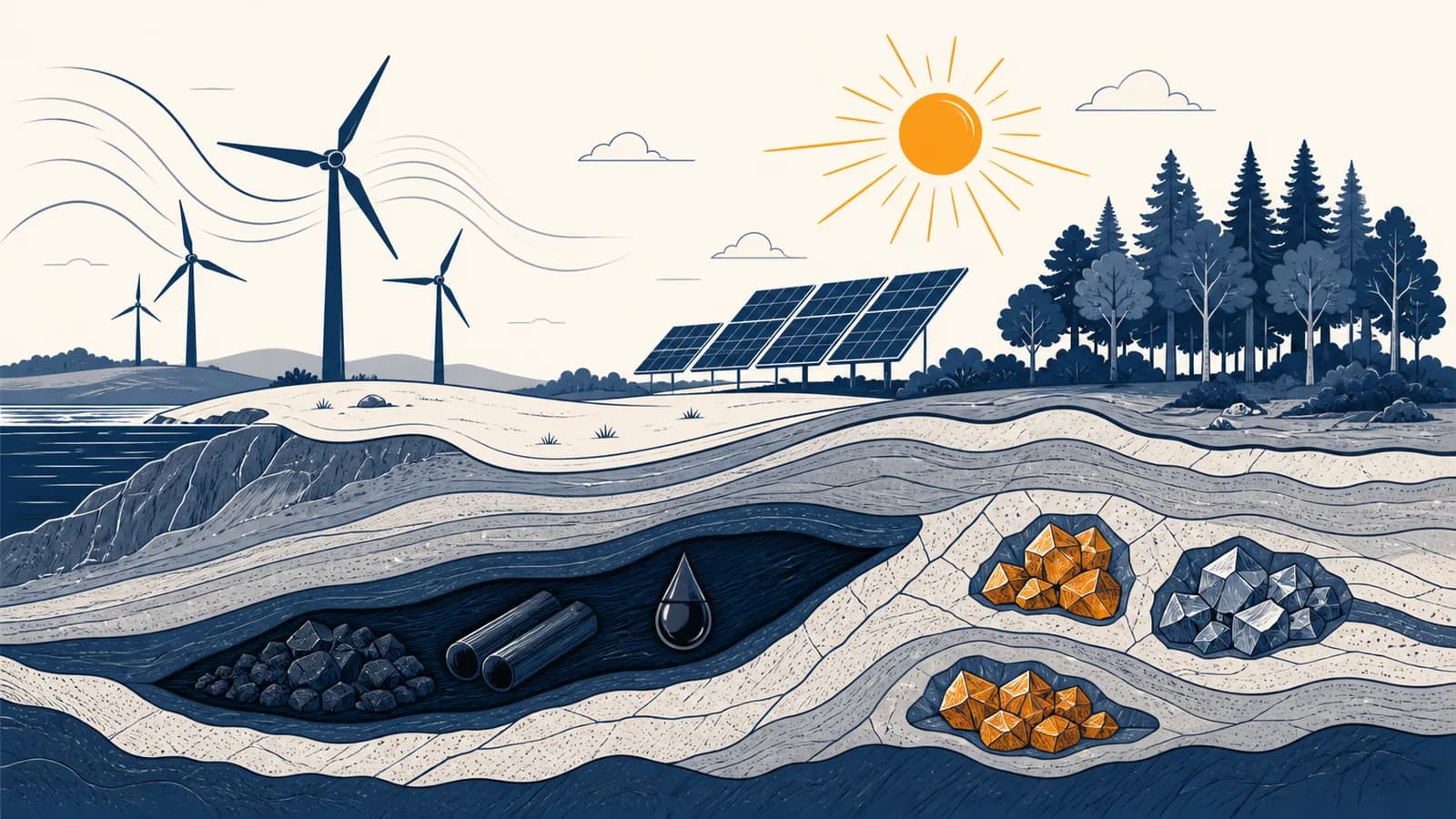
The distinction between renewable and non-renewable resources is a geographic classification that separates natural materials and energy sources by how quickly nature replaces them after people use them, in the study of resource use. Renewable resources, such as sunlight, wind, flowing water, timber, and some biomass, can return on a human timescale if use does not outrun renewal. Non-renewable resources, including coal, oil, natural gas, and metal ores, form so slowly or exist in such fixed deposits that each extraction reduces the amount left. The distinction exists because societies need to judge how long supplies can last and what their use changes.
What renewable and non-renewable resources actually are
A renewable resource is replenished by an active natural process within a useful human timescale, while a non-renewable resource is consumed much faster than geological processes can replace it. The classification concerns the rate of renewal, not simply whether something comes from nature.
Sunlight reaches Earth continuously, winds are regenerated by uneven solar heating and planetary rotation, and rivers are refilled through the water cycle. These are renewable flows. Forests, fish populations, and fertile soil can also renew, but only while harvesting and damage stay within the systems' capacity to recover.
Coal, petroleum, and natural gas formed from ancient organic matter altered by heat and pressure over geological time. A coal seam does not regrow after a mine removes it. Metal ores are also non-renewable because Earth contains finite concentrations that can be mined economically. Metals differ from fossil fuels, however, because copper or aluminium can be recovered and used again, while burned fuel cannot be unburned.
Renewable does not mean unlimited. A forest is renewable only if regrowth and ecological repair keep pace with cutting, fire, disease, and soil loss.
The useful test is a comparison between two rates: the rate at which people remove or degrade a resource, and the rate at which natural systems restore it. This same rate comparison explains many pressures described in how ecosystems and biomes function, because a resource can disappear locally even when it still exists elsewhere.
How geographers classify a resource
Geographers classify a resource by identifying its physical stock or flow, measuring the process and timescale of replacement, locating its deposits or supply, and examining the rate of human use. The answer can change with location, technology, and management.
Name the material or energy flow precisely. A wooden chair uses timber, but making it also uses land, water, transport fuel, and electricity.
Ask what puts the resource back. Rainfall refills a reservoir, tree growth replaces timber, and geological processes create new mineral deposits.
Days, seasons, and decades can matter to people making plans. Processes lasting millions of years do not replace what a present population extracts.
A theoretically renewable stock becomes depleted if withdrawal remains greater than replenishment.
Classification is therefore conditional for many resources. Groundwater in a shallow aquifer may be replenished each wet season. Water in a deep fossil aquifer may have accumulated under a past climate and receive almost no present recharge. Both are groundwater, but one can behave like a renewable flow and the other like a mined stock.
If a woodland grows 800 cubic metres of usable timber in a year and harvesting removes 600 cubic metres, its measured timber stock rises by 200 cubic metres, before allowing for fire, disease, and other losses.
Access also matters. A mineral may be physically present but too dispersed, deep, or remote to extract with available equipment at an acceptable cost. A resource is not just matter in the ground. It is matter that people know how to find, can reach, and have a reason to use. New surveys, prices, and technology can turn a known occurrence into a reserve that can be extracted under current conditions.
Renewable resources versus sustainable resource use
Renewability describes a natural replacement process, while sustainability describes whether a pattern of use can continue without exhausting its resource base or causing unacceptable damage. A renewable resource can be used unsustainably, and a non-renewable resource can be managed more carefully.
The resource has a mechanism that replenishes it on a human timescale. This is a property of the resource and its environmental setting.
The rate and method of use can persist while protecting future supply and the wider system. This is a property of human decisions.
Consider a fishing ground. Fish reproduce, so the population is renewable. If boats catch breeding adults faster than surviving fish can replace them, the population shrinks. Damage to seabed habitat can slow recovery further. The resource did not stop being biologically renewable, but its use became unsustainable.
The reverse distinction also matters. No system can make iron ore renewable on a human timescale. Yet a steel beam can remain in a building for decades, then be recovered and melted into another product. Longer product life, repair, efficient design, and recycling reduce the rate at which new ore must be mined. They manage scarcity without changing the ore's classification.
Sustainability must also include side effects. A dam uses renewable river flow, but it can block fish migration, trap sediment, flood habitats, and change water availability downstream. A decision about energy supply is simultaneously a decision about land and how water resources are stored and shared.
How resource stocks and flows work
A stock is an accumulated quantity that can be drawn down, while a flow is a quantity arriving during a period of time. Resource security depends on both: a large stock provides a buffer, but a reliable flow determines how quickly it can recover.
A reservoir makes the distinction visible. Rain and river inflow are flows measured over time. The water behind the dam is a stock measured at a moment. During a dry month, households and farms may withdraw more water than enters, so storage falls. A later wet month may refill it. Calling water renewable does not guarantee that every reservoir is full whenever demand rises.
Non-renewable resources usually begin as geological stocks. Extraction transfers material from a concentrated underground deposit into the economy. Fuel then becomes combustion gases and other products. Minerals enter buildings, vehicles, electronics, landfill, or recycling systems. The original deposit becomes smaller in every case.
The arithmetic shows why the words per month matter. The stock falls by 50 units because withdrawal exceeds inflow by that amount. Continue the same imbalance and the buffer keeps shrinking. Real managers must add evaporation, leakage, ecological releases, uncertain rainfall, and changing demand, but the stock and flow logic remains the same.
How renewable energy becomes usable power
Renewable energy systems capture a continuing environmental flow, convert it into electricity or heat, and deliver it when people need it. Their main geographic problem is matching variable supply at particular places with demand across time and distance.
Solar panels convert light directly into electric current through semiconductor cells. Wind turbines use moving air to turn a rotor connected to a generator. Hydroelectric stations release water from a height through turbines. Geothermal systems draw heat from underground, while biomass systems release stored chemical energy through combustion or biological processing.
Each source follows a conversion chain:
Location affects every chain. Strong, steady winds improve turbine output. Solar generation varies with cloud, season, latitude, shading, and panel direction. Hydroelectricity needs suitable relief and dependable water. Geothermal power is easiest where accessible hot rock or hot water can be developed. Maps of physical conditions therefore guide investment long before construction begins.
A community uses 100 units of electricity during an evening. Its wind turbines provide 55 units, a battery releases 25 units stored earlier, and a connection to a neighbouring region supplies 20 units. The balance is checkable: 55 + 25 + 20 = 100. The mix meets demand even though local wind alone does not.
Variability is managed through several tools. Grids connect places experiencing different weather. Storage shifts energy between times, as batteries store electricity and pumped storage moves water uphill for later release. Flexible demand moves some tasks to hours of greater supply. Dispatchable sources can increase output when needed. A diverse system reduces dependence on one weather pattern or one piece of equipment.
How non-renewable resources move from deposit to use
Non-renewable resources become useful through exploration, extraction, processing, transport, and consumption or manufacture. Every stage needs energy and infrastructure, produces costs and waste, and links a fixed deposit to distant households, factories, and markets.
Exploration begins with geological evidence. Rock type, structure, fossils, magnetic patterns, gravity measurements, and test drilling help locate deposits. A company then estimates grade, size, depth, accessibility, and market conditions. A rich deposit can remain unused if it lies under difficult terrain, far from transport, or in a protected area.
- Extraction removes coal, ore, oil, or gas by mining, quarrying, drilling, or pumping.
- Processing separates the useful material. Crude oil is refined into products, while crushed ore is concentrated and smelted to obtain metal.
- Transport moves bulk materials through pipelines, ports, railways, roads, and electricity networks.
- Use releases energy from fuels or incorporates minerals into products and structures.
- After use sends material toward reuse, recycling, treatment, storage, or disposal.
Energy return and ore grade affect the chain. A concentrated, accessible deposit usually requires less material movement and processing than a deeper or lower grade deposit. As easy deposits are exhausted, producers may need more machinery, water, and energy for each useful tonne. The resource has not vanished, but the effort needed to obtain it has changed.
A reserve is not every atom in the ground. It is the identified portion that can be extracted under stated technical, economic, legal, and social conditions. Those conditions can change.
Combustion creates a one-way material change. Carbon in coal, oil, or natural gas combines mainly with oxygen and moves into the atmosphere as carbon dioxide, along with other products that depend on the fuel and combustion conditions. Fossil carbon accumulated underground over geological time, but burning can release it quickly. This mismatch between slow formation and rapid use is both a depletion issue and a climate issue.
How resources show up in jobs, prices, and public decisions
Resource categories shape practical choices in engineering, farming, finance, planning, conservation, and public policy. People use maps, measurements, forecasts, prices, and environmental evidence to decide where supply should come from and what risks a project creates.
Energy planners match supply to demand
An energy planner must know when people need power, where generating sites are possible, and how electricity can travel between them. A cheap source in a remote region may require a new transmission line. A variable source may need storage, flexible demand, or backup capacity. The relevant question is the performance of the whole system, not the name of one generator.
Farmers manage renewable stocks
A farmer works with soil moisture, groundwater, nutrients, biomass, and sunlight. Crops renew each season, but repeated harvest removes nutrients. Bare ground can lose topsoil faster than soil-forming processes replace it. Crop rotation, cover crops, organic matter, careful irrigation, and erosion control protect the productive stock behind the harvest. The connection between geology, climate, and farm practice is developed further in the guide to soil types and agricultural use.
Mining and manufacturing connect distant places
A phone or electric motor contains materials extracted from specific deposits, processed in industrial plants, assembled through supply chains, and transported to buyers. Disruption at a mine, refinery, port, or border can affect factories far away. Manufacturers respond through alternative suppliers, smaller material requirements, product redesign, recycling, and inventories.
Governments balance competing claims
A proposed mine may provide materials, wages, tax revenue, and infrastructure. It may also displace land uses, create waste rock, alter water quality, and leave a site that needs care after closure. Planning authorities examine these effects, set conditions, monitor compliance, and decide whose evidence and rights count. The decision is geographic because benefits and harms fall on different places and groups.
| Decision | Evidence needed | Question being answered |
|---|---|---|
| Site a wind farm | Wind records, habitats, settlements, grid access | Can this place produce and transmit power with acceptable effects? |
| Set a timber harvest | Growth, age structure, soil, fire risk, habitat | How much can be cut while the forest system recovers? |
| Approve a mine | Ore body, water, waste, transport, community claims | Do the expected benefits justify the costs and risks? |
| Plan water use | Recharge, storage, drought, demand, river ecology | Can withdrawals continue through dry periods? |
How resource choices show up in daily life
Daily resource use is embedded in electricity, heating, transport, food, buildings, and manufactured goods. A useful choice considers the material's source, the energy used across its life, how long the product serves, and what happens after disposal.
An electricity bill may show how much power a household used, but not every physical process behind it. The generating mix can change hour by hour. Turning on a kettle increases demand now, so the relevant supply is the system able to respond at that time. Rooftop solar changes midday flows, while insulation reduces heating demand across many hours.
Products hide their resource geography. Aluminium begins with bauxite ore and requires mining, refining, smelting, fabrication, and transport. Timber begins in a managed or unmanaged forest. Plastic usually begins with fossil feedstock. A label such as recyclable describes a technical possibility, but actual recovery also requires collection, sorting, suitable facilities, and a market for the recovered material.
Two appliances provide the same service. One uses fewer kilowatt-hours each year but is difficult to repair; the other uses slightly more electricity but lasts longer and has replaceable parts. Comparing only annual electricity misses the materials and manufacturing required for replacement. Comparing only lifespan misses energy use. The better choice depends on both.
The most direct household actions often reduce throughput: use less energy for the same comfort, keep equipment working longer, share rarely used tools, avoid unnecessary trips, and sort materials according to the local collection system. These actions do not make every non-renewable resource renewable. They slow extraction and reduce waste while larger infrastructure decisions determine what options households have.
Five mistakes people make with renewable resources
The most common mistakes treat renewable as a guarantee of endless supply, zero pollution, constant availability, or equal suitability everywhere. Correct analysis asks about rates, locations, conversion equipment, ecological effects, and the complete system that delivers a useful service.
1. Renewable means it cannot run out
A renewable resource can be locally depleted. Pump groundwater faster than recharge, cut trees faster than regrowth, or catch fish faster than reproduction, and the accessible stock falls. Renewal is a process with a rate, not a promise.
2. Renewable energy has no environmental cost
Wind turbines, solar panels, dams, cables, batteries, and access roads require land and materials. Their construction and disposal have effects. The fair comparison is among complete systems providing the same service, including their emissions, land use, water use, habitat effects, reliability, and material demands.
3. A resource has the same status everywhere
Rainfall may renew one aquifer while another receives negligible recharge. A tree species may regrow quickly in one climate and slowly in another. Strong sunlight does not by itself create a useful solar site if terrain, grid access, regulation, or seasonal demand makes development difficult.
4. Installed capacity equals energy produced
Capacity is the maximum rate a generator can deliver under specified conditions. Energy is output accumulated over time. A 10 kilowatt system operating at full output for 3 hours produces 30 kilowatt-hours. Weather, maintenance, night, water availability, and grid limits can keep actual output below the capacity rating.
A turbine delivering 2 megawatts for 4 hours supplies 8 megawatt-hours during that period.
5. Recycling removes the need for extraction
Recycling reduces demand for newly mined material, but collection is incomplete, processing causes losses, products remain in use for different lengths of time, and total demand can grow. Recovered material is valuable, yet new extraction may still be needed to expand stocks and replace losses.
Is biomass always renewable?
Biomass is renewable only when biological growth replaces the harvested material and the supporting soil, water, habitat, and nutrient systems remain productive. Its climate effect also depends on what is grown, what is displaced, how it is processed, and how quickly regrowth occurs.
Biomass includes wood, crop residues, energy crops, food waste, and some other biological materials. Plants take carbon dioxide from the air as they grow. Burning biomass returns carbon to the atmosphere, but this does not make every biomass system automatically carbon neutral. Cutting a mature forest releases stored carbon quickly, while replacement trees need time to grow. Soil disturbance and processing energy add further effects.
Waste material can present a different case. Using genuine residues may recover energy from material that would otherwise decay or be discarded, but residues can already have ecological or agricultural functions. Straw may protect soil, and dead wood may provide habitat. The analysis must identify the previous fate of the material rather than assuming it had no other value.
Harvest stays within regrowth, land use does not displace high-carbon habitat or food production, soils remain productive, and processing and transport demands are controlled.
Harvest reduces long-lived carbon stocks, regrowth is slow or uncertain, soil is degraded, or the crop displaces another activity into sensitive land.
Biomass therefore sits at the boundary between a simple category and a management problem. The fuel may grow again, yet the same project can be renewable by a narrow definition and damaging when land, time, and ecosystem changes are counted.
Can a non-renewable resource be recycled?
Many non-renewable minerals can be recycled because their useful atoms remain after a product is discarded, but fossil fuels cannot be recycled after combustion in the same way. Recycling conserves a finite stock without recreating the original geological deposit.
Metals are especially suited to repeated recovery because they can be separated and remelted, although each cycle still needs collection, sorting, energy, and control of contamination. Glass can also be remelted. Some plastics can be mechanically or chemically processed, but mixed materials, additives, dirt, and degraded properties can limit the next use.
A circular material flow aims to keep products and materials useful through maintenance, repair, reuse, remanufacture, and recycling. The order matters. Keeping a working machine often preserves more of its manufacturing effort than crushing it immediately for raw material. Good product design makes parts accessible, materials identifiable, and disassembly practical.
Even a highly circular system needs inputs. Some material is lost through wear, corrosion, breakage, poor collection, and processing. Growing demand also requires more material before old products return for recovery. Recycling changes the depletion rate and the location of supply; it does not turn a finite ore body into a renewable flow.
What happens when a resource becomes scarce?
Resource scarcity occurs when available supply cannot meet demand at an acceptable economic, social, or environmental cost. It can result from physical depletion, blocked access, damaged ecosystems, weak infrastructure, political conflict, sudden demand, or unequal control rather than complete global exhaustion.
Prices often rise when buyers compete for limited supply, but price is only one signal. Households with low incomes may lose access before wealthier users reduce consumption. Governments may ration essential supplies, release stored reserves, limit exports, subsidise alternatives, or invest in new infrastructure. Companies may redesign products, seek other suppliers, or substitute a different material.
Scarcity can be temporary. A storm may close a port, a drought may cut hydropower output, or transmission damage may isolate generators. It can also be structural, as when groundwater withdrawal repeatedly exceeds recharge or an ore becomes progressively harder to extract. The response should match the cause.
Physical geography helps explain exposure. Drought risk follows climate and catchment conditions. Mineral supply follows geology. Renewable power potential follows wind, sunlight, water, and heat. Human geography then explains infrastructure, ownership, trade, law, demand, and inequality. Scarcity emerges where these systems meet.
Resource geography connects physical systems with human choices
Renewable and non-renewable resources connect Earth's physical processes with decisions about settlement, industry, trade, technology, and fairness. Reading a resource map well means asking what renews the supply, who can reach it, how fast it is used, and where the effects fall.
No resource category gives a complete verdict. Renewable sunlight still needs land, equipment, networks, and timing. Non-renewable copper is finite but can circulate through many products. Water renews through the hydrological cycle but can become scarce in a dry basin. The classification starts the analysis; rates, systems, and places complete it.
The takeaway: For any resource, identify the stock or flow, compare withdrawal with replacement, trace the conversion and transport chain, and examine effects beyond the place of use. Those four moves reveal more than a green or fossil label.
Notice the next resource decision around you: a planning notice, power bill, fuel price, recycling label, water restriction, or product repair. Trace it backward to the climate, rock, soil, water, and living systems that supply it, then forward to its waste and recovery route. That habit connects this topic to the wider study of physical and human geography and turns a simple classification into a way of reading places.