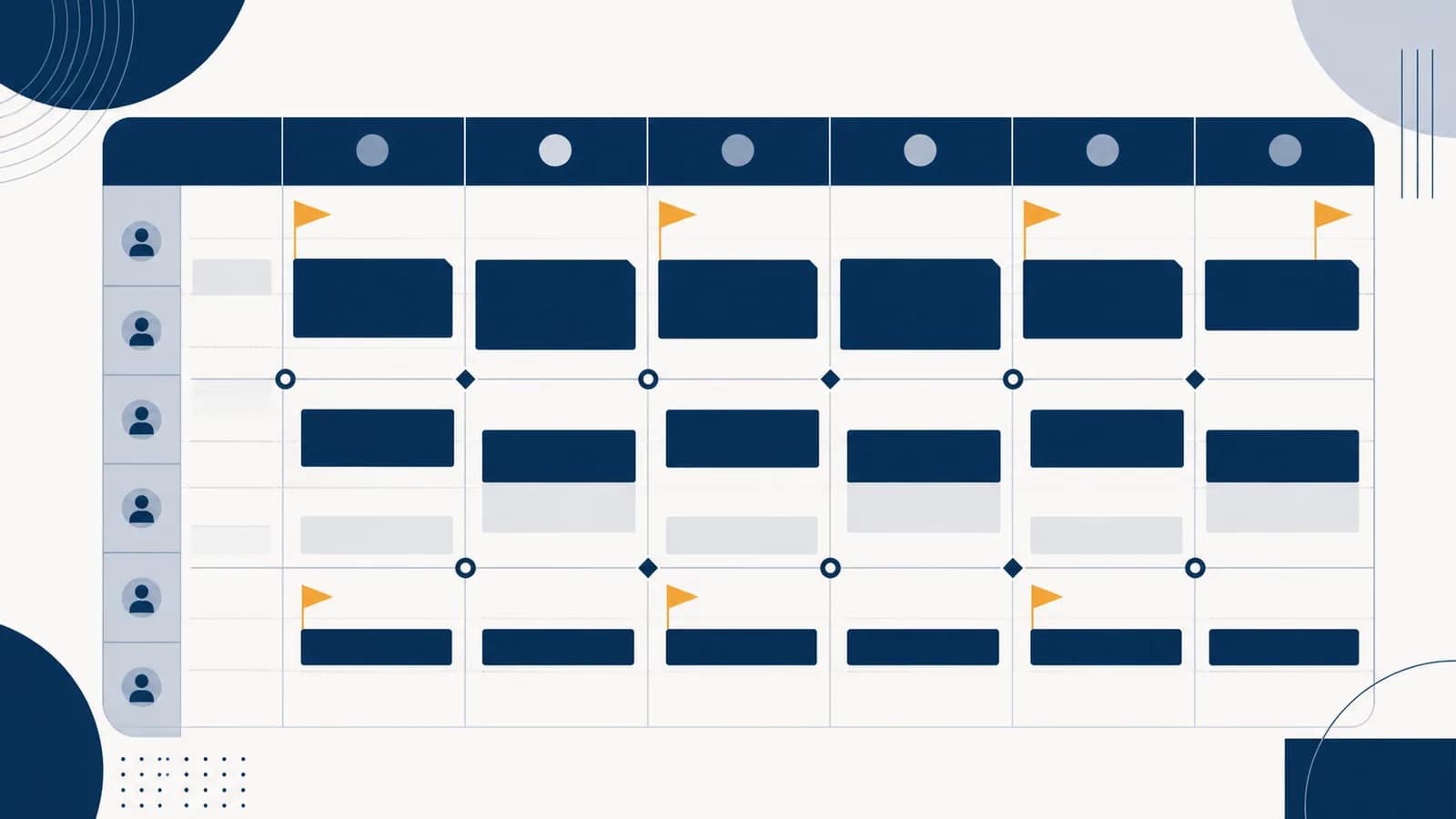
Cadence makes productive work repeatable
A productive team does not depend on constant urgency. It uses a steady project cadence: clear culture rules protect maker time, small milestones expose progress, and regular reviews turn evidence into the next decision. By the end, you can design a weekly rhythm that helps people finish useful work without filling every hour with meetings.
Cadence is the pattern in which work is planned, made, checked, and adjusted. Culture rules define the behavior people can expect from one another. Maker time gives demanding tasks enough uninterrupted attention. Milestones create moments when the team can inspect something real. These parts work as a system because each one solves a different coordination problem.
A rhythm removes repeated negotiation. People no longer need to ask when plans change, when feedback arrives, or when a decision becomes final. The calendar carries part of the answer. This is the same kind of thinking used in Operations and Process Optimization: define a process, observe where work waits or fails, then improve the process rather than blaming every delay on an individual.
Culture rules turn good intentions into predictable behavior
A culture rule is a short agreement about visible conduct, not a slogan about values. It tells people what to do in a repeated situation, such as where decisions are recorded, when interruptions are allowed, and how quickly feedback must arrive.
“Respect focus” is an intention. “Do not book internal meetings before noon” is a rule. “Communicate clearly” is an intention. “Record each project decision in the shared log before work continues” is a rule. The useful version names an action that another person can observe.
We value ownership and move quickly. People must guess what ownership means and how speed should affect quality, consultation, or working hours.
The person responsible for a decision names the deadline, asks the affected people for input, records the choice, and explains what would cause it to change.
Good rules answer common sources of friction. Who decides? Which channel carries urgent requests? What must be written down? What counts as finished? When may someone interrupt another person? A team does not need a thick handbook. It needs a small set of agreements that cover the situations that repeatedly waste time or create resentment.
Rules also need an escape clause. A production outage may justify interrupting protected work. A safety issue may require immediate escalation. Define the exception narrowly, then name who can invoke it. Otherwise every request becomes “urgent,” and the rule disappears under pressure.
A rule without enforcement becomes a trap. Conscientious people obey it while powerful or impatient people ignore it. Leaders must follow the rule publicly and correct violations consistently.
Review culture rules after observing them in use. If a decision log takes longer to maintain than the decisions deserve, simplify it. If “no meetings before noon” blocks colleagues in another time zone, protect a different shared window. The behavior matters more than the original wording.
Maker time must be long enough for the work to take shape
Maker time is a protected block for tasks that require a person to hold several connected ideas in mind. Writing, coding, analysis, design, and lesson planning often suffer when chat messages and short meetings repeatedly break that mental structure.
An interruption costs more than its duration. Before a demanding task, the worker loads context: the goal, current state, constraints, recent choices, and next move. After an interruption, much of that context must be rebuilt. A five minute conversation can therefore consume more than five minutes of productive capacity.
A developer is tracing why a form sometimes loses data. She has mapped the browser event, the validation rule, and the server response. A status meeting breaks the chain. Afterward, she must reconstruct the sequence before she can test the next cause. The meeting used twenty minutes, but the project lost the meeting time plus the reconstruction time.
Protection requires more than an empty calendar. Notifications, open chat channels, and vague availability expectations can fragment the same block. A useful team rule states the hours, identifies the few events that justify interruption, and provides a place where ordinary requests can wait.
Do not treat every task as maker work. Scheduling, routine approvals, and short factual replies fit into smaller periods. Grouping these tasks into an office hour or response window keeps them from spreading across the day. The aim is not silence. It is to match the shape of the calendar to the shape of the work.
These are example design choices, not universal biological limits. A lab, school, newsroom, and repair shop have different constraints. Start with the shortest block in which the team can produce a meaningful piece of work, then defend that block and measure what actually reaches completion. Knowledge about attention, sleep, stress, and recovery can inform the design, but a calendar still needs local evidence from the people using it.
Milestones should prove progress rather than report activity
A milestone is a testable change in the state of a project. It marks evidence that now exists, such as an approved sketch, a working prototype, or a completed trial, rather than hours spent, meetings held, or effort described.
“Work on the website” is an activity. “A new visitor can submit the contact form on a phone, and the team receives the message” is a milestone. The second statement gives the team something to test. It also reveals what remains unknown.
A strong milestone names an artifact, a condition, and an owner. The artifact is what can be inspected. The condition says how it will be judged. The owner coordinates the work and reports the result. Ownership does not mean doing every task alone; it means ensuring that the evidence appears or the obstacle becomes visible.
If 6 of 8 planned milestones meet their stated conditions, the rate is .
The calculation is simple Algebra applied to project evidence. Its interpretation requires care. A high completion rate can mean good planning, but it can also mean the milestones were too easy. A low rate can mean poor execution, but it can also expose valuable uncertainty early. Use the number to start an investigation, not to rank people.
Large milestones hide risk. “Launch the service” might contain research, design, procurement, testing, training, and legal review. If the team checks only at launch, it can discover a basic mistake after every dependent task has been built. Smaller milestones shorten the distance between a wrong assumption and the evidence that disproves it.
Milestones should also include quality. If speed alone defines completion, unfinished checking gets pushed into the future as hidden work. State acceptance conditions before work begins. For a web page, those conditions might include readable text on a small screen, keyboard access, and a successful submission. The construction details connect directly to building interfaces with HTML and CSS, where visible behavior can be tested against a written requirement.
A useful cadence separates making, deciding, and reviewing
A practical cadence gives different kinds of work different times. Planning selects the next result, maker blocks produce it, decision points remove obstacles, and reviews inspect evidence. Mixing all four into continuous conversation makes attention expensive and responsibility unclear.
Consider a one week cycle. On Monday, the team selects a few milestones and confirms their acceptance conditions. Protected blocks occupy the mornings. A short coordination period handles dependencies. On Friday, the team demonstrates artifacts, accepts or rejects milestones, and changes the next plan using what it learned.
Write the few observable results that would make the week useful. State who will coordinate each result and who can accept it.
Put maker blocks on the shared calendar before filling it with routine meetings. Publish the interruption rule beside the schedule.
Use a brief coordination check to identify blocked work and required decisions. Move problem solving to a smaller group afterward.
Demonstrate the artifact against its acceptance conditions. Record the result, the evidence, and one process change for the next cycle.
The cycle length should match the cost of feedback. A team editing daily news needs fast checks because old news loses value quickly. A research group running a long experiment cannot produce final evidence each week, but it can still review intermediate evidence such as a calibrated instrument, a completed sample batch, or a checked dataset.
Cadence is not the same as rigidity. The dates stay stable so the content can change intelligently. If each review is moved whenever work slips, the team loses the moment designed to expose slippage. Keep the review, present the incomplete artifact, identify the cause, and adjust scope or method.
That distinction changes the emotional meaning of review. A single final deadline encourages concealment because bad news feels terminal. Repeated inspection makes correction ordinary. Work can be rough at an early checkpoint because the schedule already contains another chance to test it.
Metrics help only when they lead to a decision
A project metric is useful when a change in the number could change an action. Count finished milestones, waiting time, rework, or blocked days only if the team knows what question the measure answers and what it may do next.
Measures can distort behavior. If a manager rewards the number of tasks closed, people may split easy work into tiny tickets and avoid hard problems. If speed is rewarded without quality, defects return as rework. The measure improves while the actual system gets worse.
Messages sent, hours logged, meetings attended, or tasks opened. These can rise while the project remains stuck.
Time from accepted request to usable result, days blocked, milestones accepted, or work returned for correction. These reveal movement and friction.
Pair a speed measure with a quality check. A shorter delivery time is helpful only if the result still meets its acceptance conditions. Pair a volume measure with a limit on unfinished work. More starts do not help if nothing reaches the user.
Use a small decision table before collecting data. Write the question, the measure, the observation period, and the possible response. For example: “Are reviews arriving too late to help?” Measure the time between a review request and actionable feedback for several cycles. If delay repeatedly blocks a milestone, reduce the number of required reviewers, schedule a fixed review window, or narrow the requested decision.
Measure the system, not personal worth. A blocked day may reveal an overloaded approval process, unclear authority, or missing equipment. Treating it as a character score hides the cause the measurement was meant to expose.
Keep a metric only while it informs action. Once a problem is stable, occasional sampling may be enough. This prevents the reporting system from becoming a second project that competes with the work it was created to improve.
Cadence fails when control replaces learning
A cadence becomes harmful when its rituals exist mainly to prove that people are busy. Excess status reporting, inflexible targets, and meetings without decisions consume capacity while hiding uncertainty. The repair is to reconnect every ritual to evidence and action.
Status meetings often fail because each person recites work to a manager while everyone else waits. Written updates can carry basic facts. Shared meeting time should handle conflicts, dependencies, and decisions that genuinely benefit from several minds.
Another failure appears when milestones become promises about an uncertain future. Early estimates are guesses informed by limited evidence. Treating them as moral commitments encourages people to hide defects, skip tests, or work unhealthy hours. Keep accountability for honest reporting and disciplined experiments. Allow the plan to change when evidence changes.
A school media team misses its weekly publication milestone because every article waits for one teacher's approval. The team could demand faster writing, but writing speed is not the constraint. It creates a fixed review window, gives a second teacher authority to approve routine pieces, and tracks how long drafts wait. The next cycle tests the process change.
Culture also fails when stated rules and rewarded behavior disagree. A company may praise careful work while promoting the person who creates emergencies and then works late to solve them. People learn from consequences. To change the culture, reward prevention, clear handoffs, early warnings, and sustainable delivery.
Past institutions offer many examples of rules outliving their purpose. Studying a wider history of institutions and social change helps explain why routines can preserve power as well as coordinate work. Inside a project, the practical defense is a scheduled rule review: keep the agreement, revise it, or remove it based on observed effects.
A steady system makes ambitious work sustainable
Reliable productivity comes from a system people can repeat without constant rescue. Clear rules reduce social guesswork, maker time protects demanding thought, milestones turn plans into evidence, and reviews let the next cycle respond to reality.
Start with one project and one cycle. Choose a result that can be demonstrated. Write its acceptance conditions. Reserve a block large enough to make it. Decide which interruptions are valid. Set a review that will occur even if the work is incomplete. At the review, inspect the artifact rather than the performance of confidence.
Then change one part of the system. If people could not focus, reduce interruptions. If decisions waited, clarify authority. If a milestone concealed too much work, split it around the largest uncertainty. If review produced vague opinions, strengthen the acceptance conditions. Each adjustment should answer evidence from the previous cycle.
The takeaway: Culture becomes productive when expectations are observable, attention has protection, and progress must show itself in usable evidence. Build a cadence that makes those conditions ordinary, then improve it one cycle at a time.
Cadence wins because it turns improvement into scheduled work. The team does not wait for exceptional discipline or a heroic rescue. It creates regular moments to focus, finish, inspect, and correct. Ambition then rests on a repeatable structure rather than on exhaustion.