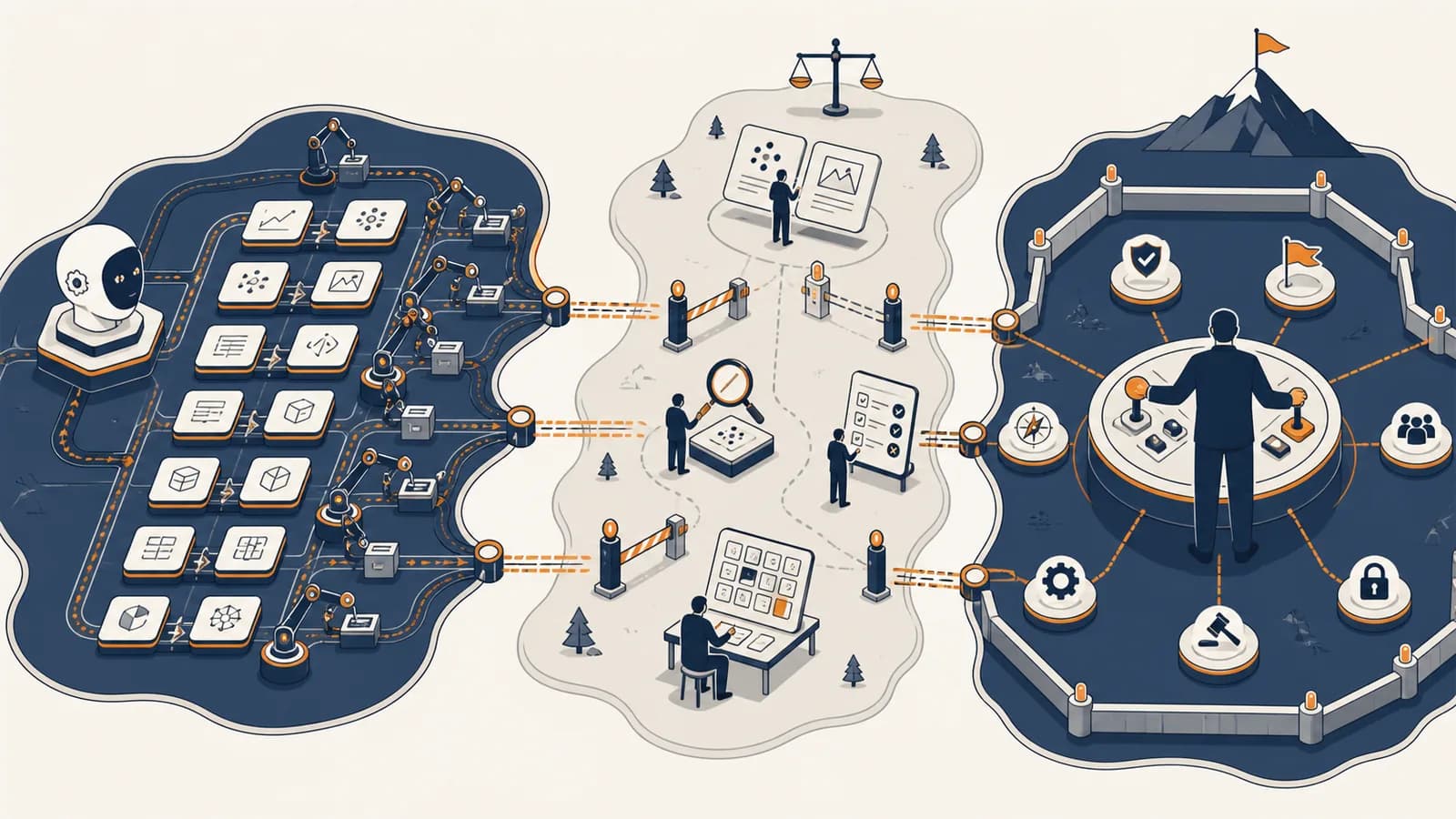
AI multiplies work only when the task has the right shape
AI automation multiplies your effort when a task is repeatable, easy to check, and supplied with clear context. It wastes time when the goal is vague, mistakes are expensive, or judging the result requires knowledge you do not have. An AI automation map separates those cases before you open a chatbot or coding assistant. By the end, you can score a task, choose a safe working method, and decide when doing it yourself is faster.
The useful unit is not a job title. “Marketing,” “programming,” and “research” each contain many different tasks. Drafting ten headline options has a different risk profile from approving a medical claim. Renaming a hundred files has a different verification cost from deciding what those files should contain. Ask what operation is being performed, what information it needs, and how an error would be found.
Can AI do this job? The job is too large and mixed to produce a useful answer.
Can AI produce a first draft of this repeated task, using these inputs, while I can cheaply test every result?
Think of AI as a fast generator with uneven judgment. It can produce text, code, classifications, summaries, and possible explanations at low marginal effort. It does not make those outputs true. Its value depends on the surrounding system: the instructions, source material, tests, review, and person accountable for the final decision.
What makes a task a strong candidate for AI?
A strong candidate has structured inputs, a narrow output, repeated examples, and a cheap test of correctness. The task should also tolerate revision. These properties let a person turn fast generation into reliable production without spending more time checking than doing.
Four dimensions matter most. Repetition means the same operation appears often enough to repay setup time. Context quality means the necessary facts fit into a prompt, file, or connected system. Verifiability means a test, source, or knowledgeable reviewer can identify errors. Consequence measures the cost of an error escaping review.
A spreadsheet formula is an excellent candidate because its output can be compared with known rows and recomputed. A personal apology is a weak candidate for automatic sending because meaning depends on a relationship, tone is hard to test, and a careless sentence cannot be recalled from another person’s memory.
Repetition changes the economics. Suppose writing a small report manually takes 20 minutes. Preparing instructions and a template takes 30 minutes, each AI-assisted report takes 4 minutes, and review takes 6 minutes. The setup loses time on the first report but pays back across a batch.
For 10 reports: minutes, compared with minutes manually.
The arithmetic also reveals bad automation. If review takes 18 minutes because each answer must be rebuilt from source material, the system takes minutes. The generator is fast, but the workflow is slow. A speed claim about generation alone hides the cost that decides the outcome.
How do you score a task before automating it?
Score the task’s repetition, context quality, and verifiability, then subtract the burden created by errors and setup. The score is a comparison tool, not a scientific measurement. Its purpose is to expose assumptions and compare candidate tasks using the same questions.
Use a scale from 0 to 3 for each factor. A score of 0 means the property is absent; 3 means it is strong. Keep the definitions stable while comparing tasks. If you quietly change what “easy to verify” means, the totals stop being comparable.
| Factor | 0 points | 3 points |
|---|---|---|
| Repetition | Rare or unique | Frequent and similar |
| Context quality | Hidden or mostly unstated | Complete and easy to supply |
| Verifiability | Judgment is uncertain | A test or source settles it |
| Error cost | Serious or irreversible | Minor and reversible |
| Setup burden | Large integration or cleanup | A prompt or small template |
Give error cost and setup burden higher numbers when conditions are favorable, so every factor points in the same direction. Then add the five scores. The maximum is 15. Do not treat a particular total as universal permission to automate. Rank your own tasks, test the highest candidate, and keep human approval wherever consequences demand it.
A teacher turns a clean answer key into practice questions: repetition 3, context 3, verification 3, error cost 2, setup 3, for 14. The same teacher writes a reference letter about a student: repetition 1, context 1, verification 1, error cost 1, setup 3, for 7. The numbers do not prove a decision. They make the reasons visible.
The score starts a discussion, while a small trial supplies evidence. Measure total time, correction time, error types, and outputs needing major repair.
Where does AI usually multiply a person’s effort?
AI usually helps most in transformations, constrained generation, search support, and first-pass analysis. In each case, a person supplies the goal and checks the result against evidence. The machine expands production capacity without taking ownership of the decision.
Transformations change the form while preserving the substance. Examples include turning meeting notes into action items, adapting a paragraph for a younger audience, extracting fields from consistent documents, or converting a specification into a checklist. The source stays available for comparison, which makes review concrete.
Constrained generation creates candidates inside explicit boundaries. A designer might request ten button labels under 25 characters. A programmer might ask for tests that cover named edge cases. Someone learning software creation through outcome-based prompting can use a model to produce a prototype, then inspect behavior and revise the instructions.
Search support is valuable when the result is treated as a lead, not evidence. A model can propose terms, possible causes, or documents to inspect. The user then opens the original sources. This is especially useful in unfamiliar subjects, where knowing the right vocabulary is often the first obstacle.
First-pass analysis can group comments, flag unusual records, or propose categories. It reduces the pile that needs attention. It should not quietly become the final ruling. Classification choices encode definitions, and definitions affect people. Keep borderline cases visible and preserve a route for correction.
The best targets have an external truth source. Tests, source documents, calculations, or observable behavior can check the answer without asking the same model to grade itself.
Code demonstrates the pattern clearly. A generated web component can be rendered, inspected, tested with a keyboard, and compared with a design. Knowledge of how HTML structure and CSS presentation work makes those checks faster because the reviewer can identify the cause of a visual or accessibility failure.
Where does AI quietly waste time?
AI wastes time when users must reconstruct missing context, untangle plausible errors, or repeatedly restate an unclear goal. It also fails economically when the task is too rare to repay setup. Output speed cannot compensate for expensive checking and repair.
The first trap is vague delegation. “Improve my business” contains no defined output, audience, constraint, evidence, or stopping condition. The model can fill those gaps with generic assumptions, but generic assumptions produce generic work. Clarifying the decision may require more human thought than generating any document.
The second trap is verification debt. A confident answer may contain a false citation, a missing exception, or code that works only on the example input. If you lack the subject knowledge to notice the defect, every polished paragraph becomes a claim that needs separate research. Studying how binary logic becomes computation, for example, gives you a foundation for checking explanations that would otherwise only sound technical.
Do not use fluency as a test. Grammar, detail, and confidence reveal how an answer is presented. They do not establish that its claims are correct.
The third trap is exception-heavy work. Some processes look repetitive until examined closely. Customer disputes, unusual contracts, and messy historical records may each require a different rule. Automation then creates a second job: finding where the standard pattern should not have been applied.
The fourth trap is premature machinery. People sometimes build an elaborate chain of prompts, integrations, and databases for a task performed twice a month. Setup, maintenance, and failures outweigh the minutes saved. A reusable text template or checklist may solve the actual problem with fewer moving parts.
The model produces a draft in seconds.
A person prepares inputs, checks claims, repairs defects, handles exceptions, and maintains the process.
How should risk change the workflow?
As the consequence of error rises, AI should move farther from unsupervised action and closer to drafting, retrieval, or checking support. High stakes require authoritative sources, qualified review, logged changes, and a human who remains responsible for the decision.
Risk combines probability and impact. A mistake that is unlikely but catastrophic deserves attention. So does a small error repeated across thousands of records. Privacy adds another dimension: even a correct output can be unacceptable if producing it exposed confidential information to a system without proper permission.
If one mistaken label causes 2 units of harm and reaches 50 cases, the exposure term makes the total much larger than a single isolated mistake.
This formula is a thinking aid, not a promise that every kind of harm can be reduced to one number. Some effects are difficult to compare. Losing money, revealing a private diagnosis, and denying an opportunity are different events. The calculation still forces attention onto scale and consequences.
In health, law, credit, hiring, safety, and public information, keep the model’s role narrow. It may format notes or surface passages for review. It should not invent missing facts or make a final decision merely because its answer looks complete. Learning the mechanisms behind biological systems and evidence also shows why a plausible explanation is weaker than a measured result.
A clinic may use software to turn a clinician’s dictated note into a structured draft. The clinician compares it with the recording and patient record before approval. The model changes form; the licensed professional checks meaning and remains accountable.
Reversibility matters too. Reordering private notes is easy to undo. Publishing a false accusation is not. Sending a payment, rejecting an applicant, or changing a production database creates external effects. Add explicit approval before those actions, and make the proposed change visible to the approver.
How do you build a workflow that improves with use?
Build the smallest repeatable loop that records inputs, produces a draft, tests it, and captures corrections. Start with one narrow task and a small sample. Expand only after the process saves total time while meeting a stated quality standard.
Define the artifact, its audience, required fields, forbidden content, and finish condition.
Supply source documents, examples, definitions, and constraints. Remove private material that the chosen system is not approved to receive.
Choose tests, citations, comparison rules, or a qualified reviewer before generating the output.
Record preparation, generation, review, and repair time. Keep examples of every important failure.
Turn repeated corrections into clearer instructions, better examples, stronger tests, or a decision to stop automating.
Separating stages makes diagnosis possible. If outputs miss facts, improve context. If they violate format, tighten constraints or use structured fields. If review catches the same defect repeatedly, add a test. If each case fails differently, the task may not be stable enough for the method.
Keep a small evaluation set containing ordinary examples, edge cases, and previous failures. Run it after changing prompts, models, or tools. A new version that looks better on one example may perform worse on another. Stable examples turn impressions into comparisons.
The human role should be specific. “Human in the loop” means little unless the person knows what to inspect and has authority to reject the result. Give reviewers a checklist, show the source beside the output, and avoid interfaces that make approval easier than careful reading.
What should you keep for yourself?
Keep tasks that define goals, carry personal responsibility, build foundational skill, or depend on relationships you understand better than a model. AI can support preparation, but delegating the central judgment can weaken both the result and your ability to improve.
Goal setting belongs with the person or group affected by the outcome. A model can list options and consequences, but it does not bear those consequences. It cannot decide what your family should value, which promise your organization should keep, or which compromise you can defend in public.
Foundational practice also deserves protection. A student who delegates every algebra step may finish worksheets while losing the ability to detect a wrong result. A new programmer who accepts every generated patch may ship features without learning why they break. Use assistance after an honest attempt, ask for hints, and explain the final solution in your own words.
A useful learning rule: If the task is meant to change what you can do unaided, do not judge success only by the finished artifact.
Relationships depend on knowledge that may never appear in the prompt. A manager giving difficult feedback knows the employee’s history and the promises already made. A friend replying to grief understands shared memories and silence. A generated draft may help find words, but the sender must make them true.
Keep final judgment where reasons matter more than output. An editor can use a model to flag long sentences but should decide which voice fits the publication. A scientist can use software to organize observations but must distinguish evidence from explanation. A citizen can request a summary but should inspect the underlying document before forming a view.
The best AI system makes responsibility more visible
A good AI workflow does more than produce faster drafts. It shows where facts came from, which rules were applied, who checked the result, and where a person must decide. Clear responsibility turns automation into a controlled tool instead of a source of hidden guesses.
Start with the task that scored highest, not the task that looks most impressive. Define one output and one test. Run enough examples to encounter ordinary variation, then count preparation and repair as real work. If the process saves time and errors remain detectable, expand it carefully. If review costs rise or exceptions dominate, simplify the system or return the task to a person.
The takeaway: Automate repeated production where context is complete, checks are cheap, and mistakes are reversible. Keep human control where goals, consequences, expertise, and trust determine what a correct answer means.
The map is not fixed. A task can move into a better zone when you clean its inputs, narrow its scope, or add a reliable test. Reassess it whenever the inputs, consequences, or actions change.
The durable advantage is judgment about systems. Learn to separate generation from verification, speed from total cost, and assistance from responsibility. Then AI becomes easier to place: use it where its fast output meets strong checks, and step back where confidence would outrun evidence.