What does a central bank actually do?
A central bank manages the monetary system by issuing settlement money for banks, steering short-term interest rates, supporting payment systems, and often pursuing stable prices and employment. By the end, you can trace an interest rate decision from a policy meeting to loans, spending, jobs, and inflation.
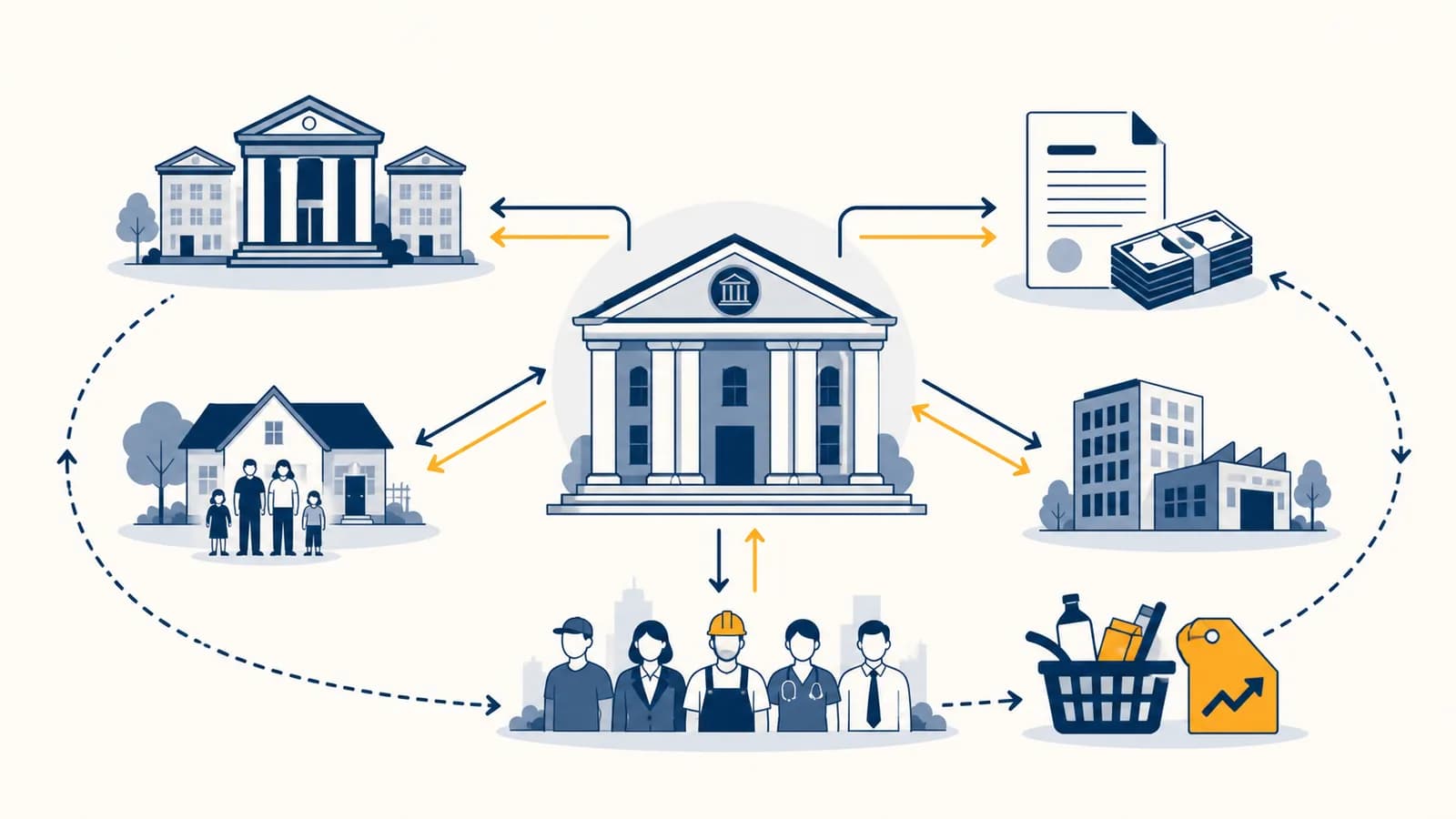
The institution sits behind ordinary money without running ordinary customer accounts. Households and businesses mostly use deposits at commercial banks. Commercial banks, in turn, hold accounts at the central bank. The balances in those accounts are called reserves. Banks use them to settle payments with one another and to meet obligations to the state.
A central bank usually has several public duties. The exact legal mandate differs by country, but monetary policy is the part behind most interest rate headlines. It chooses a policy stance, implements that stance in financial markets, and explains what could change its next decision. Many central banks also issue banknotes, supervise parts of the banking system, operate or oversee payment infrastructure, and lend against collateral during financial stress.
The central bank orders every lender to charge the same rate on mortgages, car loans, and business credit.
It controls rates on certain central bank transactions. Those rates influence market funding costs, expectations, and many retail rates, but lenders still price each loan.
Monetary policy is also different from fiscal policy. A central bank changes monetary conditions. A government taxes, spends, and borrows under laws and budgets. Both can affect total demand, but they use different machinery and answer to different decision processes. This division is one of the basic ideas in the study of economics.
Which interest rate appears in the headline?
The headline rate is normally a policy rate or target for a very short-term market rate. It is the central bank's chosen starting point for monetary conditions, not a universal price imposed on every contract in the economy.
The name depends on the system. The Federal Reserve announces a target range for the federal funds rate, the overnight rate on reserve loans between eligible institutions. The Bank of England sets Bank Rate. The European Central Bank sets several key rates on deposits and central bank credit. These frameworks differ, but each gives financial institutions a reason to trade short-term money near the intended level.
News reports often measure a rate move in basis points. One basis point is one hundredth of a percentage point. A rise from 4.00% to 4.25% is a rise of 25 basis points, not a 25% rise. The relative increase happens to be 6.25%, but policy coverage normally describes the 0.25 percentage point change.
A 50 basis point change equals 0.50 percentage points.
For a borrower, the policy announcement matters through a chain of prices. A bank considers its funding costs, the chance of default, operating costs, the term of the loan, competition, and the profit it seeks. A five-year fixed loan also depends on expected future short-term rates. This is why a mortgage rate can move before a central bank meeting, or even move in the opposite direction after the announcement if markets expected something else.
How does the central bank make its chosen rate stick?
The central bank makes its policy stance effective by setting terms on reserve balances and short-term lending, then adjusting liquidity when needed. Banks compare those official terms with private trades, so arbitrage pulls overnight market rates toward the intended range.
Suppose Bank A must send payment to Bank B. The final settlement moves reserves from A's central bank account to B's account. Across the system, some banks finish the day with more reserves than they want and others need more. They can trade reserves, use secured money markets, or deal with central bank facilities.
If a bank can earn a known rate by leaving eligible reserves at the central bank, it has little reason to lend those funds elsewhere at a much lower rate, once risk and access differences are considered. A lending facility can restrain rates at the other side by offering funds against acceptable collateral. Some systems add reverse repurchase operations or other facilities for institutions that cannot earn interest on reserves directly.
There are two broad implementation styles. In a scarce-reserves system, the central bank adjusts the quantity of reserves so that demand and supply meet near its target. In an ample-reserves system, banks hold plentiful reserves and administered rates do more of the steering. Open market purchases add reserves; sales or maturing assets can remove them. The plumbing changes over time, but the economic logic remains a controlled price for overnight central bank money.
Reserves do not leave the banking system when a customer pays a shop. The payment changes bank deposits and shifts reserves between banks. Cash withdrawal is different because reserve balances can be exchanged for physical currency.
This mechanism also explains why the phrase "the central bank sets interest rates" is useful but incomplete. It sets a small group of rates it controls directly. Competition and arbitrage transmit those rates through money markets. Risk, maturity, expectations, and market structure determine the rest.
How does one rate change reach households and firms?
A policy rate change reaches the economy through bank funding, bond yields, asset prices, exchange rates, credit standards, and expectations. Those channels alter borrowing, saving, investment, and spending, which then affect production, employment, wages, and prices with uncertain delays.
The fastest effects appear in financial prices. Overnight rates react almost immediately. Yields on longer government and corporate debt reflect the expected path of future short-term rates plus compensation for time and risk. Variable-rate loans may reset soon. Fixed-rate loans move as lenders update the cost of funding them.
Short-term trades move close to the new policy setting, while longer yields incorporate expectations about later decisions.
Some loans become dearer or cheaper. Saving becomes more or less attractive, and asset valuations adjust.
Households reconsider large purchases. Firms reconsider stock, hiring, and investment projects.
Businesses respond to sales, capacity, input costs, and worker availability. The total effect emerges gradually.
Consider a factory deciding whether to buy a machine. The manager compares its expected extra revenue with repayments, maintenance, and risk. Higher financing costs can turn a marginal project into a rejected one. The same reasoning appears in formal comparisons of costs and benefits, though real forecasts contain uncertainty that a tidy classroom example may omit.
A family is considering a loan of $20,000. At 6% simple annual interest, one year's interest would be $1,200. At 7%, it would be $1,400. The visible $200 difference may change the purchase decision, although an actual instalment loan uses scheduled balances and its total cost depends on the repayment terms.
Exchange rates form another channel. If domestic interest-bearing assets become more attractive relative to foreign alternatives, demand for the currency may rise, though many other forces act at once. A stronger currency makes imported goods cheaper in domestic money and makes domestic products dearer to some foreign buyers. This connection matters in economies linked through global trade.
No arrow in this chain is mechanical. A cautious bank may keep lending standards tight after a rate cut. A household may save more because it fears unemployment. A firm may invest despite higher rates because orders are strong. Policy works on millions of choices, so central banks estimate ranges of possible effects rather than calculate one guaranteed result.
What are quantitative easing and tightening?
Quantitative easing is a central bank's large-scale purchase of securities, paid for by creating reserve balances. Quantitative tightening reduces its securities holdings or their monetary effect. These tools reshape financial conditions when changing the overnight policy rate alone is insufficient or constrained.
In a purchase, the central bank buys an eligible bond. If a pension fund sells through a commercial bank, the fund receives a bank deposit, the commercial bank receives reserves, and the central bank receives the bond. The central bank's balance sheet expands on both sides: securities are assets and newly created reserves are liabilities.
Quantitative easing is simply printing cash and handing it to households.
The central bank buys assets and creates reserves to settle the purchase. The seller receives a deposit, while the public and private sectors hold a different mix of financial assets.
The purchase can raise the price and lower the yield of the targeted bonds. Sellers may rebalance into other assets, spreading the effect across markets. A public commitment to continued purchases can also influence expectations about future policy. These channels may lower longer-term financing costs, but their strength depends on market conditions and beliefs.
Quantitative tightening can happen when the central bank lets bonds mature without replacing all of them, or sells assets. When a bond held by the central bank matures, the issuer's payment ultimately reduces central bank liabilities, though the exact path depends on the issuer and operating framework. Asset sales reverse the purchase transaction and absorb reserves.
Asset purchases can carry costs and tradeoffs. They expose the central bank's income to interest-rate movements and may affect market functioning. Gains or losses have accounting and fiscal consequences, but a central bank's policy purpose is defined by its mandate, not by maximizing trading profit.
How do central banks decide what to do?
Policy committees compare incoming data and forecasts with their legal objectives, examine risks on both sides, vote on a decision, and communicate the result. They react to an expected path for the economy, not to one inflation release or one political demand.
A committee studies consumer prices, wages, employment, production, credit, financial conditions, surveys, and international developments. Staff models impose consistent relationships on the evidence, while policymakers test assumptions and consider events that models handle poorly. Forecasts are conditional. A projection changes when energy prices, taxes, productivity, exchange rates, or public behavior change.
The committee faces a recurring timing problem. Current inflation describes price changes that have already happened, while today's rate decision affects future spending and prices. Waiting for perfect proof can mean acting too late. Acting on a forecast can also be wrong. Good policy therefore depends on probability, revision, and explicit risk management.
A rate rise does not prove that the economy is healthy, and a rate cut does not prove that it is weak. The meaning depends on inflation, employment, financial stress, previous policy, and what markets had already expected.
Central bank independence usually means operational freedom to pursue goals set in law, combined with public accountability. It does not place the institution outside government or remove democratic scrutiny. Officials publish decisions, reasoning, forecasts, minutes, testimony, or some combination of them. Designs vary because countries make different legal choices about objectives, appointments, and reporting.
Communication is itself a policy tool. If a committee persuades markets that rates will stay higher for longer, longer-term yields can rise before any further vote. If its words are unclear or unbelievable, market prices may move in an unwanted direction. Credibility is therefore a practical relationship between promises, actions, and outcomes.
Why can central banks miss their targets?
Central banks can miss because data arrive late, forecasts are uncertain, policy acts with delays, and inflation can come from supply shocks that higher rates cannot directly repair. Their tools influence demand and finance more readily than energy output, harvests, or shipping capacity.
Inflation can rise because total spending outruns productive capacity. Tighter monetary policy can reduce that pressure by making credit dearer and saving more attractive. Inflation can also rise after a crop failure or an interruption to fuel supply. A rate increase cannot produce wheat or gas. It may still prevent the first price shock from spreading into persistent price and wage setting, but it does so by restraining demand elsewhere.
Measurement creates another problem. Price indexes summarize a changing basket of goods and services. Employment figures are revised. Estimates of potential output and the neutral interest rate cannot be observed directly. A committee has to act before the full picture is visible.
There are also competing objectives over short periods. Rapid tightening may slow inflation but weaken hiring and expose fragile borrowers. Easy policy may support employment but add inflation pressure or encourage financial risk. The relevant choices resemble shifting lines rather than fixed answers, and linear relationships in mathematics provide a useful first model before real-world complications are added.
Independence cannot remove these tradeoffs, and expertise cannot erase uncertainty. What it can do is assign the decision to an institution with a stated mandate, specialist staff, repeat meetings, and a duty to explain. The quality of that explanation lets the public distinguish an honest forecast error from an incoherent policy.
An interest rate headline is the start of the mechanism
A central bank decision begins in a policy committee but becomes real through reserve accounts, standing facilities, market trades, bank pricing, and public expectations. Reading the headline well means following that chain and recognizing where direct control ends.
Start by identifying the exact rate and whether the decision changed a level, a target range, or only the wording about future policy. Then compare the outcome with market expectations. Read the explanation for the committee's view of inflation, employment, demand, and risk. Finally, separate immediate market movements from slower economic effects.
The takeaway: Central banks directly set only a narrow set of monetary terms. Their broader power comes from settlement money, market incentives, balance-sheet operations, and expectations, all transmitting policy through an economy that can respond in unexpected ways.
This framework makes apparently conflicting news easier to interpret. A central bank can raise its policy rate while some long-term yields fall because investors expect weaker growth and later cuts. It can buy assets without commercial banks automatically expanding loans. It can miss an inflation target even while its operating system keeps the overnight rate exactly where intended.
The machinery is powerful, but it is not a control panel for every price or job. Central banks choose terms at the monetary system's center. Financial institutions, governments, firms, and households produce the final outcome through their separate decisions.