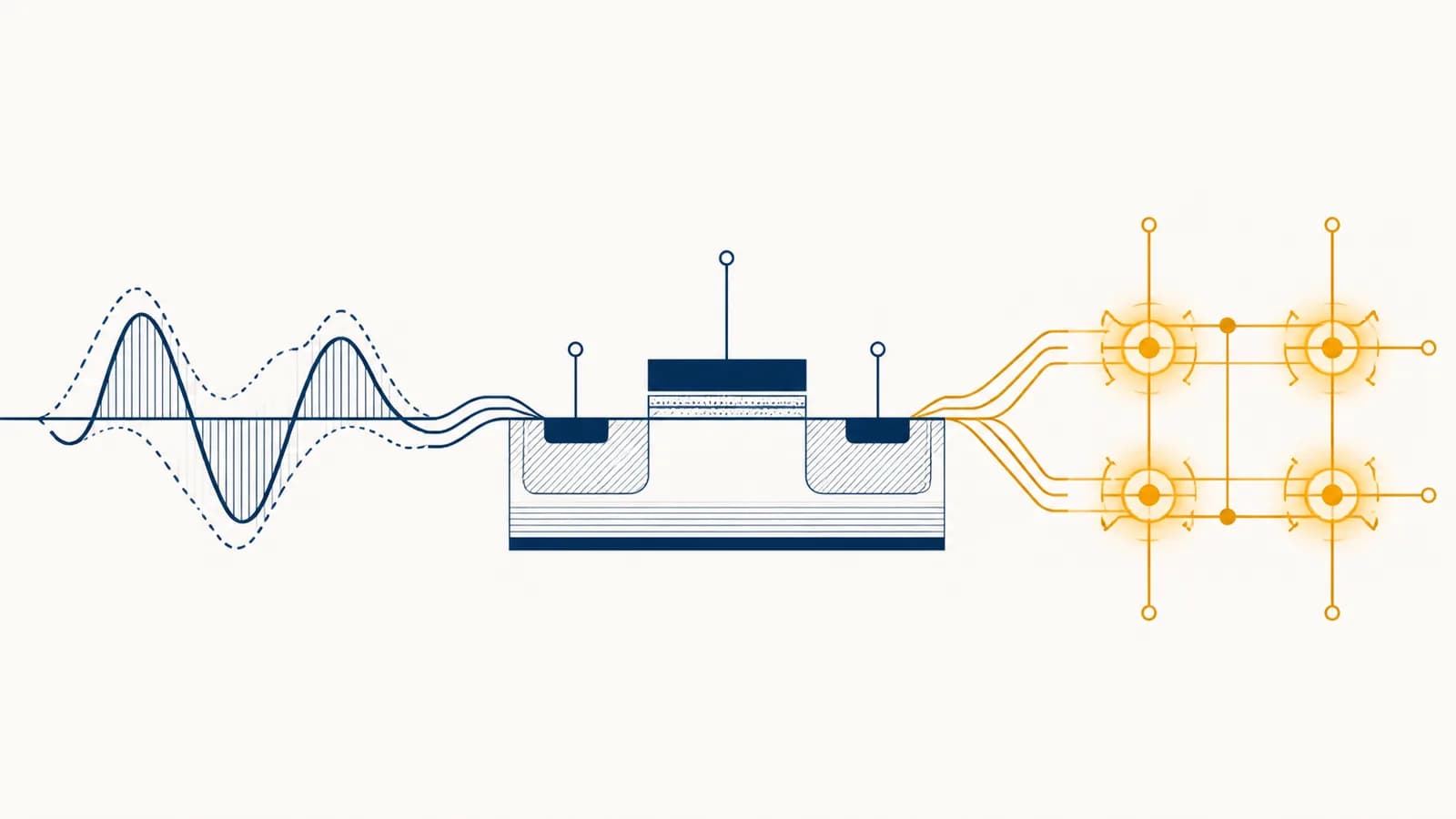
How did Schrödinger's equation reach a silicon chip?
Quantum mechanics makes modern computing possible because it explains how electrons behave inside solids, which lets engineers design semiconductors and transistors. It also supplies the rules for quantum computers, whose qubits process probability amplitudes instead of ordinary binary states.
The connection between Schrödinger and silicon is not a poetic one. A chip works because electrons in a crystal can occupy some energy ranges and cannot occupy others. Engineers use electric fields and carefully added impurities to control which electrons move. Billions of manufactured switches then turn that motion into logic, memory and arithmetic.
By separating three ideas, the subject becomes much clearer. Quantum theory explains the material. Semiconductor engineering shapes that material into transistors. Computer architecture arranges transistors into machines that execute instructions. Quantum computing is a separate branch that preserves quantum behaviour long enough to perform a different kind of computation.
This chain also explains why a laptop is a quantum device in one sense but not a quantum computer. Its materials obey quantum mechanics, as all matter does. Its useful information, however, is deliberately stored in stable classical states that can be copied, amplified and checked.
The equation gives physicists a way to calculate how a quantum state changes and which energies a system can have.
John Bardeen and Walter Brattain build the point-contact transistor; William Shockley later develops the junction-transistor design.
Several electronic components are made together on one piece of semiconductor material, a basic idea behind chip manufacturing.
What does a quantum wavefunction actually calculate?
A wavefunction is a mathematical description used to predict measurement outcomes. It does not say that an electron is a tiny water wave. Its complex-valued amplitudes evolve by Schrödinger's equation, while squared amplitude gives the probability density for a result.
For a nonrelativistic quantum system, the time-dependent Schrödinger equation is written in a compact form. The symbol is the imaginary unit, is the reduced Planck constant, represents the system's total energy, and is its state.
Once describes the forces and energies, the equation determines how changes with time.
A detector does not display the wavefunction itself. If position is measured, the Born rule connects the calculation to observations: the probability density near position is . The vertical bars mean take the magnitude, then square it. This is why complex numbers can appear in the calculation even though the final probability is an ordinary number between zero and one.
Amplitude is not probability. Quantum amplitudes can be positive, negative or complex, so they can reinforce or cancel. Probabilities are obtained only after the relevant amplitudes have combined and their magnitude is squared.
That cancellation is interference, one of the features quantum algorithms try to control. The required language comes from vectors, matrices, complex numbers and probability, so the mathematics of states and transformations is part of the mechanism rather than decorative notation.
The equation does not hand over an electron's secret classical route. It predicts distributions of possible results and the correlations between measurements. That distinction has survived every precise test of quantum theory, even though physicists still disagree about what the wavefunction says about reality between measurements.
Why can electrons occupy some energies but not others?
Allowed energies become restricted when a quantum wave is confined or moves through a repeating crystal. Boundary conditions permit only certain wave patterns. In a solid containing many atoms, closely spaced allowed energies spread into bands separated by forbidden energy gaps.
A guitar string offers a limited analogy. A string fixed at both ends supports standing waves whose shapes fit the endpoints. An electron bound to an atom also has permitted states, although its wavefunction is not a material string and its energies come from a three-dimensional quantum calculation.
Bring many silicon atoms together and their atomic states interact. Silicon's repeating crystal potential, combined with the Pauli exclusion principle, produces a largely filled valence band and a higher conduction band. An electron promoted into the conduction band can move through the crystal and carry current. The unoccupied state it leaves in the valence band behaves as a mobile positive carrier called a hole.
A semiconductor has a band arrangement that can be controlled usefully. Heat, light or an applied electric field can change the carrier population. Engineers can also dope silicon by substituting a small fraction of its atoms with atoms that supply an extra electron or create an extra hole. The crystal remains electrically neutral overall, but its mobile charge carriers change.
Doping means pouring a conductive substance into silicon so current has a new path to follow.
Selected impurity atoms replace silicon atoms in the crystal and change which electronic states and mobile carriers are available.
Joining regions with different doping produces a p-n junction. Electrons and holes diffuse across the boundary, leaving fixed charged ions behind. Their electric field creates a depletion region and a built-in barrier. An external voltage can lower or raise that barrier, which is why a diode conducts much more readily in one direction than the other.
How does quantum physics become a transistor switch?
A transistor turns material physics into control: a small electrical input changes the conductivity of a path. In a field-effect transistor, voltage on an insulated gate reshapes the carrier distribution below it, opening or closing a channel between source and drain.
The metal-oxide-semiconductor field-effect transistor, usually shortened to MOSFET, is the standard conceptual building block for digital chips. The gate is separated from the semiconductor by an insulating layer. Because charge does not need to flow steadily into the gate, its electric field can control the channel with little static gate current.
The voltage creates an electric field across the insulating layer.
The field attracts or repels carriers near the silicon surface and can form a conducting channel.
With a channel present, current can pass. Without it, the transistor strongly resists current.
Circuit designers assign voltage ranges to binary zero and one, then combine transistors into logic gates.
The switch is not perfectly open or perfectly closed. Real transistors have resistance, leakage, capacitance and manufacturing variation. Circuit designers choose voltage ranges with enough margin that small disturbances usually do not change the interpreted bit. Error checking and careful timing add further protection at larger scales.
Quantum effects can help and hinder this design. Band structure makes controlled conduction possible. Tunnelling, in which a quantum state extends through a barrier that would block a classical particle, can also cause unwanted leakage through very thin barriers. Engineers therefore solve a constrained design problem involving speed, energy use, heat and reliability.
A clocked circuit asks one transistor network to settle before the next captures its output. If the voltage reaches the accepted high range in time, the next stage records a one. The electron motion is quantum mechanical, but the recorded decision is deliberately classical.
Software sits many layers above this switch. A programming language, compiler and instruction set hide the device equations, but they cannot repeal physical limits. Good software practice still matters: judging when generated code needs direct scrutiny is especially useful for security, numerical work and hardware-facing systems where a plausible result may still be wrong.
Why is an ordinary computer not a quantum computer?
An ordinary computer uses quantum-made components but stores useful information in classical states. Its circuits suppress microscopic ambiguity through amplification, dissipation and noise margins. A quantum computer instead protects coherent amplitudes and deliberately makes them interfere before a final measurement produces classical bits.
A classical bit is read as zero or one. Its physical carrier might be a voltage, electric charge, magnetic orientation or optical signal. The important property is that engineers can distinguish the two accepted ranges and copy the result without needing to preserve an unknown quantum state.
A qubit has a state written , with . Measuring in the computational basis returns zero with probability and one with probability . The measurement does not reveal both amplitudes as two stored classical values.
A read operation can reveal the stored zero or one, and circuits can copy that value into many new bits.
Its state includes amplitudes and relative phase. Measurement samples an outcome, and an unknown state cannot be copied perfectly.
The impossibility of perfectly copying an arbitrary unknown quantum state is called the no-cloning theorem. It does not prevent a controlled-not gate from copying a known basis value. Instead, it blocks the familiar strategy of reading and duplicating an unknown qubit while leaving all its quantum information untouched.
Classical programs still organise most useful work around quantum hardware, including input preparation, repeated circuit execution and statistical analysis. The engineering discipline taught in building dependable backends with AI assistance remains relevant because a quantum processor does not replace databases, networks, access control or tested application code.
What gives a quantum algorithm its unusual power?
A quantum algorithm gains its distinctive behaviour by controlling superposition, phase, entanglement and interference. Gates transform amplitudes so unwanted computational paths cancel while useful outcomes become more likely. A final measurement samples those outcomes, so the circuit must shape probabilities before reading them.
Calling superposition "trying every answer at once" hides the hard part. A circuit can place many basis states in one mathematical state, but measurement does not print a list of all their answers. The algorithm needs a structure that converts hidden phase relationships into a useful probability advantage.
Applying twice returns the starting state because the intermediate amplitudes cancel and reinforce in a precise pattern.
That worked example shows why the minus sign matters. Starting with , the first gate creates equal amplitudes for zero and one. The second recombines them. The paths leading to cancel, while the paths leading to add, so measurement returns zero with certainty in the ideal circuit.
Entanglement adds correlations that cannot be described by assigning each qubit its own independent state. Quantum gates can spread phase information across those correlations, then later convert it into measurement statistics. This is useful only when an algorithm can exploit the mathematical structure of a problem.
Quantum speedups are therefore specific, not universal. Some algorithms target tasks such as factoring integers, simulating quantum systems or searching an unstructured set with fewer queries. They do not make every loop, web request or spreadsheet faster. Choosing quantum hardware has an opportunity cost in engineering time, classical compute and specialised equipment.
Why is building a useful quantum computer difficult?
Useful quantum computation is difficult because qubits must be controlled precisely while remaining isolated from uncontrolled interactions. Noise changes amplitudes and phases, measurement destroys the state being read, and error correction needs extra physical qubits, repeated checks and carefully designed operations.
Different hardware platforms store qubits in different physical systems. Superconducting circuits use quantised electrical states. Trapped-ion machines use internal states of charged atoms. Photonic designs encode information in properties of light. Each platform makes different trade-offs in control, connection, operating conditions and error sources.
Decoherence occurs when a qubit becomes entangled with uncontrolled degrees of freedom in its environment. Information that was available as a controlled phase relationship spreads into correlations the computer cannot track. The result looks like noise in the computation, not a mystical transition caused by human awareness.
Isolation alone is not enough. A perfectly isolated qubit could not receive gates or be measured. Quantum engineering must couple a qubit strongly enough to control it, yet weakly enough to limit unwanted disturbance.
Quantum error correction works without secretly copying an unknown qubit. It distributes logical information across entangled physical qubits and measures selected error syndromes, which reveal something about the error without revealing the encoded logical state itself. A controller can then interpret the syndrome and correct, track or compensate for the fault.
The overhead depends on the code, hardware connectivity, gate errors and target computation, so one universal physical-qubit count would be misleading. The central engineering fact is simpler: a logical qubit protected well enough for a long calculation requires more hardware and operations than an unprotected physical qubit.
A fair comparison must include the whole system: control electronics, calibration, decoding, data movement and the classical machine that directs the experiment. A quantum processor is a specialised component within that system. It is not a replacement for every layer of a conventional computer.
Quantum mechanics built computing before quantum computers
The first practical link between quantum mechanics and computing is the semiconductor transistor, not the qubit. Wavefunctions, energy bands and controlled charge carriers explain why silicon can act as a reliable switch. Classical abstraction then turns physical voltages into bits, instructions and software.
Quantum computing returns to the underlying rules and tries to preserve the features ordinary circuits suppress. A qubit retains amplitude and phase. Gates arrange interference and entanglement. Measurement converts the final state into classical evidence that can be checked across repeated runs.
Keeping those two stories separate prevents two common errors. It avoids describing a laptop as a quantum computer simply because its transistors require quantum theory. It also avoids presenting quantum computation as magic parallelism that reports every possible answer. Both machines obey the same physics, but they organise information in different ways.
The takeaway: Schrödinger's equation leads to computing twice: it explains the electronic structure that makes classical chips possible, and it defines the coherent states that quantum processors attempt to control.
The next useful step depends on the layer that interests you. Solid-state physics explains the device, linear algebra explains the state transformations, and computer science connects hardware to algorithms. Together they show exactly where the strange microscopic rules enter a machine, and where careful engineering turns them into dependable computation.