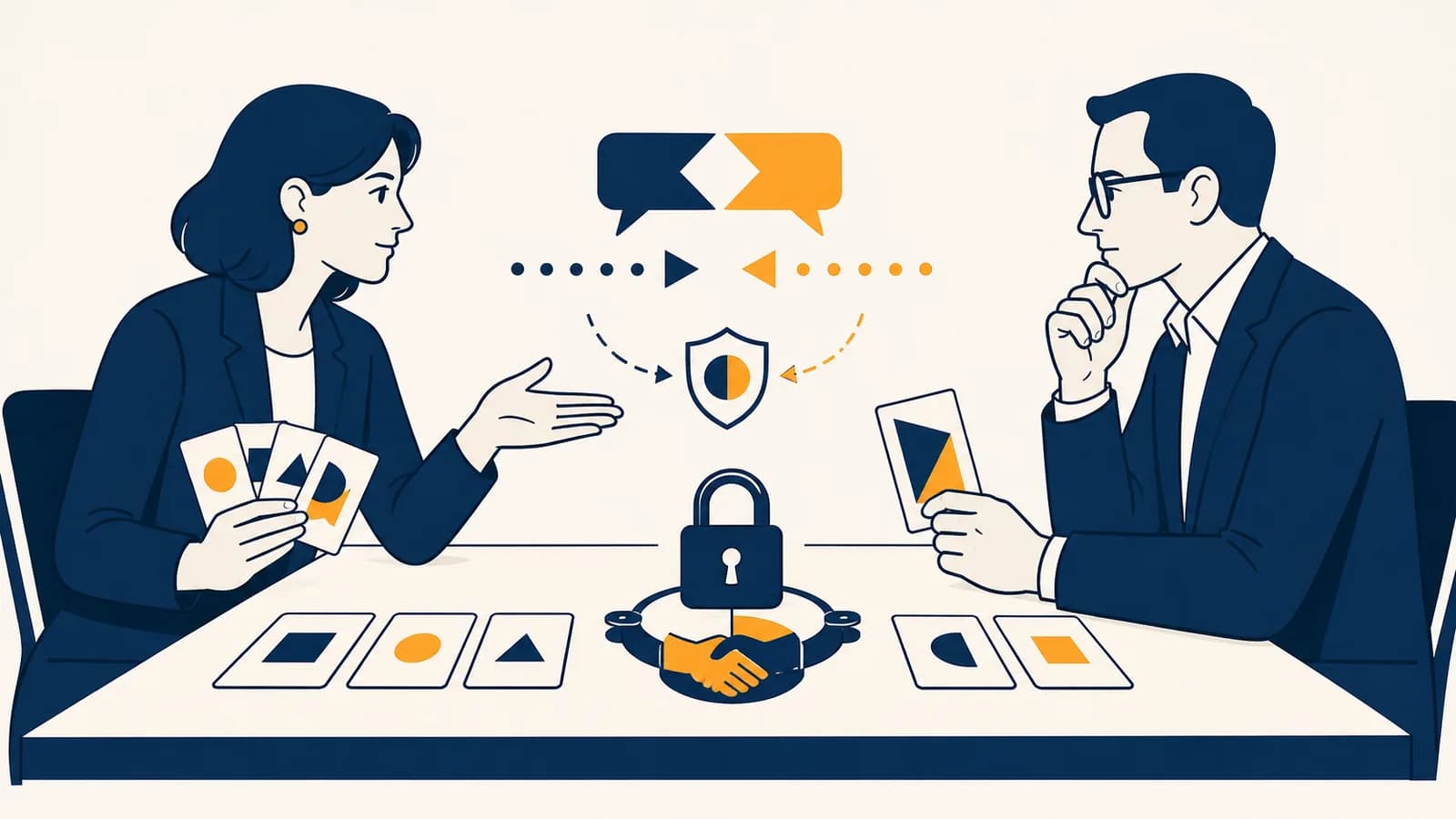
Bluffing, signaling, and commitment shape ordinary choices
Bluffing, signaling, and commitment are game theory strategies for changing what other people believe, expect, or choose. These concepts explain salary negotiations, school deadlines, online marketplaces, political promises, and arguments at home. By separating claims from costly evidence and reversible talk from binding action, you can identify each strategy, predict when it will work, and avoid being manipulated by it.
Game theory studies decisions in which your result depends partly on someone else's choice. A chess move changes the position directly. A threat in chess also changes what the other player expects you to do next. That second effect matters in many human decisions because people act on beliefs about hidden information and future behavior.
You choose an umbrella after checking the forecast. The weather does not study your choice and respond.
You name a price while bargaining. The buyer hears it, updates a belief about your minimum price, and chooses a reply.
The three concepts act on different parts of that belief process. A bluff tries to create a false belief. A signal carries information that may be true or false. A commitment changes future options so that a promise or threat becomes believable. They can appear together, but they are not synonyms.
What makes an action a bluff?
A bluff is an attempt to gain an advantage by making another player believe you have information, strength, or intentions that you do not have. It succeeds only if the other player changes a decision because the false impression seems believable.
Poker supplies the clean example. A player with a weak hand bets as if the hand were strong. The bet does not improve the cards. It changes the opponent's estimate of the chance that calling will pay. If the opponent folds, the bluff works. If the opponent calls, the cards can expose it.
An applicant says, “I would need a much stronger offer to consider moving.” If the applicant would actually accept the current figure, the statement may be a bluff. The employer must judge the chance that refusal will end the negotiation.
A bluff needs uncertainty. If the employer knows the applicant's minimum acceptable salary, the statement has little power. A bluff also needs a response that benefits the bluffer. Pretending to own a yacht in a conversation is deception, but it is not strategically useful unless the false belief changes someone's choice.
Bluffing is not free. Failed bluffs can cost money, reputation, access, or trust. A person who constantly announces that every deadline is final trains others to ignore the announcement. Repetition creates evidence about behavior, so today's cheap exaggeration can make tomorrow's honest warning less effective.
A bluff is not a probability machine. It does not make a weak position strong. It can pay only when another player may respond to the appearance of strength.
This distinction helps with news reports and public debate. A dramatic claim can sound forceful without changing the speaker's ability to act. Checking incentives, available evidence, and past follow-through often reveals more than judging confidence or tone.
How does a signal carry information?
A signal is an observable action that gives another player information about something hidden, such as skill, quality, need, or intent. Signals are most informative when sending them is easier for the genuine type than for an imitator.
Consider two bicycle sellers. Both can write “excellent condition” in an advertisement. Those words are cheap talk because either seller can type them at almost no cost. A recent inspection report is harder to imitate if a bicycle has serious faults. The report does not guarantee quality, but it changes the buyer's evidence.
The action can be a signal even if nobody planned it as one. Arriving early may signal reliability. Refusing to provide basic records may signal risk. A long product warranty can signal that a manufacturer expects few failures because an unreliable product would make the warranty expensive to honor.
Cost does not always mean money. A useful signal might require time, effort, knowledge, exposure to checking, or the risk of being proved wrong. A code portfolio can signal programming skill because producing working programs takes ability and work. Knowing how to run and change the code also makes it easier to inspect such claims.
Signals also interact with unequal access. A costly certificate may correlate with skill, but it can also reflect who had time and money to obtain it. The study of how income and opportunity are distributed helps separate evidence of ability from evidence of access. A sensible decision-maker asks what else could have produced the same signal.
Why are some signals believable and others cheap talk?
A signal is believable when its cost, risk, or design connects it to the hidden fact it claims to reveal. Cheap talk can still be honest, but words alone usually provide weak evidence when lying is easy and profitable.
The useful test is not “Did this take effort?” It is “Would the wrong type find this action harder or less attractive?” A skilled mechanic and an unskilled mechanic can both buy an expensive jacket. The jacket is costly, yet it says little about repair skill. A guarantee to fix mistakes for free is different because poor work makes that promise expensive.
If half of sellers are high quality, 80% of them provide a verifiable report, and 20% of low quality sellers do, then a reported seller is high quality with probability .
This calculation uses Bayes' rule. It makes the mechanism visible: a signal matters when it is more common among one type than another. If high quality and low quality sellers provide the report equally often, the report does not separate them and the buyer's belief does not change.
Real decisions rarely arrive with neat percentages. The structure still helps. Ask how often an honest or capable person would send the signal, then ask how often an imitator could send it. Reviews, credentials, uniforms, prices, and confident language all need this test.
Digital products add another problem: demonstrations can be selected to hide failures. A polished video proves that one run worked under some conditions. It does not prove that the system works on unfamiliar inputs. The habits taught in checking AI-generated code with deliberate tests apply more broadly: seek cases chosen by the evaluator, not only examples chosen by the seller.
What turns a promise or threat into a commitment?
A commitment is an action taken now that restricts, changes, or makes costly your later choices. It makes a future promise or threat credible because backing away will no longer be easy, even if your preferences change.
Suppose a shop promises to refund any purchase returned within an agreed period. A spoken promise may disappear when a refund becomes costly. A written policy processed by a payment platform is harder to escape. The system changes the shop's future options, so the buyer can place more weight on the promise.
“I will finish the report on Friday.” The speaker keeps every later option and can easily change course.
“If I miss Friday, the client receives an automatic discount.” Missing now carries a cost that was arranged in advance.
Commitment can support cooperation. Deposits, contracts, automatic transfers, public deadlines, and locked settings all move a cost or constraint into the future. A student who gives a draft to a classmate for comments creates social and practical pressure to produce it. A saver who schedules a bank transfer reduces the number of fresh decisions required each month.
Commitment can also make conflict more dangerous. If two sides publicly remove their ability to compromise, neither can retreat without a visible loss. A threat that becomes highly credible may deter the other side, but it can also cause a bad outcome when deterrence fails.
Credibility and morality remain separate questions. A harmful threat can be credible. A generous promise can be incredible. Game theory asks what others should expect given the incentives and constraints; ethics asks what people should do.
How do these strategies combine in one negotiation?
In negotiation, a player can signal private information, bluff about limits, and commit to a future action within the same exchange. The useful task is to identify which belief each move targets and what makes the move costly to fake.
The seller says another buyer is interested, shows a diagnostic report, and sets an automatic listing deadline. The first claim might be a bluff, the report signals condition, and the deadline may commit the seller to end the offer.
The moves look similar because all influence expectations. Their mechanisms differ. The alleged second buyer concerns hidden competition. The diagnostic report concerns hidden quality. The listing deadline concerns future availability. Treating all three as “sales pressure” loses information you can use.
Ask what you cannot directly observe: the minimum price, product quality, competing offers, or future intent.
Separate checkable records and actions from statements that anyone in the same position could make.
Ask who benefits if you believe the claim, and what a false claim would cost if discovered.
Look for a contract, deposit, automatic process, deadline, reputation cost, or other limit on later retreat.
This method does not reveal minds. It improves the questions. If the diagnostic report comes from software selected by the seller, request a test you control. If the deadline can be extended with one click, treat it as pressure rather than a strong commitment. If another buyer supposedly exists, avoid paying more than the laptop is worth to you.
Good negotiation also includes your own signals. A clear budget can signal a real constraint, but only if your behavior matches it. A willingness to walk away makes a price limit more credible. Providing proof of funds may signal ability to complete a purchase, though it should be done without exposing unnecessary financial information.
When does strategic behavior damage cooperation?
Strategic behavior damages cooperation when private rewards favor misleading signals, empty threats, or taking a shared benefit without contributing. Repeated interaction can discourage this conduct because today's gain may reduce trust and access tomorrow.
Imagine four housemates sharing a kitchen. Cleaning benefits everyone, but each person would prefer someone else to do the work. If nobody can observe effort, a housemate may claim to have cleaned or may wait for others. This is a problem involving shared benefits and public goods, because individual incentives can produce a worse group result.
Reputation is stored evidence. A history of keeping promises can make future words informative. A history of bluffing makes even truthful claims less persuasive.
Repeated games change the cost of deception. A seller who expects only one sale may gain from hiding a defect. A seller who expects customers to return and compare notes risks future business. Schools, firms, platforms, and communities often create records or feedback systems for exactly this reason.
Those systems can fail. Reviews can be faked, retaliation can silence honest reports, and old mistakes can follow people after their behavior changes. Better systems make evidence checkable, give accused people a fair response, and distinguish a repeated pattern from one ambiguous event.
Geography also shapes strategic choices. A country dependent on one pipeline or shipping route has fewer options during a dispute. Studying how places, resources, and connections affect decisions shows why a commitment that sounds strong on paper may depend on physical routes, neighboring states, and replacement supplies.
You can read the game without assuming everyone is dishonest
Game theory is most useful when it improves judgment without turning every conversation into suspicion. People often tell the truth, keep informal promises, and help without payment. The method simply asks what information exists and how incentives affect its reliability.
Start with the hidden fact. Then classify what you observe. A claim might be cheap talk, a bluff, a genuine signal, or several at once. Look for the cost of imitation and the possibility of verification. Finally, check whether a promise changes future options or only describes a current intention.
The takeaway: A bluff tries to create a false belief, a signal supplies evidence about hidden information, and a commitment makes future action credible by changing the options. Judge each move by its mechanism, not by how confident it sounds.
These tools do not produce certainty. They help you locate uncertainty and respond in proportion to it. Ask for evidence when evidence is possible. Keep an exit when the other side's claim cannot be checked. Use commitments carefully, because a device that makes a good promise believable can also lock people into a bad decision.
The practical advantage is simple: you can slow down a pressured choice and inspect its structure. What does the other person want you to believe? What action produced that belief? Could an imitator produce it cheaply? What prevents retreat later? Clear answers make manipulation harder and cooperation easier to build.