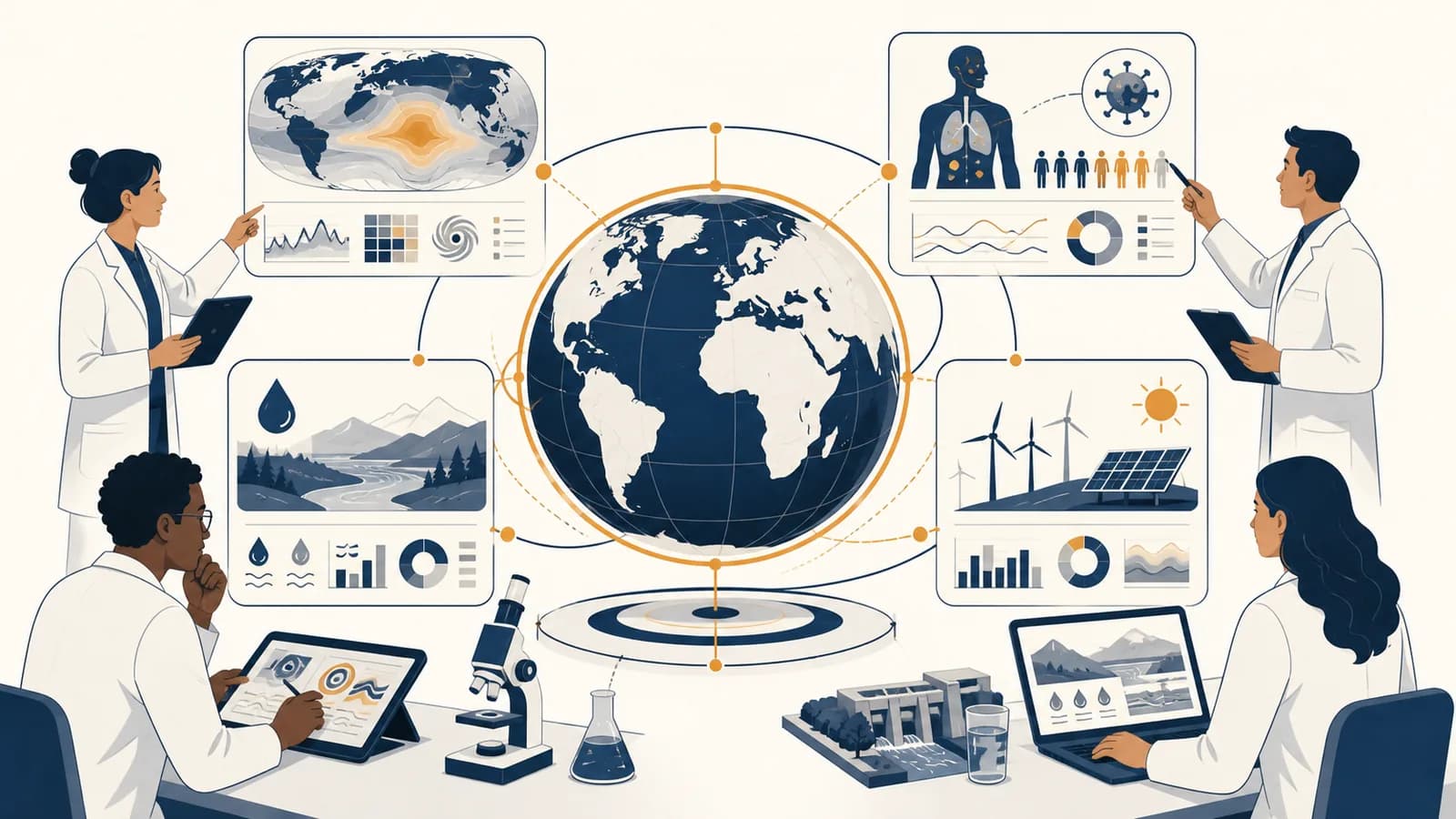
Science turns global problems into testable decisions
Science helps solve global issues by turning broad dangers into measurable causes, testable explanations and interventions whose results can be checked. Its importance lies in the method: by the end, you can trace how scientific evidence guides action on climate, disease, food, water, energy and disasters.
A global problem crosses borders or affects systems that countries share. Greenhouse gases mix in the atmosphere. A virus can move with its host. Smoke travels downwind, rivers cross frontiers and a failed harvest can alter food prices far from the field. No single observation or laboratory can describe all of these systems. Scientists therefore combine measurements, experiments, models and repeated checks across places and times.
Science does not produce a policy automatically. It can identify causes, estimate likely consequences and compare possible interventions. People and governments still decide what outcomes they value, which risks they will accept and how costs should be shared. This boundary matters. Evidence can show that a flood barrier reduces expected damage, but it cannot decide by itself which neighbourhood receives protection first.
The method also corrects itself. Measurements can be recalibrated. Another research group can repeat an analysis. A model can fail against new observations and be revised. Error is not proof that science is useless. Hidden or uncorrected error is the danger; organised checking is the response.
How does science define a problem that crosses borders?
Scientists define a global problem by specifying what changes, where it changes, over what period and through which physical, biological or social mechanism. A useful definition also names the population exposed and the outcome that counts as harm, improvement or failure.
Consider extreme heat. The phrase is incomplete until a study states the temperature measure, the duration, the local baseline and the outcome being examined. Air temperature, surface temperature and the heat experienced by a human body are related but different. Humidity can slow the evaporation of sweat. Buildings and paved surfaces store heat. Age, health, housing and access to cooling change exposure. Each detail suggests a measurement and a possible response.
Scale changes the question. A satellite can reveal regional vegetation loss, while a soil sample can reveal which nutrients are missing from one field. Neither view replaces the other. Researchers connect them by using ground measurements to check remote observations, then using the wider map to find patterns that a local survey could miss. The tools of Geography are especially useful because location, distance and spatial concentration often determine who is exposed.
Definitions also prevent misleading comparisons. A city may report fewer flood deaths after installing warning systems, even while property damage rises because more buildings occupy the floodplain. If success means only fewer deaths, the programme worked. If it means lower total damage, the conclusion may differ. Good science makes the chosen outcome visible.
A measurement is not the same as the thing measured. A thermometer records temperature at a place and time. It does not, by itself, describe a person's heat exposure, the source of the heat or the best response.
How does evidence become an effective intervention?
Evidence becomes an intervention through a chain of causal reasoning: identify a cause, change it in a controlled or carefully compared setting, measure the outcome and check for unwanted effects. An intervention earns confidence when different methods point to the same explanation.
Suppose a town finds harmful material in drinking water. A test must first distinguish the substance from other compounds. Samples must show where and when it appears. Investigators then trace possible sources, such as a pipe, a factory discharge or naturally occurring minerals. A treatment is tested at a suitable scale, and water is sampled after treatment. Health protection also requires maintenance, staff training and a way to detect failure.
State what improvement means, such as a lower concentration of a contaminant at the tap.
Trace how the hazard reaches people and identify a point where the pathway can be interrupted.
Compare measurements before and after the change, with a suitable control or comparison where possible.
Check cost, access, maintenance and side effects rather than reporting only the intended result.
Different study designs answer different questions. A controlled laboratory experiment can isolate a mechanism. A randomised trial can compare interventions while reducing some forms of bias. An observational study can examine exposures that would be unethical or impossible to assign. Natural experiments use events or rules that create useful comparisons. Confidence grows when the weaknesses of one design are covered by the strengths of another.
Effectiveness is not the same as efficacy. A filter may remove a contaminant under laboratory conditions but fail in homes if replacement cartridges are costly or unavailable. This is where science meets economics and public administration. Lessons about Income Distribution and Inequality help explain why the same technical solution can protect one group while leaving another exposed.
A school installs carbon dioxide monitors as a rough indicator of ventilation in occupied rooms. A high reading prompts staff to inspect airflow, open suitable windows or adjust mechanical systems. The monitor does not detect every airborne hazard, so it guides investigation rather than proving that a room is safe or unsafe.
What can climate science tell decision-makers?
Climate science explains how energy moves through the atmosphere, oceans, ice and land, then uses observations and models to estimate how added greenhouse gases alter that movement. It can compare possible futures, locate risks and test whether emissions or adaptation measures work.
Earth receives energy mainly as sunlight and loses energy by emitting infrared radiation. Greenhouse gases absorb and re-emit some infrared radiation, changing the rate at which energy escapes to space. When incoming energy exceeds outgoing energy, the climate system gains energy. Oceans store much of that added heat, while air, land and ice also respond.
If a system receives 100 energy units and emits 99 during the same interval, its stored energy increases by 1 unit.
This relation is simple; the climate system is not. Clouds can reflect sunlight and trap infrared radiation. Ice loss exposes darker surfaces that absorb more sunlight. Ocean circulation transports heat. Scientists represent these processes with equations based on physics, then check model output against observations that were not used to construct a particular test.
A projection is conditional. It asks what is likely under stated assumptions about emissions, land use and other influences. It is not a promise that one exact temperature or rainfall total will occur on one date. Decision-makers can compare scenarios, identify choices that work across several plausible futures and revise plans as observations arrive.
A scientific model should predict the exact weather in a particular street many decades ahead.
Models can estimate changes in climate patterns and ranges under stated conditions, then help planners compare risks and responses.
Mitigation and adaptation answer different parts of the problem. Mitigation reduces the causes of climate change, for example by cutting greenhouse gas emissions. Adaptation reduces harm from changes that occur, for example through heat plans, water storage or buildings designed for local hazards. Research on Rural and Urban Development shows why the same climate hazard produces different consequences depending on settlement patterns, infrastructure and public services.
How do biology and public health contain shared threats?
Biology and public health contain shared threats by identifying an agent, learning how it spreads, interrupting transmission and monitoring the result. Laboratory work explains mechanisms, while field data show how behaviour, immunity, living conditions and health services shape real outbreaks.
For an infectious disease, investigators may examine the pathogen's genetic material, the route of transmission, the time between infection and symptoms and the immune response. These facts guide tests, treatment and prevention. If transmission occurs mainly through the air, ventilation and filtration matter. If an insect vector is required, controlling breeding sites may matter more.
Surveillance turns scattered cases into a pattern that can be investigated. A case definition tells clinics which signs, test results or exposures to report. Laboratories check samples. Epidemiologists compare time, place and affected groups. When the pattern changes, the explanation must be tested rather than assumed.
Evolution matters because populations contain variation. A mutation that improves a pathogen's survival under a particular pressure can become more common through natural selection. The same principle explains antibiotic resistance. Antibiotics kill susceptible bacteria, but resistant bacteria may survive and reproduce. Correct prescribing, infection control and continued monitoring reduce the opportunities for selection and spread.
Public trust affects the final link in the chain. A technically accurate message can still fail if it hides uncertainty, ignores past harm or offers advice people cannot follow. Clear communication states what is known, what remains uncertain, what action is recommended and what new evidence would change that advice.
How do science and engineering protect food, water and energy?
Science explains the limits and interactions within food, water and energy systems; engineering turns those explanations into equipment, processes and infrastructure. Protection comes from testing performance under real conditions, tracking tradeoffs and designing backups for failures that cannot be completely prevented.
A farm needs water and nutrients, but adding more of either does not guarantee more food. Roots require oxygen as well as water. Excess nutrients can leave fields and change aquatic ecosystems. Crop breeding, soil chemistry, weather observations and ecological knowledge help match a crop and method to local conditions. Field trials then reveal how the method performs outside a greenhouse.
Water treatment uses a sequence because no single step removes every hazard. Screening can remove large debris. Settling can remove suspended material. Filtration catches smaller particles, and disinfection inactivates many microorganisms. Operators measure the water before, during and after treatment because a process that cannot be monitored cannot be trusted for long.
Energy planning joins physics to patterns of demand. A generator's rated power states how quickly it can deliver energy under specified conditions. The energy supplied over a period depends on power and time. Storage, transmission capacity, maintenance and changing demand all affect whether supply is available when needed.
A 2 kilowatt device operating for 3 hours uses kilowatt-hours of energy.
Food, water and energy also compete for land, materials and money. Pumping and cleaning water uses energy. Some electricity generation uses water. Growing, processing and transporting food use both. A good intervention therefore measures effects beyond its immediate target and looks for shifted burdens.
Why do uncertainty and disagreement belong in good science?
Uncertainty and disagreement belong in science because every measurement has limits, samples vary and models simplify reality. Good researchers estimate those limits, test competing explanations and show which conclusions remain stable. Stated uncertainty is information for a decision, not an admission of ignorance.
Measurement uncertainty may come from an instrument's resolution, calibration or sampling method. Statistical uncertainty arises because a sample is only part of a population. Model uncertainty reflects incomplete knowledge of a system or different reasonable ways to represent it. Scenario uncertainty comes from future choices that have not yet been made.
A single estimate is presented without its assumptions, range or possible sources of error.
A result states what was measured, how variable it was, which assumptions matter and what evidence could revise the conclusion.
Decisions cannot always wait for perfect information. Expected loss offers one way to compare risks by combining probability with consequence. It does not capture every ethical concern, especially when harms are irreversible or distributed unfairly, but it makes one part of the reasoning visible.
If an event has probability and would cause 50 units of loss, the expected loss is units.
Replication and transparent records help separate a durable result from an accident. Researchers should keep data definitions, code, parameter choices and analysis steps clear enough to inspect. The computing practice taught in Version Control: Never Lose Your Work Again is useful here because it records what changed, when it changed and which version produced a result.
Scientific disagreement is most informative when its source is named. Researchers may use different data, assumptions or definitions. They may agree on the mechanism but disagree about its size. Public debate often compresses these distinctions into two opposing positions. Reading the methods and identifying the exact disputed step produces a clearer picture.
Scientific knowledge works only when institutions can use it
A discovery changes a global issue only when people can manufacture it, maintain it, afford it, regulate it and judge its effects. Laboratories can show that a method works under specified conditions. Institutions determine whether the method reaches the people and places where it is needed.
This translation creates feedback. Health workers report which diagnostic tests fail in hot or dusty settings. Farmers report which seed varieties perform under local rainfall and storage conditions. Engineers inspect damaged structures after a storm. Each observation can improve the next design, provided the system records failure instead of hiding it.
Fairness is part of performance. If an early warning reaches only people with smartphones, its technical accuracy does not protect people without them. If a cleaner technology removes pollution locally but moves hazardous extraction elsewhere, the full system has not improved equally. Scientists can map these effects and compare outcomes across groups. Law and politics still decide which distribution is acceptable.
A technical fix can move a problem instead of solving it. Always ask where the materials came from, who can access the benefit, who carries the waste and how failure will be detected.
Citizens do not need specialist training to ask strong scientific questions. What exactly was measured? Compared with what? How large was the effect? Which assumptions connect the data to the claim? Who was missing from the sample? What evidence would change the conclusion? These questions expose weak reasoning and make strong reasoning easier to recognise.
Global cooperation is difficult because countries have different resources, laws and immediate needs. Shared measurement standards allow results to be compared. Open methods allow errors to be found. Local knowledge reveals conditions that a distant research team may miss. Durable solutions connect these forms of knowledge without pretending that one institution can see the entire system.
The takeaway: science contributes most when it links a measurable problem to a tested mechanism, a practical intervention and continued observation. Evidence narrows uncertainty, while transparent choices decide how knowledge becomes action.
The importance of science in solving global issues is therefore practical and limited in a useful way. Science can explain causes, reveal tradeoffs and show whether an intervention performs as claimed. It cannot choose society's values. Better decisions happen when evidence is tested openly, uncertainty is stated honestly and affected communities can shape how the solution is used.