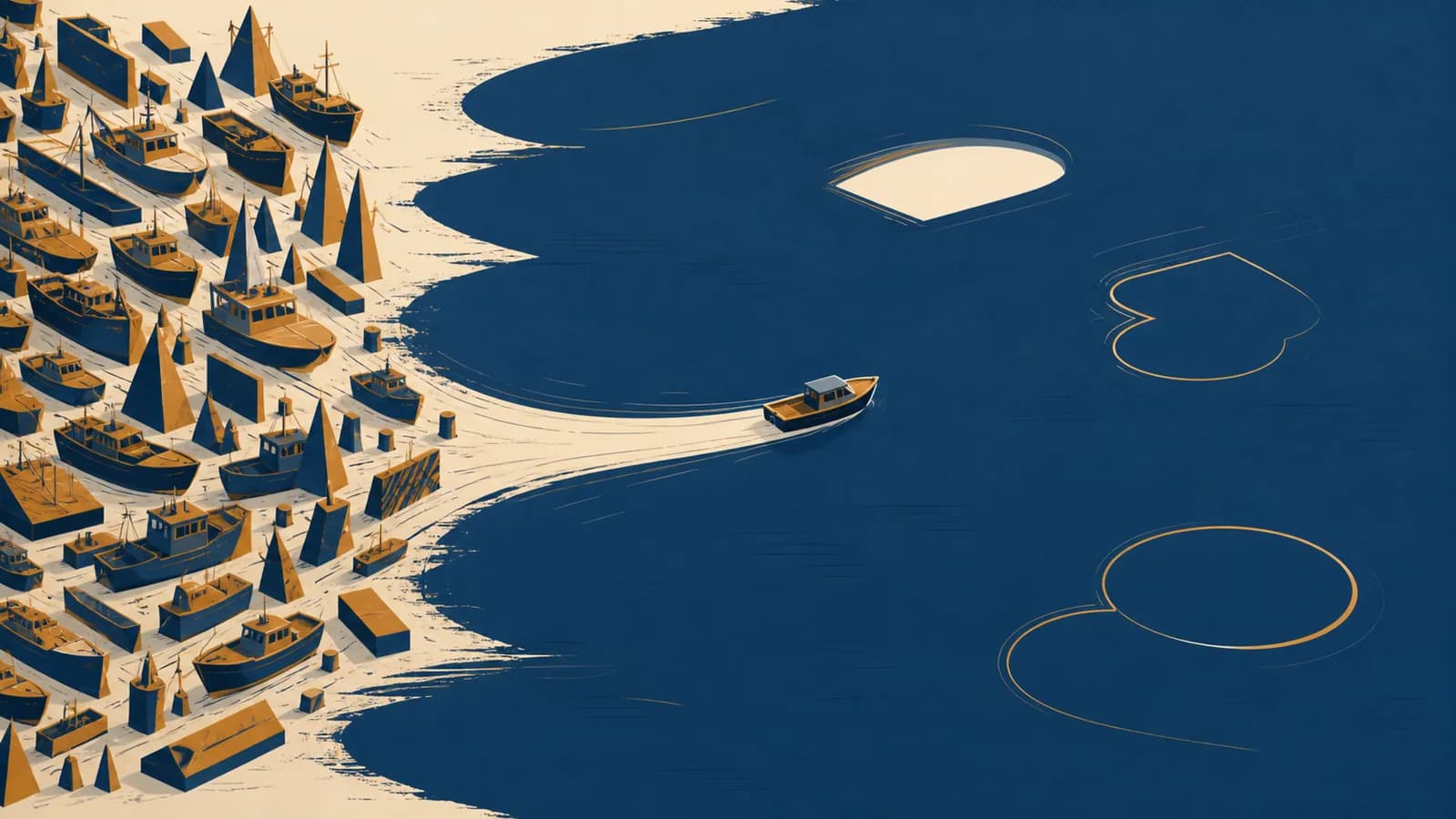
Blue ocean strategy creates demand instead of stealing market share
Blue ocean strategy finds growth by creating useful demand where competitors are not yet fighting. To find an uncontested market space, identify people an industry ignores, remove the barriers that keep them out, and redesign the offer around a different mix of value and cost.
A red ocean is an existing market with accepted boundaries. Sellers compete for known buyers using familiar measures such as price, speed, status, or feature count. As more sellers chase the same demand, each improvement becomes easier to copy and each sale becomes harder to win profitably.
A blue ocean is not an empty industry or a magical idea with no alternatives. It is a new value curve: a combination of benefits, omissions, price, and access that makes old comparisons less useful. A meal kit still competes with supermarkets, restaurants, and cooking from scratch. Its market space comes from combining measured ingredients, home preparation, and reduced planning.
How can we beat the current sellers on the measures buyers already compare?
Which buyers and uses are missing because the accepted measures make the offer too costly, difficult, or irrelevant?
The distinction changes the research task. Competitor analysis studies what current sellers do. Blue ocean research also studies noncustomers, workarounds, abandoned attempts, and jobs people still perform badly. The richest evidence often appears outside the current customer list.
What makes a market space genuinely new?
A market space is genuinely new when an offer changes who can buy, what problem is solved, or how the result is obtained. Novel branding alone does not count. The change must produce a reason for people to act differently and support a workable business.
Consider a hypothetical bookkeeping service for solo tradespeople. Ordinary accounting software may compete through more reports, integrations, and controls. A different offer might replace most controls with photo capture, plain-language cash reminders, and a fixed monthly review by a human. It serves people who rejected accounting software because it felt like another job.
The offer is not technologically unprecedented. Cameras, forms, and accountants already exist. The novelty sits in the assembled system and the chosen buyer. This matters because founders often search for a new invention when they should search for an unresolved tradeoff.
A useful test is substitution. Ask what people do before your offer exists. They may use a spreadsheet, ask a relative, tolerate a delay, pay an unsuitable provider, or do nothing. Doing nothing is still a competitor because it shows the current cost of solving the problem exceeds the expected benefit.
New demand is observable. It appears when previous noncustomers begin paying, participating, or completing a task they once avoided. Attention without changed behavior is weak evidence.
Another test is comparison. If buyers can rank the offer using exactly the same scorecard as every rival, the market may still be red. A blue ocean candidate changes the scorecard itself. It could make ownership unnecessary, turn an expert task into a guided task, or trade maximum performance for reliability and ease.
Where do overlooked markets hide?
Overlooked markets hide around noncustomers: people about to leave an industry, people who consciously reject it, and people whom the industry has never treated as possible buyers. Their reasons reveal barriers that customer surveys rarely expose because existing customers already crossed those barriers.
Start with behavior, not a broad demographic. “Young people” is too vague to guide design. “Apprentices who photograph paper receipts but postpone entering them until Friday” names a task, a delay, and an existing workaround. A team can observe each part and test a replacement.
Look for six kinds of friction:
- Money: the price, deposit, equipment, maintenance, or risk of a wasted purchase is too high.
- Time: setup, travel, waiting, learning, or coordination takes longer than the result feels worth.
- Skill: the buyer needs vocabulary, technique, or confidence that the industry assumes.
- Access: the offer depends on location, opening hours, physical ability, language, or permission.
- Trust: the buyer cannot judge quality before purchase or recover easily after a bad result.
- Identity: using the product signals membership in a group the person does not identify with.
Evidence can come from support tickets, search terms, sales notes, returns, community discussions, and interviews. Store observations in a consistent format so patterns can be counted and traced. The subject page on organizing evidence with databases explains why structured records make comparisons more reliable than scattered notes.
A local climbing gym interviews people who visited once but never returned. Several describe the same chain: they did not know what to wear, feared looking foolish, and could not tell which wall was safe for a beginner. The opportunity is not another advanced wall. It may be a timed beginner circuit, clothing guidance at booking, visible difficulty cues, and a host who introduces the first route.
The interview question matters. “Would you buy a beginner membership?” invites politeness and imagination. “Tell me about the last time you considered returning” asks for remembered behavior. Follow with questions about what happened next, what the person tried instead, and what cost or uncertainty stopped them.
Value innovation changes benefits and cost together
Value innovation means raising buyer value while changing the cost structure, rather than adding benefits without limit. A strong blue ocean offer removes expensive features that target users barely value, then directs resources toward the barriers that keep noncustomers from entering.
The practical tool is the four actions framework. List the factors on which the industry competes, then decide what to eliminate, reduce, raise, and create. The sequence prevents “new” offers from becoming the old product with extra features and a higher price.
| Action | Question | Bookkeeping example |
|---|---|---|
| Eliminate | Which accepted feature adds cost without helping the chosen user? | Complex departmental permissions for a solo operator |
| Reduce | Which factor is supplied far beyond what the user needs? | The number of configurable reports |
| Raise | Which source of uncertainty deserves more attention? | Plain-language explanations and response speed |
| Create | Which missing benefit would bring a noncustomer into the market? | A monthly human check before records accumulate |
Eliminate and reduce create room for a lower cost base. Raise and create make the offer attractive to a specific group. The sides must connect. If a service removes live support but promises anxious beginners greater certainty, its choices contradict one another.
Hypothetical example: a result valued at $65, minus an $18 fee and two setup hours valued at $12 each, gives $23 of buyer value.
Full buyer cost is wider than price. It includes time, effort, anxiety, complementary purchases, switching work, and the chance of failure. The values in the worked example are assumptions for one buyer, not market facts. Their purpose is to make hidden costs discussable.
Price still affects demand, and different groups respond differently to a change. The relationship is developed further in the lesson on price elasticity. For a blue ocean candidate, test price together with the new benefit bundle because buyers judge the package, not the number in isolation.
How do you draw a strategy canvas?
A strategy canvas plots the factors buyers receive along one axis and the level offered along the other. It shows whether a proposal has a distinct shape or simply copies the industry average. The drawing is a thinking tool, not proof of demand.
Use buyer language such as waiting time, expert help, choice, setup effort, and predictable cost. Avoid internal department names.
Choose a simple shared scale, such as 1 to 5, and support every score with observations, prices, product behavior, or interviews.
Show where the offer eliminates, reduces, raises, or creates value. A distinctive curve should reflect deliberate choices, not random difference.
Name the user, result, and removed barrier. If the sentence needs a long feature list, the offer probably lacks focus.
Suppose the alternatives for evening study support are private tutoring, recorded courses, and open study groups. Factors might include scheduling flexibility, personal feedback, social pressure, subject range, and price predictability. A new offer could provide a quiet supervised room, short expert check-ins, and bookable focus blocks. It would reduce continuous one-to-one teaching while raising structure and access.
Do not treat the vertical scale as precise measurement unless the underlying data support that claim. A score of 4 is usually an organized judgment. Its value comes from making assumptions visible and comparable. If two team members disagree, ask what evidence would change the score.
A canvas becomes useful when it forces a decision. If every factor rises, costs will probably rise too. If the new curve matches a competitor, the proposal needs sharper choices. If created factors solve no observed barrier, they are decoration.
How can you test demand before building the full offer?
Test the riskiest behavior with the smallest honest version of the offer. Ask people to spend something meaningful, such as money, time, data, or reputation. A compliment tests politeness; a booking, deposit, completed task, or repeat use tests commitment.
Begin by writing the chain of assumptions. The target user experiences a specific problem. The barrier is strong enough to block the current solution. The new design removes that barrier. The user understands the promise. Delivery costs leave room for a sustainable price. One weak link can break the business.
For the beginner climbing offer, the gym could publish one bookable session, deliver it manually, and observe where participants hesitate. Staff can record booking completion, attendance, first-route completion, requests for help, and return bookings. The experiment tests the whole promise without rebuilding the facility.
Use a denominator whenever reporting a rate. Six returns sound encouraging, but six out of eight and six out of eighty describe different behavior. If rates feel unfamiliar, working confidently with fractions and decimals makes the arithmetic easier to check.
Worked example: 9 paid bookings from 60 eligible visitors gives .
The 15 percent result is computed example data, not a benchmark. It cannot declare success by itself. Compare it with the test cost, capacity, expected margin, source of visitors, and what happened after the first booking. A small test can reject a weak assumption, but it rarely measures a whole market.
Do not disguise research as a finished service. Tell participants what exists, what is manual, what they will pay, and what happens if the test stops. Honest limits protect trust and improve the evidence.
Set a decision rule before seeing results. For example: run the session again if enough participants pay the stated price, attend, complete the first route, and request another booking while delivery fits the staffing limit. Define “enough” from the economics of the proposed operation, not from a universal startup benchmark.
What causes blue ocean attempts to fail?
Blue ocean attempts fail when difference replaces usefulness, research samples only enthusiasts, or the business cannot deliver the promise at its chosen price. The usual problem is not a rival copying the idea. It is an untested assumption about demand, access, or cost.
Several failure patterns recur:
- Novelty without a job: buyers notice the idea but have no important reason to use it.
- Features without sacrifice: the team adds new benefits and removes nothing, so complexity and cost climb.
- The wrong noncustomer: some people reject a market because they do not value the result at any feasible price.
- A hidden adoption chain: the user likes the product, but a parent, manager, regulator, installer, or payment system can block use.
- Temporary difference: the offer is easy to copy and has no advantage in trust, distribution, learning, community, or operating method.
- Bad unit economics: each sale creates more delivery cost than contribution toward the rest of the business.
Map the people involved in adoption. A school tool may be used by students, selected by teachers, approved by administrators, paid for by a district, and constrained by privacy rules. Winning one person does not complete the chain.
People say the concept is clever, a post attracts views, and friends say they would probably try it.
Target users complete the intended action, accept the real conditions, return, and can be served within the cost limit.
Imitation is not automatic failure. Competitors validate demand and can enlarge awareness. The defence is to learn faster about the chosen users, build a delivery system that supports the value curve, and keep examining noncustomers. Patents or contracts may matter in some industries, but no legal barrier rescues an offer that people do not value.
Markets also turn red over time. Once buyers understand a new category, they gain comparison criteria and sellers cluster around them. Blue ocean strategy is therefore a repeated practice of observation, subtraction, redesign, and testing, not a permanent label a company earns.
A useful blue ocean begins with a barrier you can remove
The most credible opportunity begins with observed exclusion: a person wants a result but rejects the available route because of cost, skill, time, access, trust, or identity. Remove that barrier while preserving sound economics, and new demand can become a market.
Use a one-page decision record. Name the target noncustomer and the job they already try to complete. Describe the current workaround. Quote or summarize the observed barrier. List what the offer eliminates, reduces, raises, and creates. State the price assumption, delivery constraint, riskiest belief, first experiment, and decision rule.
Then calculate what must be true. If a manual session costs $180 to staff and can serve 12 people, the direct staffing cost is $15 per occupied place because . Empty places raise the cost per participant. Add space, materials, payment fees, acquisition, support, and refunds before judging the price.
Good strategy connects human behavior with arithmetic. The broader tools of economics for studying choices and markets help explain opportunity cost, demand, incentives, competition, and the limits imposed by scarce resources. Blue ocean work applies those foundations to a specific design decision.
Treat that sentence as a standard to test, not a slogan. Better means the barrier falls. “Reason to act” means behavior changes. Overlooked buyers means evidence comes from outside the comfortable group of existing customers.
The takeaway: Search for noncustomers with a shared, costly barrier. Build a focused value curve by removing some industry assumptions and raising the benefits those people need. Test commitment before scale, and let observed behavior plus visible arithmetic decide what happens next.
A blue ocean is found in the gap between a wanted result and an unacceptable way of reaching it. The work is concrete: observe the gap, redesign the tradeoff, price the system, test the behavior, and revise the offer until value for the buyer and value for the provider can exist together.