What can a $0 AI stack actually replace?
A $0 AI stack can replace chunks of expensive knowledge work, but it cannot replace the judgment, accountability, or relationships of a highly paid employee. Free AI tools can draft, transcribe, classify, search, and automate a supervised office workflow on hardware you already own.
The useful comparison is not software versus a whole person. It is software versus a queue of repeatable tasks. A manager may spend Monday turning meeting notes into action items, checking a spreadsheet for exceptions, drafting routine replies, and moving facts between systems. Each task has a recognizable input and output. That makes each one a candidate for automation.
Give one chatbot a job title, connect every account, and expect it to manage the work without supervision.
Split the job into narrow tasks, give each task a fixed input and output, then put a human at the expensive decision points.
The phrase “$200K employee” describes the market value of a broad set of abilities, not a machine benchmark. Pay also reflects scarce experience, legal responsibility, negotiation skill, and trust. Software can imitate a visible deliverable while missing the hidden work that made it safe. A polished client memo may rest on interviews, source checking, political judgment, and the writer's willingness to sign their name.
A sensible target is therefore task replacement. Ask what enters the task, what a good result contains, how failure is detected, and who owns the final decision. Those four questions turn a boast about AI into a workflow that can be tested.
Which free tools belong in the stack?
A practical free AI stack needs five functions: model inference, document conversion, a workbench, automation, and storage. The names can change, but these functions remain. Choose tools that exchange ordinary files or documented data formats, so one vendor cannot trap the entire workflow.
Ollama runs compatible language models on a local computer and exposes an application programming interface on that machine. This is the reasoning and text generation layer. The runner may be free, but every model has its own license, memory needs, and limits. Read the model card before using its output commercially.
Whisper converts speech into text. OpenAI publishes the Whisper code and model repository under the MIT License, so it can run locally without a metered transcription service. Tesseract performs optical character recognition on images and scanned pages. It is useful for extraction, although a blurred receipt or complex table still needs inspection.
Python handles exact transformations that a language model should not guess: dates, totals, file names, validation rules, and application programming interface calls. SQLite stores structured records in a single database file. Git records changes to prompts, scripts, and tests. These are the quiet parts of the stack, and they often prevent more errors than the model does.
Visual Studio Code or the community build VSCodium provides the workbench. Microsoft's published VS Code source is under the MIT License, while Microsoft's distributed product has its own license. For generated software, the habits taught in Debugging AI-Generated Code matter more than the speed of the first draft.
n8n Community Edition can connect triggers and actions in a self-hosted workflow, while a short Python script can do the same job with less machinery. n8n uses a source-available license rather than a conventional open-source license, so check the current terms for the planned use. A folder watcher, scheduled task, or operating system shortcut may be enough for a first system.
The stack is modular. A chat interface is optional, a vector database is optional, and a large model is optional. Start with the smallest model that passes the tests. Smaller local models usually need less memory and return results faster, while larger models may follow difficult instructions better. Measure the actual task instead of treating size as a score.
$0 means no new software fee. It does not erase the cost of a computer, electricity, setup time, maintenance, backups, or human review.
How does work move through the system?
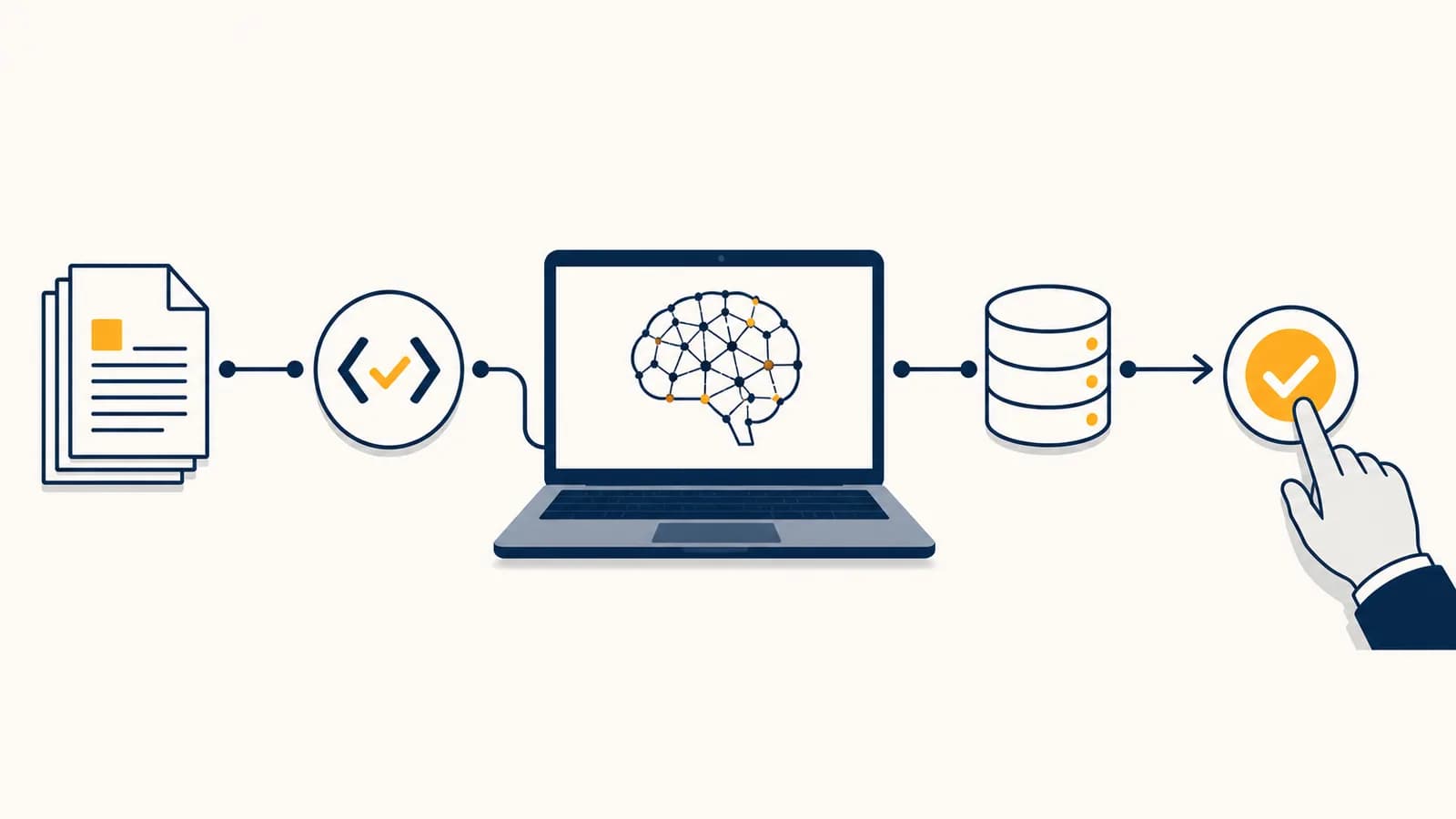
A dependable AI workflow is a pipeline, not a long conversation. It receives a known input, converts it into machine-readable text, asks the model for a fixed structure, validates that structure with ordinary code, and sends uncertain cases to a person.
Suppose invoices arrive as PDFs. A text extractor reads digital PDFs, while optical character recognition handles scanned pages. The local model receives the extracted text and returns JSON with fields such as supplier, invoice number, currency, total, and due date. Python then rejects missing fields, malformed dates, and totals that cannot be read as numbers. SQLite stores accepted records, and the original PDF remains attached as evidence.
JSON matters because it has a grammar. A program can test that a response contains the required keys and valid value types. A paragraph that “looks right” offers no comparable guarantee. The model still may place the wrong number in a valid field, so structural validation is only the first gate.
A customer calls to change a delivery address. Whisper produces a transcript, the model extracts the proposed address and order number, and code checks that both fields exist. A staff member compares the change with the customer record before anything is written. The system saves typing; the person prevents account fraud.
Document search uses the same separation of duties. Software splits approved files into passages and creates numeric representations that place related passages near one another. A query retrieves the closest passages, then the model answers using only those passages and returns source references. The foundation is the same problem covered by Sorting and Searching: Finding Needles in Haystacks: reduce a large collection to a small, relevant set before doing expensive work.
Retrieval does not prove that an answer is true. It proves only that the search selected some passages. The source could be outdated, the best passage could be missed, or the model could add unsupported details. Store the source file name and page with every extracted passage, then make missing citations a reason to withhold the answer.
What makes the output dependable?
Dependability comes from specifications, test cases, and controlled failure, not from a clever prompt alone. Define acceptable output before choosing a model, test normal and awkward inputs, and design the workflow to stop when evidence is missing or confidence is weak.
A strong instruction names the role of the model in plain terms, provides the permitted evidence, defines the output schema, and states what to do when the answer is unknown. “Extract the invoice total exactly as printed; return null if none is visible” is testable. “Read this carefully and help me” is not.
Use genuine examples with private details removed where possible. Include clean files, messy files, missing fields, duplicates, and inputs that should be rejected.
Create the correct output by hand before running the model. This prevents the model's answer from quietly becoming the answer key.
Keep the model, prompt, settings, and code version with each result. A change is an experiment only if the conditions are recorded.
Separate extraction errors, unsupported claims, formatting failures, and bad source data. Each category needs a different repair.
Decide which cases may continue automatically and which require review. High impact work should have the stricter gate.
Accuracy is easy to calculate for a labeled test set, but the denominator must be visible. If 17 of 20 examples pass every required check, the observed pass rate on that set is 85 percent. It does not mean the system will be 85 percent correct on every future file, because the test set may not represent future work.
Worked example: on that specific test set.
A useful score must match the consequence of failure. Missing one newsletter topic is different from inventing a payment amount. Track false acceptance, where bad output passes the gate, separately from false rejection, where good output is sent for review. The mathematics of uncertain outcomes explains why a sample gives evidence rather than certainty.
Where does local AI save money, and where does it shift cost?
Local AI removes per-request fees and can keep selected data on the user's machine, but it shifts cost into hardware capacity, power, setup, maintenance, and review. The economic question is not “Is the software free?” It is “Does the whole workflow save more than it consumes?”
Time saved should be counted after review and correction. Imagine eight recurring documents that each take 12 minutes by hand. Automation reduces handling to 3 minutes each, but setup and weekly maintenance take 35 minutes. Manual work takes 96 minutes. Automated handling plus maintenance takes 59 minutes, leaving 37 minutes of net time saved for that batch.
Worked example: minutes.
This calculation exposes a common mistake. Teams count the model's five-second response but ignore the time spent preparing files, repairing edge cases, and confirming the answer. The correct unit is a completed, accepted task. If review takes as long as manual work, the automation may still help with scheduling or consistency, but it has not created a time saving.
Local processing can also reduce exposure to outside services, provided the entire path is local. A local model does not protect data if the automation later sends its output to a cloud spreadsheet, analytics service, or remote logging tool. Map every destination, disable unnecessary telemetry, restrict file permissions, and delete temporary copies on a defined schedule.
Opportunity cost belongs in the calculation too. A week spent automating a task that happens twice a year is usually a poor trade. Begin with work that is frequent, dull, easy to check, and costly to delay. Those properties support a small, reversible experiment.
Which tasks should stay human?
Keep humans in control where errors can harm rights, safety, employment, money, reputation, or trust. AI may prepare evidence or draft options, but a named person should verify the facts, consider context, make the decision, and remain accountable for the result.
Do not let an unreviewed model approve payments, diagnose illness, select candidates, interpret a contract, grade consequential work, or send sensitive accusations. These tasks involve more than text prediction. They require authority, domain knowledge, procedural fairness, and a way for affected people to challenge a decision.
Human review must be real. A tired employee clicking “approve” on hundreds of fluent outputs is not a control. Show the source beside the proposed result, highlight uncertain fields, limit the number of cases in a batch, and require an explicit reason for high impact decisions. Good interface design shapes judgment, which is one reason Building Frontends With AI belongs beside model and automation skills.
Assign an owner before connecting a trigger. If nobody can pause the workflow, correct stored records, and explain a released decision, the system is not ready to run unattended.
Privacy sets another boundary. Do not place confidential client files, student records, medical details, or credentials into a model merely because it runs locally. Confirm who may access the source, where derived text is stored, what backups contain, and how deletion works. Local software changes the data path; it does not cancel the duty to protect the data.
Some work also depends on tacit knowledge. A skilled employee notices that a polite email signals anger because of the history of the account. They know which exception is harmless and which one predicts a larger problem. A model may reproduce the surface pattern without understanding the relationship. Escalation rules should therefore include context a machine cannot observe.
How do you build the first workflow without creating a mess?
Build one narrow workflow in shadow mode, where it produces results without taking action. Compare those results with human work, record failures, and add an approval step. Only then automate a reversible action, while keeping logs, version history, and a manual stop control.
Pick a task with one owner and a clear finish line, such as turning a recorded internal meeting into a draft action list. Avoid the company inbox, the payment system, and the customer database for the first attempt. A low impact task lets the team learn about installation, prompts, file handling, and review without risking a serious incident.
State the accepted input, required output, rejection conditions, owner, and maximum acceptable delay in a short text file.
Run the extractor, model, validator, and storage step separately. Save each intermediate result so the source of an error remains visible.
Keep ordinary cases and difficult cases with their expected outputs. Remove or mask private data before placing examples in version control.
Produce the output beside the existing process. Measure corrections and review time without sending messages or changing official records.
Create a draft, move a copy, or add an item to a review queue. Keep deletion, payment, and publication behind human approval.
Version every moving part: model name, model file or digest where available, prompt, extraction code, validation code, and test data. A model update can change results even when the prompt stays fixed. Run the saved tests before accepting an update, just as software developers run regression tests after changing code.
Keep the architecture boring. Plain text, JSON, CSV, and SQLite are inspectable and portable. Logs should record when a job ran, which inputs it used, which version produced the result, what checks passed, and who approved release. The wider foundations of Computer Science explain why data structures, algorithms, testing, and security matter more than a fashionable tool name.
The winning stack is a supervised system, not a synthetic employee
The best $0 AI stack does not pretend to be a person. It turns unstructured material into a draft, lets deterministic code check what code can check, and gives a human the evidence needed for judgment. Its value comes from the design of the system around the model.
Start with a recurring task whose result can be checked. Run the model locally if the hardware and data rules support it. Demand structured output, preserve the source, test against labeled examples, and stop safely on uncertainty. Count review, maintenance, and failures in the cost. Expand only after the narrow version earns trust.
The takeaway: Free tools can perform valuable parts of expensive knowledge work, but they do not inherit an employee's responsibility. Build a pipeline that makes errors visible, keeps consequential choices human, and saves time after every hidden cost is counted.