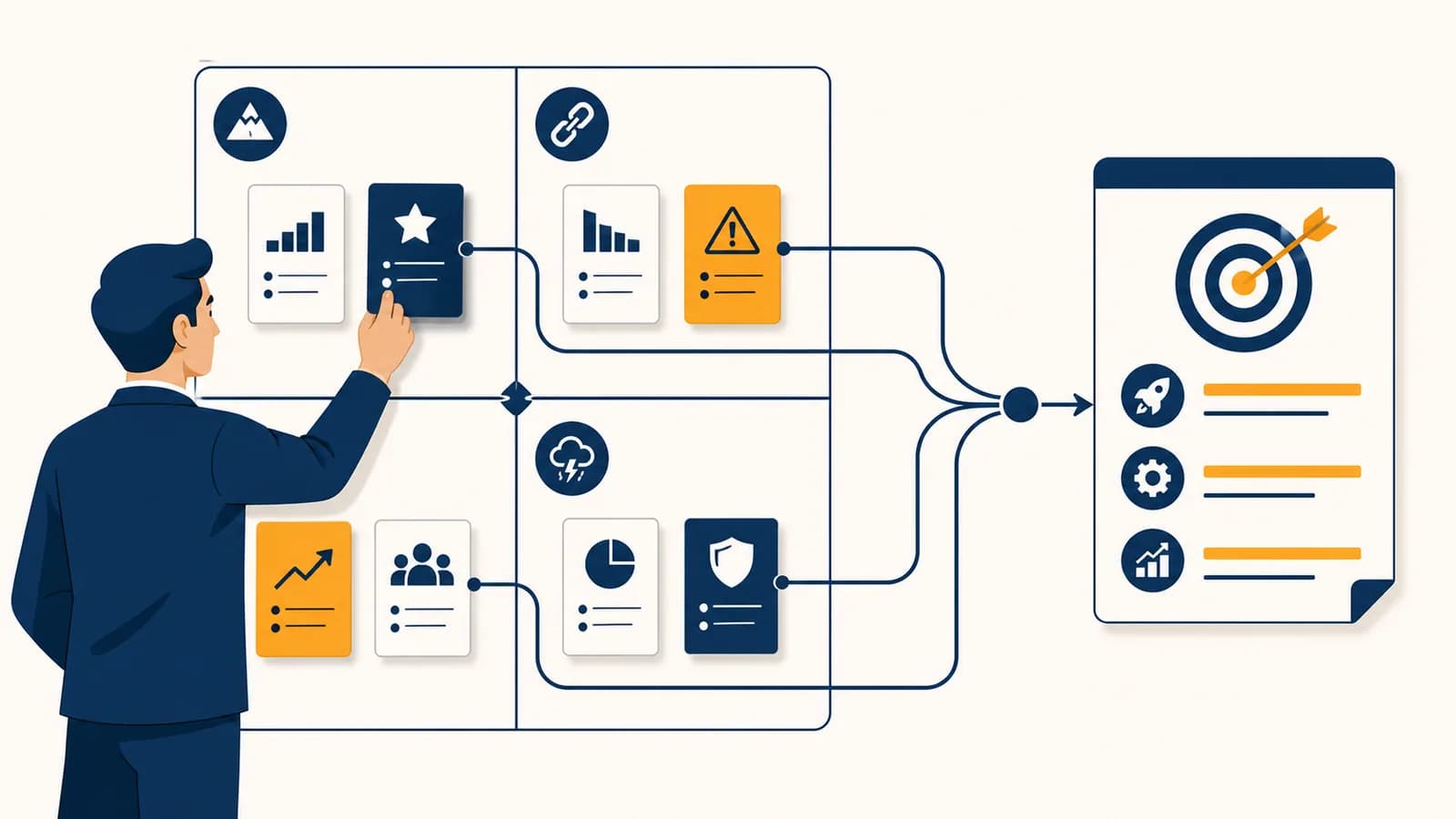
A SWOT becomes strategy only when it forces a choice
A real SWOT analysis compares your position with a specific competitor, uses evidence instead of adjectives, and ends with a decision you can test. Done properly, the SWOT framework shows which competitor weakness your business can serve, what advantage you can defend, and which tempting plans to reject.
SWOT stands for strengths, weaknesses, opportunities, and threats. Strengths and weaknesses describe conditions inside the organisation: skills, assets, limits, habits, contracts, costs, and processes that management can change. Opportunities and threats describe conditions outside it: customer behaviour, rival moves, laws, technology, suppliers, and the wider economy.
The familiar four box grid is not the analysis. It is only storage. Analysis begins when you compare the boxes and ask what action follows. A competitor taking four days to answer support messages is interesting. Your ability to answer within an hour is useful. A group of customers who care enough about speed to switch makes the combination strategic.
Strength: great team. Weakness: small budget. Opportunity: social media. Threat: competition.
Strength: technicians answer support directly. Weakness: no evening cover. Opportunity: local firms report slow replies from national providers. Threat: a rival is hiring local technicians.
The second version names an observable condition, a boundary, and a comparison. Someone else could check it. More important, it suggests a choice: promise direct technical support during covered hours, sell first to local firms that value fast answers, and decide whether evening staffing would pay for itself.
What belongs in each SWOT box?
A fact belongs in the box determined by two tests: who controls it, and whether it helps or harms the chosen objective. Internal and helpful means strength. Internal and harmful means weakness. External and helpful means opportunity. External and harmful means threat.
The objective must come first because the same fact can change meaning. A small shop may treat its size as a strength when customers want direct access to the owner. It may treat the same size as a weakness when a contract requires round the clock coverage. Without a defined objective, people sort facts by mood.
| Box | Control test | Useful evidence | Decision it can affect |
|---|---|---|---|
| Strength | Internal and helpful | Repeatable skill, lower unit cost, protected access, faster process | Where to compete |
| Weakness | Internal and harmful | Capacity limit, missing skill, costly delay, dependence on one supplier | What to fix or avoid |
| Opportunity | External and helpful | Unmet demand, rule change, cheaper input, underserved group | What to test |
| Threat | External and harmful | New substitute, price pressure, legal exposure, changing buyer habit | What to monitor or reduce |
Keep causes separate from symptoms. “Sales are falling” is an outcome, not yet a weakness. The weakness might be poor product fit, delayed delivery, weak distribution, or a checkout error. Each cause calls for a different response. This is where basic ideas from behavioral economics help: customer choices depend on defaults, friction, framing, and limited attention, not only on price.
Do not put the same vague idea in several boxes. “Brand awareness” is not automatically a weakness, an opportunity, and a threat. State the fact, identify who controls it, and connect it to the objective.
Scope matters too. “Strong brand” may be true among existing customers and false among the new group you want to reach. Name the market, customer, product, place, and time period wherever they change the meaning. A narrow accurate statement beats a broad compliment.
Evidence turns opinions into usable inputs
Every important SWOT entry should carry a source, a comparison, and a consequence. The source shows where the claim came from. The comparison says better or worse than what. The consequence explains which customer choice, cost, risk, or operating limit the fact can change.
Good sources include customer interviews, support logs, invoices, win and loss notes, delivery records, public price pages, job adverts, product trials, and direct observation. Each source has limits. Reviews overrepresent people motivated to post. Sales staff remember vivid objections. A rival’s website shows its promise, not necessarily its delivery.
Suppose three recent prospects say a rival’s setup feels confusing. Do not write “competitor has bad software.” Record what each prospect tried to do, where the task stopped, which device they used, and what they chose next. If the complaint concerns a web interface, knowledge of how HTML and CSS shape what people see can help you distinguish a layout problem from a deeper product limitation.
Use confidence tags such as observed, reported, inferred, and unknown. These words prevent a repeated guess from hardening into a “fact.” They also tell you what research to do next. A reported complaint may need a product trial. An inferred cost problem may need a supplier quote or a look at public accounts.
Evidence does not need to be perfect before you act. It needs to be good enough for the size and reversibility of the decision. A cheap landing page test can rest on a plausible pattern. A long lease, major hire, or regulated product requires stronger proof because error costs more and is harder to reverse.
How do you find a competitor weakness customers care about?
Look for a repeated customer job that the competitor performs slowly, awkwardly, expensively, or unreliably. Then verify that customers notice the gap, have a reason to switch, and can reach your alternative. A weakness without customer consequence is simply trivia.
Start with the customer’s sequence of actions. Search, compare, buy, receive, use, get help, renew, and leave are common stages. At each stage, note waiting, confusion, extra work, uncertainty, failure, and unwanted risk. The best opening is often a small piece of friction attached to an important job.
A bicycle repair service learns that a large rival requires online booking and gives customers a broad collection window. Riders with a broken commuting bike care less about a polished booking screen than a definite repair time. The smaller shop tests same day diagnosis with a fixed collection slot.
The rival’s weakness is not “being large.” It is the operating tradeoff created by scale: standardised intake improves scheduling across many locations but can reduce flexibility for urgent cases. Your strategy should target the urgent job, not copy the rival’s entire offer with a lower price.
Study the constraint behind the weakness. If a low price depends on self-service, the rival may be unable to add personal support without changing its cost structure. If a marketplace grows through many sellers, it may struggle to guarantee consistent quality. A visible flaw backed by a structural constraint is harder to repair than a neglected webpage.
Be careful with gaps created by shifted costs. A cheap service may leave pollution, noise, risk, or unpaid work for other people. Economics calls these effects costs imposed outside the transaction. Building your advantage by moving harm elsewhere can create legal exposure, public opposition, and a weak business once those costs are priced in.
A useful matrix connects four boxes instead of filling them
The four lists become useful when you pair them. Match a strength to an opportunity, use a strength against a threat, repair a weakness that blocks an opportunity, or reduce exposure where a weakness meets a threat. Each pairing should produce a possible action.
These pairings are sometimes called TOWS because they reverse the order of the letters to emphasise the external situation before the internal response. The name matters less than the discipline. You are converting descriptions into choices.
- Strength plus opportunity: use an existing ability to serve emerging demand.
- Strength plus threat: use an advantage to reduce exposure or make switching away less attractive.
- Weakness plus opportunity: fix, buy, or partner for the missing ability that blocks a promising move.
- Weakness plus threat: avoid the contest, reduce dependence, or build a fallback before the risk arrives.
Return to the bicycle shop. Direct access to a mechanic is a strength. Demand for predictable repair times is an opportunity. Their pairing suggests a timed diagnosis offer. Limited weekend staffing is a weakness. A national chain extending weekend hours is a threat. Their pairing suggests avoiding a seven day promise until demand covers another shift.
A pairing can also reveal that the sensible strategy is restraint. If the opportunity requires a capability you lack, the capability is expensive to acquire, and a well placed rival already has it, “do not enter” is a valid result. Strategy includes deliberate refusal.
How do you rank SWOT ideas without faking certainty?
Rank ideas with explicit criteria, visible evidence, and sensitivity checks. Scores help a group compare judgments, but they do not turn guesses into facts. Use a small scale, explain every rating, and see whether a modest score change reverses the decision.
A practical screen asks about customer value, evidence quality, your ability to act, durability, cost, and downside. Rate each factor on the same short scale. Do not add factors that count the same benefit twice. “Demand” and “customer interest,” for example, may be duplicates unless you define them differently.
If evidence , relevance , control , and relative cost , then .
This formula is a comparison aid, not a law of business. A different scale changes the number. Multiplication also punishes a low rating more strongly than addition, which may or may not fit your decision. Write down why you chose the relation, then keep the underlying notes beside the score.
Run a sensitivity check. If raising the estimated cost from 2 to 4 changes the worked score from 40 to 20, cost deserves investigation before commitment. If one option wins under every reasonable rating, the choice is less dependent on a fragile assumption.
Rank actions, not adjectives. “Strong service” cannot be prioritised. “Offer a named technician and a two hour reply target to local accountancy firms” can be costed, assigned, and tested.
Keep non-negotiable constraints outside the score. A plan that breaks the law, risks serious harm, or exceeds available cash does not become acceptable because it scores well elsewhere. Averages can hide fatal conditions.
How does a SWOT become an action plan?
Turn the strongest pairing into a hypothesis with a customer, offer, channel, measure, deadline, owner, and stop rule. Test the smallest version that could disprove the idea. Record the result, update the SWOT, and either expand, change, or stop.
Name the choice and boundary: “Should the shop add timed diagnosis for weekday commuters?” is better than “How can we grow?”
Observe customer work, rival offers, your own delivery, and the constraint behind each apparent gap.
State each fact with its scope and source, then create actions by connecting internal ability with external conditions.
Define what you will offer, to whom, for how long, and which behaviour will count as evidence.
Choose in advance what result supports expansion, revision, or stopping, so enthusiasm does not rewrite the rule afterward.
For the repair shop, the test might offer ten timed diagnosis slots to weekday commuters over two weeks. The measure is not page views. It is booked slots, attended appointments, repair acceptance, delivery on time, and contribution after the extra labour. The numbers are proposed test design quantities, not market statistics.
Good tests preserve learning. Keep versions of the matrix, evidence notes, assumptions, and decisions so you can see why a choice changed. The logic behind version control applies beyond software: a dated history prevents the newest opinion from erasing earlier evidence.
Assign an owner to every action and indicator. “Marketing will monitor the rival” is too loose. Name the person, source, review date, and trigger. A useful trigger might be a rival adding guaranteed repair times in your local area, because that event attacks the gap your offer depends on.
A living SWOT makes assumptions visible
A SWOT is finished when it supports a choice, not when every box looks full. Its lasting value comes from exposing the assumptions behind that choice and showing which evidence would change your mind. Review it when the market, objective, or evidence changes.
Do not schedule a ritual rewrite just to move words around. Update the analysis after a meaningful event: a test result, a new rival offer, a supplier failure, a law change, or a shift in customer behaviour. Remove entries that no longer affect a live decision.
The deeper subject is economics. Scarcity forces choice, opportunity cost reveals what each choice gives up, incentives shape behaviour, and competitive advantage lasts only while rivals cannot cheaply copy it. Those foundations sit together in the economics subject hub.
The takeaway: Find a specific customer problem inside a competitor’s constrained weakness, connect it to an ability you can repeat, and test the resulting offer. A real SWOT is an evidence trail from comparison to choice.
The final document should make disagreement productive. A colleague can challenge the source, the comparison, the proposed cause, the score, or the test rule. That is much better than arguing over “good brand” or “strong team.” Specific claims can be checked, and checked claims can guide action.