Effective study habits make memory do real work
Effective study habits for high school students replace vague effort with actions that make knowledge easier to recall, apply, and check. By building ten habits into a repeatable routine, you can plan your time, remember more, find weak spots, and prepare for tests without relying on panic.
A useful habit changes what your brain does. Rereading can make a page feel familiar, but familiarity is not the same as recall. Closing the book and producing an answer forces memory to reconstruct the idea. Checking that answer supplies feedback. Returning later makes the memory work again after some forgetting has occurred.
The ten habits below fit that cycle. They do not require special stationery, expensive apps, or unusually long sessions. They require clear tasks and honest checking. A student learning how exponents and powers behave, for example, needs to solve expressions without a model in view, not simply recognize worked solutions on a page.
A study session should produce evidence. An answered question, a solved problem, a corrected diagram, or a short explanation shows what you can do. Time spent at a desk does not.
How should you plan a study week?
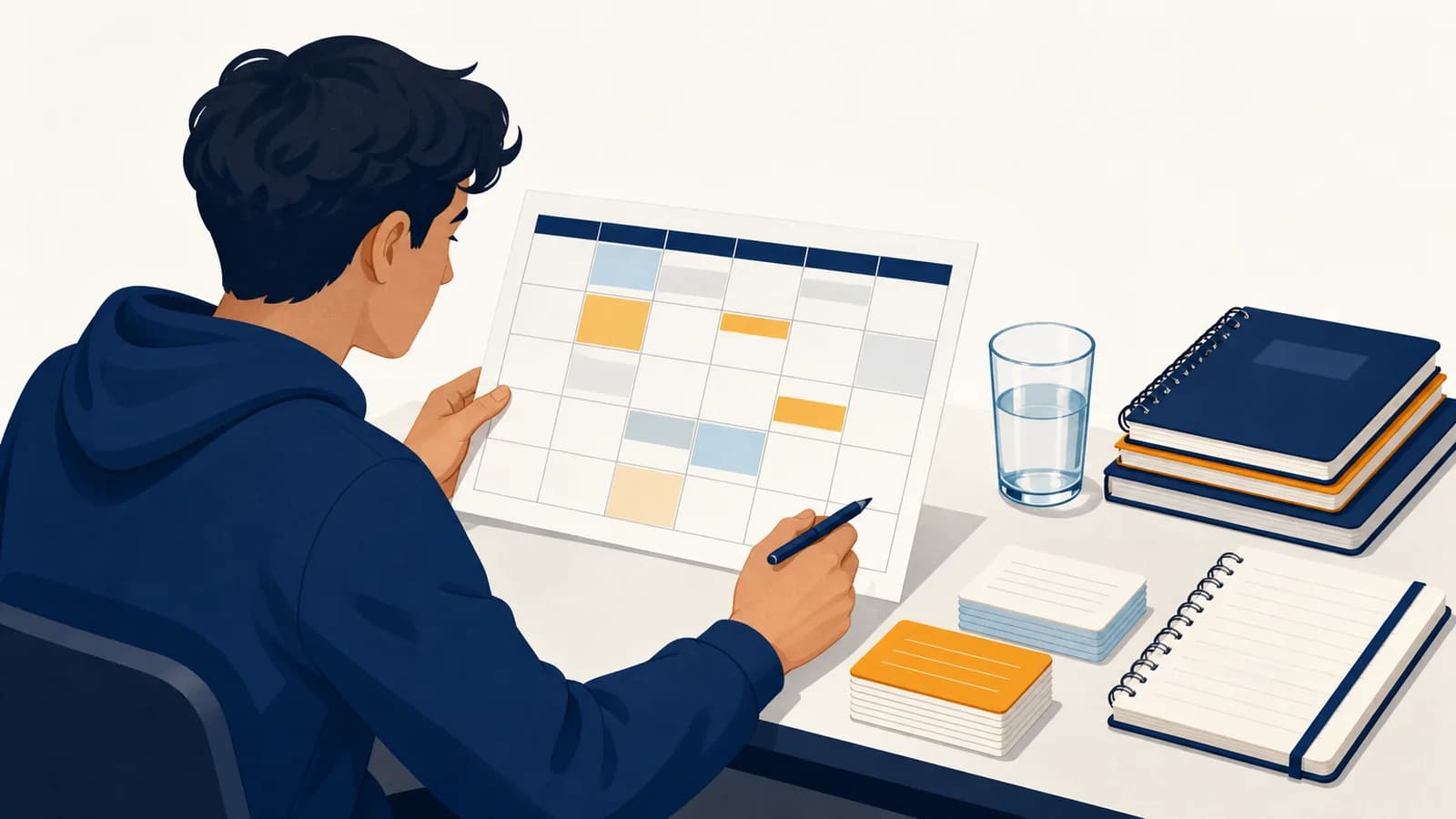
Plan a small number of specific study appointments, then give each one a visible result. A calendar answers when you will work. A task such as “solve six equations and correct every error” answers what finished work will look like.
Habit 1: Give study a fixed place in the week. Choose times that fit around school, work, meals, travel, and sleep. Put the appointments on the calendar before the week fills up. A fixed appointment removes a daily negotiation with yourself. At the scheduled time, the decision has already been made.
Keep the plan believable. A short session that happens is more useful than an ambitious block that gets postponed. Leave spare space for an assignment that takes longer than expected. If Monday is crowded, a planned Tuesday return is better than hoping motivation appears late at night.
Habit 2: Define the output before you begin. “Study chemistry” has no finish line. “Draw the particle model for three changes of state, label it, then check it against the textbook” has a start, an action, and a test. Use verbs that create evidence: solve, explain, compare, label, recall, calculate, or correct.
Include tests, assignments, and any material that must be ready for class.
Turn “revise history” into tasks such as building a cause table or answering two essay plans from memory.
Schedule the earliest attempt before the final evening, so mistakes can guide a later session.
Move unfinished work deliberately and reduce the next task if the original plan was too large.
An example week can be modest and still useful. Four planned sessions with two recall rounds and one weekly review are not universal targets. They simply show how a plan can separate first learning, practice, and checking instead of squeezing them into one evening.
Why does retrieval beat another reread?
Retrieval practice makes you produce knowledge without seeing the answer, which reveals what memory can actually supply. Rereading mainly exposes you to the material again. It can support learning, but it cannot by itself show that you can recall or use an idea.
Habit 3: Begin with a closed-book attempt. After learning a section, shut the source and write everything you can remember. Answer questions, redraw a process, or solve a problem. Then reopen the source and compare. The comparison matters because uncorrected recall can preserve a mistake.
You read the same paragraph again and think, “I know this.” The words are present, so recognition feels easy.
You hide the paragraph and explain its claim, evidence, and key terms. Missing parts become visible and can be corrected.
Questions are the basic tool. Turn a heading into a prompt, cover a diagram and recreate it, or use flashcards that demand a complete answer. For a historical topic, you might close the page about social structures in the Middle Ages and reconstruct who owed duties to whom. The blank page gives no hints, so the result is informative.
Avoid making every prompt a definition. Tests often require transfer, which means applying knowledge in a changed situation. Ask why a process occurs, what would change if one condition changed, and how two cases differ. After you answer, compare the response with a reliable source and repair it in a different color.
When should you return to material?
Return after enough time has passed for recall to require effort, but before the topic disappears from your plan. Several shorter encounters spread across different days create repeated chances to retrieve, correct, and rebuild knowledge under changing conditions.
Habit 4: Space reviews across the calendar. A practical sequence might include a brief recall later the same week, another during the next week, and further returns before a cumulative test. Those intervals are examples, not laws. Hard material and weak answers deserve earlier attention.
Spacing changes the job. During a single long session, the previous example is still active in working memory. A later session removes that support. You must identify the method again, which is closer to the demand of a test. Each return should start with recall, not a complete reread.
On Tuesday, Maya learns how electric current behaves in series and parallel circuits. On Thursday, she draws both circuits from memory. The following Monday, she predicts what happens when a bulb is removed, checks the prediction, and corrects one confused label. Before the test, she answers a mixed circuit question without notes.
Use your results to set the next return. A clean, reasoned answer can wait longer. A guessed answer should come back soon. This is more efficient than reviewing every topic for the same amount of time, because the schedule responds to evidence rather than treating all memories as equal.
How should practice expose weak spots?
Mix question types once the basic method is understood, and record errors by cause rather than hiding them. Mixed practice makes you choose a method. An error log turns each wrong answer into a precise instruction for the next round of work.
Habit 5: Mix related kinds of problems. A page of identical exercises tells you which method to use through repetition. A mixed set removes that clue. In mathematics, alternate equations, graphs, and word problems that depend on the same concept. In science, mix calculation, explanation, and experimental design.
Do not mix so early that every attempt is a guess. First learn and practise a method until its steps make sense. Then place it beside a related method and ask what feature tells them apart. The useful difficulty is choosing between plausible tools, not working with material you have never learned.
Habit 6: Keep an error log. For each meaningful mistake, record the question type, what you did, why it failed, and what you will do next time. “Careless” is usually too vague. Write “lost the negative sign while expanding the bracket” or “gave evidence but did not connect it to the claim.”
If 9 of 12 answers are correct, accuracy is . The three errors still need to be classified and corrected.
The percentage is a summary, not a diagnosis. Two students can both score 75 percent for different reasons. One may misunderstand a concept; the other may know the concept but misread units. Their next study tasks should differ. Rework missed questions after a delay, without copying the original solution.
What makes a study session easier to start?
Reduce the number of decisions and distractions between sitting down and doing the first task. Prepare the source, questions, paper, and timer in advance. Give the session one defined target, then place unrelated devices and tabs outside your immediate reach.
Habit 7: Prepare a repeatable study setup. The setup can be a desk, a library seat, or one end of a kitchen table. Consistency helps because the required materials and first action become predictable. Keep only the current task visible. Put the phone away unless the task genuinely needs it.
Habit 8: Work in focused blocks with real breaks. Choose a block short enough to protect attention and long enough to finish a meaningful unit. There is no single correct duration. A difficult proof may need more uninterrupted time than vocabulary recall. During the break, stand up, drink water, or look away from the screen.
Do not confuse switching with resting. Moving from an essay to messages gives your attention a new task. It may also make the unfinished conversation compete with the next study block.
Make starting almost mechanical. Write the first prompt at the end of the previous session. Leave the relevant book marked. If you are learning how to write a first Python program, open the correct project and leave a comment describing the next tiny feature. The next session begins with action instead of setup.
How do sleep and movement support learning?
Sleep gives the brain conditions needed to stabilize and reorganize recently learned information, while movement and breaks help restore attention during waking study. Neither replaces practice. They protect the biological system that performs the remembering, reasoning, and self-control practice requires.
Habit 9: Protect sleep and use breaks deliberately. A late study session can create more exposure while reducing alertness the next day. Stop at a planned time when possible. Place demanding work earlier, and use the final minutes before stopping to list what needs another attempt.
Sleep is not empty time. Memory continues to change after initial learning, and sleep supports that consolidation. This does not mean reading notes under a pillow works. The brain needs an earlier learning event to process. Active recall before sleep can expose gaps, but the correction still needs to be understood.
Movement also has a practical role. Long periods in one position can let attention drift while the clock keeps running. A short walk between blocks changes posture and visual focus. Return to a written next action, so the break has a clear end. Readers curious about the organs and processes behind memory can build the foundation through the biology subject hub.
Watch for the difference between tiredness and avoidance. If you are alert but resisting a large assignment, shrink the first action. Open the document and write one claim with one piece of evidence. If you are repeatedly unable to stay awake or function normally, studying harder is not the right response; speak with a trusted adult or health professional.
How can you prove that you understand?
Explain the idea in your own words, answer a new question, and show each step that connects evidence to a conclusion. Understanding is visible when you can reconstruct the reasoning and adapt it, not when you can repeat a polished sentence.
Habit 10: Teach the idea, then test the explanation. Choose an imagined beginner and explain the topic without notes. Define technical terms when they first appear. Give one example and one nonexample. Mark every place where you become vague, because vagueness often hides a missing link.
Then verify the explanation. Teaching yourself is only useful if a textbook, mark scheme, worked solution, teacher, or reliable reference checks the content. Look for omitted conditions and steps that happen to produce the right answer. A confident explanation can still be wrong.
Sam writes, “Inflation means prices rise.” After checking, he improves it: inflation is a sustained increase in the general price level, so one product becoming expensive is not enough. The revised explanation adds the condition that separates the concept from a tempting nonexample.
Use a new context for the final test. If you learned a scientific rule with one diagram, apply it to a different diagram. If you learned an argument from one source, evaluate another source. If you can only reproduce the original example, you may have memorized its surface without learning the structure underneath.
A good study system makes progress visible
The ten habits form one connected system: schedule specific work, define an output, retrieve without notes, space later reviews, mix related problems, log errors, prepare the environment, focus in workable blocks, protect sleep, and teach the idea back. Each habit produces information for the next.
Start with two changes, not all ten at once. Put two study appointments on the calendar, and begin each with five minutes of closed-book recall. At the end, record one result: what you could produce, what failed, and the next action. Add another habit after that routine becomes ordinary.
The takeaway: Effective studying is a feedback loop. Produce an answer, check it, correct it, and return later. The quality of that loop matters more than how busy the session looks.
Progress becomes easier to trust when it leaves a trail. A calendar shows that sessions happened. Answer sheets show what memory produced. An error log shows what changed. A later test shows what lasted. Those records turn “I studied a lot” into a clearer claim: “I can now do this without help, and I know what to practise next.”