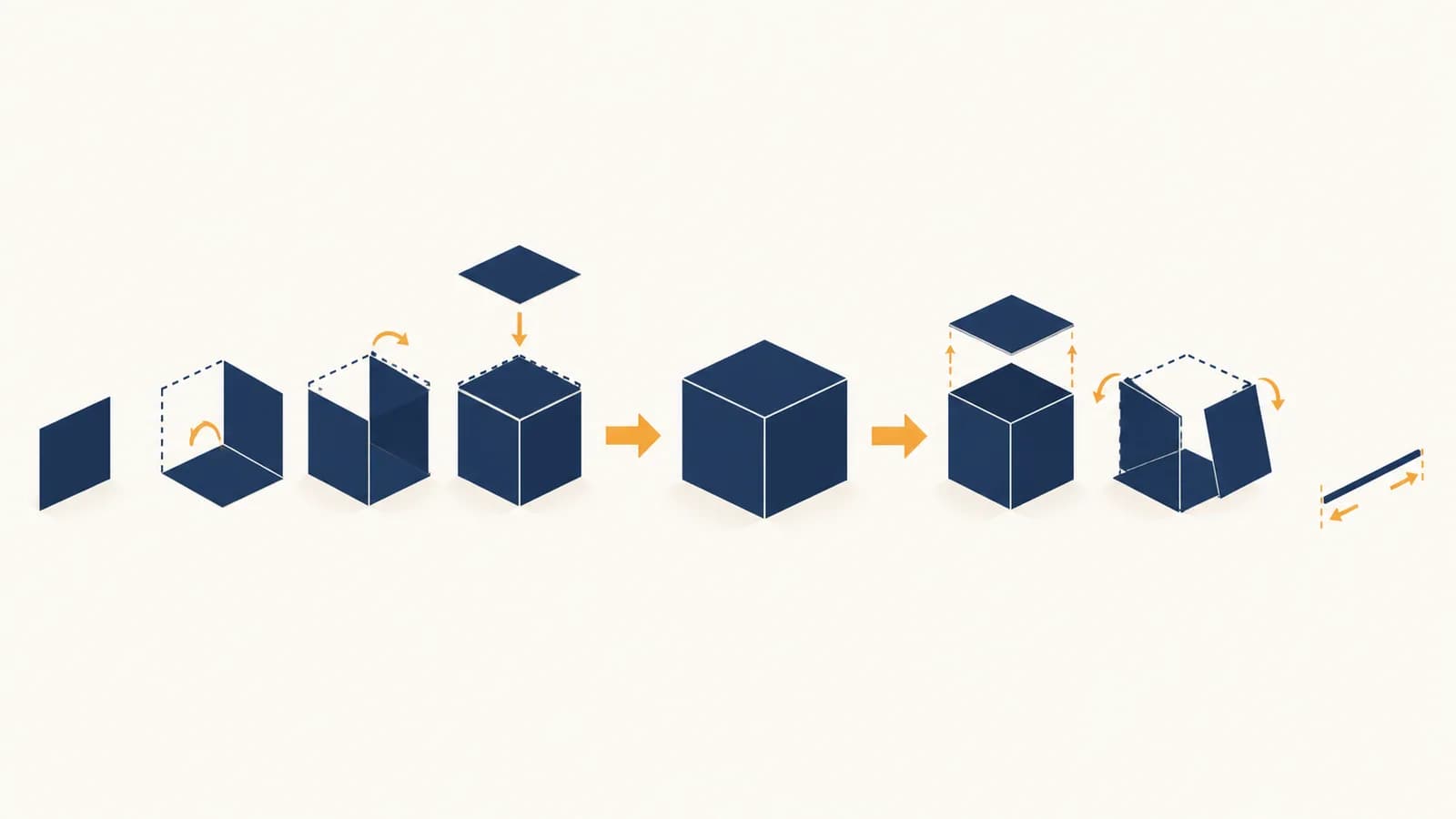
Powers and roots undo each other
A power builds a number by repeated multiplication, while a root asks which number was multiplied to produce it. That inverse relationship is the difference between powers and roots. Once you can move between the two forms, you can simplify expressions, solve equations, compare rates of growth, and recognize the same structure in area, data, finance, and science.
In the power , the base is and the exponent is . The exponent tells you to use four factors of : . The fourth root reverses that operation: . It asks which positive number, raised to the fourth power, equals .
Start with a base and an exponent. Compute the result: .
Start with the result and the index. Recover the base: .
The small number on a radical is its index. A square root has index , but the is normally omitted. A cube root has index . More generally, asks for a number whose th power is . This is why the two notations describe one relationship viewed in opposite directions.
Example: , so .
This equivalence is the central translation rule. It lets you choose the notation that makes a problem easiest to read. A power is useful when the base is known. A root is useful when the result is known and the original base is missing.
What does an exponent actually count?
A positive whole-number exponent counts how many copies of the base appear as factors. It does not tell you to multiply the base by the exponent. Thus means three factors of , giving , not .
Repeated multiplication creates growth much faster than repeated addition. If the base is , each increase of one in the exponent doubles the previous value. The sequence begins , , , , and . The zero exponent fits the pattern because stepping backward divides by the base, so .
Exponents also encode dimensions. A square with side length has area because its two independent lengths are multiplied. A cube with edge length has volume . The words squared and cubed come directly from these shapes, but higher powers follow the same arithmetic even when no everyday shape represents them.
Computing systems use powers constantly. Image width multiplied by image height gives a pixel count, and doubling both dimensions multiplies that count by four. That link between dimensions and data appears in the way machines interpret images, where arrays of pixel values become the input to calculations.
Parentheses control the base. because both factors are negative, but because the exponent applies to before the minus sign is applied.
This distinction is not typographical fuss. It identifies the object being repeated. Whenever the base contains a negative sign, a fraction, or several terms, parentheses show exactly what the exponent controls.
How does a root recover a missing length?
A root recovers an equal factor from a known power. If a square has area square units, its side length is units because . The operation reverses the area calculation.
A square courtyard covers square metres. Equal side lengths satisfy , so metres. Multiplying checks the result.
Cube roots do the same job for volume. A cube with volume cubic centimetres has edge length centimetres. The units change with the operation: cubing centimetres produces cubic centimetres, while taking the cube root of cubic centimetres returns centimetres.
Not every root is a whole number. Since and , lies just above . The exact answer can be simplified because :
Write as . The factor is a perfect square.
Use .
Since , the simplified result is .
The simplified form is exact. A calculator decimal is an approximation unless the decimal terminates or repeats in a way that exactly represents the number. Keeping during a calculation prevents rounding error from accumulating, and a decimal can be found at the end if a measurement needs one.
This convention makes the square-root symbol a function: every allowed input has one output. Equations can still have multiple solutions. The symbol and the equation answer different questions, so they must not be treated as interchangeable.
Fractional exponents are roots written as powers
A fractional exponent combines a root and a power. The denominator names the root, while the numerator names the power: . In particular, , so the notation preserves the inverse relationship.
Why must this be true? Exponent rules say that multiplying powers with the same base adds exponents. If is multiplied by itself, the result is . A number that squares to is its square root, so for nonnegative real .
You can often reverse the order and compute , but taking the root first usually keeps the intermediate number smaller. With real numbers, domain restrictions still matter. An odd root of a negative number is real, as in . An even root of a negative number is not a real number because every real number has a nonnegative square.
Negative exponents encode reciprocals rather than negative results. The rule , for , follows from stepping backward through powers by division. Combining both ideas gives .
The denominator is the root, not a divisor. means . It does not mean .
Fractional exponents are especially convenient in formulas and software because all the exponent rules remain visible in one notation. Code still needs careful handling, however. A language may represent decimal exponents approximately, and an expression involving a negative base may leave the real numbers or produce a domain error. Those implementation choices belong to the larger practice of turning a calculation into reliable software.
Which exponent rules survive when roots appear?
The standard exponent rules still work with fractional exponents wherever the expressions are defined. Products add exponents, quotients subtract them, and a power raised to another power multiplies them. Roots therefore follow from the same compact system rather than a separate bag of tricks.
- Product of powers:
- Quotient of powers: , for
- Power of a power:
- Power of a product:
For example, becomes when is nonnegative. Likewise, . The fractional form exposes why the simplification works.
for nonnegative real and . Multiplication fits the exponent rules.
in general. Addition inside a root does not split.
A quick counterexample catches the false addition rule. If and , then , while . Testing a proposed identity with small perfect squares is a fast error check.
The same warning applies to powers: is not . Expanding gives . Exponents distribute across multiplication because each factor can be grouped separately. They do not distribute across addition because multiplying a sum creates cross-products.
How do powers and roots solve equations?
To solve an equation containing a power, isolate the powered expression and apply the matching root to both sides. Then account for every value that satisfies the original equation. Even powers can produce two real solutions, while odd powers produce one real solution.
Consider . First add , then divide by , giving . Both and square to , so the solution is . Writing only would lose the negative solution.
For , the cube is already alone.
Take the cube root of both sides: .
Add to get . Substitution gives .
Squaring both sides can also remove a square root, but it may introduce an extra solution. Suppose . Squaring gives , which simplifies to , so the candidates are and . Substitution rejects because the original equation would say . Only works.
Checking is part of solving a radical equation. An inverse step can preserve solutions, but squaring is not one-to-one: . That loss of sign information can create candidates that were never solutions.
Search procedures use a related idea. To estimate , you can test values between and , square them, and repeatedly narrow the interval. Each comparison discards part of the range. This logic connects algebra to methods for finding values efficiently, even though a production square-root routine may use more specialized numerical methods.
Growth and inverse growth answer different questions
Powers answer what a repeated growth process produces; roots answer what repeated factor produced a known result. The same pair appears whenever scale changes across dimensions, quantities compound, or a system must recover an input from an output.
Suppose a square image is enlarged so each side becomes three times as long. Its area becomes times as large. If you know only that the pixel area increased by a factor of , the linear scale factor is . The power predicts the area change; the root recovers the change in length.
For area, . For volume, . A volume factor of corresponds to an edge factor of .
Compound growth has the same forward and backward structure. If a quantity is multiplied by the same factor during each of periods, its final value is . If the start and finish are known, the per-period factor is found with an th root: . This is arithmetic, not a promise that real prices, populations, or investments follow a constant rate.
A quantity rises from to over three equal compounding periods. The total factor is . Since , the per-period growth factor is , which corresponds to a increase per period.
Roots also appear in statistics through distance-like measures. Squaring deviations prevents positive and negative differences from cancelling. Taking a square root later returns the result to the original unit. This square, average, root pattern explains why root-mean-square quantities and standard deviation have the same units as the measurements they summarize.
The wider mathematics subject hub develops these connections across algebra, geometry, statistics, and functions. The notation changes with the setting, but the forward operation and its inverse remain recognizable.
One growth story has two directions
Powers and roots are best learned as inverse views of one relationship. A power starts with a factor and builds a result. A root starts with that result and recovers the factor. Translating between them turns separate-looking rules into one connected system.
When an expression feels unfamiliar, rewrite it. Turn into , or turn a fractional exponent back into a radical. Identify the base, the exponent or index, and the domain. Then use the form that exposes the operation you need.
Three checks catch most mistakes. Confirm that parentheses identify the full base. Test any claimed rule with small perfect powers. Substitute solutions into the original equation, especially after squaring. These checks take seconds and reveal sign errors, false distribution, and extra solutions.
The takeaway: Powers build repeated multiplication, roots reverse it, and fractional exponents express both in one notation. If you can move accurately among those forms, you can reason about scale, solve powered equations, and recover hidden growth factors.
The final test is simple: run the operation backward. If , then must equal . If , then raising to the reciprocal exponent must return . A correct inverse undoes the original operation, which is the cleanest proof that the two directions match.