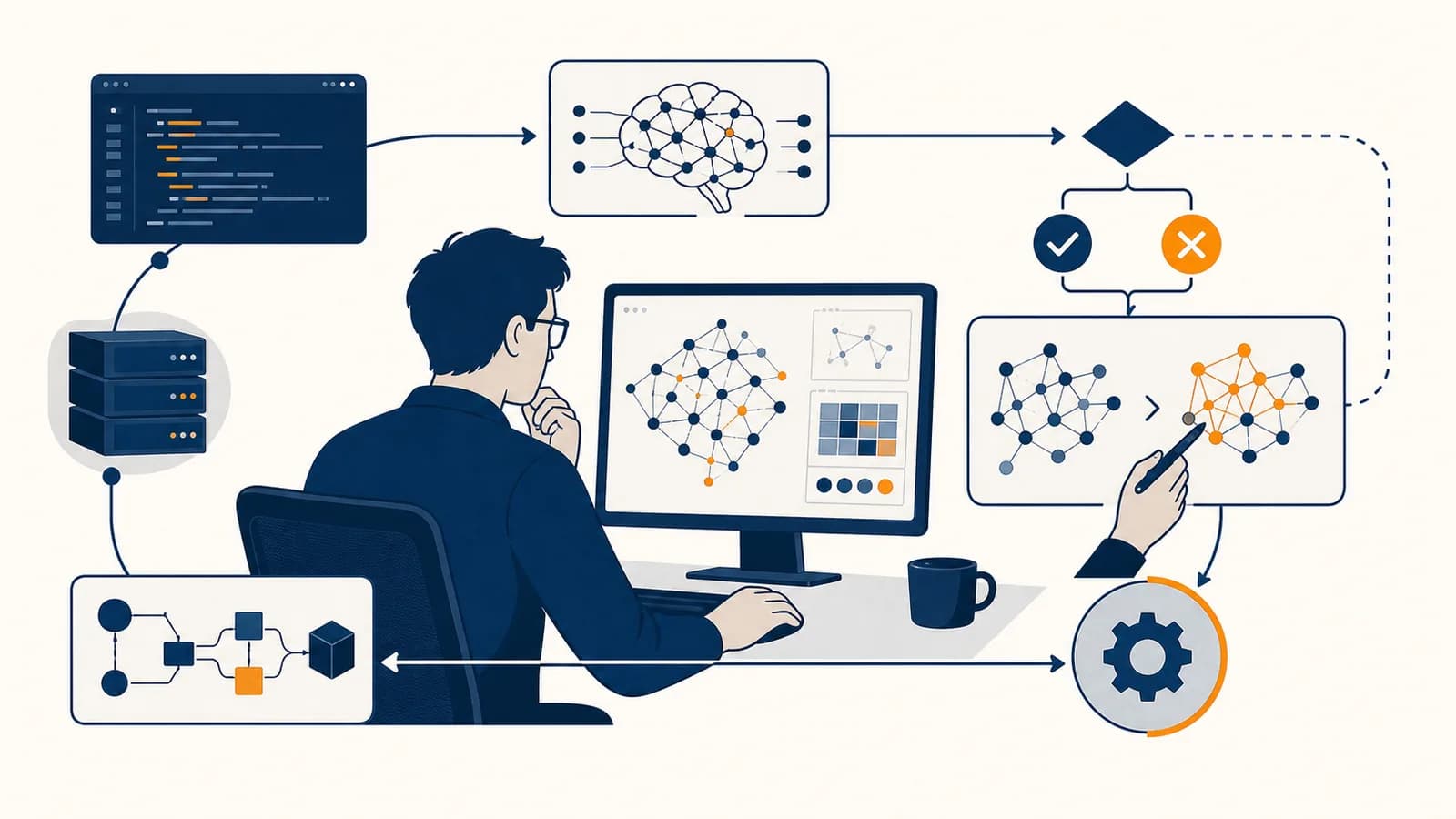
Human-in-the-loop development is a software engineering approach that places deliberate human decisions inside an AI system's design, operation, and improvement cycle, in the context of building and maintaining computer systems. In human-in-the-loop AI development, a model proposes, predicts, or generates; a person checks selected results, supplies corrections, and remains responsible for choices the system should not make alone. This human feedback loop exists because machine learning systems work with uncertainty, can fail in unfamiliar cases, and cannot decide what a product's users consider acceptable. It turns oversight into part of the program rather than a rescue performed after damage.
Consider an email service that suggests replies. Most suggestions may be ordinary enough to show immediately. A reply involving a payment, a threat, or private medical information deserves a different path. The software can hold it for approval, show why it was flagged, accept an edit, and record the final choice. That sequence is a designed interaction between code and judgment.
What human-in-the-loop development actually is
Human-in-the-loop development is the practice of assigning specific decisions in an automated workflow to people, then using their actions as inputs to operation, evaluation, or later improvement. The human has a defined job, interface, authority, and response path.
The word loop matters. A person does not simply inspect a finished system once. Information moves around a cycle: software produces an output, a person acts on it, the system records the action, and developers use the record to change rules, tests, prompts, data, or models. Some loops run in seconds. Others run during a weekly evaluation session.
A useful design names each part. The input might be a support request. The model output might be a proposed answer and a confidence score. The human decision might be approve, edit, reject, or escalate. The recorded outcome includes the original proposal, the final response, and the reason for the change. The system change might be a new test case or an updated retrieval source.
There are several places for people in such a system. Before release, people label examples, define policies, build evaluation sets, and test unusual inputs. During use, they approve actions, correct outputs, and take over difficult cases. After use, they investigate failures and decide what should change. A product does not need all of these loops, but every loop it claims to have should identify an actual person and an actual decision.
How the feedback loop works
A feedback loop works by routing an AI output according to risk and uncertainty, presenting enough evidence for a person to judge it, capturing a structured decision, and sending that decision to the part of development that can prevent a repeat failure.
Write down what the model may recommend, what a person may approve, and what nobody using the interface may authorize.
Use a checkable condition such as missing evidence, a policy match, disagreement between methods, or a score below a tested threshold.
Show the original input, proposed output, cited sources, relevant policy, and the actions available. Hiding context turns review into guessing.
Store approve, edit, reject, or escalate, plus a reason code. Preserve the model version and prompt so the event can be reproduced.
Convert recurring corrections into regression tests, policy changes, better examples, retrieval fixes, or carefully reviewed training data.
Suppose a school help desk uses an AI system to draft password reset instructions. A request that matches a known procedure can reach a staff member as a ready draft. A request asking to bypass identity checks is routed to a security queue. If staff repeatedly edit a confusing sentence, that edit becomes a test: future versions must explain the step correctly. The valuable feedback includes more than the fact that someone clicked reject. It connects the rejection to a reproducible cause.
The loop also needs a fallback. If no reviewer is available, the system might wait, return a limited answer, or transfer the case to an ordinary support process. Letting the model proceed silently is not a fallback. It removes the human exactly when the planned control cannot operate.
What the human actually decides
The human decides questions that require authority, missing context, policy interpretation, or responsibility for consequences. The useful task is usually a bounded choice such as approve, revise, reject, label, or escalate, rather than a vague command to supervise the AI.
People set the objective and its limits
An optimization target is not the same as a social goal. A system can minimize response time by sending quick replies, yet those replies may be inaccurate or rude. People must decide which errors matter, whose interests count, what evidence is required, and which actions stay forbidden even when a score improves.
People resolve cases that the software cannot settle safely
A low confidence score can trigger review, but uncertainty is broader than one number. An input may contain conflicting instructions, fall outside the model's tested data, or request an action with irreversible effects. Reviewers bring account history, local knowledge, and authority that the model does not possess.
A warehouse system predicts that a package address is wrong. It can highlight the mismatch and suggest a correction. A worker compares the label, order record, and carrier rules, then accepts the change or holds the package. The model detects a pattern; the worker authorizes the physical consequence.
The interface should match that division of labor. If the person must compare two addresses, show them side by side. If the decision depends on a source, open the relevant passage rather than displaying an unsupported answer. If rejection requires a reason, offer meaningful codes and an optional note. Interface design determines the quality of the feedback that later reaches engineers.
People investigate patterns across many cases
One corrected answer may be an isolated edge case. Fifty corrections with the same reason code may reveal a broken source or instruction. A reviewer working case by case protects the current user. A developer or domain specialist studying the collection protects future users. Those are different human roles and should have different tools.
Human-in-the-loop development versus human review
Human review is one inspection event, while human-in-the-loop development connects review to routing, evidence, recorded decisions, and system change. A person approving outputs can reduce immediate harm, but there is no development loop unless the result informs later engineering work.
A moderator reads a flagged answer and removes it. The reason is left in a private note, the model version is unknown, and developers cannot reproduce the event.
The moderator chooses a reason code, the system preserves the input and version, a test case enters the evaluation set, and the team checks the next release against it.
Human-in-the-loop development is also different from placing a person near an automated process. A driver who cannot see why an automated vehicle is slowing has little useful control. A clinician asked to approve a suggestion without the underlying image or patient record is being used as a signature, not as a decision-maker.
It also differs from fully manual work. In a manual process, a person performs the whole task. In a human-in-the-loop process, software handles a defined portion, such as retrieval, ranking, drafting, or anomaly detection. The person handles a defined decision. The boundary can move as evidence improves, but it should never be invisible.
How human input shows up while software is being built
During development, human input appears in requirements, labeled examples, prompt and tool design, adversarial testing, evaluation judgments, and release decisions. These activities teach the team what correct behavior means before a live user depends on the system's output.
Requirements come first. A team building a document assistant might state that answers must cite provided documents, refuse requests outside an employee's access, and transfer uncertain policy questions to a specialist. Those statements become acceptance tests. Without them, a developer may improve fluency while missing the product's actual constraints.
People then create and inspect examples. A domain expert can label which policy passage answers a question. A developer can turn a discovered failure into a fixed regression case. A test group can probe ambiguous wording and conflicting instructions. If examples later become training data, they need provenance, consent where appropriate, and a review for mistakes. A correction made under time pressure is evidence to inspect, not automatically a perfect label.
Feedback is not automatically truth. Reviewers can misunderstand a case, disagree with each other, follow an outdated policy, or click the fastest option. Treat human labels as measured observations with context, not as flawless answers.
Building the surrounding software matters as much as calling a model. The backend must store versions and route cases. The interface must display evidence and capture decisions. Access controls must limit what each reviewer can see. The work described in designing backends that safely coordinate AI tools becomes especially important once a queue, audit record, and retry path enter the system.
AI can assist with the code itself, too. A developer may accept, edit, or reject a generated function, then run tests and inspect the diff before merging it. Learning how coding prompts specify constraints and checks helps produce a better proposal, but the loop still depends on tests, review authority, and version control.
How human-in-the-loop systems show up in real products
Real products use human-in-the-loop systems to moderate content, verify documents, approve financial actions, correct generated text, handle unusual support requests, and inspect model failures. The exact loop changes with the cost, speed, privacy, and reversibility of each decision.
A content platform can let software rank reports and detect likely policy violations. A moderator sees the content, the matched policy, and relevant history, then chooses an action. An appeals team may review disputed decisions. The model reduces the amount of material that must be searched manually, while people interpret policy and handle contested cases.
In document processing, software can extract a name, date, and account number. A person checks fields that fail validation or conflict with another record. The correction can improve a parser or add a new layout to the test set. The system should distinguish between a reviewer correcting a character and changing a source document. Those actions have different meaning and authority.
In a writing product, the model drafts text but the user chooses what to send. This is a human loop, although it is often weakly instrumented. A product team can make it more useful by preserving explicit ratings, separating style edits from factual corrections, and asking for a reason only when the value justifies the effort. The mechanics behind adding an AI feature to an existing product include this decision about where feedback enters the product.
| Setting | Software contribution | Human decision | Safe fallback |
|---|---|---|---|
| Customer support | Retrieve policy and draft a reply | Approve accuracy and tone | Send to a specialist queue |
| Document intake | Extract and validate fields | Resolve a mismatch | Hold the record for inspection |
| Content moderation | Rank or flag likely violations | Apply policy to context | Limit distribution pending review |
| Software development | Suggest code and tests | Verify behavior and merge | Keep the existing version |
The safest fallback is often boring. A message waits. A transaction stays pending. Existing software continues running. A limited response asks for more information. Good automation includes these non-automated states in its design rather than treating every delay as failure.
How teams measure whether the loop works
Teams measure a human feedback loop by tracking decision quality, coverage, delay, reviewer agreement, repeated failure types, and what happens after correction. No single accuracy score can show whether the right cases reached people or whether their work improved the system.
Start with a confusion matrix for the routing decision. A true positive is a case correctly sent for review. A false positive is safe work sent unnecessarily. A false negative is a risky case that bypasses review. A true negative is safe work allowed to continue. The costly cell depends on the product. Missing an unsafe payment request may matter far more than delaying an ordinary one.
If 18 of 120 eligible cases enter the queue, the review rate is . This measures workload, not correctness.
That last distinction prevents a common reporting error. A lower review rate might mean routing improved, or it might mean dangerous cases escaped. Pair workload measures with sampled audits of cases that bypassed review. Also measure time to decision and queue age, since a sound judgment delivered after the action occurs may be useless.
Reviewer agreement can expose ambiguity. Give the same carefully selected cases to two qualified reviewers and compare their decisions. Disagreement may show weak instructions, missing context, or a policy that allows multiple reasonable readings. It does not automatically show that one reviewer is careless. Discuss disputed cases and update the decision rules.
Finally, measure closure. Count how many recurring failure groups receive an owner, a test, a change, and a later check. A queue that produces thousands of corrections but no engineering response is a labor process, not a learning loop. Sample the corrected outputs as well, because a fast reviewer can still make poor decisions.
How automation and review thresholds are chosen
Teams choose automation and review thresholds by comparing the likely cost of an error with the cost and delay of human review, then testing the rule on representative cases. Higher model confidence alone does not prove that automation is acceptable.
A simple decision model makes the tradeoff visible. Suppose an unreviewed class of cases has an estimated error probability of , and the agreed impact score for an error is . The expected error cost is impact units per case. If review costs unit and reliably catches that defined error, review is favored under those assumptions.
Worked example: , and , so the rule routes the case to review.
This formula is a thinking aid, not a complete moral calculator. Impact scores reflect human choices. Some harms cannot sensibly be traded for speed. Review may miss errors. Delays can create their own harm. Different groups may bear different costs. Teams should document assumptions, test several thresholds, and identify decisions that always require authorization regardless of the model's score.
Thresholds should be evaluated on the inputs the product actually receives, including rare and difficult cases. A score of has no universal meaning. It may be a well-calibrated probability in one classifier, an arbitrary similarity score in another system, or a value produced by asking a language model to rate itself. Calibration testing asks whether cases assigned similar probabilities fail at similar observed rates.
Capacity belongs in the calculation. If incoming review work exceeds what qualified people can finish, the queue grows and feedback arrives too late. The remedy may be a narrower automated feature, better prioritization, more reviewers, or a safe pause. Quietly dropping old cases changes the system's safety claim and should never happen unnoticed.
Four mistakes people make with human oversight
Human oversight fails when teams use a person as decoration, automate reviewer judgment through poor interface defaults, collect corrections without learning, or overload the queue. Each mistake breaks a different connection between authority, information, feedback, and action.
1. Giving responsibility without authority
A reviewer is told to stop harmful outputs but cannot block an action, inspect evidence, or contact an owner. The person may be blamed for a result they could not control. Define the available actions, the time window, and the escalation path before claiming that a human is in control.
2. Letting the default make the decision
If the interface highlights Approve, hides Reject, and starts a short countdown, it pressures reviewers toward acceptance. This is automation bias built into the screen. Balance the controls, show uncertainty in a form the reviewer understands, and test the interface with realistic workload rather than a polished demonstration.
A reviewer must be able to disagree meaningfully. If rejection is punished, ignored, or impossible, the system has human presence without human control.
3. Saving feedback that nobody can use
A free-text box may collect comments such as “wrong” with no model version, source, or category. Engineers cannot reproduce the failure or group it with similar events. Save the smallest useful audit record, then give recurring categories an owner and a route into testing.
4. Treating people as unlimited capacity
Review takes attention. Repetitive queues create fatigue, and specialized cases require specialized knowledge. Measure arrival rate, completion time, age of open items, and decision quality. If the queue cannot keep up, reduce the scope of automation or change the routing policy before promising instant service.
These mistakes are engineering failures because software defines the reviewer's view and powers. They also connect interface design, databases, testing, access control, and operations. AI coding assistants show a familiar version: generated code is useful only when a developer can inspect the change, run checks, and refuse it.
How privacy and security shape the loop
Privacy and security shape the loop by limiting who may view an input, what the review interface reveals, how long records remain, and where feedback may be reused. Human access can reduce one risk while creating another.
A reviewer should see enough context to decide, but not every available field. Role-based access can separate ordinary cases from records requiring special authorization. Sensitive values can be masked when they do not affect the choice. Audit logs should record access and action without copying private content into every system.
Feedback reuse requires its own decision. A corrected customer message may contain personal data, confidential business information, or material that the organization has no permission to place in a training set. It can sometimes remain in a restricted evaluation set, be transformed into a synthetic test, or be excluded. “Use feedback to improve” is too vague to serve as consent or a data policy.
How a small team can begin
A small team can begin with one narrow decision, a safe fallback, a simple review screen, a structured reason code, and a fixed evaluation set. The first goal is a visible, testable loop, not maximum automation.
Choose a task where the proposed output is easy to inspect and the action is reversible. Drafting an internal summary is easier to control than sending money or changing a medical record. Write five to ten representative test cases, include known awkward inputs, and state the expected action for each. These are created examples, so the quantity reflects the team's chosen starting scope rather than a claimed industry standard.
Run the workflow with logging. Inspect every routed case at first, plus a sample of cases that bypass the queue. Meet regularly enough to turn repeated reason codes into tests and fixes. Expand automation only after the evidence supports a larger boundary.
The takeaway: Put a named person at a named decision, give that person evidence and authority, record the outcome, and make sure the outcome reaches engineering. Anything less is observation, not a working human feedback loop.
Human feedback makes computer science accountable to consequences
Human-in-the-loop development connects algorithms to the people affected by their outputs. It turns judgment, uncertainty, and correction into explicit system behavior, making responsibility something developers can inspect in code, interfaces, queues, tests, and operating rules.
This topic ties together classification, probability, databases, user interface design, security, software testing, and ethics. You can trace those connections through the wider computer science ideas behind working software. The important habit is to follow one decision all the way through the system.
Pick an AI feature you already use. Identify its input, output, person, allowed actions, evidence, fallback, and stored result. Then ask what happens after a correction. If you cannot find that path, you have found the missing part of the loop. That is a concrete place to improve the design.