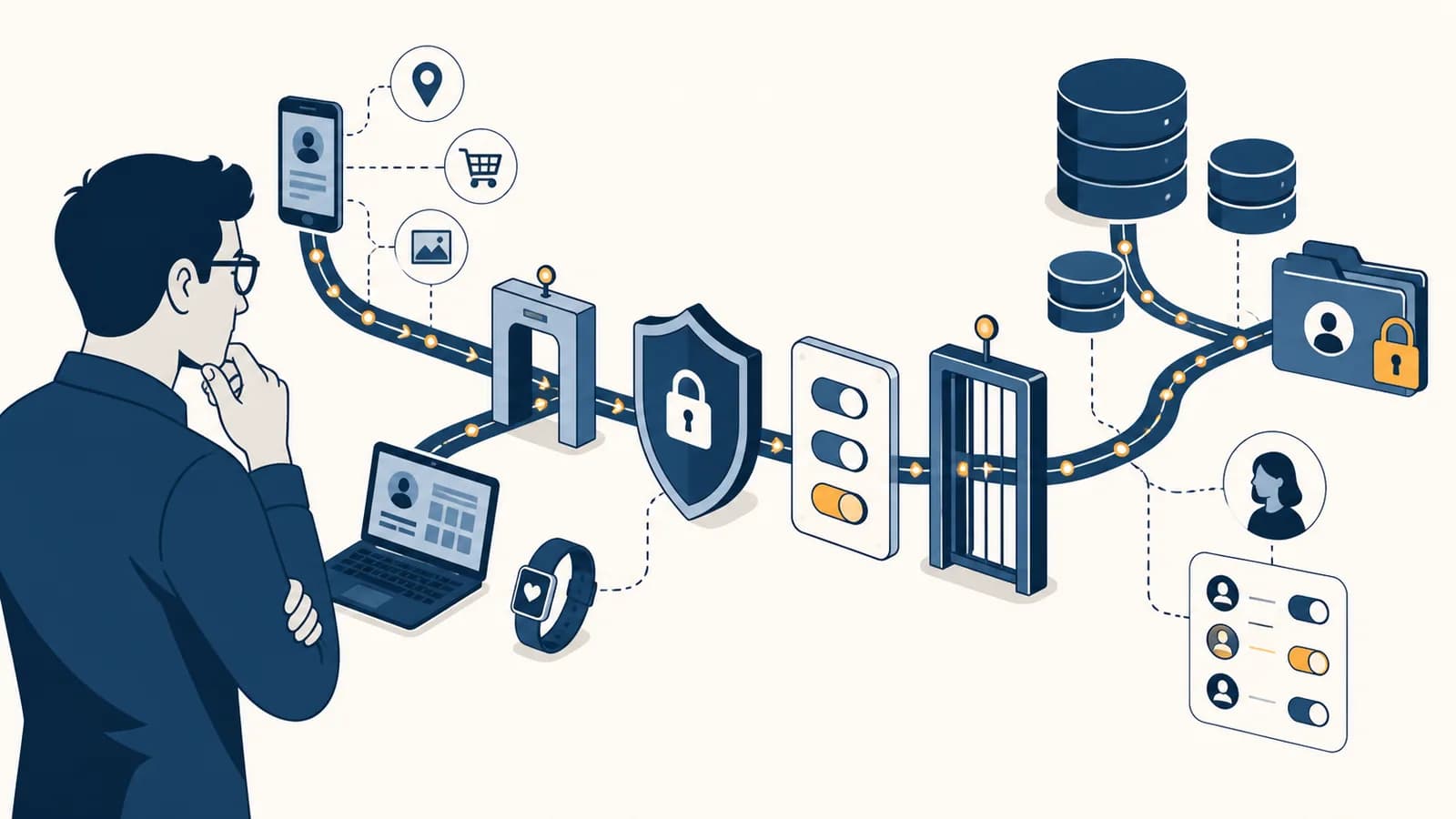
Privacy and ethics in tech is a field of computer science that determines who may collect, use, share, sell, secure, and delete personal data in digital systems. Data privacy asks what happens to information about a person; tech ethics asks what should happen, even when an action is legal or technically possible. The question “who owns your data?” has no single answer because ownership, access, control, and legal rights are different. These ideas exist because software can copy personal information instantly, combine harmless details into sensitive profiles, and make decisions that affect real people.
A photo, search, location ping, school login, and fitness reading can each become data. The important questions begin after collection: What was gathered? What can it reveal? Who receives it? How long does it remain? What choices does the person actually have? Answering those questions requires both technical knowledge and moral judgment.
What privacy and tech ethics actually are
Privacy is a person’s ability to influence how information about them is observed and used, while tech ethics is the reasoned study of which technical choices are fair, responsible, and harmful. Both concern power over data, not simply secrecy.
Privacy does not mean hiding everything. A student may willingly give a school an address for emergency contact but object if that address appears in a public directory. The same fact can be appropriate in one context and intrusive in another. Purpose, audience, timing, and consequences all matter.
Personal data is information linked, or reasonably linkable, to a person. A name and passport number are obvious examples. An advertising identifier, device fingerprint, voice recording, or repeated travel pattern can also point to one person. Sensitive data commonly includes health details, precise location, financial records, biometric templates, sexual information, and political or religious beliefs. Legal definitions vary by country, so a system must identify which rules apply rather than assume one universal list.
Who can learn this fact about a person, for what purpose, and with what control?
How does the system prevent unauthorized access, alteration, loss, or disruption?
Privacy and security overlap, but neither guarantees the other. A company can encrypt a detailed location history and still use it in a way the person never expected. That is secure storage with a privacy problem. A private journal saved without a password reflects a privacy intention with weak security. The technical protections behind defending systems, data, and people from attack are necessary, but ethical collection and use require separate decisions.
Privacy is contextual. The right question is rarely “Is this fact secret?” It is “Does this use fit the purpose and relationship in which the fact was provided?”
Ethics enters where a design creates benefits and burdens. A face recognition system may make entry faster for some people while misidentifying others, recording everyone who approaches, or removing the option to enter anonymously. Ethical analysis names the affected groups, tests the likely harms, compares alternatives, and assigns responsibility for failures.
How personal data is created and collected
Personal data is created through direct submission, observation, and inference. A person may type a fact, a sensor may record an event, or an algorithm may predict a trait from other records. Collection therefore includes more than forms and uploaded files.
Provided data comes directly from a person
Provided data includes an email address entered during registration, a message sent to a friend, or a birthday added to a profile. The act feels explicit because the person can see the field or content. Even here, hidden details may travel with the submission. A photograph can contain capture time, camera model, and sometimes coordinates in its metadata.
Observed data records behavior or surroundings
Observed data is recorded as activity occurs. Websites log page requests, apps record taps, card systems record purchases, and phones estimate location from satellite signals, nearby networks, and cell towers. Servers often need some logs to deliver a service or find faults. The privacy issue is how much they log, how long they retain it, and what later uses become possible.
Inferred data is produced by analysis
Inferred data is a conclusion calculated from other information. A service might infer likely interests from viewing history or estimate whether a transaction looks fraudulent. The inferred label may be wrong, yet it can still shape prices, recommendations, investigations, or access. A person cannot correct a label they cannot see.
Combination changes meaning. A bus stop location seems ordinary. A repeated stop at the same hour, joined with a home address and a workplace directory, can reveal a commute. Several weak signals can identify a routine more clearly than one obvious identifier. This is why removing names does not automatically make a dataset anonymous.
A weather app asks for location to show a local forecast. If it requests precise location every minute, keeps a long history, and shares an advertising identifier, the collection exceeds what a city-level forecast needs. A coarse location entered by the user would serve the stated purpose with less exposure.
The example shows data minimization: collect the least detailed information needed for a defined task. Minimization also means limiting frequency, retention time, and recipients. It is a design decision, not a cleanup task performed after a database is full.
How a data system works
A data system turns human activity into records, moves those records through software and organizations, and produces actions or decisions. Privacy can fail at any stage: collection, transmission, storage, analysis, sharing, retention, or deletion.
The organization states the service it is providing and the reason each data field is necessary. A vague purpose such as “improve experience” does not set a useful boundary.
An interface, sensor, or import creates a record. Validation checks format and plausibility, but it cannot prove every statement is true.
Networks carry the record to a service. Encryption can protect it while moving and while stored, while access controls decide which accounts and programs may read it.
Code sorts, searches, aggregates, or models the record. Joining datasets can create new knowledge that was absent from either dataset alone.
The result may personalize a screen, flag a payment, train a model, or pass to another organization. Every recipient creates another place where control can fail.
A retention rule decides when records expire. Deletion must cover live databases, caches, exports, and scheduled removal from backups where immediate erasure is impractical.
Consider a music app that recommends songs. It receives a play event containing an account identifier, track identifier, and time. A service stores that event. An analysis job groups plays into preferences. A recommendation model ranks the next tracks. Engineers may inspect samples while testing. A measurement service may receive a separate event. One tap has become several records, processes, and access paths.
Good architecture keeps a data inventory that maps each field to its purpose, location, recipients, retention period, and access rules. Logs should record sensitive operations so investigators can learn who accessed a record and when. Permissions should follow least privilege: a program or employee receives only the access required for a task. These practices make policy testable in code and operations.
Data ownership versus data control
Data ownership suggests one party possesses a record like physical property, while data control describes specific powers such as access, correction, transfer, restriction, and deletion. Digital records can have several legitimate interests at once, so control is usually the more accurate idea.
If you buy a chair, ownership normally lets you exclude others and transfer the object. Data behaves differently because copying it does not remove the original. A hospital may create and maintain a medical record, a patient may have rights over information about them, a laboratory may contribute results, and law may require retention. Asking who owns that entire record compresses several relationships into one misleading word.
| Question | Possible holder of the power | What the power means |
|---|---|---|
| Who stores the record? | A service provider | It operates the database or file system. |
| Who is the record about? | The data subject | The information identifies or describes that person. |
| Who decides the purpose? | An organization using the data | It chooses why and how processing occurs, subject to applicable law. |
| Who can copy or license it? | A party with contractual or legal authority | Its permission may still be limited by privacy, confidentiality, or intellectual property rules. |
| Who can demand access or deletion? | Often the data subject, depending on law and exceptions | The right concerns a particular action, not total ownership of every copy. |
Copyright adds another distinction. Copyright may protect an original photograph or written message, but a person’s name or a raw fact is generally not protected in the same way as a creative work. Privacy law, confidentiality duties, database rights, contracts, consumer protection, and sector rules may still limit use. The exact answer depends on jurisdiction and context.
A privacy policy is not a deed of ownership. It describes claimed practices and legal terms. It does not convert every fact about a person into unrestricted company property.
The practical approach is to ask a set of narrower questions. Can the person see the record? Can they correct a false inference? Can they export it in a usable format? Can they object to a secondary use? Which copies must remain for fraud prevention, legal claims, or safety? Specific rights produce specific engineering requirements.
Consent versus meaningful choice
Consent is an expressed agreement to a defined data use, while meaningful choice requires understandable information, a genuine alternative, and the ability to change the decision. Clicking “accept” is weak evidence of choice when refusal is hidden or service is unfairly withheld.
Useful consent is informed, specific, freely given, and reversible. “We may use information to improve services” does not tell a person which information, which services, which analyses, or which recipients are involved. Separate choices help when uses are genuinely separate. A map may need location to provide directions, but it does not necessarily need permission to use location history for targeted advertising.
A bright “accept all” button appears immediately. Refusal requires opening several screens, toggling many switches, and confirming twice.
Accept and reject choices have similar visibility. Purposes are separated clearly, defaults are restrained, and a later settings page permits withdrawal.
Designs that steer people through confusion, obstruction, or visual pressure are often called dark patterns. Examples include a preselected marketing box, a countdown that implies false urgency, or a cancellation path much harder than sign-up. The ethical issue is not only what text says. It is what the interface predictably causes people to do.
Consent is also not the only possible basis for processing. Depending on the law and setting, an organization may need data to perform a contract, meet a legal duty, protect someone in an emergency, carry out a public task, or pursue a limited legitimate interest. Those grounds are not blank checks. Purpose limits, necessity, transparency, security, and individual rights can still apply.
A school attendance system needs a student identifier, class, date, and attendance status. Requiring agreement to sell attendance patterns to advertisers would not be a free choice because students cannot realistically refuse school. The extra use should be removed, not buried in consent text.
Young people create an additional responsibility because age can affect legal capacity and because children may understand future consequences differently. A safe design uses plain explanations, restrained defaults, limited profiling, and age-appropriate controls. It does not treat a long policy as proof that every user understood every use.
How privacy shows up in jobs, law, money, and daily decisions
Privacy appears wherever software turns personal information into access, predictions, prices, or attention. Engineers implement controls, lawyers interpret duties, investigators examine misuse, managers choose purposes, and individuals make daily tradeoffs through phones, cards, cameras, and accounts.
Software jobs translate policy into system behavior
A product manager may define why an app needs a field. A designer makes the choice understandable. A developer limits collection and builds access controls. A data engineer sets retention jobs. A security specialist tests defenses. A privacy engineer maps data flows and looks for unnecessary exposure. An auditor checks whether actual behavior matches documented claims.
These roles require concrete questions. Which database column stores the value? Which internal services call its interface? Does a test environment contain real customer records? Can support staff see the whole profile or only the fields needed for one case? Privacy becomes an engineering discipline when each answer can be inspected and tested.
Law sets rights, duties, and boundaries
Privacy laws differ, but many use recurring concepts: notice, purpose limitation, data minimization, accuracy, security, retention limits, and accountability. Some provide rights to access, correct, delete, object, or receive a portable copy. Exceptions may preserve records needed for public safety, legal obligations, freedom of expression, research, or legal claims. A real dispute needs advice based on the governing jurisdiction, not a generic internet summary.
Law sets a floor, not a complete ethical answer. A practice can satisfy a narrow reading of a rule and still exploit people who have little bargaining power. Ethical review asks who benefits, who bears risk, who was excluded from testing, and how a person can challenge an error.
Money changes the incentives around data
Many services earn revenue by selling subscriptions, showing advertisements, measuring campaigns, licensing analysis, or facilitating transactions. Personal data can improve targeting and prediction, but calling data “the new oil” is inaccurate. Data can be copied, combined, reused, and linked to a person who continues to experience consequences.
A free price does not mean a person literally pays with ownership of every record. It means the business needs another source of revenue. The useful questions are which parties pay, what they receive, and which user behavior the business has an incentive to encourage. An advertising service may optimize time spent and clicks, while a subscription service may optimize renewal. Neither model is automatically ethical.
Daily tools reveal privacy choices
A shared document exposes names in edit history. A photo can reveal a home address in the background. A loyalty card connects purchases across visits. A smart speaker processes sound to detect a wake phrase. A car can store destinations and driving events. Privacy is present in ordinary settings because sensors, accounts, and networks turn actions into durable records.
This sentence is a design test, not a claim that all explanation makes collection acceptable. Necessity must be checked against less intrusive alternatives. The wider set of new computing systems and their practical consequences shows why this test should happen before a product spreads, when architecture is still easier to change.
How privacy rules shape software
Privacy rules shape software by turning principles into data structures, permissions, interfaces, timers, and audit records. A promise becomes real only when the system’s normal operation enforces it and its logs can show what happened.
Purpose limitation can become separate storage paths or permissions for separate uses. Data minimization can remove fields from a form and reduce sensor precision. Retention limits can become expiration timestamps and scheduled deletion jobs. Access rights require a reliable way to find records connected to a person. Correction rights require controlled updates and a method to stop stale copies from restoring an error.
Suppose a service promises to retain support chats for ninety days. A developer can store an expiration time when each chat closes. A scheduled job deletes expired chats from active storage. Monitoring reports failures. Backup policy specifies when old snapshots cycle out. Tests create an expired record and verify that search, support tools, and exports can no longer retrieve it. The promise now has observable behavior.
Privacy by design means considering these controls during architecture and product planning. It is cheaper and clearer to avoid collecting a precise location than to protect, document, export, and delete it across ten systems. Default settings matter because many people never change them. A privacy-protective default limits exposure while still allowing a person to choose a broader use knowingly.
Decentralized systems pose a special tension. An append-only ledger can make later alteration difficult, which supports integrity, but that same property conflicts with demands to correct or erase personal information. Good designs avoid placing raw personal data directly on a public chain. The mechanics behind shared ledgers and trust without one central operator help explain why a hash on a ledger is not the same as safely storing a person’s full record there.
5 mistakes people make with privacy
Common privacy mistakes confuse secrecy with harmlessness, consent with fairness, and deletion with instant disappearance. Correcting them requires tracing the whole data lifecycle and considering what records reveal after they are copied, combined, inferred, or used to make decisions.
1. “I have nothing to hide” ends the analysis
Privacy protects ordinary life, not only secrets or wrongdoing. People close curtains, use envelopes, and choose which friend hears which story. Information can be harmless now but risky after a change in employment, health, family circumstances, law, or social context. The issue is appropriate use and power, not guilt.
2. Removing names makes a dataset anonymous
Names are only direct identifiers. Dates, locations, rare attributes, and repeated patterns can reconnect records to people, especially when another dataset supplies missing context. A dataset of trips may identify a home through night stops and a workplace through weekday stops even if every rider is represented by a number.
3. A user accepted the terms, so every use is fair
A click may show that an interface recorded agreement. It does not prove comprehension, free choice, proportionality, or absence of harm. Ethical review examines the design of the choice, the necessity of the data, the treatment of people who refuse, and the consequences of later uses.
4. More data always produces a better model
Additional data can add noise, stale records, sampling bias, and security exposure. A model trained on irrelevant fields may learn shortcuts that fail outside its training set. Teams should ask which variables support the task, how quality will be checked, and whether a less sensitive signal performs adequately.
5. Privacy is one team’s final review
Collection begins in product design, permissions live in code, copies spread through data pipelines, and retention depends on operations. A privacy specialist can guide the work, but cannot repair every choice at launch. Responsibility must be assigned across the system lifecycle.
Use a data map to test assumptions. Draw every source, store, process, recipient, and deletion path. Unknown arrows reveal work that a policy document can hide.
A mistake becomes easier to spot when stated as a testable claim. “We do not share location” can be checked against network requests, software development kits, server logs, contracts, and employee access. Clear claims let testers look for counterexamples in the same spirit that programmers use while finding the causes of broken software.
What deleting an account actually does
Deleting an account should end active use and remove or detach associated personal records, but it may not erase every copy immediately. Backups, legal records, fraud controls, public posts, and copies held by other recipients can follow different schedules and rules.
An account is usually one row linked to many objects: profile fields, messages, uploads, payment records, device tokens, logs, preferences, and derived features. Deleting only the login row can orphan the rest without making it anonymous. A complete process needs an inventory of identifiers and relationships, plus a decision for each record: erase it, aggregate it, deidentify it, retain it under a valid rule, or transfer control where appropriate.
Mina closes a delivery account. The service removes her profile, saved addresses, device tokens, and marketing preferences from active systems. It retains a limited transaction record required for accounting and fraud disputes, restricts who can access it, and states the retention reason. Old backups expire on their scheduled cycle and are not restored into active use.
Copies given to other people create a separate limit. Deleting a social account can remove the service’s version of a post, but it cannot reach a screenshot saved on someone else’s phone. Search caches and connected services may also update later. A truthful deletion message explains scope and delay instead of promising magical erasure.
Soft deletion marks a record as inactive so it can be recovered, while hard deletion removes the active record. Soft deletion is useful for short recovery windows, but indefinite hidden retention defeats a deletion promise. Teams should set a time limit, restrict access during the window, and make final removal automatic.
Anonymity versus pseudonymity
Anonymity means a person is not reasonably identifiable in the relevant data and context, while pseudonymity replaces direct identifiers with a code that can still reconnect records. Pseudonymous data reduces exposure, but it usually remains personal data because linkage is possible.
A patient table might replace names with random study identifiers. If a hospital keeps a separate file mapping those identifiers back to patients, the research table is pseudonymous. Separating the mapping, restricting access, and encrypting both stores reduces risk. It does not make reidentification impossible.
Quasi-identifiers are details that may identify a person in combination, such as a narrow age, small area, uncommon occupation, and event date. Deidentification can generalize exact ages into ranges, remove rare categories, reduce geographic precision, perturb values, or release only aggregates. Each change trades detail for lower identification risk.
If five records share the same released age range, area, and occupation, that combination has within the released table.
K-anonymity is one model, not a guarantee. If all five matching records contain the same sensitive diagnosis, membership in the group still reveals that diagnosis. An attacker may also possess outside information. Analysts therefore assess the dataset, likely attackers, release method, and consequences together. Techniques such as aggregation, controlled query systems, and differential privacy can add protection for suitable tasks.
Differential privacy adds carefully calibrated randomness to outputs so that the presence or absence of one person has a limited effect on the result. It is useful for population statistics, but parameters, repeated queries, and implementation details matter. It does not make raw records safe to publish.
How privacy shows up in AI systems
Privacy enters AI systems through training data, prompts, model outputs, evaluation records, and automated decisions. A model can expose memorized details, infer sensitive traits, or apply opaque classifications, so teams must control both the data pipeline and the resulting behavior.
Training data may include licensed material, public webpages, purchased datasets, user submissions, or organization records. Public access does not erase privacy concerns. A forum post may be visible to anyone yet written for a limited community and time. Collection at scale changes discoverability and permits new analysis.
Prompts can also contain personal data. An employee who pastes a customer complaint into an assistant may include a name, address, and account number. The organization needs clear rules about approved tools, permitted fields, retention, human review, and output use. Redacting unnecessary details before submission reduces risk at the source.
State what the model predicts and what action follows. A vague goal hides consequences.
Confirm that each source may be used for this purpose and that sensitive fields are necessary.
Measure errors across relevant groups and examine who bears the cost of false positives and false negatives.
Tell affected people enough to question a result, correct bad input, and reach a qualified human where stakes justify it.
Accuracy alone does not settle ethics. A highly accurate prediction may rely on data collected for another purpose or deny people a fair chance to contest an error. A less intrusive rule may be easier to explain and sufficient for the decision. Teams should compare the model against that simpler baseline.
AI also complicates deletion. Removing one training record from a source database does not necessarily reverse its effect on an already trained model. Possible responses include retraining, machine unlearning methods, output filters, and preventing the record from entering future training runs. The right approach depends on the model, risk, legal duty, and evidence that the record influenced outputs.
Ethical computing makes data choices visible
Ethical computing treats every data field, permission, prediction, and retention period as a choice that can be explained and tested. Computer science supplies the machinery; responsible practice decides which machinery should exist, whose interests it serves, and how mistakes are corrected.
The strongest habit is to trace one familiar digital action. Choose a map search, school login, game purchase, or shared photo. List the input, inferred details, storage locations, possible recipients, decision produced, and deletion path. Then ask which stage could use less data or give the person more control.
The takeaway: “Who owns your data?” is a useful opening question, but the better analysis separates possession, access, purpose, rights, security, retention, and accountability. Privacy improves when each power has a limit and each limit has a technical control.
This topic connects code to databases, networks, interface design, security, artificial intelligence, and law. The broader set of computer science explanations and applications shows how those parts interact. The next time an app requests a permission, notice the exact data requested and the function promised. That small pause is the beginning of ethical system analysis.