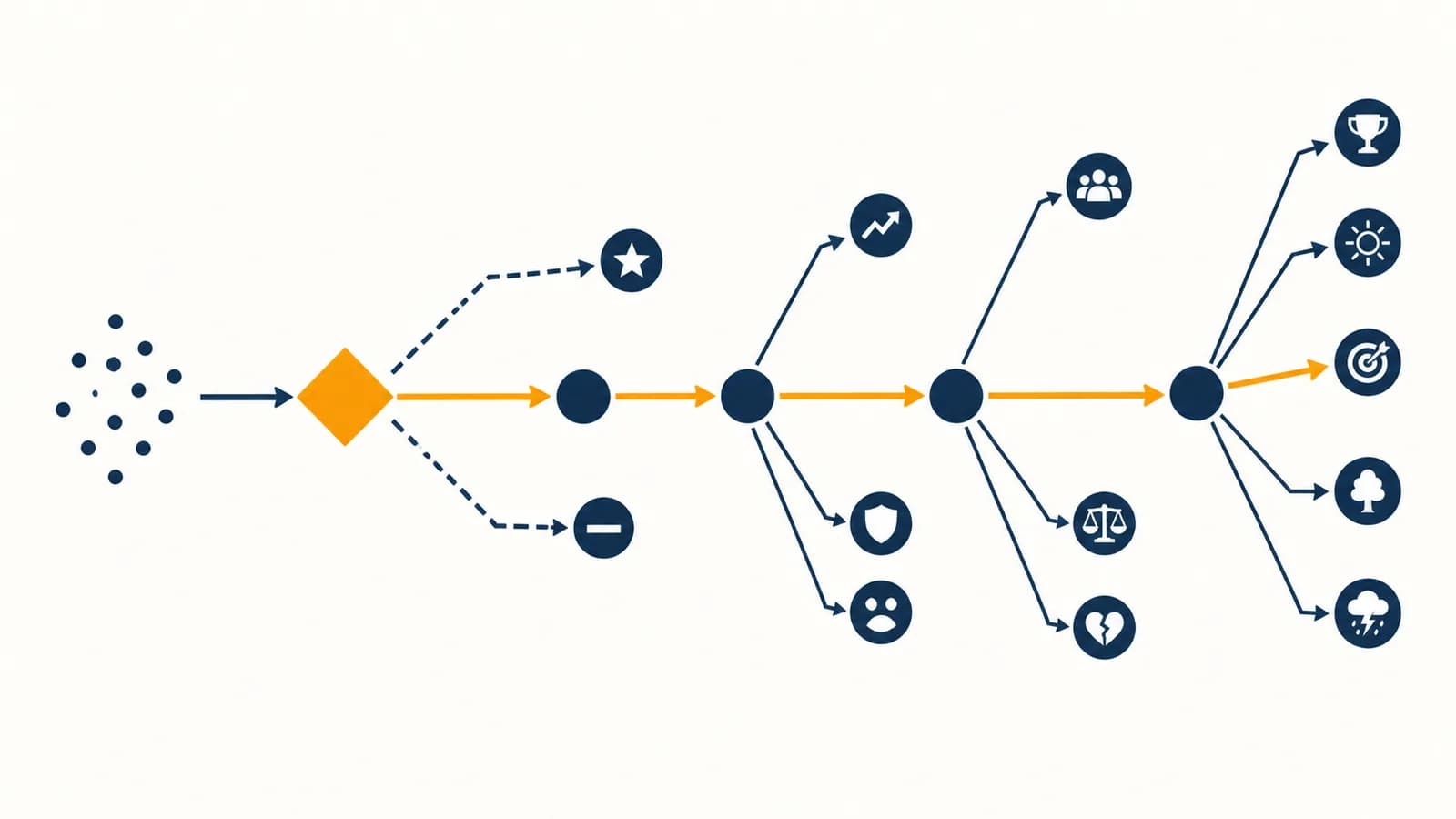
Second-order thinking looks past the first result
Second-order thinking is the habit of asking what happens after the immediate consequence of a decision. It improves decision-making by exposing delayed effects, feedback loops, incentives, and reactions that first-order thinking misses. By the end, you can map a choice across time, test assumptions, and compare options by their total effects rather than their quickest rewards.
First-order thinking stops at the direct result. Lowering a price should attract more buyers. Automating a task should save time. Giving someone a target should improve performance. Each statement can be true and still support a bad decision, because people and systems respond to what changed.
Ask, “What happens next?” Then treat that immediate result as the answer.
Ask, “What happens after that, and how will people respond?” Then trace the effects far enough to find the important tradeoffs.
Imagine a shop cuts the price of a popular product. More customers may buy it, which is the visible first effect. Yet the lower margin can reduce profit on every sale. A crowded shop can slow service. Regular customers may delay future purchases because they expect another discount. A competitor may cut its price too. The decision has changed behavior, not just a number on a label.
This chain is the basic shape of second-order thinking. A careful thinker does not predict every possible future. That would be impossible. The aim is narrower: identify the few later effects that could reverse the apparent value of the first result.
Why can the obvious move produce the opposite result?
The obvious move can fail because it changes the incentives and constraints inside a system. People adapt, resources move, bottlenecks shift, and repeated actions accumulate. The first effect may be helpful while the response it triggers is larger and harmful.
Suppose a manager measures a support team only by the number of tickets closed each day. The obvious prediction is simple: a clear target will encourage faster work. It probably will. But the measure also tells workers what the organisation rewards. Difficult cases now consume time without improving the score, so workers may avoid them, split one issue into several easy tickets, or close cases before the customer’s problem is solved.
A measure can become a target. Once rewards depend on a number, people have a reason to improve the number even when that does not improve the result the number was meant to represent.
The target did not make the team careless by magic. It changed the payoff attached to each action. Second-order thinking makes this mechanism visible by asking two practical questions: “What behavior does this rule reward?” and “What useful behavior does it accidentally punish?”
Constraints move in a similar way. A factory buys a faster machine, but total output barely changes because packing is now the slowest stage. A student saves time by watching lectures at double speed, but later spends more time rebuilding ideas that never entered long-term memory. A city widens a busy road, then drivers change routes and travel times until congestion grows again. In each case, improving one part exposes or enlarges another limit.
This is why a good first result is evidence, not a verdict. It tells you that one link in the chain worked. It says little about the whole chain unless you also inspect the reactions, delays, and displaced costs.
How do feedback loops change a decision over time?
A feedback loop occurs when the result of an action changes what happens next. Reinforcing loops amplify movement, while balancing loops resist it. Recognising which loop is active helps explain why small choices can grow or why strong efforts can fade.
Consider saving money. A deposit earns interest. The next interest payment is calculated on the original deposit plus earlier interest, so growth feeds further growth. Debt can behave the same way in the other direction. The mathematics behind how interest rates change borrowing and saving shows why time belongs inside any financial decision.
If 100 units grow by 10% for two periods, the result is units.
The visible gain after the first period is 10 units. The second period adds 11 because the earlier gain now earns a return too. This is a reinforcing loop. Repetition matters more than the first change suggests.
Balancing loops push back. A room heater raises the temperature until a thermostat switches it off. A high price encourages some buyers to leave or suppliers to offer more, reducing the pressure that raised the price. A person who trains hard every day may initially improve faster, then fatigue reduces the quality of each session. More effort stops producing more progress because recovery has become the limiting factor.
Feedback is also central to finding what is broken in a computer program. A programmer changes one condition, runs a test, observes the output, and uses that result to choose the next test. Random edits create confusing feedback. Controlled changes produce information. The same discipline improves decisions outside software.
What should you put on a consequence map?
A useful consequence map records the action, its direct effects, the likely responses, and the later results. It also marks who gains, who pays, when each effect appears, and which assumptions would make the chain fail.
Take a school considering a phone ban during lessons. The first-order effect is fewer visible phones. That is easy to count, but it is not the final goal. The school wants more attention and better learning. Students may comply, hide phones, switch to smartwatches, or use school laptops for the same distractions. Teachers may spend less time correcting phone use, or more time enforcing a rule. Parents may need a different route for urgent contact.
A school collects phones at the classroom door. Lessons begin with fewer interruptions, but collection takes four minutes and creates disputes over damaged devices. The policy succeeds only if the learning gained from fewer interruptions exceeds the learning and trust lost through collection.
The example does not prove that bans work or fail. It shows what must be measured. “Fewer phones” is an intermediate result. Time on task, quality of work, enforcement time, and predictable emergency contact are closer to the outcomes the school actually values.
Replace “deal with phones” with a testable action such as “collect phones at the start of each lesson for four weeks.”
Describe what changes immediately, without assuming that it achieves the larger goal.
List how affected people could adapt and how long each important effect might take to appear.
Ask what would need to be true for an attractive choice to become harmful, or an unattractive choice to become useful.
A map is a thinking aid, not a prediction machine. Keep it small enough to use. Two or three strong branches are better than twenty vague possibilities. Give priority to effects that are plausible, large enough to matter, and hard to reverse.
How can simple arithmetic expose a hidden tradeoff?
Simple arithmetic forces benefits and costs onto the same scale. It reveals break-even points, repeated losses, and opportunity costs that verbal reasoning can hide. The numbers do not need false precision; clear assumptions and visible calculations are enough.
Suppose a student is offered a five-hour shift paying 12 units per hour on the evening before an exam. The first-order result is 60 units earned. The second-order question is what those five hours replace. If the shift removes three hours of focused revision and two hours of sleep, the full choice includes money, preparation, alertness, and any effect on later options.
No honest formula can turn sleep, exam performance, and money into exact equivalents without personal judgments. The arithmetic still helps. It isolates the certain immediate reward, then shows which uncertain costs must be considered rather than silently treated as zero.
A 40% chance of gaining 50 units and a 60% chance of gaining 10 units has an expected value of units.
Expected value is useful when outcomes repeat or when probabilities are reasonably grounded. It is not permission to invent a probability. If you cannot defend the probabilities, calculate a break-even point instead. Ask how likely a bad outcome would need to be before it changes the decision. Then judge whether that threshold seems plausible.
This habit belongs to mathematical reasoning about quantities and uncertainty. Its value is not complexity. A small equation makes assumptions inspectable. Someone else can challenge the probability, the value, or the time period instead of arguing with a vague feeling.
Which questions catch the mistakes people miss?
The best questions search for reactions, repetition, displacement, delay, and reversibility. They do not demand a perfect forecast. They direct attention toward the mechanisms most likely to make the immediate answer incomplete or wrong.
- Then what? Repeat this after each consequence until later effects become small or speculative.
- Who changes behavior? Identify every person or group whose incentives, information, or constraints have changed.
- What does this replace? Time, money, attention, and physical space cannot usually serve two uses at once.
- What happens if everyone copies it? A choice that works for one person may fail when adopted by a crowd.
- What happens if it is repeated? A harmless exception can become an expensive habit.
- How will I know? Choose an observation that can distinguish success from a flattering intermediate result.
- Can I reverse it? Require more evidence before choices that are expensive, public, or difficult to undo.
The “everyone copies it” question matters in connected systems. One company can reduce costs by moving production abroad, while widespread movement can alter wages, skills, supply chains, and political pressure across several countries. The history of global connections and their modern consequences is full of choices whose wider effects differ from their private benefits.
Look for displaced harm. If a policy solves one visible problem, check whether the cost disappeared or simply moved to another person, place, budget, or time.
Reversibility changes how much analysis a choice deserves. Trying a new study schedule for one week is cheap to reverse. Publishing private information is not. A useful rule is to move quickly on small, reversible trials and slowly on commitments whose later costs cannot be recovered.
When does second-order thinking become overthinking?
Second-order thinking becomes overthinking when extra possibilities no longer improve the choice. If consequences are tiny, remote, unsupported, or easily reversed, more analysis adds delay rather than useful information. The depth of thought should match the stakes and uncertainty.
Every action has countless possible consequences. Walking to a different shop might introduce you to a future friend, expose you to rain, or inspire a career. These outcomes are possible but too weakly connected to guide the choice. Good analysis follows mechanisms, not stories that merely can be imagined.
Names a clear causal chain, tests an assumption, finds a threshold, or supports a reversible experiment.
Adds remote scenarios without evidence, repeats the same uncertainty, or delays a cheap choice that can be corrected.
Set a stopping rule before analysis expands. For a small choice, allow a few minutes and inspect one later consequence. For a larger commitment, identify the two most serious failure modes, find evidence that would change your mind, and set a decision time. The stopping rule protects thought from becoming avoidance.
Experiments can replace prediction. A restaurant considering a new menu does not need to forecast a year of customer behavior from imagination. It can test several dishes for a limited period, track orders, preparation time, waste, and repeat purchases, then revise. The test creates feedback while limiting the cost of being wrong.
Uncertainty never reaches zero. The aim is a decision that is reasonable given the available evidence, with a plan to notice errors and adjust. Thinking one step further is valuable only when that step could change what you do.
Better decisions come from shorter, testable chains
Strong second-order thinking ends with a compact causal chain and an observable test. It connects a choice to a direct effect, a likely response, and a later outcome, then names the evidence that would confirm or challenge the reasoning.
Before a meaningful decision, write one line for the immediate result and one for what happens after people adapt. Add the cost that moves out of sight. Mark the delay. If the choice repeats, calculate the accumulated effect. If the choice is hard to reverse, look for a smaller trial.
The takeaway: Do not reject the obvious move merely because it is obvious. Test it. Ask what it changes, who responds, what the response causes, and what evidence would show that your chain is wrong.
This method does not guarantee a correct forecast. It makes errors easier to find because assumptions are visible. You can update a stated chain when new evidence arrives. You cannot easily update an intuition that was never expressed.
A mature decision is not the one with the longest explanation. It is the one that has looked far enough ahead to catch the likely reversal, then acts while learning remains possible.