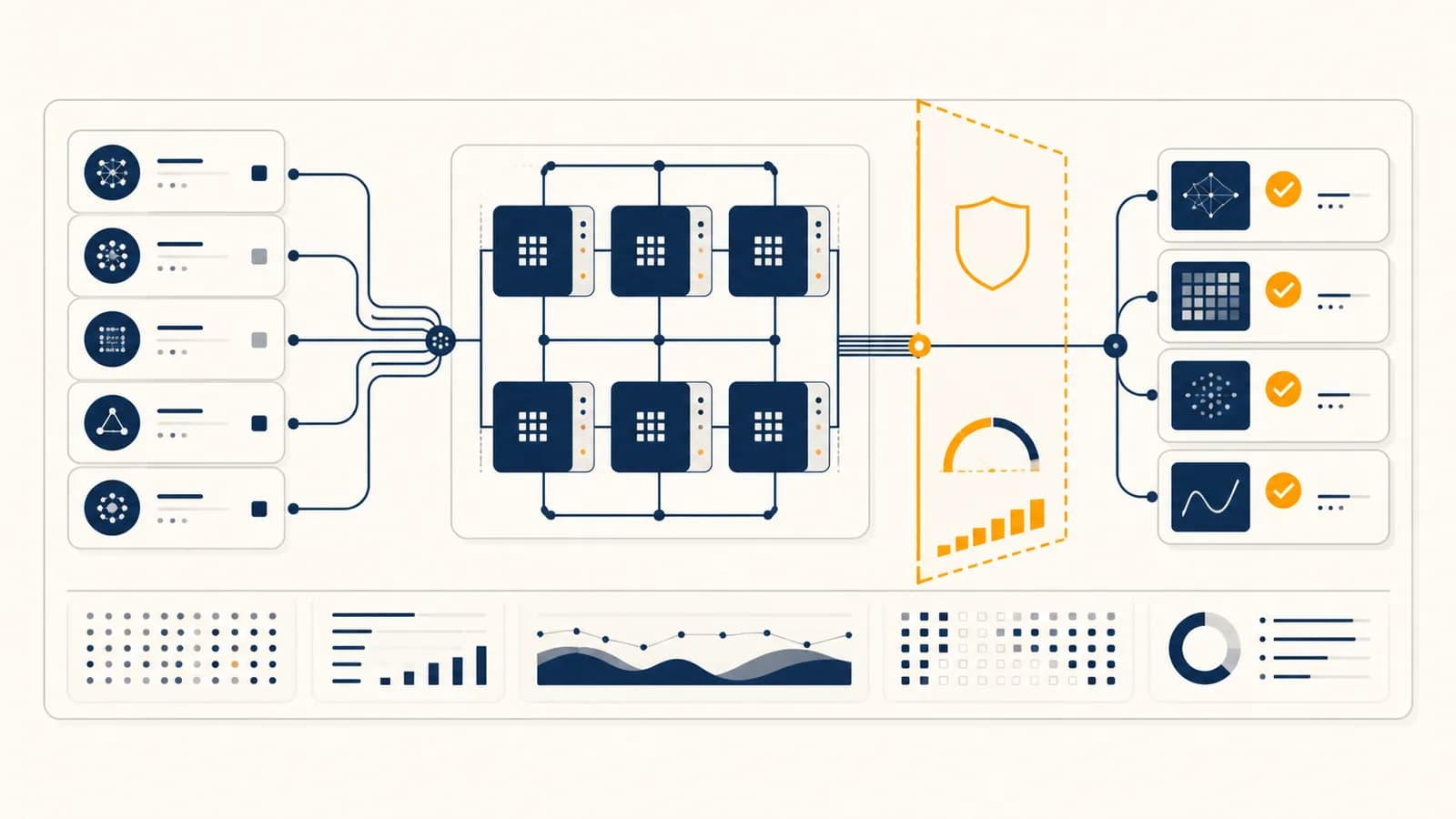
Cost management for AI development is a software engineering practice that measures, predicts, and controls spending on models, computing, data, storage, and human review, in the context of building and operating artificial intelligence systems. AI development cost tracking exists because every request consumes limited resources, while a useful product must stay affordable as usage changes. A practical AI cost management strategy connects each billable event to a feature, user, and result. That makes questions such as “What does this answer cost?”, “Which model should handle it?”, and “Will the budget survive ten times more traffic?” answerable with evidence rather than guesses.
What AI development cost management actually is
AI development cost management is the process of assigning resource use to specific work, comparing that use with a budget, and changing the system when spending buys too little value. It covers design, experimentation, deployment, monitoring, and revision.
The word cost includes more than an invoice from a model provider. A team may pay for graphics processors, central processors, memory, network traffic, databases, vector search, logs, evaluation runs, and people checking results. A free local model still uses electricity and hardware time. A cheap model call can trigger expensive database searches or long human reviews.
Management begins by naming a unit that the product actually delivers. For a study tool, the unit might be one accepted explanation. For a support system, it might be one resolved ticket. For a coding tool, it might be one merged change that passes tests. The team then attaches all relevant resource use to that unit.
“The model account cost $600 this month.” This records spending but does not show which feature caused it or what the spending produced.
“Accepted document summaries used $420, retries used $110, and failed experiments used $70.” This connects money to behavior and results.
A budget is therefore a design constraint, much like response time or memory. It does not automatically mean choosing the least expensive model. It means choosing an architecture whose quality, speed, and expense fit the job. Model calls, databases, and application code must be measured together because one user action can consume resources in every layer.
How AI development costs work
AI costs arise when a system consumes a metered resource: model tokens, accelerator time, storage, network transfer, retrieval queries, or human attention. Total cost is the sum of each quantity multiplied by its unit price, plus fixed expenses.
If hosting is $40, 8,000 model calls cost $0.02 each, and storage is $12, the worked total is . These are hypothetical prices chosen to show the arithmetic.
Fixed costs stay similar across a range of use. A reserved server is one example. Variable costs grow with activity. Per-token inference is one example. Step costs stay flat until a threshold forces another purchase, such as adding a second server when the first cannot handle peak traffic.
AI applications often create a chain of billable events for one visible action. A user asks a question. The application converts the question into an embedding, searches stored material, sends selected passages to a language model, checks the answer, stores logs, and perhaps retries after an error.
The cost of that action depends on fan-out. One button click might launch one request, or it might launch five agents that each make several requests. Retries multiply the chain again. A team needs traces that preserve the parent-child relationship, so it can see that fifteen charges came from one user action.
A usage limit is not a cost explanation. A monthly cap can stop a surprise bill, but only per-feature traces reveal why the money was spent.
Price is also separate from cost efficiency. If Model A costs one cent and succeeds half the time, two attempts are needed on average for one success. If Model B costs one and a half cents and succeeds every time on the same defined test, Model B has the lower cost per successful result. The example is hypothetical, but the comparison method is general.
AI cost management versus ordinary cloud budgeting
Ordinary cloud budgeting mainly tracks infrastructure by service and time, while AI cost management must also track prompts, outputs, model choices, retries, evaluations, and result quality. AI workloads can change cost sharply even when user traffic stays constant.
A conventional web request usually follows predictable code paths. Its compute time and database activity vary, but repeated requests of the same kind often use similar resources. A generative request accepts variable-length input and produces variable-length output. A small prompt change can add a large document to every request. An agent may choose to call a tool once or many times.
| Question | Cloud budgeting view | AI cost management view |
|---|---|---|
| What caused the charge? | Service, region, server, or database | Feature, prompt version, model, tool call, or retry |
| What was delivered? | Requests served or jobs completed | Answers accepted, tasks completed, or outputs passing evaluation |
| What can change suddenly? | Traffic, storage, or machine count | Those factors, plus context length, output length, branching, and model routing |
| What should be optimized? | Cost per request at a required reliability | Cost per useful result at required quality, speed, and safety |
The two disciplines still overlap. Tags, budgets, alerts, capacity planning, and unit economics matter in both. AI development adds semantic variables, meaning variables connected to the content and quality of the task. A prompt version is semantic. So is the difference between a correct answer and a fluent mistake.
How cost management works before a model call
Cost control starts before inference by defining the task, quality threshold, latency target, spending limit, and fallback behavior. These constraints determine which model, prompt, context, and architecture the application may use for each request.
Name what counts as success. “Produces text” is weak. “Extracts the invoice total that matches a checked answer” is measurable.
Collect normal, difficult, long, short, and malformed inputs. Remove private information or handle it under an approved data policy.
Record input tokens, output tokens, calls, latency, errors, and evaluation score for a simple working version.
Try shorter instructions, smaller context, caching, a less costly model, deterministic code, or a route that escalates only difficult cases.
Limit output, tool calls, retries, and per-user activity. Define what the application returns when a limit is reached.
Compare live traffic with the evaluation set. Alert on abnormal unit cost, not only on the total bill.
Model routing is one of the strongest design tools. A classifier or simple rule can send routine requests to a smaller model and difficult requests to a more capable one. The route itself must be evaluated. A bad router saves money by sending hard work to a model that cannot complete it, which produces retries and worse outcomes.
A school help desk receives password resets and complex account investigations. A fixed form and database lookup can handle a password reset without a language model. A small model can classify unclear messages. Only the unusual cases need a more expensive reasoning step and human review. The design cuts unnecessary inference while preserving escalation.
Guardrails need a planned user experience. If an agent reaches its tool-call limit, it can summarize completed work and ask for confirmation before continuing. If the high-quality model is unavailable or over budget, the application can queue the job instead of silently sending it to an unsuitable model.
How cost management shows up in coding and testing
In coding and testing, cost management means measuring the full loop that turns a request into verified software: generation, compilation, tests, debugging, human review, and rework. The cheapest first draft may produce the most expensive finished change.
An AI coding assistant can create code quickly, but output volume is a poor measure of progress. Generated code may fail to compile, duplicate an existing function, or weaken access control. Each failure consumes developer attention. That makes review time part of the economic calculation, even if it does not appear on the provider invoice.
A useful experiment gives two approaches the same task set and acceptance tests. Track model cost, elapsed time, number of retries, tests passed, and minutes of review. The work described in finding and fixing faults in AI-written programs is part of cost control because every undetected fault can move expense into support and maintenance.
The cards show arithmetic, not a market price: . Human review, test infrastructure, and later maintenance would still need to be added. If another method costs $0.90 in model use and passes on its first attempt, it is cheaper before review even though each attempt has a higher price.
Testing itself has a budget. Running a complete suite after every tiny generated edit may waste compute and time. A staged test plan runs fast unit tests first, then integration and security tests once the change clears the early checks. This is cost-aware scheduling, not permission to skip evidence.
Prompt and model experiments also need version control. Record the code revision, model identifier, model settings, prompt template, evaluation dataset, and results. Without those links, a team cannot reproduce a cheap successful run or explain why the next run became expensive.
How cost management shows up in production
In production, cost management connects every live request to usage, quality, and operational limits, then responds to unusual patterns. Teams use traces, budgets, alerts, caching, rate limits, and model routing to keep service predictable under real traffic.
The most informative dashboard starts with a unit-cost graph. Total daily cost naturally rises when more people use the product. Cost per completed task should remain within an expected band unless the mix of tasks changes. A sudden rise can reveal longer prompts, a retry loop, an agent calling the same tool repeatedly, or a cache that stopped matching.
If a hypothetical batch costs $24 in total and produces 80 accepted results, then per accepted result.
Production systems also need attribution. Each trace can carry a feature name, customer or account category, prompt version, model, and request identifier. Private data should not be copied into cost logs simply because it is available. Use opaque identifiers and keep access to traces limited.
Caching avoids repeated work. Exact caching returns a stored result when the input and relevant settings match. Semantic caching may reuse an answer for a meaningfully similar request, but similarity can hide important differences. A medical or legal query that looks similar may require a fresh, carefully sourced response. Cache policy is therefore a correctness decision as well as a spending decision.
Rate limits protect both budget and system health. They can restrict requests per user, account, feature, or time window. A global limit alone allows one runaway customer or faulty loop to consume the shared allowance. Per-request limits on output tokens, tool calls, and retries stop smaller failures from growing.
Alert on ratios as well as totals. Cost per accepted task, retry rate, and tokens per request can expose a defect before the monthly total crosses its budget.
Deployment architecture affects these controls. The choices covered in putting AI-built applications into production determine where traces, limits, queues, and fallback routes can be enforced.
How cost management shows up in training and customization
For training and customization, cost management compares the one-time and continuing cost of changing a model with the value of improved behavior. The calculation includes data preparation, accelerator time, evaluation, deployment, monitoring, and future retraining.
Training a model from scratch, fine-tuning an existing model, retrieval-augmented generation, and prompt design solve different problems. A team should not choose among them by prestige. If facts change often, retrieval may be easier to update because the source collection can change without retraining model weights. If the desired change is stable response format or domain behavior, fine-tuning may reduce prompt length and improve consistency, but it adds a data and maintenance pipeline.
| Approach | Main cost source | Recurring work | Good reason to consider it |
|---|---|---|---|
| Prompt design | Experiment calls and longer prompts | Retest after model or prompt changes | The task can be specified clearly in context |
| Retrieval | Document processing, embedding, search, and added input | Refresh sources and test retrieval quality | Answers need current or private reference material |
| Fine-tuning | Dataset creation, training, evaluation, and hosted inference | Monitor drift and retrain when needed | Many examples demonstrate stable desired behavior |
| Training from scratch | Data, large-scale compute, engineering, and repeated experiments | Operate and improve the full model stack | The required model cannot be obtained or adapted suitably |
The break-even question can be expressed without pretending the future is certain. Let an improvement cost to create, let it save on each task, and let tasks occur. It breaks even when . If a hypothetical fine-tuning project costs $2,000 and saves $0.01 per task, the arithmetic break-even point is tasks. Quality changes and maintenance costs must also be counted.
What tokens, context, and caching actually cost
Tokens are the chunks of text a model reads and writes, context is the full material supplied for a request, and caching reuses eligible prior computation or results. Their cost depends on the provider, model, direction, and cache rules.
A token is not exactly a word. Punctuation, fragments, code, and different languages can split in different ways. Estimate with the tokenizer for the chosen model, then record actual counts returned by the service. A word-count rule can help with early planning, but it is not a billing record.
Context includes system instructions, conversation history, retrieved passages, tool descriptions, and the current request. Applications often focus only on what the user typed and miss everything added behind the interface. Long tool schemas and repeated documents can dominate input even when the visible question is short.
A chatbot sends 600 tokens of instructions, 2,400 tokens of retrieved text, 500 tokens of conversation history, and a 100-token question. Its input is tokens before the model writes anything. Cutting retrieval to 1,200 tokens saves 1,200 input tokens on that request, provided answer quality stays acceptable.
Output limits matter because generated text can continue until the model stops or reaches a cap. Set a cap that fits the task, then state the expected form clearly. A classification may need a short structured response. A lesson explanation needs more room. An extremely low cap can cause truncated answers and retries, which defeats the saving.
There are several kinds of reuse. A response cache stores a finished result. A retrieval cache stores search results. A provider may offer discounted processing for repeated input prefixes under specific rules. The implementation must verify which data is cached, how long it stays valid, who may receive it, and how invalidation works when the underlying information changes.
Delete text until the token count falls. This can remove the evidence or instruction that makes the answer correct.
Rank candidate material, keep the parts linked to evaluation gains, and test the shorter context against representative tasks.
Context reduction is a computer science problem about information selection. Better retrieval, concise schemas, conversation summaries, and references to stored state can reduce repetition. Each method creates a new failure mode, so savings must be checked against task accuracy.
How cost per useful result is estimated
Cost per useful result is estimated by modeling request volume and resource use, testing those assumptions on representative tasks, and dividing total expected expense by accepted outcomes. A range is more honest than one precise forecast when usage is uncertain.
Start with three traffic cases: low, expected, and high. For each case, estimate requests, input and output tokens, tool calls, storage growth, review time, and failure rate. Obtain current unit prices from the actual providers or measured infrastructure. Prices change, so they belong in a dated configuration file rather than permanent application code or an undated slide.
Here is monthly requests, and are average tokens per request, is the provider's pricing token unit, is average paid tool calls, and each is its current unit price.
Then adjust the denominator. If 10,000 hypothetical requests produce 8,500 accepted results, divide the full cost by 8,500, not 10,000. If rejected outputs are retried, their resource use stays in the numerator. If humans correct some results, include the review time at an agreed planning rate.
Sensitivity analysis shows which assumption matters most. Recalculate with double the average context, a lower cache hit rate, more difficult traffic, or a higher retry rate. A forecast that stays acceptable across plausible cases is more useful than a forecast that works only at the exact midpoint.
These proportions come directly from the worked assumption: . They are not claims about typical AI performance. Replace them with measurements from the product's own evaluation and live monitoring.
Five mistakes people make with AI costs
The most common AI cost mistakes are counting only model invoices, optimizing before measuring quality, ignoring fan-out, treating limits as complete controls, and forecasting from averages alone. Each mistake hides a different path by which small charges become expensive outcomes.
1. Counting only model calls
Model charges are often the easiest line item to see, so teams mistake them for total cost. Add retrieval, storage, observability, evaluation, security review, development time, and human correction. Include later maintenance when comparing architectures, especially if one design creates a custom pipeline that must be operated.
2. Choosing the cheapest model before defining success
A low unit price says nothing about fitness for a task. Build an evaluation set and acceptance threshold first. Then select the least costly setup that meets the threshold and operational requirements. This prevents a cheap model from generating repeated failures that people or larger models must repair.
3. Ignoring fan-out and retries
Agent systems can branch into searches, code execution, subtask generation, judging, and retry loops. Put a trace around the whole user action, count all descendants, and set a maximum depth and call count. A retry should respond to a defined recoverable error, not to vague dissatisfaction with the answer.
4. Using a hard cap without graceful behavior
A cap can prevent unlimited spending, but an abrupt failure can lose work and prompt repeated clicks. Return partial progress, explain the constraint in ordinary language, and offer a safe next action. Queueing, human approval, or a later retry may fit better than a silent downgrade.
5. Planning around one average request
Averages hide long conversations, large documents, unusual tool use, and traffic peaks. Inspect percentiles and task categories, then model high-cost cases separately. Put additional approval around bulk jobs or unusually large inputs. One malformed request should not be allowed to consume the budget intended for many ordinary requests.
Useful review question: If this request loops, branches, or repeats, which limit stops it, and what useful state does the user receive?
Good controls are visible in the product design. A user can see that a long analysis will take more time or consume an allowance. A developer can trace a charge back to code and input. An operator can distinguish healthy growth from waste. A manager can compare expense with accepted results.
Cost management makes AI systems observable
Cost management makes an AI system observable by turning resource use into evidence about program behavior. Tokens, calls, retries, latency, and accepted results reveal how algorithms, data structures, interfaces, and infrastructure interact under real constraints.
This is why the topic belongs in computer science rather than only in accounting. A surprising bill may be a symptom of an unbounded loop, duplicated context, poor caching, an inefficient search, or a missing state transition. Cost is another output of the program, and it can be tested.
Start with one feature. Give it a trace identifier, record its complete resource chain, define an accepted result, and calculate cost per acceptance for a small evaluation set. Change one variable, such as context length or model route, then rerun the same test. Keep the change only if the tradeoff is visible.
As the application grows, connect engineering metrics to budgets and alerts. Keep price data dated, keep evaluation cases versioned, and review failures instead of discarding them. Human approval is especially useful where a model can trigger expensive actions, a pattern explained in designing meaningful human checkpoints.
The takeaway: Measure the whole path from request to accepted result, control the branches that can multiply work, and optimize cost beside quality, speed, and safety.
Look for the same reasoning across the wider collection of computer science explanations: programs transform inputs under limits, and good designs make those limits measurable. The next time an AI feature runs, notice what it reads, what it calls, what it stores, and what proves the result was useful.