




























What does computer science study?
Computer Science is the study of information and computation that explains how problems can be represented, solved, and automated, in the context of digital systems. It asks what a computer can do, how efficiently it can do it, and how people can trust the result.
The subject is larger than programming. Code is one way to express a solution, but computer science also studies the machine that runs the code, the rules that make networks possible, the structures that organize data, and the limits beyond which no algorithm can help. A computer scientist might ask how a map app finds a route, why a website slows under heavy traffic, how an image model recognizes a bicycle, or how an encrypted message stays private.
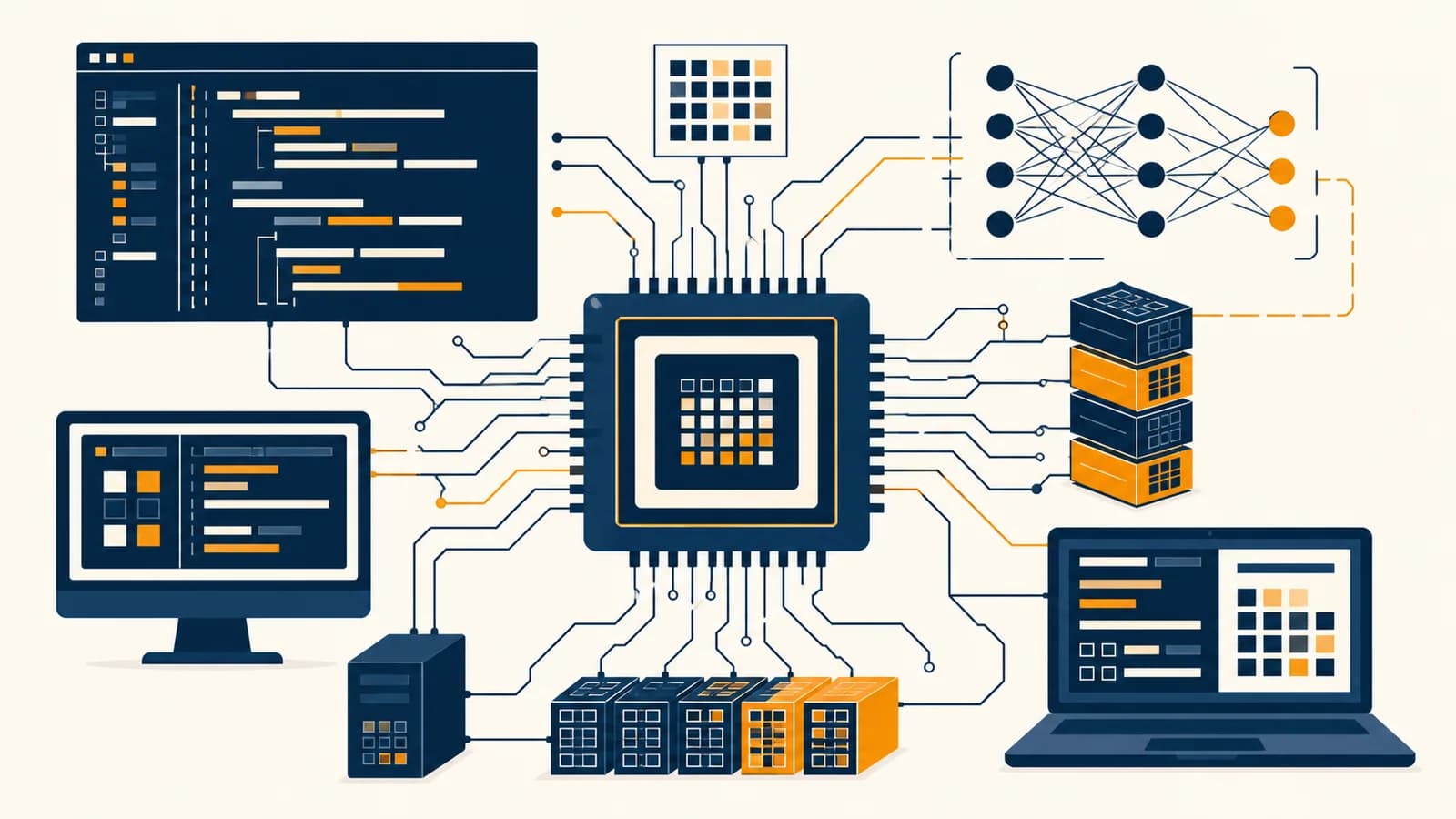
Most computer systems can be understood as a chain. Something enters, rules transform it, a result leaves, and some form of storage preserves what must be used later. The details vary, but the pattern appears in a calculator, a search engine, a bank database, and a robot.
Each stage raises questions. How should a photograph be represented as bits? Which algorithm should transform those bits? How much memory and time will it consume? What should happen if a disk fails or an attacker sends hostile input? Computer science supplies concepts for answering each question rather than treating a computer as a mysterious box.
How can switches represent words, pictures, and instructions?
A digital computer represents information with discrete states, usually written as 0 and 1. Electronic circuits combine those states with logical operations, allowing the same physical machine to encode numbers, text, images, sound, and the instructions that transform them.
A bit has two possible values. Group bits together and the number of possible patterns doubles with every bit: patterns for bits. Eight bits therefore provide patterns. A convention decides what each pattern means. One convention maps patterns to integers; another maps them to characters; an image format arranges them as pixel colours.
The bit positions carry values 16, 8, 4, 2, and 1, so this pattern represents 22.
Representation is not the thing itself. A file containing a song stores measurements and coding choices, not sound waves. Compression removes repetition or details judged less important. Encryption changes readable data into a form that should be useless without a key. Errors arise when software interprets bits under the wrong convention, such as opening text with the wrong character encoding.
Logic gates perform small Boolean operations such as AND, OR, and NOT. Engineers connect gates into adders, memory cells, and processors. A processor repeatedly fetches an instruction, decodes it, performs the operation, and moves to the next instruction. The path from transistor switches to meaningful computation is developed in the explanation of binary, logic, and circuits.
One machine, many meanings. Bits do not carry meaning by themselves. The format, program, and surrounding agreement determine how a pattern is interpreted.
This separation between physical state and assigned meaning is powerful. The hardware does not need a special kind of wire for tax records and another for video games. General-purpose hardware follows different instructions to perform different jobs.
Programs turn precise rules into repeated action
A program is an ordered description of data and operations that a computer can execute. Programming turns an intended outcome into explicit steps, using variables to retain values, conditions to choose actions, functions to package behavior, and loops to repeat work.
Consider software that calculates a shop discount. It must receive a price, check an eligibility rule, calculate the reduction, and return a valid result. Each vague phrase hides decisions. Is the boundary included? Can the price be negative? Should money be rounded before or after tax? A machine follows the implemented rule, including its omissions.
Name the data that arrives, its permitted form, and the result the program must produce.
Identify conditions that change the result, including boundary values and invalid input.
Express each transformation in a programming language, using names that preserve the meaning of the problem.
Compare actual output with expected output for ordinary cases, limits, and deliberately awkward cases.
The grammar changes between languages, but the reasoning transfers. The basic machinery of variables, loops, functions, and control flow is useful before specializing in any particular language. A browser may execute JavaScript, a data analyst may use Python, and a phone app may use several languages, yet all must represent state and control execution.
Programs rarely run alone. They call operating system services to open files, allocate memory, display windows, or send network traffic. They also use libraries written by other people. An application programming interface, or API, defines an agreed way to request a capability without knowing every internal detail. Good interfaces reduce the number of assumptions one part of a system makes about another.
Writing code is therefore both translation and specification. The programmer translates a human goal into operations, but also specifies what happens when reality does not match the happy path. Clear code makes those decisions visible to the next person who must inspect them.
Algorithms decide how work grows
An algorithm is a finite method for solving a class of problems, while a data structure arranges information so useful operations are possible. Their design determines not only whether a result is correct, but how time and memory demands grow as input expands.
Suppose a list of names contains a target. Reading each name in turn works even if the list is unsorted, but the search may inspect every entry. If the list is sorted, binary search checks the middle and discards half of the remaining range after each comparison. The data structure and its maintained order make the faster method possible.
The comparison follows directly from arithmetic: . It does not mean binary search is always best. Inserting into a maintained sorted sequence may be expensive, and binary search requires indexed access. Computer scientists examine the pattern of operations instead of choosing an algorithm from one benchmark.
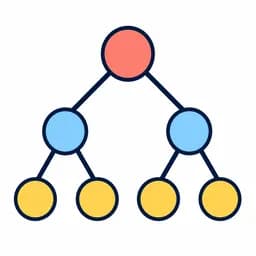
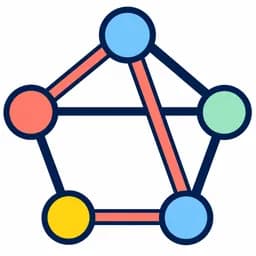
Arrays store items in an ordered sequence. Hash tables associate keys with values and usually provide quick lookup under suitable conditions. Trees represent hierarchy and support ordered operations. Graphs represent objects connected by relationships, which makes them useful for roads, social links, dependencies, and communication networks. The page on lists, trees, maps, and other data structures explains how storage choices enable some operations and constrain others.
Efficiency is commonly described with asymptotic notation. If work grows in direct proportion to input size, it is . If repeated halving is possible, it may be . If every item is compared with every other item, it may be . This notation describes growth, not exact seconds. Hardware, implementation, input shape, and constants still affect measured performance.
A courier company needs more than a route that reaches every address. It may need a short route under limits on vehicle capacity, delivery windows, and road access. Modeling the addresses and roads as a graph makes the choices explicit, while the difficulty of finding the absolute best route may justify a good approximation.
Some problems are difficult because the obvious search space explodes. Dynamic programming saves answers to overlapping subproblems so they are not recomputed. Greedy methods make a locally attractive choice at each step. Approximation methods trade guaranteed perfection for a result available within useful time. Algorithm design is the art of matching guarantees and costs to the need.
Operating systems and networks coordinate shared machines
System software manages limited resources and communication. An operating system schedules processor time, isolates memory, controls devices, and organizes files. Networks move messages among machines through layers of protocols that define addressing, routing, delivery, and interpretation.
Many programs appear to run at once because the operating system switches processor attention among them and may use several processor cores. Each process receives an address space, which helps prevent an ordinary mistake in one program from overwriting another program's memory. Permissions restrict which users and processes can read a file or control a device. The operating system's work as an invisible resource manager connects these mechanisms.
A network breaks information into manageable units and sends them across links. Addresses identify endpoints or interfaces. Routers choose the next hop toward a destination. Transport protocols handle needs such as reliable ordered delivery or fast delivery without that guarantee. Application protocols specify what a request and response mean to a browser, mail service, or game.
Each layer adds information needed for its task, then the receiving machine removes and interprets that information in reverse order. This layered design lets a web application work across fibre, Wi-Fi, or a mobile link without implementing each transmission technology itself. For the full path involving names, packets, routers, and protocols, see how an internet request reaches another computer.
Distributed systems add harder coordination problems. Messages can arrive late, arrive twice, or fail to arrive. One server may stop while others continue. Clocks on different machines disagree. Designers use timeouts, retries, replication, consensus methods, and carefully defined failure behavior. A retry that seems harmless can charge a payment twice unless the operation is designed to be idempotent, meaning repetition has the same intended effect as one execution.
Data gains value through structure, queries, and evidence
Data becomes usable when a system defines what each item means, how items relate, and which operations preserve their integrity. Databases support durable storage and controlled updates, while data science uses computation and statistics to turn recorded observations into defensible conclusions.
A database schema might state that every order has an identifier, refers to an existing customer, and contains a valid status. An index creates an additional structure that speeds particular searches, much like a book index points to relevant pages. Transactions group operations so a multi-step change can succeed as a unit or leave the previous state intact.
Fields may change meaning, duplicates can disagree, and unrelated programs may update the same facts without coordination.
A schema states permitted structure, constraints reject invalid states, queries retrieve selected records, and transactions control related changes.
The choice between relational tables, document stores, key-value systems, and graph databases follows the shape of the data and access pattern. A relational database is strong when relationships and consistency rules matter. A document store can fit records whose fields vary. The mechanics of schemas, queries, indexes, and transactions appear in the guide to how databases organize persistent data.
Analysis begins with a question and a data-generating process. A column does not explain how its values were measured, which cases are missing, or why the sample exists. Cleaning can correct known format errors, but it cannot magically make a biased sample representative. Models reveal patterns under assumptions, and visualizations help inspect those patterns, but a correlation alone does not establish cause.
Artificial intelligence learns patterns rather than receiving every rule
Artificial intelligence studies systems that perform tasks associated with perception, language, planning, or decision-making. Machine learning builds many such systems by fitting model parameters to examples, then using the fitted model to estimate outputs for new inputs.
Traditional programming and machine learning place the human instruction in different locations. In a rule-based spam filter, a programmer writes explicit tests. In a learned filter, people choose data, labels, model design, training method, and evaluation, while optimization adjusts many internal parameters to reduce an error measure.
A useful evaluation separates training data from data used to test generalization. If the model is judged on examples it has already absorbed, a low error can hide memorization. Even a held-out test can mislead if it differs from deployment. A vision model trained in bright weather may fail at night; a language system can produce fluent text without a reliable connection to evidence.
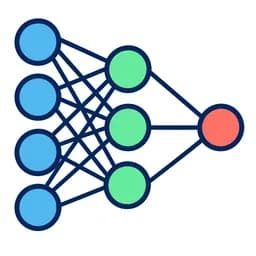
The broad ideas behind features, labels, training, prediction, and evaluation are covered in the introduction to learning patterns from data. Neural networks arrange parameterized operations in layers and use calculated error gradients to adjust weights. Their scale can support striking abilities, but it does not remove dependence on training data, objective design, computation, and human evaluation.
A confident output is not a verified output. A model can generate a plausible answer because it matches learned patterns, even when the answer is false, insecure, or unsupported.
AI coding tools make this distinction practical. They can suggest functions, tests, and explanations, but generated code still runs with real permissions against real data. A developer must inspect assumptions, reproduce failures, test boundaries, and review dependencies. The techniques in finding faults in AI-generated code treat the output as a candidate implementation rather than an authority.
Software engineering makes programs survivable
Software engineering applies disciplined design, testing, review, deployment, and maintenance to programs that must serve people over time. It handles change, collaboration, failure, and operational responsibility, because useful software is rarely finished when its first correct version runs.
A short script may live in one person's head. A production service has users, dependencies, stored data, security boundaries, performance targets, and colleagues changing it at the same time. Requirements must be translated into modules with clear responsibilities. Interfaces must remain understandable as implementations change. Logs and metrics must reveal failures that were not visible during development.
State what the system should do in normal, boundary, and failure cases.
Limit the scope so its assumptions and effects can be inspected.
Use focused tests for components and broader tests for interactions, data, and deployment configuration.
Monitor behavior, investigate failures, and feed what happened back into design.
Version control records related changes and lets collaborators combine work while preserving history. Code review gives another person a chance to examine the behavior and maintenance cost. Automated tests execute examples of expected behavior. None proves that all bugs are absent, but together they make claims about software easier to inspect and repeat.
The wider discipline of taking software from prototype to dependable production includes architecture, team practices, deployment, and maintenance. User interface and user experience design add another test: can the intended people understand the system, recover from mistakes, and achieve their goal without guessing what the software means?
A team renames a database field. The application code is updated, but an older mobile app still sends the previous name and a nightly report still reads it. Engineering work includes finding these dependants, designing a compatible migration, monitoring the release, and keeping a way to recover.
Security and ethics define what a system should be allowed to do
Cybersecurity protects the confidentiality, integrity, and availability of systems and data. Ethics asks a different but connected question: even if a system works as designed and resists attack, are its goals, data practices, incentives, and effects acceptable?
Security begins with a threat model. Designers identify assets, possible attackers, entry points, and consequences. Authentication asks who or what is making a request. Authorization asks what that identity may do. Encryption can protect data in transit or storage, but keys must still be managed and endpoints can still be compromised.
These goals can conflict. Locking every record away might protect confidentiality but destroy availability for the nurse who needs it. A secure design applies least privilege, gives each actor only the access required, and layers defenses so one mistake does not expose everything. The mechanisms and adversarial way of thinking are introduced in the guide to protecting systems, data, and people.
Privacy is about power as well as secrecy. A company may lawfully collect a location history and still create harm by keeping it too long, combining it with other records, or using it for a purpose the person did not reasonably expect. Data minimization reduces both misuse and the damage of a breach by avoiding collection that the service does not need.
Automated decisions can reproduce measurement errors and social patterns present in their inputs. Fairness is not fixed by deleting one sensitive column because other fields may act as proxies. Meaningful review asks who is represented, which errors fall on whom, how a person can challenge a result, and who is accountable when the system causes harm.
This is not an attributed quotation or a historical claim. It is a design test. A perfectly optimized engagement system may promote outrage because the target rewards attention. A highly accurate face matcher may still be inappropriate for constant public surveillance. Computer science can explain what a system can do; social judgment, law, and ethics help decide what it should do.
Computer science is commonly mistaken for typing code
The common misunderstanding is that computer science means memorizing language syntax or becoming skilled with current devices. The field actually studies representations, algorithms, machines, systems, and limits. Programming is an experimental tool for expressing and testing those ideas, not the whole subject.
A good computer scientist knows every command, writes code quickly, and can fix any laptop or printer.
A good solution states the problem precisely, chooses a fitting representation and method, checks costs and failure modes, and can explain why the result deserves trust.
Syntax knowledge helps, just as vocabulary helps a writer. It is searchable and changes across languages. The more durable skills are decomposition, abstraction, modeling, testing, and tracing cause through a system. A careful programmer who looks up a library call can be far more effective than a fast typist who cannot explain the program's state.
Computer science is also not identical to information technology. IT often focuses on selecting, operating, and supporting deployed systems. Computer engineering concentrates more heavily on electronic hardware and the boundary between circuits and software. Software engineering focuses on building and maintaining software under practical constraints. The areas overlap, and many jobs combine them, but their central questions differ.
Another mistake is to imagine that abstraction removes the need to know lower layers. Abstraction lets a person work without considering every detail all the time. It does not erase those details. A slow database query, a memory leak, or a network timeout often requires moving down a layer until the hidden mechanism becomes visible.
Computer science connects models to the physical and social world
Computer science connects to mathematics through logic and proof, to physics through hardware and signals, and to social subjects through institutions and human behavior. Its systems act inside real organizations, so technical choices often become economic, legal, scientific, and political choices.
Mathematics supplies discrete structures, probability, algebra, and ways to prove that a method works. Graph theory describes networks. Probability helps model uncertain events and randomized algorithms. Calculus supports optimization used in machine learning. Computer science adds the demand that a method be representable and executable with finite resources.
Physics and electrical engineering explain the devices beneath computation. Transistors depend on semiconductor behavior. Communication depends on electromagnetic signals moving through copper, fibre, or air. Heat and energy constrain processor design and data centres. Quantum computing uses quantum states to perform particular forms of computation, but it still requires algorithms, error control, and classical systems around the quantum hardware.
A map route crosses several subjects. Graph algorithms find paths, geography supplies road meaning, economics can price tolls, environmental science can estimate emissions, and law determines which roads and location records may be used.
Economics explains incentives, markets, network effects, and the cost of computing resources. Law shapes copyright, contracts, accessibility, consumer protection, evidence, and data rights. Politics enters through public infrastructure, platform governance, censorship, surveillance, and unequal access. A technical design can distribute benefits and burdens even when no line of code names a social group.
Computer science turns vague wishes into testable systems
The lasting habit of computer science is to replace a vague request with a representation, a procedure, and a standard of evidence. It asks what must be true, what resources are available, what can fail, and how anyone will know the result is acceptable.
That habit begins before code. Define the actors and the information they possess. Separate the desired outcome from one proposed implementation. Make constraints visible. Choose data structures that match the operations. Estimate how work grows. Identify trust boundaries and failure cases. Then build the smallest version that can test the most important assumption.
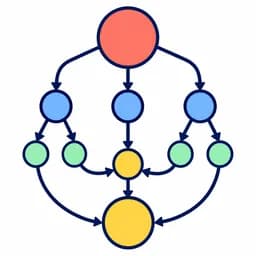
A finished system is never only an algorithm. Hardware executes it. An operating system allocates resources. Networks connect it to other machines. Databases preserve state. Interfaces present choices to people. Security controls authority. Monitoring reveals behavior after release. Each layer can change the outcome, so competent reasoning follows the chain rather than stopping at the first plausible answer.
The takeaway: Computer science explains how information can be represented and transformed by machines, how to judge the cost and correctness of that work, and how to build systems whose limits remain visible.
The strongest computer science answer does more than produce output. It states its assumptions, exposes tradeoffs, and survives a serious attempt to prove it wrong. That standard applies to a ten-line classroom program, a recommendation model, and the infrastructure behind a public service. It is how computation becomes something people can examine, improve, and responsibly use.