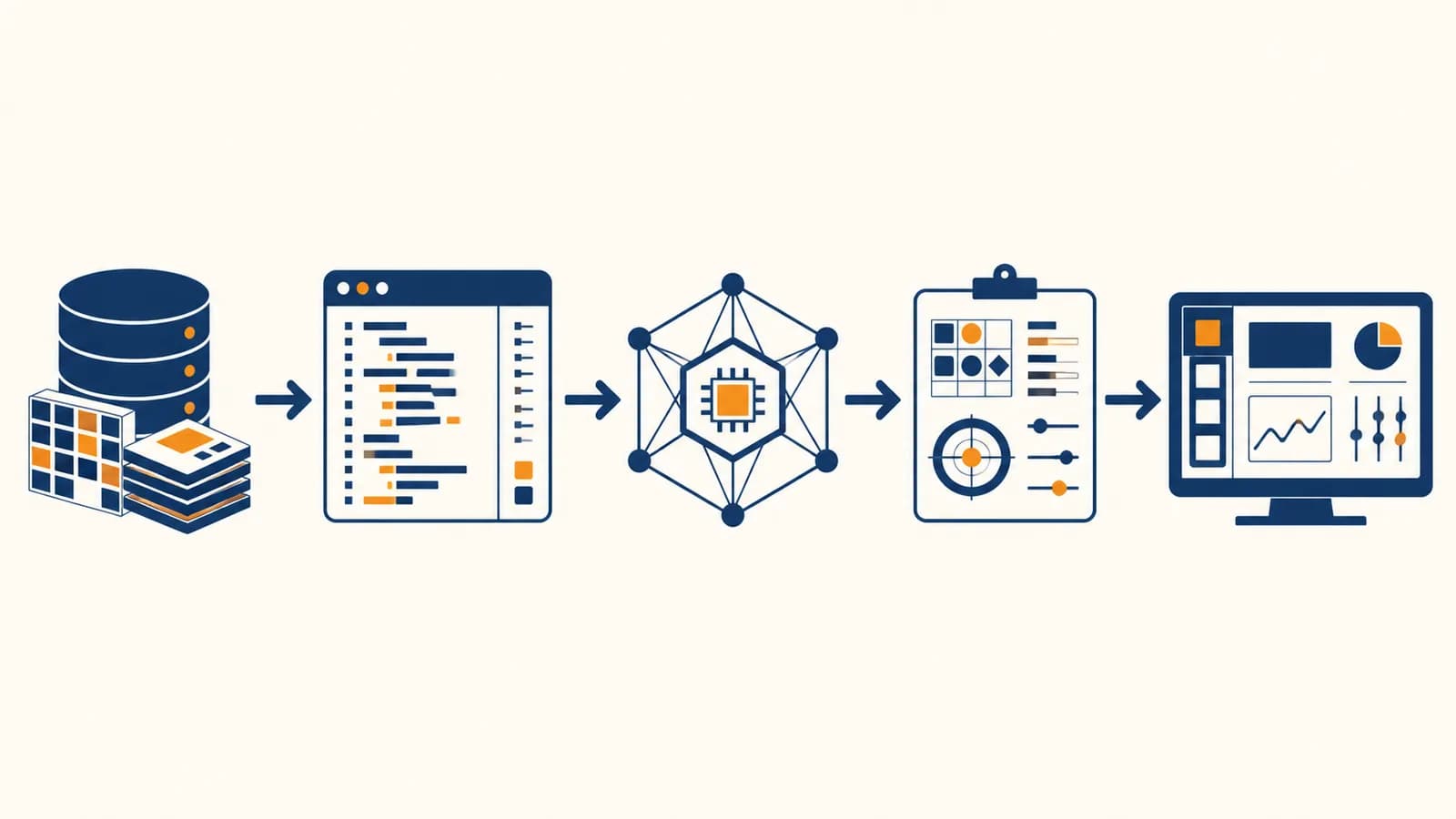
Foundations for AI developers is a body of programming, data, mathematical, and software-engineering knowledge that enables people to build and check systems driven by machine-learning models, in the context of artificial intelligence development. These AI developer fundamentals include Python, algorithms, APIs, databases, probability, model training, evaluation, testing, security, and deployment. They exist because an AI model is only one component of a working product. A useful system must also receive valid data, call the model correctly, measure uncertain outputs, protect users, and behave sensibly when the model is wrong.
Consider a program that reads a support email and suggests a reply. The visible feature may look like a text box and a button. Underneath, code authenticates the user, retrieves account facts, prepares a prompt, sends an API request, parses a response, checks it against business rules, records what happened, and shows the result. Each step depends on a different foundation. Weakness in any one can make the entire feature slow, misleading, expensive, or unsafe.
What foundations for AI development actually are
Foundations for AI development are the reusable ideas that explain how software, data, models, and people interact. They let a developer reason about a system instead of treating an AI service as a mysterious box that accepts words and returns answers.
The foundations fall into connected layers. Programming gives exact instructions to a computer. Data work determines what information reaches a model. Mathematics describes patterns, error, and uncertainty. Machine learning explains how parameters are fitted and used. Software engineering keeps the surrounding application testable and maintainable. Human factors define what success means and which failures matter.
This chain is more useful than a list of fashionable tools. If an output is poor, it gives you places to investigate. The user need may be vague. The input facts may be missing. The instructions may conflict. The model may be unsuitable. The output check may be weak. The interface may encourage a person to trust a guess.
A beginner does not need to master every layer before building anything. The layers are learned together. A small project creates a reason to learn file formats, functions, network requests, evaluation sets, and error handling. Each new concept should answer a problem you can point to in the system.
Programming makes behavior explicit
Programming is the practice of expressing procedures and data transformations precisely enough for a computer to execute them. An AI developer uses variables, functions, conditions, loops, modules, and types even when a model supplies part of the behavior.
Suppose a model labels a message as urgent. Ordinary code still decides what values are valid, what confidence information to store, who receives the alert, and what happens if the service times out. Python is common in machine learning, while JavaScript and TypeScript are common in web interfaces and servers. The language matters less than being able to trace state through a program.
Computer science explains cost and structure
Algorithms describe procedures, and data structures organize information for those procedures. A list may preserve document order, a map may retrieve an account by identifier, a queue may absorb bursts of requests, and a graph may represent connections among facts.
These choices affect latency and memory. Searching an unsorted list item by item takes time proportional to its length. Looking up a key in a well-designed hash table is usually close to constant time on average. That difference becomes visible when retrieval runs for every user request.
How an AI system turns data into an output
An AI system converts raw input into a usable output through a pipeline: validate the input, encode it in a model-readable form, run inference, decode the result, apply checks, and present or act on the result with enough context for a person.
State the input, expected output, acceptable delay, and cost of a wrong answer. “Help with email” is vague. “Draft a reply using only the attached order record” is testable.
Check file type, size, missing fields, permissions, and text encoding. Then normalize or split the content in a repeatable way.
Combine instructions, user content, examples, and retrieved facts. Keep untrusted content separate from authoritative rules so that a document cannot quietly replace the system's instructions.
Send the prepared input to a local model or an API. Record the model version, settings, latency, and request identifier needed to investigate failures.
Confirm that required fields exist, values have valid types, citations point to available material, and forbidden actions are rejected.
Show uncertainty and sources when they matter. Require confirmation before an irreversible action such as sending a message, changing a record, or spending money.
A language model handles text as tokens, which are pieces of text represented by integer identifiers. Its input tokens pass through layers that calculate numerical representations and produce scores for possible next tokens. The scores become a probability distribution. A decoding rule selects a token, appends it to the sequence, and repeats the process.
For scores 0 and 0, each option gets probability 0.5 because both exponentials equal 1.
The model does not fetch a finished sentence stored inside it. It repeatedly calculates a distribution conditioned on the tokens already present. Sampling can make repeated runs differ. Choosing the highest-scoring token can make output more repeatable, but it does not make the underlying claim true. Factual checking remains a system responsibility.
Fluent text is not evidence. A language model is trained to continue patterns in data. Grammatical confidence can accompany a false name, an invented citation, or a calculation error.
Models versus ordinary programs
An ordinary program follows rules written by developers, while a trained model follows numerical parameters learned from examples. Both execute computer operations, but a model's useful behavior is specified indirectly through training data, an objective, and inference settings.
A tax calculation can encode a published formula. Given the same valid inputs and version of the rules, it should return the same amount. Each branch can be inspected directly.
A spam classifier learns patterns from labeled messages. Its decision boundary is distributed across fitted parameters. New examples can be misclassified even when training accuracy was high.
The distinction guides design. Use ordinary code for exact arithmetic, permission checks, inventory limits, legal constraints, and database integrity. Use a model where the task involves patterns that are difficult to express as complete rules, such as recognizing objects in images or classifying the intent of varied language.
Many useful products combine both. A model extracts a requested date from a sentence. Code verifies that the date exists, falls within office hours, and remains available. A database transaction reserves the slot. The model interprets flexible language; the program enforces the contract.
Generative models add another distinction. A classifier chooses among defined labels. A generative model produces a sequence such as text, audio, pixels, or code. Open-ended output increases the need for validation. The mechanics behind how coding assistants generate and revise code follow this same split: the model proposes, while tools and deterministic checks decide what can be accepted.
How data and representations work
Data becomes useful to an AI system only after it is represented in a consistent form with a clear meaning. Collection, labels, units, missing values, sampling, and access rights shape what a model can learn and where it can fail.
A table row might represent one customer, one purchase, or one day. Confusing those units can leak future information or count the same person many times. A label such as “fraud” also needs a definition. It could mean a confirmed investigation, a customer dispute, or an automated rule. Those are not interchangeable targets.
Features turn observations into model input
A feature is a measurable property supplied to a model. For a delivery estimate, features might include distance, package type, dispatch time, and current traffic. Raw identifiers are usually poor numerical features because their ordering has no natural meaning.
Representations preserve some information and discard other information. Lowercasing text may help match words but erase distinctions in acronyms. Resizing an image reduces computation but may hide a tiny defect. Aggregating purchases by month can reveal a spending pattern while concealing the order of events. The right representation depends on the decision being made.
Embeddings make similarity computable
An embedding is a vector of numbers that represents an item so that useful relationships can be measured. Text passages with related meanings may receive vectors that point in similar directions, even when they share few exact words.
For vectors [1, 0] and [1, 1], the similarity is . The angle, rather than raw length, carries the comparison.
A retrieval system can embed a user's question, compare it with stored passage vectors, and send the closest passages to a language model. This is retrieval augmented generation. Retrieval does not guarantee correctness. The index may omit the needed document, similarity may return a related but irrelevant passage, and the model may ignore a useful source. Each stage needs its own test.
How training, inference, and evaluation work
Training adjusts model parameters to reduce measured error on examples, inference uses the fixed parameters to make outputs, and evaluation tests those outputs against criteria that represent the intended task. Keeping the three stages separate prevents misleading results.
During supervised training, the model receives an input and a known target. It predicts, a loss function measures the difference, and an optimization algorithm changes parameters in a direction expected to reduce future loss. The process repeats across batches of examples. Training stops before evaluation on a held-back test set.
If a parameter is 2, the learning rate is 0.1, and the loss gradient is 3, the updated parameter is .
The loss is a training signal, not a complete definition of product quality. A lower average loss can hide failures affecting a small group. A benchmark score can miss latency, refusal quality, privacy, or the ability to cite evidence. Evaluation therefore starts with concrete cases and expected behavior.
Metrics encode different kinds of error
Accuracy is the fraction of predictions that are correct. Precision asks how many positive predictions were truly positive. Recall asks how many actual positives were found. The choice depends on consequences, not on which number looks largest.
Those values describe one visible test result: 100 cases contain 5 actual positives, and the system flags those 5 plus 5 false alarms. It gets 90 true negatives and 5 true positives, so accuracy is . Precision is , while recall is . One result can look strong or weak depending on which error the metric exposes.
Keep one fixed confusion matrix and compute every metric automatically. Evaluation code deserves tests because an incorrect dashboard can send a team in the wrong direction. It should also report raw counts, since a percentage without the number of cases can conceal how little evidence supports it.
A test set is spent when it shapes development. Repeatedly choosing models based on the same test results turns that set into part of the tuning process. Keep a final set untouched for an honest estimate.
Generative outputs often lack one perfect answer, so evaluation combines methods. Exact checks can validate JSON structure, calculations, citations, and forbidden phrases. Reference examples can cover known cases. Human reviewers can judge usefulness using a written rubric. Production monitoring can reveal new inputs and failures, but user data must be collected with clear permission and retention rules.
How software engineering keeps AI systems dependable
Software engineering makes an AI feature changeable and observable by separating components, controlling versions, testing contracts, handling failures, and recording enough evidence to diagnose behavior. These practices matter more when a model's output can vary across requests.
Start with boundaries. Put model access behind one interface so the application does not depend everywhere on a provider's request format. Keep prompt templates versioned beside code. Validate model output against a schema. Store configuration outside source files, and never place secret API keys in a browser bundle or commit them to a repository.
Tests cover layers, not only final wording
A unit test checks a small deterministic function, such as removing unsupported fields. An integration test checks that components exchange data correctly. An evaluation checks model behavior on a set of cases. An end-to-end test follows a user action through the full application.
Exact sentence matching is often brittle for generated text. Test stable properties instead: the response parses, required facts appear, unsupported actions do not occur, citations resolve, and the application handles refusal or timeout. A fuller method appears in techniques for testing code produced by models, where execution and review catch errors that plausible syntax can hide.
Observability turns failures into evidence
Observability means collecting signals that explain what a running system did. Useful records include timestamps, model and prompt versions, retrieval identifiers, tool calls, response status, token counts, latency, validation failures, and user feedback. Sensitive text should be redacted or omitted when it is not needed.
A document assistant begins giving outdated leave policies. The model has not changed. Logs show that retrieval is selecting an archived handbook because its title closely matches the query. The repair belongs in document status filters and indexing, not in a longer prompt.
Failure handling should be designed before launch. Network calls can time out. Providers can reject requests. Structured output can be malformed. Retrieval can return nothing. The application needs bounded retries, useful error states, rate limits, and a fallback that does not pretend success. For high-impact actions, the safe fallback may be to stop and ask a person.
How foundations show up in product development
AI foundations appear in product work as decisions about task scope, data access, interface design, evaluation, cost, and responsibility. The best model cannot rescue a feature whose success condition is vague or whose users cannot detect and correct mistakes.
Take an assistant that answers questions about school policies. Product design defines whose policies count and what the assistant must refuse. Data engineering converts approved documents into searchable passages and records effective dates. Retrieval finds candidate evidence. The model writes an answer using that evidence. The interface displays sources. Evaluation measures supported answers, missed documents, and unsafe claims. Monitoring finds new question types.
This is also where privacy and security become engineering requirements. Collect only data needed for the task. Define how long requests and outputs are retained. Restrict documents by user permission before retrieval. Treat uploaded text as untrusted input. A malicious instruction inside a document, often called prompt injection, should not gain authority to reveal secrets or call tools.
“Does the assistant seem smart?” This invites a few impressive demonstrations and gives no rule for release.
“On the approved question set, does every policy answer cite a current source, and does the system decline when no approved source supports an answer?”
Cost and latency follow the same pipeline logic. Larger inputs require more computation. Repeating unchanged context wastes time and money. Retrieval can narrow context, caching can reuse safe results, smaller models can handle simple classifications, and background jobs can process work that does not need an immediate answer. Measure before optimizing, because a slow database query can look like a slow model.
Teams meet these choices in laboratories, hospitals, banks, newsrooms, factories, schools, and public agencies. The risk changes with the setting. A bad game hint is inconvenient. A false medical instruction or denied benefit can harm a person. Higher stakes call for stronger evidence, tighter access, human review, and a clear route to challenge a decision.
What mathematics do AI developers actually need?
AI developers need enough linear algebra, calculus, probability, and statistics to trace how data becomes numbers, how training changes parameters, and how evaluation can mislead. The required depth depends on whether they integrate models, train them, or research new methods.
Linear algebra covers vectors, matrices, dimensions, dot products, and transformations. These ideas explain embeddings, neural-network layers, and batches of data. Calculus supplies derivatives and gradients, which describe how a small parameter change affects loss. Probability describes uncertain outcomes. Statistics helps with sampling, variation, estimation, and comparison.
An application developer calling a model API may not derive backpropagation by hand, but still benefits from understanding distributions, averages, false positives, and sampling. A machine-learning engineer training models needs deeper command of optimization and numerical computing. A researcher proposing new architectures needs enough mathematics to read and test formal arguments.
Mathematics is most useful when paired with code. Implement cosine similarity for two short vectors. Calculate precision and recall from counts. Plot how a loss changes as one parameter moves. The calculation gives the formula a visible behavior and makes mistakes easier to catch.
What should a beginner build first?
A beginner should build a small, inspectable application with one model call, a narrow task, a hand-written evaluation set, and a visible failure path. A document question-answering tool or message classifier is better practice than a broad autonomous agent.
A good first project accepts a short passage and a question, then answers only from that passage. Begin with ten questions you write yourself. Include direct answers, paraphrases, a question with no answer, conflicting statements, and an instruction hidden inside the passage. Define expected behavior before trying prompts.
Create input fields, length limits, request handling, a result view, and clear error messages before tuning the model.
Place the API call in a single module. Pass explicit instructions and request a small structured response containing an answer and supporting quotation.
Record pass or fail for support, refusal, structure, and latency. Keep failures rather than replacing them with easier examples.
Alter the prompt, model, or retrieval method one at a time. Rerun the same cases so the comparison has meaning.
Then add storage, retrieval, or tool use only when the project reveals a need. Version control records experiments. A small test suite protects parsing and permissions. Environment variables hold credentials. A README states the task, setup, known limits, and evaluation method.
Visual polish can come later, but interface choices are part of correctness. Show the source passage beside the answer. Mark a refusal as an expected outcome, not a crash. Disable repeated submissions while a request is running. Display enough evidence for a person to inspect the result without exposing hidden instructions or private records.
Which tools belong in an AI developer's stack?
An AI developer's stack needs a programming language, version control, a test runner, data tools, model access, and monitoring. Frameworks can shorten setup, but each dependency should solve a named problem and remain replaceable behind a clear interface.
Python offers mature libraries for data processing and machine learning. JavaScript or TypeScript may be enough for a web product that calls hosted models. SQL remains important because useful context often lives in relational databases. Git records changes and enables review. Containers can make environments repeatable, while continuous integration runs checks after each change.
Model access may come through a hosted API or a model running on controlled hardware. The choice affects privacy, latency, maintenance, and available features. A hosted service reduces infrastructure work. A local model can keep data inside a defined environment, but someone must manage hardware, updates, scaling, and security.
A framework is compressed code, not a substitute for a mental model. You should still be able to identify the exact prompt, retrieved context, model request, tool call, and validation step used for one output.
Learn tools by tracing data through them. Print or inspect a sanitized request. Read the generated schema. Force a timeout. Replace the model response with a fixture. Query the database directly. If a framework hides these actions completely, debugging becomes guesswork.
Five mistakes people make with AI foundations
Most early AI failures come from treating generated output as trusted, testing only demonstrations, mixing model judgment with hard rules, ignoring data boundaries, or adding complexity before measuring a simple baseline. Each mistake has a direct engineering correction.
1. Trusting output because it sounds certain
A model can express a false claim in polished language because style and truth are different properties. Require sources for factual answers, verify calculations with code, constrain structured fields, and place human approval before consequential actions. Confidence in wording is not a confidence score.
2. Testing only the examples used during development
Examples that shaped a prompt no longer provide an independent test. Keep separate development and evaluation cases. Add edge cases, missing information, adversarial instructions, long inputs, spelling variation, and cases from actual use. Record the expected result before viewing model output.
3. Asking a model to enforce exact rules
Models are a poor authority for permissions, totals, uniqueness, and transaction state. Let the model interpret language or propose a choice. Let code verify identity, compute exact values, enforce allowed ranges, and commit database changes. A probabilistic suggestion should cross a deterministic gate.
4. Moving private data without mapping its path
Prompts can contain names, contracts, health details, source code, or internal instructions. Document which service receives each field, where logs are stored, who can read them, and when they are deleted. Redact before transmission when the task does not need the sensitive value.
5. Building an agent before building one reliable step
An agent can choose actions repeatedly, which multiplies failure paths. First make one tool call work with explicit inputs, validation, permission checks, and a test set. Then add planning or repeated actions if measurement shows that the simpler workflow cannot meet the task.
Some tasks should stay outside a prompt-led workflow altogether. Exact compliance rules, inaccessible private context, irreversible operations, and systems without meaningful tests demand another design. The discussion of situations where prompt-first coding is a poor fit shows how to recognize those boundaries.
Strong foundations make AI development inspectable
Strong AI foundations let a developer explain every boundary in a system: what enters, what the model calculates, what code verifies, what gets stored, how performance is measured, and who remains responsible when an output affects another person.
This connects AI development to the wider set of computer science ideas and applications. Abstraction helps separate model access from product logic. Algorithms explain retrieval cost. Networks carry requests. Databases preserve state. Security limits authority. Human-computer interaction shapes appropriate trust. AI does not replace those subjects; it creates another demanding place to use them.
Choose one small AI feature and draw its pipeline on paper. Mark every point where data changes form, crosses a permission boundary, can fail, or needs a test. Then implement the thinnest complete version and collect failures. Those failures are not an interruption to learning. They are the evidence that tells you which foundation to study next.
The takeaway: Learn AI development by connecting model behavior to ordinary code, explicit data, measurable tests, and responsible human decisions. If you can trace one output and explain why it should be trusted, rejected, or reviewed, you are building on solid ground.