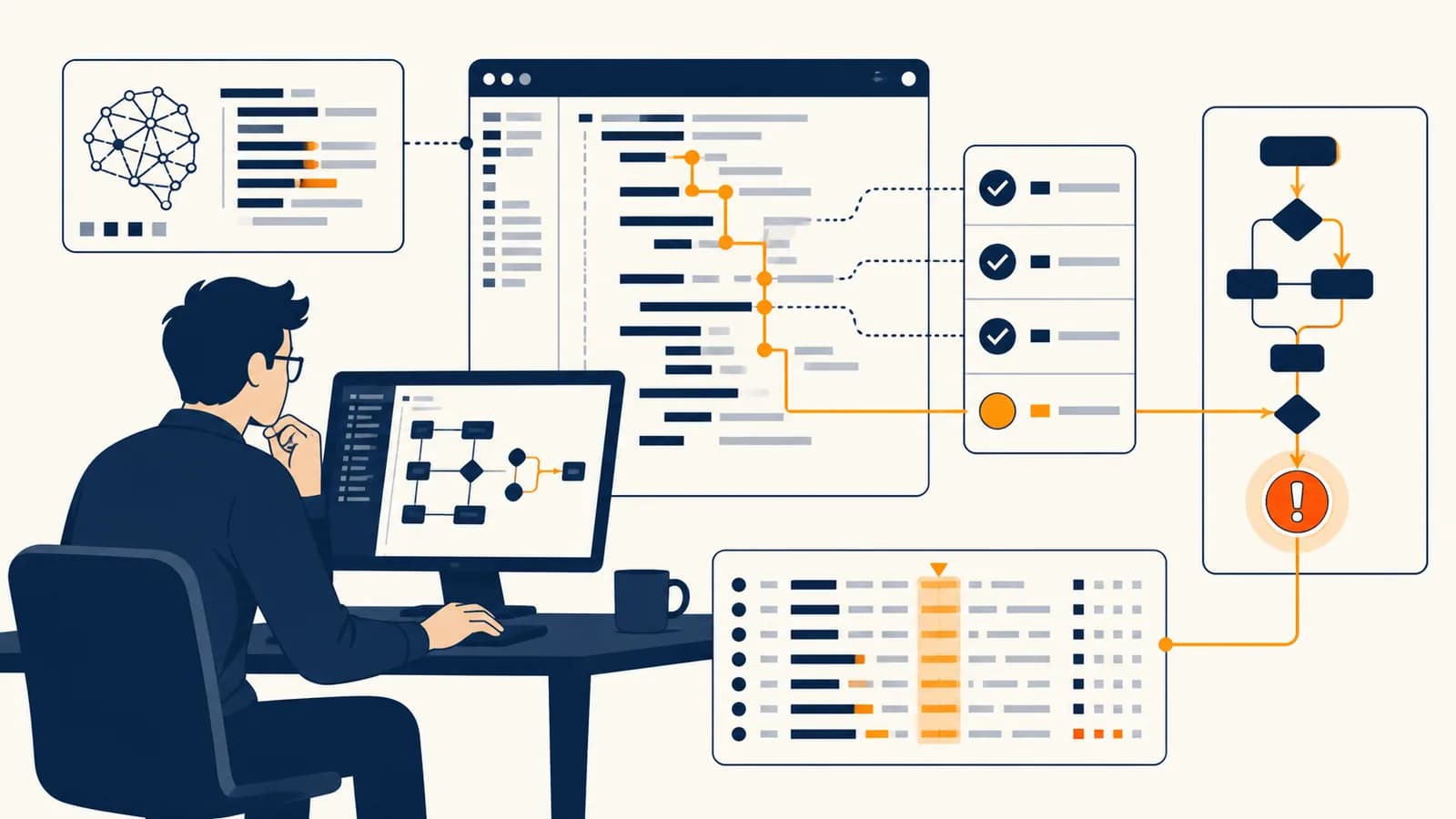
Debugging AI-generated code is an evidence-driven process that finds, explains, and fixes defects in software produced with a coding model, in the context of software development. People searching how to debug AI code, test generated code, or fix AI coding errors need the same basic answer: treat every generated change as an unverified proposal. The process exists because code can look convincing, compile successfully, and still violate a requirement, expose data, or fail on an input the model never considered. Effective debugging turns a vague symptom into a reproducible case, traces that case to a cause, applies the smallest justified repair, and proves the repair with tests.
What debugging AI-generated code actually is
Debugging AI-generated code is the disciplined conversion of an observed failure into a tested explanation and a verified repair. The code's origin changes which suspicions deserve attention, but it does not change the need for reproducible evidence, controlled experiments, and regression tests.
A coding model predicts a useful continuation from its prompt and context. It does not inspect a program with perfect knowledge of its runtime, business rules, database contents, deployment settings, or hidden requirements. It may produce a locally sensible function that conflicts with a decision made elsewhere in the system. It may call an API that has a similar name but different behavior. It may preserve the shape of a type while changing the meaning of a value.
That makes generated code a particular kind of debugging input. It often arrives polished. Names are plausible, comments sound certain, and common paths work. Those qualities can encourage trust before there is evidence. A debugger must separate presentation from behavior.
The function is readable, uses familiar patterns, and returns the expected result for the example in the prompt.
The function satisfies written requirements, passes boundary tests, handles failures, and behaves correctly inside the real system.
The useful unit of investigation is not “the AI made a mistake.” That statement identifies an author, not a cause. A usable cause sounds like this: “The pagination loop stops when a page contains fewer than 100 records, but the service can return a shorter intermediate page while more records remain.” That explanation names a condition, a mechanism, and a wrong assumption. It can be tested.
Generated is not a defect category. Classify the actual failure: incorrect requirement, invalid assumption, API misuse, state error, concurrency error, security flaw, performance problem, or missing test.
How does an evidence-driven debugging loop work?
An evidence-driven debugging loop moves through six linked actions: preserve the symptom, reproduce it, reduce the failing case, form one specific hypothesis, test that hypothesis, and verify the repair. Each action narrows uncertainty instead of asking for another ungrounded code rewrite.
Suppose an AI-generated checkout function sometimes charges shipping even when an order qualifies for free delivery. “Sometimes” is not yet a test case. Preserve one failing order: its items, currency, destination, customer status, configuration, returned price, and relevant log lines. Remove personal data, but do not simplify facts until you know they are irrelevant.
Write expected and actual behavior using the same input. “For a subtotal of 50.00 in the configured currency, expected shipping is 0.00; actual shipping is 4.99” is testable.
Run the failure in a controlled environment. Fix random seeds, freeze time, stub remote services, and record configuration where those factors affect the result.
Delete unrelated items, fields, requests, and setup until the failure disappears. Restore the last necessary detail. The smaller case exposes which condition matters.
Predict what evidence should exist if the idea is true. For example, “The function compares a decimal subtotal with a threshold stored in minor currency units.”
Inspect the values at the comparison or add a focused assertion. A good check distinguishes the current hypothesis from at least one competing explanation.
Make the smallest change that corrects the cause. Run the new regression test, nearby tests, static checks, and a realistic end-to-end path.
If the threshold is 5,000 cents while the subtotal is 50.00 dollars, the comparison is numerically valid but semantically false. Converting both values to cents fixes the unit mismatch. A test for exactly 5,000 cents captures the boundary, while tests just below and just above it expose an off-by-one comparison.
This loop also improves requests sent back to a coding model. A prompt containing the failing input, expected output, actual output, stack trace, relevant function, and constraints gives the model a bounded problem. The techniques in writing precise prompts for code tasks help most after the human has gathered this evidence.
AI-generated code versus human-written code
AI-generated and human-written code fail through many of the same mechanisms, but their error patterns often differ. Generated code commonly reflects missing context or plausible API guesses, while human code more often carries the author's persistent mental model and project history.
Both can contain wrong conditions, races, injection flaws, memory leaks, and confusing interfaces. Both deserve the same gates before release. The difference is where an investigator should look first. A human author may remember why an odd branch exists. A model has no durable memory outside the supplied context, so a polished change can ignore a rule stored in a migration, ticket, test fixture, or neighboring service.
| Signal | Useful suspicion | Check |
|---|---|---|
| A library call looks right but fails at runtime | The model guessed a method, version, or parameter shape | Read the installed version's types and official API documentation |
| Happy path works, unusual input fails | The prompt showed examples but omitted invariants and boundaries | Derive tests from the requirement, not from the generated implementation |
| Several files contain similar new logic | The model copied a pattern instead of finding the existing abstraction | Search the repository for the rule and identify its authoritative owner |
| A fix changes unrelated behavior | The requested edit was too broad or the context was incomplete | Review the diff by responsibility and split independent changes |
Authorship is still less informative than evidence. Once a failing test points to a branch, inspect that branch as code. Ask what inputs reach it, what state it reads, what units its values use, and what contract it must preserve. The label “AI-generated” guides the first search; it never proves the cause.
How do you turn a symptom into a minimal failing example?
A minimal failing example is the smallest input, program state, and execution path that still produces the observed defect. Build one by removing factors systematically, while preserving the original failure and recording every environmental condition that can alter the result.
Consider an imported CSV file that causes a generated parser to reject one customer record. Begin with the exact file. Copy it, then remove rows until one failing row remains. Remove columns one at a time. Shorten field values. Preserve the byte encoding and line ending because changing them may remove the cause. If the failure remains only when a name contains a comma inside quotes, the problem has moved from “CSV import is broken” to a precise grammar case.
Input: 17,"Garcia, Ana",active. Expected: three fields. Actual: four fields. Inspection shows that the generated parser uses line.split(","), which treats the comma inside the quoted name as a separator.
The repair is not a more complicated chain of string splits. CSV is a defined format with quoting and escaping rules, so the appropriate fix is a parser that implements those rules. The regression test should use the reduced row, plus cases for an escaped quote, an empty field, and a line break inside a quoted field if the product accepts that form.
Reduction works for more than input data. For an interface failure, remove components until the layout still breaks. For a database bug, copy the smallest set of rows that preserves the bad query result. For a concurrency problem, reduce the number of workers and identify the ordering that triggers the race. For an agent-generated multi-file change, revert unrelated hunks in a temporary branch until the failing test passes, then restore the smallest responsible change.
How do tests expose the hidden assumptions?
Tests expose hidden assumptions by comparing behavior with an independent contract across normal cases, boundaries, invalid inputs, and interactions. A useful test is derived from what the software must do, so it can detect a generated implementation that merely repeats the prompt's example.
If a model writes a function that applies a 10 percent discount to orders above 100 units of currency, one example at 150 proves little. The words “above 100” define a boundary. Test 99.99, 100.00, and 100.01 using an exact money representation. If 100.00 receives the discount, the implementation used greater than or equal instead of greater than.
Different tests answer different questions. A unit test isolates a small rule. An integration test checks collaboration with a database, file system, queue, or service. An end-to-end test follows a user-visible path through the deployed shape of the system. A static type checker catches incompatible shapes without running the program. A linter identifies specified code patterns. None replaces the others because each observes a different class of evidence.
Property-based testing is especially useful when generated code handles a wide input space. Instead of listing only examples, state an invariant. Sorting a list should preserve its length and elements, and sorting the result again should not change it. A test tool can generate many lists and search for a small counterexample. The human still decides whether the property represents the requirement.
Security tests should focus on trust boundaries. Pass malicious-looking text as data and verify that it stays data. Check authorization with a user who owns no target record. Confirm that secrets never enter client bundles or logs. If generated code constructs database statements from strings, move values into parameterized queries supported by the database library. The material on using AI safely around database code explains why schema details, transactions, and permissions need direct verification.
How do traces, logs, and diffs locate the cause?
Traces, logs, and diffs locate a cause by connecting the visible symptom to executed code and changed state. A stack trace shows the active call path, structured logs show selected runtime facts, and a diff limits attention to behavior that recently changed.
Read a stack trace from the first frame in your own application where the state becomes wrong, not only from the final exception message. A database driver may throw “invalid input syntax,” but the useful frame is often the mapper that supplied a date string where an identifier belonged. Inspect the exception type, message, causal chain, local inputs, and nearby source. Do not paste secrets, access tokens, customer records, or private source into an external model.
Good debugging logs report events and identifiers with structure. “Payment failed” is weak. A log event with an operation name, internal correlation identifier, payment state, error category, and elapsed time can connect requests across services. Sensitive fields should be omitted or redacted at the logging boundary. Adding every variable creates noise and can create a data leak.
A log is an observation, not an explanation. Seeing a null value at the crash proves that the value was null there. It does not prove which earlier operation produced it or why.
A version-control diff provides another boundary. Read it as a behavior change, not as a style sample. For each changed condition, query, default, error handler, and public type, ask what input crosses it. Generated changes deserve extra attention when they touch more files than the task requires, introduce a second way to perform an existing operation, or modify tests to match the new output without showing that the requirement changed.
Use a debugger when logs cannot answer the ordering or state question. Break before the suspected transformation, inspect values and types, then step through the smallest relevant path. Conditional breakpoints can stop only for the failing customer type or record identifier. Watchpoints can reveal where mutable state changes. The goal is not to watch the whole program run; it is to observe the exact transition your hypothesis predicts.
How does missing context create convincing defects?
Missing context creates convincing defects because a coding model fills absent facts with patterns that are statistically plausible but wrong for the project. The resulting code may be valid in another codebase while violating this repository's versions, conventions, ownership rules, or operational constraints.
A request such as “add caching to this function” leaves major choices unstated. Can two users see the same result? How long may data be stale? What invalidates the entry? Does an empty result count as cacheable? What happens after a deployment? A model can write a tidy global cache that leaks one user's result to another because no tenant boundary was supplied.
Good context has several layers. The task states the required behavior and exclusions. Repository context identifies the relevant files, types, commands, and existing patterns. Runtime context includes versions, configuration, permissions, and service contracts. Evidence context contains the failing case and observed output. Keeping stable project rules in repository instructions for coding agents can reduce repeated omissions, but those instructions still need tests that enforce the important rules.
“The cache is broken. Fix it and improve the code.” This supplies a verdict but no reproducer, contract, scope, or success condition.
“This test shows one tenant receiving another tenant's cached result. Keep the public API. Key entries by tenant ID and query hash, then add a regression test for two tenants.”
Context can also be excessive. A huge prompt containing unrelated files makes important constraints harder to identify and increases the chance that stale examples influence the answer. Supply the smallest connected slice that preserves the contract: the failing test, implementation, called interface, relevant types, version details, and local conventions. Ask the model to list assumptions when a missing fact would change the design.
What five mistakes make AI code harder to debug?
Five mistakes repeatedly waste debugging time: rewriting before reproducing, trusting the generated explanation, changing too much at once, weakening tests to obtain a pass, and sharing sensitive material. Each mistake removes evidence or expands uncertainty precisely when the investigation needs a tighter boundary.
1. Rewriting before reproducing the failure
A rewrite destroys the original experiment. The symptom may disappear because the environment changed, an error was swallowed, or a timing window moved, not because the cause was repaired. Preserve a failing test or recorded request first. Then every proposed fix must face the same case.
2. Accepting an explanation because it sounds technical
A model can produce a detailed causal story without runtime evidence. Convert each explanation into a prediction. If it claims a race, identify the shared state and force the relevant ordering. If it claims stale cache data, inspect the key, stored value, invalidation event, and timestamps. Reject explanations that cannot name a discriminating check.
3. Asking for a broad cleanup during the fix
Refactoring, renaming, dependency upgrades, and behavior repair in one change create several possible causes for every new failure. First repair the demonstrated defect with a narrow diff. Refactor later under passing tests. Small commits also make code review and reversal more reliable.
4. Editing the test until the generated code passes
A failing test may be outdated, but the requirement must decide. If the code returns a different value, find the product rule, interface contract, or accepted behavior before changing the assertion. A model trained on the implementation can reproduce the same mistake in its test, creating agreement without correctness.
5. Sending secrets or private data to a model
Debugging artifacts can contain session cookies, API keys, personal records, internal addresses, and proprietary code. Redact at the source, use synthetic records, and follow the organization's approved tools and data policy. Rotating an exposed credential is incident response, not an optional cleanup.
These mistakes share one pattern: they replace a constrained investigation with a larger and less observable one. A person remains responsible for deciding what counts as evidence, what data may be shared, and what behavior is acceptable. Human review should remain attached to each high-impact decision.
How does debugging show up in real software work?
Debugging AI-generated code appears wherever people accept model-written changes: interface development, data processing, automation scripts, internal tools, and production services. The setting changes the evidence available, but the work still connects a user-visible symptom to a controlled, tested cause.
In a frontend team, a generated form may work with a mouse and fail from a keyboard. The defect becomes visible through an accessibility check and a manual tab sequence. The investigator inspects focus order, labels, validation announcements, and submission behavior. A screenshot alone cannot prove keyboard or screen-reader behavior because those depend on semantics and events, not pixels.
In a data pipeline, generated transformation code may silently turn an empty string into zero. A dashboard total then looks reasonable but is wrong. The team traces one source record through ingestion, parsing, storage, aggregation, and display. The repair preserves “missing” as a distinct state and adds a count reconciliation at the pipeline boundary.
In an internal automation script, a model may assume every file name contains a date. One unexpected file causes half the batch to be processed before a crash. A safe repair validates all inputs before mutation, reports rejected names, and makes rerunning idempotent, meaning the same operation can be repeated without duplicating effects.
A generated retry loop repeats a request after a timeout. The server completed the first request, but the client never received the reply, so the retry creates a duplicate order. Engineers reproduce the lost-response case, add an idempotency key recognized by the server, and test repeated requests with the same key.
In production, containment can come before full diagnosis. Disable a feature flag, stop a worker, limit traffic, or revert a narrow change if those actions are authorized and safer than continued impact. Preserve logs and traces before they expire. After service is stable, reconstruct the sequence and add detection plus prevention. A fast model-generated patch still goes through review because urgency increases the cost of a second defect.
Can an AI system debug its own code?
An AI system can assist with debugging its output by reading errors, proposing hypotheses, generating focused tests, and comparing results, but it cannot independently guarantee correctness. Its value rises when tools provide fresh evidence and a person controls requirements, permissions, and acceptance.
A model without tool access reasons only from the text it receives. If the supplied stack trace is incomplete or the library version is wrong, the answer may confidently target code that never ran. A tool-using coding agent can execute tests, search files, inspect types, and revise a patch. Those actions create a feedback loop, but the loop can still optimize toward an incomplete test suite.
Use the model as a hypothesis generator and mechanical assistant. It can enumerate call sites, reduce repetitive fixtures, suggest boundary cases, or explain a trace. Require it to show the failing test before the repair, state assumptions, keep the diff narrow, and report which checks actually ran. Independently inspect high-impact paths such as authorization, money movement, deletion, secret handling, and database migrations.
Passing available tests means the tested behavior passed. It does not prove that the requirements were complete, the tests were independent, or every possible execution was safe.
How do you debug a failure that will not repeat?
A failure that will not repeat must be turned into a better recorded event before it can be explained reliably. Capture inputs, versions, timing, identifiers, state transitions, and environment safely, then control likely sources of variation one by one.
Intermittent failures usually depend on hidden state or ordering. Common sources include clocks, randomness, concurrency, network timing, shared caches, eventual delivery, resource limits, locale, and mutable global data. Record which worker handled the event, which software build ran, and which configuration was active. Use a correlation identifier to connect related operations without exposing personal data.
Then make the variation controllable. Inject a clock so a test can cross midnight on command. Seed a pseudorandom generator and record the seed. Replace a remote call with a test double that delays or drops a chosen response. Use barriers to force two workers into the suspicious order. Repeat the focused case enough times to learn whether the intervention changes the outcome, without treating repetition alone as proof.
Do not “fix” flaky tests by adding arbitrary delays. A delay may reduce the chance of the bad ordering on one machine while making the suite slower and leaving the race alive. Wait for an observable condition with a defined timeout, or redesign the component so completion is explicit.
How do you know the fix is actually finished?
A fix is finished when evidence shows that it removes the identified cause, preserves required neighboring behavior, introduces no unjustified scope, and can be detected if it returns. A green test is necessary evidence for many fixes, but it is not sufficient by itself.
Start with the regression test. It should fail on the defective revision for the reason under investigation and pass on the repaired revision. Run it against both states when practical. Then run nearby unit and integration tests, static checks, and the smallest realistic system path. Review the diff for accidental changes, unreachable error handling, new dependencies, altered permissions, and sensitive logging.
Match verification to risk. A text-formatting fix may need focused tests and review. A schema migration needs rehearsal on representative data, compatibility checks across deployed versions, a recovery plan, and monitoring for incomplete conversion. An authorization repair needs negative tests proving that unauthorized identities cannot reach the resource, not only a positive test for the owner.
After release, observe the signal that first revealed the defect. Confirm that error events fall for the expected reason and that a neighboring success measure remains healthy. If no signal can distinguish “fixed” from “quietly failing elsewhere,” add one. Document the cause in the test name and commit message so a later maintainer can understand the constraint without preserving a long narrative.
The takeaway: accept a generated repair only after the original failure is reproducible, the causal claim survives a focused check, the regression test fails before and passes after, and broader verification matches the possible harm.
Debugging AI-generated code is applied computer science
Debugging generated code applies the central ideas of computer science: precise specifications, state, control flow, data representation, abstraction, and experiments. The model changes how code is drafted, but observable behavior remains the final judge of what the program actually does.
A type error asks what values an operation permits. A race asks how concurrent events can be ordered. A stale cache asks where state lives and when it becomes invalid. A security defect asks which boundary failed to enforce authority. These are not special AI mysteries. They are ordinary computational questions made harder by code that can arrive faster than a person can build a mental model of it.
The practical habit is simple: keep one claim tied to one observation. The next time generated code fails, write the smallest expected-versus-actual statement you can, preserve the input, and add one check that could prove your current explanation wrong. That habit scales from a five-line script to a distributed service. It also connects this topic to the wider set of computer science ideas and applications, where programs become understandable through models, evidence, and careful limits.