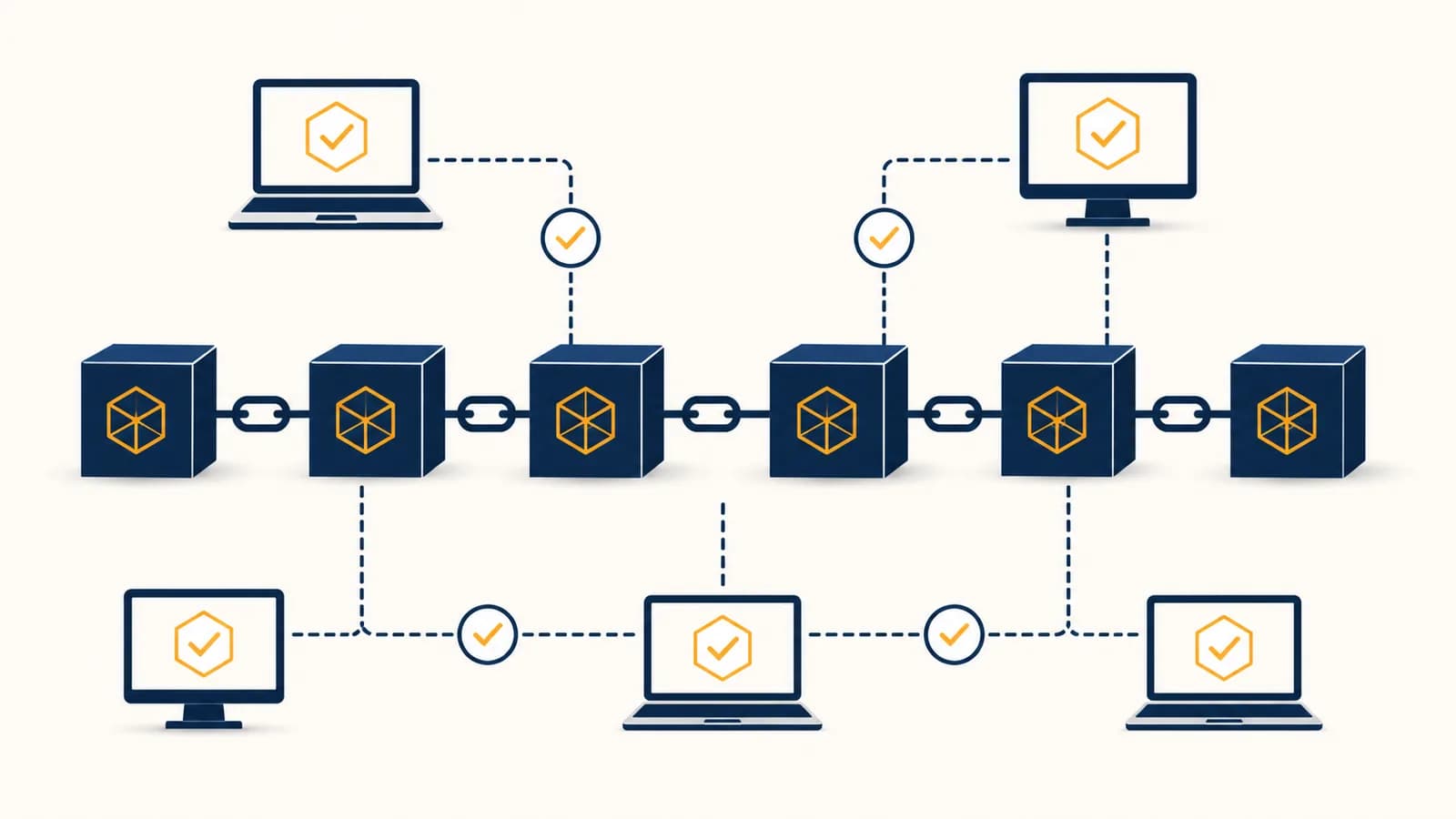
Blockchain is a distributed record system that lets many computers agree on an ordered history of transactions, in the context of digital networks where participants may not trust one another. Also called a distributed ledger, it groups database entries into linked blocks checked by a network. Questions such as what is blockchain, how does blockchain work, and how is blockchain used point to this mechanism. Cryptocurrency systems such as Bitcoin made it famous, but blockchain is broader than digital money. It exists to create one agreed record without giving a single middleman complete control.
What a blockchain actually is
A blockchain is an append-oriented ledger copied across multiple computers, where each accepted block refers cryptographically to the block before it. The copies, linking rules, and agreement process make unauthorized changes visible and difficult to have accepted by the network.
A ledger is simply a record of changes: Alice paid Bob, a concert ticket moved to Chen, or a shipment passed an inspection. A blockchain stores those changes as transactions. It usually does not store a perfect snapshot of reality. Instead, software calculates the current state by processing the accepted transaction history in order.
The word distributed means that several network participants keep or verify the record. These participants are often called nodes. Depending on the system, a node may retain every block, check new transactions, propose blocks, or do only some of those jobs. A blockchain can be public, where anyone may inspect and possibly join it, or permissioned, where an organization decides who can participate.
A blockchain does not prove that an input is true. It can prove that particular data was accepted in a particular order under the network's rules. If a sensor, person, or website supplies false information, the chain can preserve that false information faithfully.
The name describes the data structure. Transactions are collected into a block. Each block contains a compact cryptographic reference to its predecessor, making a chain. The name does not guarantee decentralization, privacy, good economics, or honest operators. Those properties depend on the system around the chain.
How a blockchain works
A blockchain works by having users sign proposed transactions, nodes check them against shared rules, and a consensus process select an ordered block. Each accepted block includes a fingerprint of prior history, then nodes update their local copies to the new state.
Imagine Mira wants to transfer one digital token to Sol. The network must answer several exact questions. Does Mira control the account that currently owns the token? Has that token already been spent? Does the transaction follow size, fee, and format rules? Where does this transaction sit relative to other valid transactions?
Mira's wallet forms a message naming the assets and destination. It uses her private key to create a digital signature. The signature lets other nodes verify authorization without learning the private key.
The wallet sends the signed message to one or more nodes. Those nodes relay a valid proposal through the peer-to-peer network. At this stage it is pending, not final.
Each receiving node independently checks the signature and current ledger state. A node rejects an invalid signature or an attempt to spend the same asset twice.
An eligible participant gathers valid pending transactions into a candidate block. The consensus mechanism determines which candidate becomes part of the agreed history.
Other nodes verify the entire block before accepting it. They then calculate the new ownership state. Later blocks add stronger evidence that the network continues to recognize that history.
Nothing in this process requires every node to trust Mira or the block proposer personally. A node trusts the protocol only to the extent that it can check the data itself and expects the agreement mechanism to resist attack. This separation between personal trust and verifiable rules is the central engineering move.
How hashes connect blocks
A cryptographic hash turns any input into a fixed-length fingerprint, and a tiny input change produces an unpredictable new fingerprint. A block records the previous block's hash, so rewriting old data breaks every later link unless the attacker rebuilds the accepted history.
Hash functions are deterministic: the same bytes always produce the same result. They are designed so that finding an input from its output, or finding two useful inputs with the same output, is computationally infeasible. Bitcoin, for example, uses SHA-256 in key parts of its block construction. SHA-256 produces a 256-bit result.
Block n includes the prior fingerprint . Changing an earlier header changes its hash, so the recorded reference no longer matches.
A real block often summarizes its transactions with a Merkle tree. First, software hashes individual transactions. It then pairs those hashes and hashes each pair, continuing until one root remains. A verifier can use a short path of neighboring hashes to prove that one transaction belongs to a block without downloading every transaction in that block.
Hash linking makes edits detectable, not literally impossible. Someone can change a private copy of a chain. The hard part is persuading other nodes to accept the altered copy. That resistance comes from consensus, network participation, and the cost or stake attached to rewriting history.
How digital signatures establish control
A digital signature proves that a transaction was authorized by someone controlling a particular private key and that the signed message was not altered afterward. It supports verifiable control of a blockchain account, but it does not prove the signer's legal name or intentions.
Public-key cryptography gives a user a mathematically related key pair. The private key stays secret and creates signatures. The public key, or an address derived from it, lets other people check those signatures. Verification answers a narrow question: does this signature match this message and public key?
A wallet displays “send 2 tokens to address B.” It signs the exact transaction data with address A's private key. If malware changes the amount to 20 after signing, the signature check fails because the message has changed. If malware changes the transaction before the user signs, however, the signature may be valid even though the user was deceived.
A seed phrase often acts as a human-readable backup from which wallet keys can be derived. Anyone who learns it may be able to create valid signatures and move the assets. A blockchain normally cannot distinguish the owner from a thief using the owner's key. This is why wallet security belongs beside protocol security. The broader principles in protecting systems, data, and people from attack explain threats such as phishing, malicious software, and stolen credentials.
Signatures also do not guarantee identity. A company can connect an address to a verified customer through an outside identity process, but the cryptography alone sees keys and messages. Losing a key can mean losing control, while rotating a compromised key may require an on-chain transaction or a specially designed recovery system.
How consensus works without a central referee
Consensus is the protocol that lets independent nodes settle on one valid transaction order despite delays, failures, and dishonest participants. Public blockchains commonly make block production costly or stake-backed, then define how nodes choose among competing valid histories.
Networks need consensus because messages do not arrive everywhere at once. Two valid payments might compete for the same funds, or two participants might propose blocks almost simultaneously. Nodes require a deterministic rule for deciding which history to follow. Consensus does not mean every human agrees with every transaction. It means compliant software can converge on an accepted state.
Proof of work ties block production to computation
Proof of work requires block producers, commonly called miners, to search for a block header whose hash falls below a network target. Each guess is cheap to verify, but finding a successful one usually takes many attempts. The protocol rewards successful work and makes a replacement history expensive to build.
is the target. A lower target admits fewer hash results, so the expected search requires more guesses.
Nodes do not accept a block merely because a miner announces effort. They hash the header and check the result. They also verify every included transaction. If competing histories appear, the protocol has a rule based on accumulated work. Confirmation is therefore probabilistic: additional blocks make a successful reversal less likely, but “included once” is not identical to irreversible.
Proof of stake ties block production to locked value
Proof of stake selects validators according to protocol rules involving assets committed as stake. Validators propose or attest to blocks. Misbehavior can lose rewards and, in systems with slashing, can destroy some committed stake. Exact selection, penalty, and finality rules vary between networks.
Security depends on verifiable computation and the economic cost of acquiring hardware and energy. Miners can stop using equipment without the protocol directly destroying it.
Security depends on validators committing native assets under protocol rules. Penalties can be imposed within the ledger, but ownership concentration and validator design require careful analysis.
Neither method removes governance or incentives. Developers write software, operators choose versions, users value assets, and institutions decide which records they recognize legally. A network is decentralized only in specific ways, such as block production, validation, software development, or asset ownership. Those dimensions can differ.
Blockchain versus an ordinary database
A blockchain is useful when several parties need a shared record but cannot comfortably appoint one writer; an ordinary database is usually better when one trusted organization controls the service. Databases offer simpler correction, higher efficiency, and clearer responsibility for most applications.
| Question | Ordinary managed database | Public blockchain |
|---|---|---|
| Who approves writes? | The system owner or authorized accounts | Protocol participants under consensus rules |
| Who stores the record? | Selected servers and backups | Many independent nodes may hold copies |
| Can errors be corrected? | An administrator can edit or restore data | A later transaction usually records the correction |
| Is data public? | Only if the owner publishes it | Often broadly readable, depending on the chain |
| Main trust assumption | Trust the operator and its controls | Trust open verification, incentives, and consensus assumptions |
A school attendance system does not need global consensus. The school already has authority to mark attendance, correct a teacher's mistake, and protect student records. A conventional database with access controls, logs, and backups fits that job. Adding a token and replicated consensus would raise cost without solving a genuine trust conflict.
A shared settlement network is different. Banks, exchanges, or people in different countries may want one transaction order without letting a single participant rewrite balances. A blockchain can make sense if open verification and resistance to unilateral control are valuable enough to justify slower processing, duplicated storage, and complicated governance.
This sentence is a design test, not a law. Engineers should still ask who supplies external data, who can change the software, how users recover from theft, and which court resolves disputes. A technically valid record can remain legally contested.
How blockchain shows up in money and payments
Blockchain appears in money as a settlement ledger for cryptocurrencies, stablecoins, and tokenized assets. Users submit signed transfers, while the network prevents the same on-chain funds from being spent twice and establishes an order that wallets and services can verify.
Bitcoin's design joins a native digital asset with proof of work and a public transaction history. Its ledger tracks spendable transaction outputs rather than accounts that behave exactly like bank balances. Other chains use account models, where software updates a stored balance and a transaction counter for each address.
A stablecoin is a blockchain token designed to track an external reference such as a national currency. The chain can verify token transfers, but it cannot by itself guarantee that the issuer holds adequate reserves or will honor redemption. Those promises depend on organizations, contracts, custody, audits, and law. The on-chain mechanism and the off-chain claim are separate layers.
Jules sends a token to a freelance designer. The transfer reaches the designer's address without the chain knowing the designer's name or whether the promised work was delivered. An exchange may later identify Jules through its customer records. The blockchain settles the token movement; people and institutions settle the commercial dispute.
Fees pay for scarce block space and help discourage spam. They can vary with demand and with a transaction's data requirements. A wallet may show a transfer as pending, included, confirmed, or finalized. Those words are not interchangeable across systems, so a merchant should use the relevant network's confirmation and finality model instead of assuming every visible transaction is permanent.
Financial applications also bring financial risks. Asset prices can change sharply, software can fail, issuers can default, and a transaction sent to the wrong address may be impossible to reverse through the protocol. A ledger can reduce one kind of intermediary while creating dependence on wallet makers, exchanges, stablecoin issuers, and network developers.
How blockchain shows up in shared records
Blockchain can support shared records by giving separate organizations one ordered audit trail, especially when no participant should control every write. Useful designs usually store compact proofs or identifiers on-chain and keep private, bulky, or correctable documents in managed storage elsewhere.
Consider a shipment that passes through a manufacturer, carrier, port, warehouse, and retailer. Each party can sign a handoff record. The chain can show the order and source of those claims. It cannot inspect the box. If an employee scans the wrong item or a sensor is tampered with, consensus preserves the submitted claim, not physical truth.
A known key submitted a particular record, the record appeared before a later block, and the accepted history has not changed under the protocol's rules.
The key belonged to the claimed company, the package contained the claimed goods, and the human or sensor reported honestly.
Similar limits apply to diplomas, property records, medical documents, and identity credentials. A university can sign a digital credential, and a verifier can check its signature. The university still decides who earned it. A land registry can publish tamper-evident entries, but law still decides ownership after fraud, inheritance, or a boundary dispute.
Nonfungible tokens, commonly called NFTs, are unique token records or identifiers on a chain. The linked artwork or media may live elsewhere, and owning the token does not automatically transfer copyright. The smart contract, sale terms, file storage, and applicable law determine what the buyer actually receives.
These cases raise questions about consent, permanence, surveillance, and responsibility. The page on who owns data and how technology affects privacy develops the human side of those design choices. A permanent public trail can make audits easier while making a person's past activity harder to escape.
What smart contracts actually are
A smart contract is program code stored or referenced by a blockchain and executed according to network rules. It can update on-chain state automatically when a transaction calls it, but it is neither inherently intelligent nor a complete replacement for a legal contract.
Suppose a program holds 100 tokens for a group. Its code says that a withdrawal succeeds only after three approved addresses have supplied valid signatures. When someone requests a payment, network nodes run the same code against the same prior state. If the condition passes, they record the new balances. If it fails, they reject the state change.
Execution must be deterministic. If honest nodes receive the same inputs and previous state, they need the same result. A contract therefore cannot simply ask an ordinary website for today's temperature while it runs, because nodes might receive different responses. An oracle supplies outside information through a defined transaction or reporting scheme. The oracle then becomes a trust dependency.
Code permanence magnifies mistakes. A contract can execute exactly as written and still violate its designer's intention. Access controls, upgrade paths, testing, audits, and emergency procedures matter because a public function may control assets directly.
Smart contracts can issue tokens, coordinate loans, run exchanges, or enforce game rules. They can also contain bugs such as reentrant calls, mistaken arithmetic, unsafe authorization, or dependence on manipulable price data. The useful question is not “is it on a blockchain?” It is “which actions can this code take, who can change it, and what assumptions can make it fail?”
How public blockchains handle privacy
Public blockchains usually provide pseudonymity rather than anonymity: addresses replace names, but transactions, amounts, contract calls, and timing may remain visible. Investigators and companies can combine that public trail with exchange records, network data, or behavior to infer who controls an address.
Reusing one address makes its activity easier to connect. Even with fresh addresses, transaction patterns can reveal relationships. If funds move from a regulated exchange account to an address and then through several public contracts, the chain supplies a durable graph that analysts can study later.
Some systems use cryptographic techniques such as zero-knowledge proofs to verify a claim without exposing all supporting data. A proof might establish that a transaction obeys balance rules without publishing the hidden values. The mathematics can protect selected fields, but software design, metadata, setup assumptions, and the points where users enter or leave the system still affect privacy.
Putting personal information directly on a permanent ledger is risky. Encryption can hide content, but encrypted data may remain available indefinitely, keys can leak, and cryptographic methods can age. Many designs keep personal records off-chain and put only commitments, hashes, or revocation references on-chain. Even a hash of predictable personal data can reveal information if an attacker can guess the input and test it.
How blockchain uses energy
Blockchain energy use depends mainly on its consensus design and activity, not on hash linking itself. Proof of work intentionally rewards repeated computation, while proof of stake replaces that contest with validator commitments and ordinary protocol operation, producing a very different energy profile.
In proof of work, miners run specialized equipment to make hash guesses. More competition increases total work, while the protocol adjusts difficulty to preserve its intended block schedule. Useful comparisons must state the network, time period, system boundary, and data source. A transaction count alone is a poor allocation rule because miners secure blocks, and one block can contain different kinds and numbers of transactions.
Proof of stake validators still require computers, networking, storage, and data centers, but the protocol does not make security depend on a global race to consume computation. This reduces one environmental cost without answering every concern. Hardware manufacture, geographic concentration, electronic waste, and the source of electricity remain relevant engineering questions.
The same discipline applies to claims about future systems. Comparing quantum computing and other emerging technologies helps separate current capabilities from predictions. Large fault-tolerant quantum computers could threaten widely used public-key schemes, but present planning involves migration paths and new cryptography, not the instant disappearance of every blockchain.
Four mistakes people make with blockchain
Four common mistakes are treating immutability as absolute, confusing public addresses with anonymity, assuming consensus verifies outside facts, and using a blockchain where a managed database fits better. Each mistake assigns the data structure a power that belongs to people, institutions, or system design.
1. “The record can never change”
Blockchain history is resistant to change under stated assumptions, not protected by a law of nature. A chain can reorganize, validators can coordinate, software rules can change, and communities can adopt a new history after an emergency. Mature analysis asks how finality works, who could reverse a transaction, and at what cost.
2. “An address is anonymous”
An address is a public identifier without a built-in civil name. Its visible activity can still expose patterns, counterparties, balances, and timing. Once one address is tied to a person, earlier and later transactions may become easier to trace. Privacy depends on the whole system and user behavior.
3. “Consensus makes the data true”
Consensus makes nodes agree about valid submitted data and order. It does not check a warehouse, inspect a diamond, or decide who legally owns a house. Every link between a physical fact and an on-chain statement introduces an oracle, authority, sensor, or human whose reliability must be evaluated.
4. “A blockchain improves every shared database”
Replication and consensus create costs in speed, storage, governance, and error correction. If one accountable organization should control the record, ordinary database permissions and signed audit logs may solve the problem more directly. Blockchain earns its complexity only when independent verification or resistance to unilateral control provides enough value.
The takeaway: A blockchain replaces some trust in a record keeper with verifiable data, cryptography, consensus rules, and economic assumptions. It does not eliminate trust. It redistributes trust across code, operators, keys, incentives, institutions, and the sources of real-world facts.
Blockchain turns trust into a system you can inspect
Blockchain belongs in computer science because it combines data structures, networks, cryptography, distributed agreement, programming languages, and security tradeoffs. Studying it well means tracing each claim to a mechanism and naming every person or component the mechanism still requires you to trust.
When you meet a blockchain claim in a product, job, law, or news story, draw its trust map. Name who signs transactions, who proposes blocks, who checks them, who writes the software, who supplies outside data, who can change the rules, and who handles mistakes. Then compare that map with the system it proposes to replace.
You can test the idea with a small exercise. Write four pretend transactions on cards, number them, and give each card a fingerprint derived from the previous card. Change the second transaction and watch the later references fail. Then add the harder question: how would several people agree on the replacement history if two cards appeared at once?
That question connects blockchain to the larger study of algorithms, operating systems, networks, and social consequences. See how these ideas fit into computer science as a whole, then notice the next time “trustless” appears in a claim. Ask which trust moved, which evidence became checkable, and which responsibility stayed with people.