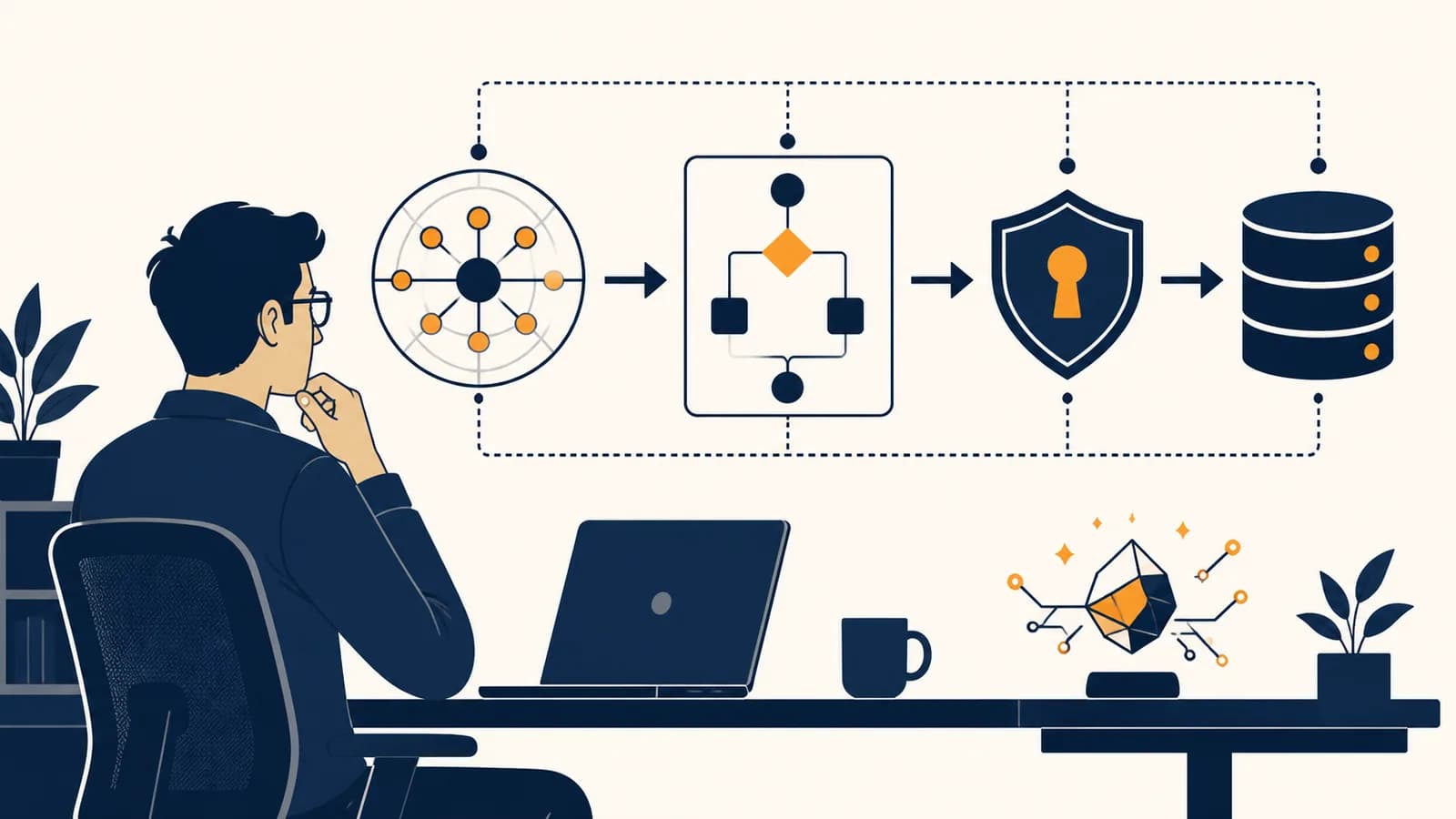
Building backends with AI is a software development practice that uses AI coding tools to design, write, inspect, and test server-side systems, in the context of web and application development. AI backend development covers the code users do not see: APIs, databases, authentication, permissions, scheduled jobs, and connections to other services. It exists because these systems contain many repeated patterns, yet still demand careful decisions about data, security, and failure. An AI assistant can produce a useful first draft quickly, but a human must define the behavior, examine the code, and prove that it works.
What a backend actually is
A backend is the part of an application that receives requests, applies rules, reads or changes stored data, and returns results. It usually runs on servers and exposes controlled operations to websites, mobile apps, internal tools, or other computer systems.
Consider a school lunch ordering app. The screen that shows meals and buttons is the frontend. The backend answers questions the screen cannot settle by itself. Which meals are available on Tuesday? Has this student already ordered? Is the account allowed to charge a parent? Has the kitchen reached its limit?
A useful backend usually contains several connected parts:
- Routes or endpoints accept requests at addresses such as
/ordersor/users/42. - Business logic enforces rules, such as refusing an order after a deadline.
- Data access code reads and writes records in a database.
- Authentication and authorization establish who is making a request and what that identity may do.
- Integrations communicate with services such as payment processors, email providers, maps, or an AI model.
- Operational code records logs, measures failures, runs background jobs, and helps operators diagnose trouble.
The word server can mean a physical computer, a virtual machine, a container, or a managed function that starts only when called. The backend is the software behavior. Its location and packaging can change without changing its job.
The backend is a trust boundary. A browser can suggest that a user is an administrator, but only server-side code should decide whether the request has administrator permission.
How a request becomes a response
A backend handles a request by matching it to a route, checking its structure and identity, applying application rules, using stored data or another service, and returning a status code plus a response body that the client can interpret.
Suppose a phone sends POST /orders with a meal identifier. The word POST signals an attempt to create something. The path selects the order operation. A token in the request may identify the student, while a JSON body carries the meal choice.
The server reads the method, path, headers, and body. Invalid JSON is rejected before application rules run.
A schema can require a nonempty meal identifier and reject unexpected fields. Validation turns vague assumptions into executable checks.
The server verifies the login token and checks that this account may place an order for the named student.
The application checks the deadline, availability, duplicate orders, and any account restriction.
The database records the order. Related changes that must succeed together are grouped in a transaction.
A successful creation might return status 201 and the saved order. A conflict might return 409 with a stable error code.
An API is the agreement at that boundary. It states which requests are allowed and what responses mean. A clear contract lets a frontend developer build against examples while the backend developer changes internal code without breaking the client.
A student taps the order button twice because the connection looks slow. If both requests carry the same idempotency key, the backend can recognize the retry and return the first result instead of creating two lunches. The screen action looks simple, but the server must account for duplication and delay.
Network calls can arrive late, arrive twice, or never return to the caller even after the server completed the work. Good backend design treats those outcomes as normal possibilities. It does not assume that one button press always produces exactly one clean request.
How AI changes the backend development loop
AI changes backend work by turning a written specification, existing code, errors, and tests into candidate code or explanations. It shortens drafting and investigation, but it does not know the unwritten product rules or prove that its output is safe.
The most productive unit of work is not “build my backend.” It is a bounded change with observable behavior. For example: “Add POST /orders. Require an authenticated student. Reject an unavailable meal with 409. Store one order per student and date. Add tests for success, duplication, and missing permission.”
That prompt supplies the facts an assistant cannot infer reliably. It names the route, identity, failure behavior, data invariant, and evidence required. The assistant can then inspect nearby routes, copy the project’s conventions, draft a migration, and propose tests.
“Make an order API.” The assistant must guess the framework, data shape, permissions, error behavior, and definition of success.
“Create one daily order per authenticated student, return 409 for a duplicate, and add route tests.” The expected behavior can be checked.
A disciplined AI-assisted loop has four activities: describe the contract, ask for a small change, inspect the diff, and run checks. If a test fails, give the assistant the exact failure and relevant code. If the code passes, inspect cases the tests may have missed. Each loop should leave behind code that another person can understand without reading the conversation that produced it.
AI is especially helpful for repeated framework syntax, test setup, data transformations, documentation, and tracing an error across several files. Human judgment carries more weight for permissions, irreversible data changes, payment behavior, privacy, and rules expressed imperfectly by stakeholders.
How stored data survives separate requests
A database gives separate backend requests shared, persistent state. The backend converts product rules into tables or documents, keys, constraints, queries, and transactions so that valid information survives restarts while invalid combinations are rejected or repaired.
Memory inside a running process is temporary. If one server stores an order only in a variable, another server cannot see it, and a restart erases it. A database stores the record independently of any one application process.
A relational design for the lunch app might use students, meals, and orders tables. Each order can point to one student and one meal through foreign keys. A unique constraint on student_id plus service_date makes “one lunch per student per day” a rule the database can enforce, even if two requests race.
| Rule | Backend check | Database protection |
|---|---|---|
| The meal must be orderable | Check its date, status, and deadline | Foreign key prevents an unknown meal reference |
| One order per student per day | Look for an existing order | Unique constraint settles concurrent attempts |
| An order needs a quantity | Validate the incoming integer | Non-null and range constraints reject bad stored values |
The application check produces a friendly error. The database constraint is the final guard against timing and programmer mistakes. Both are useful because two requests can pass an application check before either one writes.
For page 4 with 25 records per page, the offset is , so the query skips the first 75 records.
Offset pagination is easy to generate and explain, but records inserted between page requests can shift later results. Cursor pagination instead asks for records after a stable value, such as an order identifier. Choosing between them requires knowledge of the user experience, not only knowledge of SQL syntax. The broader mechanics are covered in how AI tools assist with database design and queries.
AI-built backends versus AI-powered backends
An AI-built backend is ordinary server software whose development involved an AI coding tool. An AI-powered backend calls a model while the product is running. The first changes how programmers work; the second changes the system’s runtime behavior, cost, and risks.
An assistant drafts a password reset route. Once deployed, that route runs normal code and does not need a model call for each request.
A study app sends a student’s paragraph to a model and returns feedback. The model is an external runtime dependency.
The distinction affects architecture. Generated code can be tested, reviewed, committed, and executed predictably. A model response can vary for similar inputs. It also introduces request limits, latency, provider failures, and content risks. The backend should wrap the model behind a narrow function rather than scatter model calls throughout route handlers.
Suppose an application creates quiz questions. The server can validate the requested subject, build a controlled prompt, call the model, parse the result into a schema, reject malformed output, and store accepted questions with their source material. A teacher may review them before students see them. Each boundary changes an uncertain text generator into one component inside a controlled process.
Model output is untrusted input. Validate its structure, escape it before display where needed, and never let generated text directly choose privileged commands or database queries.
A backend can also queue the model job and return a task identifier immediately. The frontend polls for status or receives an event later. This pattern keeps a slow generation request from holding open an ordinary web request and gives the system a place to retry temporary failures.
How safety and reliability become executable rules
Backend safety and reliability come from explicit controls: validate every external input, grant each identity limited permissions, protect secrets, make multi-step changes atomic, limit resource use, record useful events, and design predictable behavior for dependency failures.
Authentication asks, “Who is this?” Authorization asks, “May this identity perform this action on this resource?” A valid login is not permission to do everything. In the lunch app, a student may view their own order, a kitchen worker may view totals, and an administrator may alter meal availability.
Authorization belongs near the protected operation and should default to denial. Checking only whether a request has a user identifier creates an object access bug: one student might change /orders/81 simply by guessing its number. The backend must confirm that order 81 belongs to that student or that the caller holds a role allowed to edit it.
Secrets such as database passwords and service keys should come from protected configuration, not source files or prompts. Logs should identify the operation and failure without copying passwords, session tokens, private messages, or full payment details. An AI tool can accidentally echo sensitive values if they are included in its context, so context selection is a security decision.
Reliability also requires timeouts and bounded retries. If an email provider stops responding, the application should not wait forever. It can record an email job, attempt delivery separately, retry temporary errors with increasing delays, and stop after a defined limit. Retrying a permanent error wastes capacity, while retrying a non-idempotent payment without a stable key can duplicate a charge.
Tests convert these promises into repeatable checks. Unit tests examine isolated rules. Integration tests use real boundaries such as a test database. End-to-end tests exercise the route through a client. A focused companion explanation of ways to test code drafted by AI shows how these layers catch different failures.
How backend code shows up in real work
Backend code appears wherever a product must remember facts, coordinate users, enforce ownership, connect services, or continue work after a screen closes. The same request, rule, state, and response pattern appears across commerce, health, media, logistics, government, and internal operations.
A ticket sale coordinates scarce inventory
A ticketing backend must prevent two buyers from owning the same seat. Showing a seat as available is not enough because another customer may click at nearly the same moment. The server may place a short reservation, complete payment, then convert that reservation into ownership. Expired reservations return to inventory.
A clinic portal protects records by relationship
A health portal may let a patient read their own result, a clinician read records for assigned patients, and a receptionist see scheduling details without seeing clinical notes. The rule depends on both identity and relationship. A single broad “staff” permission would expose more information than each job requires.
A news site prepares work before a reader arrives
A publishing backend stores drafts, records revisions, checks publication time, processes images, and invalidates cached pages after an editor publishes. Some work happens in response to a click. Other work runs on a schedule or through a queue so that readers do not wait for every transformation.
Change the delivery address on an online order after it has shipped. The interface may refuse, offer a carrier link, or contact support. That response exposes a backend rule tied to order state. Before shipment, the shop controls the address. After handoff, another system controls the parcel.
Backend engineers spend time reading existing systems, tracing failures, discussing rules, reviewing changes, planning data migrations, and watching production behavior. Writing a new route is only one part. AI can accelerate the reading and drafting, while responsibility for the deployed behavior remains with the people and organization operating it.
Five mistakes people make with AI-built backends
The most common mistakes are accepting plausible code without checking its assumptions, mixing responsibilities, trusting external data, changing stored data carelessly, and treating a successful demonstration as production evidence. Each mistake hides uncertainty instead of making it testable.
1. Asking for a whole system in one prompt
A large request encourages the assistant to invent product rules and join them into code that is difficult to inspect. Split work by behavior. Define one resource, its permitted operations, its data constraints, and its tests. Small diffs make incorrect assumptions easier to see and reverse.
2. Putting every operation in the route handler
A route that parses input, checks permissions, calculates prices, sends email, writes records, and formats errors becomes difficult to test. Separate transport concerns from application rules and external adapters. Then the pricing rule can be tested without starting a server or contacting an email provider.
3. Trusting inputs because the frontend checked them
Anyone can send a request without using the official interface. The backend must validate type, length, range, format, identity, and permission as appropriate. Parameterized queries or a safe data library keep input values separate from SQL instructions. Generated queries still deserve inspection.
4. Editing a database schema without a migration plan
Changing a model file does not safely transform existing records. A migration must describe how the stored structure changes. Removing a column can destroy information. Adding a required column may fail while old rows lack a value. Safe changes often add new structure, copy or compute data, switch application code, and remove old structure only after verification.
5. Calling a demo finished
A demo usually proves one favorable path. A usable service also needs failure responses, access control, monitoring, backups, limits, deployment configuration, and a way to change the schema. Passing local tests is evidence, but the evidence covers only the cases and environment those tests exercised.
A practical review asks four questions. What facts did the assistant assume? Which boundary receives untrusted data? What can fail after the main operation succeeds? Which automated check would reveal a regression? Those questions turn review into a search for concrete failure modes.
What backend stack should a beginner choose?
A beginner should choose one widely used language, one web framework, one relational database, and a simple test runner, preferably tools already used in a course or project. Familiar documentation and a small number of moving parts matter more than novelty.
JavaScript or TypeScript can serve both browser and server code. Python has readable web frameworks and a broad teaching ecosystem. Java, C#, Go, Ruby, PHP, and other languages also run serious backends. The best first stack is one you can run locally, test automatically, and deploy without hiding every mechanism.
Start with a single application process and one database. Add queues, separate services, caches, and multiple databases only after a measured need appears. An AI assistant may propose fashionable infrastructure because it has seen it in many codebases. Frequency in training examples does not prove suitability for a small application.
A framework is a set of conventions and reusable code. It can route requests and parse JSON, but it cannot decide who should be allowed to cancel an order. That decision belongs to the application.
How does a backend go live?
A backend goes live when a repeatable build packages its code and dependencies, a hosting system supplies configuration, a database is prepared, traffic is directed to the service, and operators can detect failure and return to a known working version.
Development and production differ. A laptop may use a local database and a file containing harmless settings. Production needs protected secrets, a public network address, encrypted connections, persistent storage, and logs or metrics available after a process stops.
A basic release pipeline runs formatting checks, static analysis, and tests, then builds an artifact identified by a commit. The hosting system starts that artifact with production configuration. A health check confirms that the process can serve requests. Database migrations require special care because rolling application code back does not automatically restore removed data.
Deployment choices shape failure behavior. Two running instances can keep serving while one restarts, but both must share durable state outside process memory. A managed platform can handle machines and certificates, yet the application still needs useful errors, timeouts, and safe schema changes. See how AI-built applications move into production for the release process in greater detail.
How should a backend call an AI model?
A backend should call an AI model through a narrow service layer that controls input, model settings, output validation, timeouts, logging, and fallbacks. Routes should depend on a product operation, such as generating feedback, rather than on provider-specific response objects.
This boundary makes change possible. A test can replace the live model with a fixed response. A later model or provider can fit behind the same application interface. The team can limit input size, remove sensitive fields, cache suitable results, and record enough metadata to investigate an error without storing unnecessary personal content.
Cost follows usage. If an operation sends input tokens and receives output tokens, its model charge can be expressed without inventing a market price:
If a provider lists per-million-token prices and , substitute the measured token counts for each request.
The formula exposes two controls: reduce unnecessary input and cap output length. Actual pricing must come from the provider’s current documentation. Latency, accuracy, privacy terms, and failure handling also belong in the decision. A cheaper request is not useful if its result regularly fails the application’s validation.
The takeaway: Treat an AI model as an uncertain external service. Give it bounded work, validate what returns, measure the calls, and preserve a useful response when the service is slow or unavailable.
Building a backend makes computer science observable
Backend development turns computer science into visible choices about data structures, algorithms, state, concurrency, networks, security, and evidence. AI can speed up implementation, but understanding those ideas is what lets a developer recognize a wrong answer and design a better system.
A database index connects a data structure to query speed. A transaction connects concurrency to a lunch order or ticket purchase. A timeout turns distributed failure into a controlled branch. A permission check turns a security principle into a yes or no decision at one line of code. These are school concepts with users waiting on the result.
Build one small service and make its behavior visible. Create a resource, add a database constraint, require identity, write a test for a forbidden action, and log one failure without exposing private data. Ask an AI assistant to draft one change, then explain every changed line and challenge one assumption. The surrounding ideas connect to the wider set of computer science topics and applications.
A working endpoint is the beginning of the evidence, not the end. Notice what happens when the same request arrives twice, when another user names the resource, when the database is unavailable, or when old data meets new code. Those cases reveal the system you actually built.