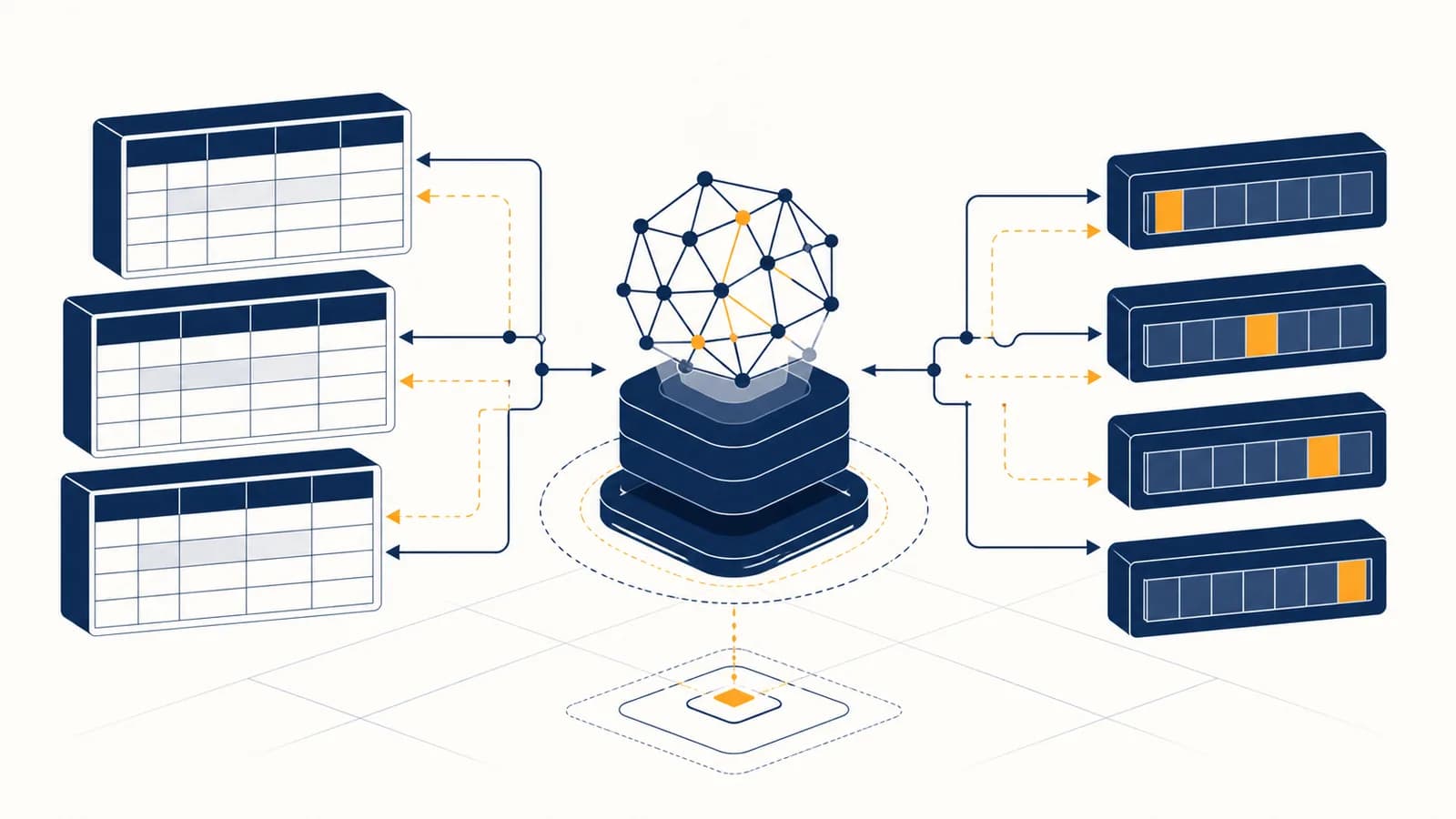
Databases with AI is a software approach that stores, finds, and updates information for artificial intelligence systems, in the context of application development and data management. It covers AI databases, vector databases, semantic search, text-to-SQL, retrieval augmented generation, and ordinary relational databases connected to language models. The idea exists because an AI model cannot safely remember every private fact, current record, or source document inside its trained parameters. A database gives the system controlled access to information that can change, while queries, permissions, and citations make the result easier to inspect.
Consider a school support chatbot. The language model may know how to explain attendance rules in general, but it does not know this school’s current policy or a particular student’s timetable. A database can supply the approved policy paragraph and the permitted timetable rows at the moment of the question. The model then uses those records to form an answer. AI handles meaning and language; the database remains responsible for stored facts.
What a database with AI actually is
A database with AI is usually an ordinary database plus one or more AI operations, such as generating a query, creating an embedding, ranking matches, or drafting an answer. The database stores records; the AI helps interpret requests or unstructured content.
The phrase describes several designs, so it helps to separate them. An application can put AI in front of a database by translating a user’s sentence into SQL. It can put AI beside a database by creating vector embeddings for documents. Some database products also provide AI functions inside the database engine. These designs can overlap, but none turns the database itself into a human-like mind.
A relational database stores facts in tables with named columns. A document database stores records shaped more like JSON objects. A vector index stores numerical representations used for similarity search. Many working systems combine these forms. A product catalog might keep price, stock, and product ID in relational columns, description text in a document field, and an embedding of that description in a vector column.
The model is not the source of truth. If the official price is stored in a database, the application should retrieve that value instead of asking a language model to recall or estimate it.
This division of labor is useful because database operations have properties that model output does not. A database can enforce a unique email address, reject a missing customer ID, record a transaction, and return the same stored row on repeated reads. A model produces likely sequences of tokens. Its wording may be helpful, but probability alone does not make a claim an approved record.
How a natural-language question becomes a database answer
A natural-language database system converts a request into a constrained retrieval operation, executes that operation against permitted data, and turns the returned records into a response. Each stage has a separate job, so the application can inspect and limit what happens.
The exact middle stage depends on the data. If a manager asks, “Which orders are overdue?”, an AI component can generate a structured query over order dates and status fields. If a technician asks, “What causes this warning light?”, the system can embed the sentence and search repair manuals by meaning. A combined request might retrieve matching manuals first, then filter the results to a specific machine model.
The application supplies table names, column meanings, document collections, and access rules. A model should not invent a schema or search data the user cannot access.
The AI identifies the likely intent, relevant entities, filters, and output shape. “Open orders for Maya” contains a status condition and a customer name, not a request for every order.
The system produces SQL, a vector query, a keyword query, or a combination. Application code should validate the operation before execution.
The database executes through an account that can perform only the necessary actions. A reporting assistant normally needs read access, not permission to delete tables.
The model explains the returned records, while code checks types, required fields, citations, and other rules. The interface can show the source rows or passages beside the answer.
Good systems keep these stages visible in logs. If the final answer is wrong, a developer can ask a precise question: Did the system misunderstand the request, generate a bad query, retrieve irrelevant records, or misstate good evidence? That separation is also central to designing AI-assisted backend services, where model calls must fit inside ordinary request handling, authentication, and error control.
How embeddings and vector search work
Embeddings turn items such as sentences or images into fixed-length lists of numbers, and vector search finds stored items whose lists are close to the query list. The closeness estimates similarity in learned features, not equality of words or guaranteed truth.
An embedding model maps each item to a point in a space with many dimensions. Text about “resetting a forgotten password” may land near text about “recovering account access,” even though the phrases share few words. The same embedding model must normally encode both the stored items and the incoming query, because coordinates from unrelated models do not have a shared meaning.
One common comparison is cosine similarity. For vectors a and b, it compares the angle between them:
For and , the result is . The vectors point partly in the same direction.
A vector database or vector extension builds an index so it does not need to compare a query with every stored vector. Approximate nearest-neighbor algorithms organize the space to find likely close items quickly. The tradeoff is explicit: a faster approximate search can occasionally miss the mathematically nearest item. Applications measure recall and latency to choose acceptable index settings.
Before indexing a long document, the application normally splits it into chunks. A chunk might be a paragraph, a section, or a bounded number of tokens with some overlap. Chunks that are too large mix several topics, which makes the embedding less specific. Chunks that are too small lose context. Metadata such as document ID, date, department, language, and access group travels with each vector so the database can filter candidates.
Vector search is also not limited to text. An image embedding can support searches such as “red shoes with a low heel,” and an audio embedding can find clips with related sound patterns. The database still needs ordinary fields for facts such as ownership, file location, publication status, and price.
Relational queries versus semantic search
Relational queries match explicit fields and conditions, while semantic search ranks items by learned similarity. Use relational operations for exact facts and rules; use semantic search for meaning in unstructured material. Many useful AI applications combine both in a hybrid query.
A condition such as status = 'open' has a defined meaning. Sorting, joining, grouping, and transactions operate on declared fields. The result is suitable for balances, dates, inventory counts, and legal states.
A sentence is embedded and compared with stored vectors. The result is a ranked set of related passages or items. It is suitable for support articles, notes, descriptions, and other language whose wording varies.
Suppose a shop user asks for “waterproof hiking shoes under 100 in size 8.” Semantic search can identify descriptions related to waterproof hiking. Structured filters should enforce the price ceiling, available size, and active inventory. Leaving the price condition to similarity would be a category error, since closeness in an embedding space does not implement arithmetic comparison.
| Question | Best primary operation | Reason |
|---|---|---|
| Which invoices are more than 30 days late? | SQL filter and date arithmetic | The conditions are exact and the fields are structured. |
| Which help article discusses a frozen login screen? | Semantic or hybrid search | The user’s wording may differ from the article. |
| Which approved safety notes concern this chemical? | Metadata filter plus semantic search | Approval and chemical ID are exact, while relevance depends on text meaning. |
| How much stock remains across warehouses? | SQL aggregation | The answer requires sums over stored quantities. |
Keyword search remains valuable. Product codes, names, error numbers, and quoted phrases often need exact lexical matching. Hybrid systems combine keyword and vector rankings, then apply a reranker or a deterministic scoring rule. AI does not erase older search methods; it adds another signal.
How retrieval augmented generation grounds a model
Retrieval augmented generation, often shortened to RAG, retrieves relevant external records and places them in a model’s input before it generates an answer. It gives the model temporary evidence without retraining it, but it does not guarantee faithful use of that evidence.
A basic RAG system indexes trusted documents, retrieves several chunks for a question, and sends those chunks with an instruction such as “answer only from the supplied sources.” The prompt may also require a source identifier after each factual claim. The model uses its language ability to connect and explain the passages, while the supplied context carries the local facts.
A nurse searches a hospital’s approved equipment instructions for a device alarm. The system filters by the exact device model and the current document version, then retrieves passages that describe similar alarm wording. The interface displays the source section beside the generated summary. Clinical judgment and hospital procedure still control the action.
RAG helps with information that changes more often than a model is trained: internal policies, product documentation, case notes, and current catalogs. Updating a document and rebuilding its index is usually more direct than retraining a large model. It also allows per-user retrieval rules, so two employees asking the same question can receive evidence from different permitted collections.
Failures can enter at every boundary. A parser may extract a table badly. Chunking may separate a warning from the instruction it limits. Retrieval may choose a related but outdated passage. The prompt may exceed the model’s context limit, causing useful evidence to be omitted. The model may then add an unsupported detail. Evaluation must test the complete pipeline, not only the model.
Good evaluation uses a set of representative questions with expected sources and acceptable answers. Developers can score retrieval separately by checking whether the needed passage appears among the results. They can then check whether the generated response states only supported facts, follows refusal rules, and cites the right record. This distinction tells a team which component needs work.
How text-to-SQL turns a request into a query
Text-to-SQL uses a language model to translate a natural-language request into a structured query language statement. It works best when the model receives a clear schema, column definitions, examples, and limits, then the application validates the statement before the database runs it.
Imagine two tables: customers(customer_id, name) and orders(order_id, customer_id, placed_at, status, total). The request “Show the total value of Maya’s open orders” requires a join, a name filter, a status filter, and an aggregate:
SELECT SUM(o.total) AS open_order_value
FROM orders AS o
JOIN customers AS c ON c.customer_id = o.customer_id
WHERE c.name = :customer_name
  AND o.status = :open_status;
The placeholders are parameters supplied separately, such as Maya and open. Parameterization prevents user text from being treated as SQL syntax. It is still necessary when AI writes the query, because a model can copy hostile or malformed instructions from a request.
Schema context needs meaning, not just names. A column called closed_at might indicate a completed case in one system and a cancelled account in another. Short descriptions, valid values, relationships, and example queries help the model select the right fields. Large schemas can first be narrowed to relevant tables so the prompt stays focused.
Never execute model-generated SQL with unrestricted credentials. Use read-only accounts for analysis, allowlisted tables, statement timeouts, row limits, and a parser or database policy that rejects forbidden operations.
Validation can be layered. Code can permit only a single SELECT statement, reject comments and data definition commands, inspect referenced tables, and ask the database for a query plan before execution. The application can cap returned rows and execution time. Sensitive systems may require a person to approve the query or offer only prewritten query templates whose parameters the model fills.
AI can also help developers write migrations and data access code, but generated changes deserve the same review as any other database change. Precise instructions should state the allowed schema, show relevant examples, and define acceptance tests before the model produces code.
How databases with AI show up in real work
Databases with AI appear wherever people need language, images, or flexible search to meet changing stored facts. Common settings include customer support, commerce, software operations, research, and public services, each with different standards for permission, accuracy, and review.
Support agents search private manuals
A support assistant can retrieve troubleshooting steps, warranty rules, and a customer’s authorized account data. Document search handles varied wording; relational queries fetch the exact order or device record. The agent sees suggested wording and sources, then decides what to send. Logs preserve the query, evidence, and final action for later review.
Shops combine descriptive search with exact inventory
A shopper may describe a need rather than a product name: “a quiet fan for a small bedroom.” Embeddings can rank product descriptions, while filters exclude unavailable items and enforce a stated budget. The database returns current price and stock, so the model does not invent them from an old product description.
Developers investigate software incidents
An engineering assistant can search logs, runbooks, previous incident notes, and service metadata. Similarity search may find an earlier failure with different wording. Structured queries can restrict events to the affected service and time window. Connecting this assistant safely to application data follows the same boundaries used in working with AI inside older codebases: inspect existing contracts, preserve behavior, and verify every proposed change.
Researchers organize literature and observations
A research tool can index paper abstracts, lab notes, and dataset descriptions, then retrieve related material for a question. Bibliographic IDs and publication dates belong in structured fields. Similarity can suggest connections, but it cannot establish that a paper supports a claim. The researcher must read the source and judge methods, scope, and evidence.
Public services classify incoming requests
A council can route free-text reports about broken lights, waste, or road damage to the right queue. A model proposes a category and extracts a location; the database stores the original message, confidence, chosen category, and staff correction. Low-confidence or high-impact cases can go directly to a person. Corrections later become evaluation data.
How permissions, privacy, and transactions control the system
Database controls determine which records an AI application may read or change, while privacy rules limit what it should collect, retain, and expose. Transactions preserve valid state during updates. Model instructions support these controls but cannot replace enforcement in code and the database.
Authentication establishes who the user is. Authorization decides what that identity may do. The application should pass the user’s scope into retrieval, or execute through database rules that enforce row and column access. Filtering after retrieval is too late because secret data may already have entered a prompt, a log, or a third-party model request.
Least privilege means granting the smallest useful set of operations. A question-answering tool might read approved policy documents but have no write permission. A scheduling agent may create an appointment through one reviewed function rather than receive general access to appointment tables. Tools should use typed inputs, validate identifiers, and return only fields needed for the response.
Transactions matter when AI proposes actions. Suppose a system transfers 20 units of stock from warehouse A to warehouse B. Decreasing one row and increasing the other must succeed together or fail together. A database transaction provides that all-or-nothing behavior. The model may select the intended operation, but the database protects the invariant.
If warehouse A changes from 70 to 50 and B changes from 30 to 50, both sides equal 100. A partial update would break the check.
Privacy work begins before prompts are written. The team should identify personal and confidential fields, decide why each is needed, set retention periods, and control where model requests are processed. Logs need their own access and deletion rules because they can contain user questions and retrieved records. Redaction can remove unnecessary secrets before model input, though redaction itself must be tested.
Prompt injection is another data boundary problem. A retrieved document may contain text that tells the model to ignore its rules or reveal unrelated records. The application should treat retrieved text as untrusted data, separate it from system instructions, limit available tools, and enforce authorization outside the model. The model cannot grant itself access that its database identity does not have.
5 mistakes people make with databases and AI
The most damaging mistakes confuse generated language with stored truth, or similarity with a database rule. Teams also expose excessive access, skip end-to-end evaluation, and ignore ongoing index maintenance. Each mistake has a concrete engineering correction that can be tested.
1. Asking the model to remember live facts
A model’s training data is not a current inventory, account ledger, or policy register. The correction is to retrieve the authoritative record at request time and label the result with an identifier or timestamp when freshness matters. If retrieval fails, the system should say it cannot verify the fact.
2. Treating vector similarity as proof
The nearest passage can be irrelevant, expired, or contradicted by a more authoritative source. The correction is to filter on metadata, set source priorities, test retrieval against known questions, and permit a “no sufficient evidence” result. A similarity threshold alone is not a universal measure of correctness.
3. Giving an agent broad database credentials
A flexible model with administrator access creates an avoidable failure path. The correction is a small set of reviewed tools, each backed by restricted credentials and validation. Destructive or high-impact changes can require confirmation and an idempotency key, which helps prevent the same action from running twice.
4. Measuring only the final prose
A polished answer can hide weak retrieval, and awkward wording can hide correct data access. The correction is to measure intent recognition, query validity, retrieval recall, source faithfulness, permission behavior, latency, and the final task outcome separately. Realistic test cases should include missing data, ambiguous names, and hostile input.
5. Building the index once and forgetting it
Documents change, permissions change, and embedding models change. The correction is a repeatable indexing pipeline that records source version, chunking method, embedding model, and processing status. Updates and deletions must reach both the source database and the vector index, or stale chunks can keep appearing.
Can an AI database replace SQL or a database administrator?
An AI database does not replace SQL, database design, or database administration. It adds interfaces and search methods, while people still define schemas, constraints, indexes, backups, access policies, and recovery procedures. Generated queries make those foundations more important, not less.
SQL remains the precise language for relational operations. A natural-language interface can make analysis easier for someone who does not know table names, but the generated SQL still runs according to database rules. Complex reports often need a developer or analyst to resolve ambiguous business meanings, review joins, and confirm that missing values are handled correctly.
Database administrators and platform engineers manage work that a chatbot cannot safely own by itself: capacity, replication, encryption, backup tests, query performance, access reviews, and incident recovery. AI can summarize slow-query logs or propose an index. A person still weighs storage cost, write overhead, workload patterns, and rollback plans before changing production systems.
The same boundary applies when shipping the whole application. Model selection is only one part of deploying and operating AI-built software; database migrations, secrets, monitoring, rollback, and user-visible failure states also need explicit design.
Do small projects need a vector database?
Small projects often do not need a separate vector database. A relational database with a vector extension, a search engine, or even a small in-memory index may be enough. The right choice follows data size, update rate, filtering needs, latency, and operating skill.
Start by naming the operation. If users search exact titles, tags, or codes, ordinary indexes and full-text search may solve the problem. If they need meaning-based retrieval over a manageable collection, an existing database’s vector support can keep records, permissions, and backups in one place. A specialized service becomes useful when vector workloads, scale, replication, or indexing features justify another system.
A prototype can compare approaches with a small evaluation set. Write representative questions, mark the passages that should be retrieved, and test keyword, vector, and hybrid search. Record response time and missed evidence. This is more informative than choosing a database because its product page uses AI language.
These numbers describe a design exercise, not a performance rule. Some applications need several stores, and some need only SQL. Every additional service creates synchronization, monitoring, security, and recovery work, so it should earn its place through a requirement that can be stated and measured.
How do you keep AI database answers current?
Current answers require a controlled path from each source record to every searchable copy, plus deletion handling, version tracking, and freshness tests. Retrieval should prefer valid records and expose dates when they affect meaning. The model cannot repair a stale index by wording.
An indexing pipeline listens for created, updated, and deleted documents. It extracts text, applies the chosen chunking rule, creates embeddings, and writes vectors with source IDs and version metadata. A successful update replaces the old chunks. A deletion removes them. Failed jobs enter a retry queue and become visible to monitoring.
Some facts should bypass vector indexing. A live delivery status, bank balance, or stock count belongs in a direct database query or service call. Retrieved documents can explain what a status means, while the structured system supplies its current value. Separating explanatory knowledge from live state reduces stale answers.
Freshness tests can insert a known document update, run the pipeline, and confirm that search returns the new version while excluding the old one. Teams should also test permission changes and deletions. A system that adds content correctly but fails to remove it can expose outdated or forbidden information.
Good AI database systems make uncertainty visible
Good AI database systems separate interpretation, retrieval, authority, and action so uncertainty can be seen and handled. This is database thinking applied to AI: define valid states, constrain access, preserve evidence, test failure cases, and make important updates reversible.
The next time an application gives a confident answer, inspect the path behind it. Ask which record supplied the fact, how the query selected it, what permissions applied, how fresh it is, and what happens if no supporting record exists. Those questions reveal more than the fluency of the response.
The takeaway: Let AI interpret language and rank possibilities, but let databases enforce facts, relationships, permissions, and transactions. Connect the two through narrow, observable steps that can fail safely.
This pattern connects the topic to the wider study of computer systems and software: representation, algorithms, security, abstraction, and testing all meet inside one practical design. Build a tiny version with a few documents and a table, then deliberately try an ambiguous question, a missing fact, an expired source, and a forbidden record. The behavior under those conditions shows whether the system actually works.