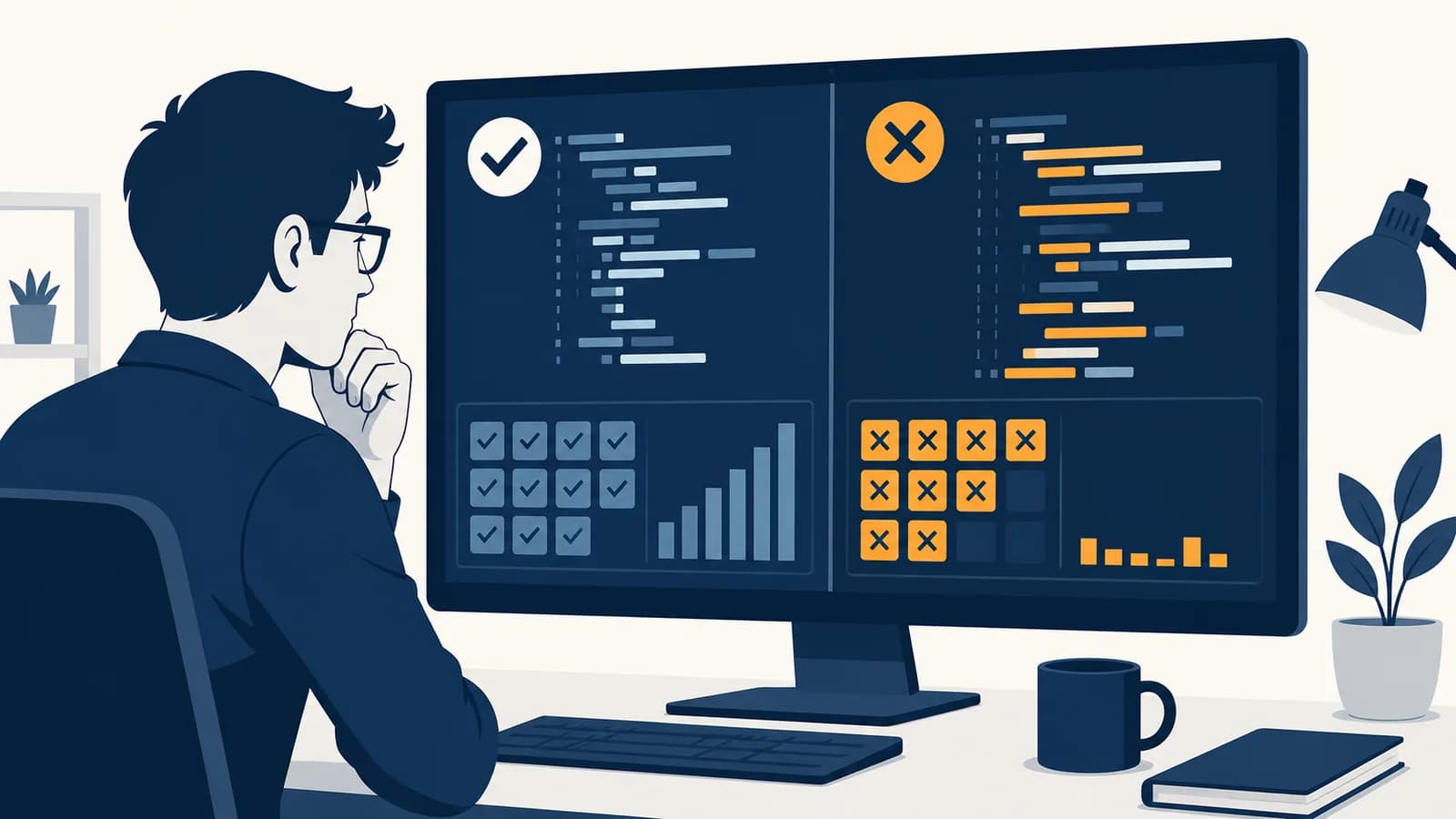
Testing AI-generated code is a software verification practice that checks whether code produced with an AI system behaves correctly and safely in the context of software development. People searching for how to test AI code, validate generated code, or catch AI coding errors are asking the same basic question: what evidence shows that this output deserves to run? The practice exists because plausible code is not the same as correct code. A model can produce tidy functions with convincing comments and passing examples while missing an edge case, misunderstanding a requirement, or introducing a security flaw.
The source of the code changes the risks, but not the standard of evidence. Generated code must satisfy the intended contract under normal inputs, boundary values, failures, and hostile conditions. A person still decides what correct means, chooses the evidence, and accepts responsibility for release.
What testing AI-generated code actually is
Testing AI-generated code is the process of turning a human requirement into executable checks, running those checks against generated output, and investigating any mismatch. It combines ordinary software testing with extra attention to hidden assumptions, copied patterns, and errors that look reasonable.
A test supplies a known setup, performs an action, and compares the observed result with an expected result. If a generated function is meant to calculate a shopping cart total, a test might provide two items priced at £4 and £6, apply no discount, and expect £10. That test establishes one fact. It does not prove that discounts, empty carts, negative quantities, rounding, or very large orders work.
The central object is not the model's confidence or the neatness of its answer. It is the relationship between a requirement and observable behavior. Tests make that relationship repeatable. The same checks can run after a new prompt, a model change, a dependency update, or a human edit.
A passing test is evidence for the cases it covers. It is not a certificate that the whole program is correct.
This distinction matters because generated code often arrives with generated tests. The code and the tests may repeat the same mistaken assumption. If the prompt says a password must be eight characters but the actual policy says at least twelve, a generated implementation and its generated tests can agree perfectly and still be wrong.
What a test oracle actually is
A test oracle is the rule or source used to decide what the correct result should be. It may be an exact value, a specification, an invariant, an approved implementation, or a person qualified to judge a result.
For arithmetic, an oracle can be exact. A function named areaOfRectangle(3, 5) should return 15 because the defining relation is known.
For width 3 and height 5, the oracle gives .
Many programs have less obvious oracles. A tax calculation depends on an authoritative rule set and the relevant dates. A search ranking may have several acceptable orders. An image resize should preserve dimensions and file validity, but exact pixels may differ between libraries. Before generating tests, the tester must identify what kind of answer can be defended.
| Oracle type | What it checks | Example |
|---|---|---|
| Exact output | One input has one required answer | A parser returns a specified date value |
| Invariant | A property remains true across many inputs | Sorting never changes the number of items |
| Reference implementation | New output matches trusted old behavior | A rewritten encoder matches the released encoder |
| External authority | Behavior follows a standard or policy | An invoice applies the documented rounding rule |
| Human judgment | A qualified reviewer evaluates meaning or risk | A clinician reviews a decision support explanation |
Weak oracles create false comfort. “The function does not crash” is useful for a smoke test, but it says nothing about whether the answer is right. “The output looks reasonable” is too vague for repeatable verification. A better oracle names a result or a property that another person can independently check.
How testing AI-generated code works
Testing AI-generated code works by separating specification, generation, and evaluation. A person defines behavior independently, creates tests across several risk categories, runs the code in a controlled environment, reads failures, and repeats until the evidence supports release.
State accepted inputs, returned outputs, side effects, error behavior, performance limits, and permissions. Do this before treating generated tests as evidence.
List normal use, boundaries, malformed data, dependency failures, concurrency, security abuse, and recovery. Give more attention to failures with greater consequences.
Derive expected results from the contract, examples, standards, or a trusted implementation. Do not let the generated function define its own expected behavior.
Use a temporary database, test credentials, controlled files, and blocked external side effects. Generated code should not send real messages or alter live records during evaluation.
Decide whether each failure reveals bad code, a bad test, or an unclear requirement. Coverage reports show unexecuted code, but they do not show whether assertions are meaningful.
Save every useful check so later prompts and edits cannot silently restore an old defect. A fixed bug becomes a permanent example of required behavior.
Consider a generated function that parses an age from a web form. The happy path uses "16" and expects the number 16. Boundary tests cover the youngest and oldest allowed values. Invalid tests include an empty string, spaces, decimal text, letters, and a negative sign. Security tests check that error messages do not echo unsafe input into HTML. Integration tests confirm that invalid ages are not stored.
A requirement says, “Accept whole-number ages from 13 through 120.” Tests should accept 13 and 120, reject 12 and 121, reject 13.5, and decide explicitly whether " 16 " is trimmed. Those five cases reveal more about the contract than twenty random happy-path values.
A useful technique is to ask an AI coding tool for candidate edge cases, then judge each candidate against the independent contract. The model can widen the search, but the oracle must remain outside the code being judged. Its suggestions are inputs to the testing process, not proof of correctness.
Unit tests versus type checks and code review
Unit tests execute a small behavior and check its result; type checks examine whether values are used in permitted ways; code review inspects logic and design without relying only on execution. These methods overlap, but none substitutes for the others.
A type checker can flag a string passed where a number is required. A linter can flag unreachable code, suspicious comparisons, or prohibited syntax. Neither knows that a correctly typed discount rate violates company policy.
A test can show that one behavior produced an expected result in one environment. It may miss an insecure design, an unreadable dependency, or an untested branch that a reviewer can spot.
Suppose generated code receives a price and discount, both typed as numbers. It calculates price * discount when the requirement is price * (1 - discount). The types are valid. A test with a £100 price and a 20 percent discount exposes the error because the expected result is £80, not £20. A reviewer may also see that percentage units need documentation.
Integration tests add another layer. They check that components agree about data formats, transactions, authentication, timeouts, and failure behavior. End-to-end tests exercise a complete user task through the real interfaces. These tests are slower and can fail for more reasons, so teams usually keep many focused tests and a smaller set of broad workflows.
Review is especially valuable for generated output because a model can introduce an unnecessary package, duplicate an existing utility, weaken an authorization check, or produce code no maintainer understands. The companion topic on reviewing the structure and intent of AI output covers that human inspection in more detail.
How generated code shows up in a delivery pipeline
Generated code enters a delivery pipeline like any other change: it is committed, checked automatically, reviewed, built, tested in a staging environment, and released under controls. Its origin should influence scrutiny, not bypass the established gates.
A continuous integration system can run formatting checks, type checks, unit tests, integration tests, dependency scans, and build steps whenever a change is proposed. A failed gate blocks the change until someone resolves it. A passing pipeline means only that the configured gates passed; omitted checks remain omitted.
Testing continues after deployment because test environments cannot reproduce every production input, traffic pattern, permission state, or dependency failure. Monitoring watches error rates, latency, security signals, and business invariants. A rollback plan limits damage if observed behavior contradicts the pre-release evidence.
For a payment change, a team might use sandbox transactions before release, then enable the code for a limited set of internal accounts. It would watch for duplicate charges, mismatched totals, and failures from the payment provider. Release controls do not make faulty code correct. They reduce exposure while the team gathers evidence.
Never test unknown generated code against live secrets or valuable data first. Use restricted credentials, disposable records, and an environment where network and file access are limited.
The testing gate connects directly to the controls used to release AI-built applications, because a test result has practical value only when the delivery system responds to it.
Five mistakes people make with AI-generated tests
The most common mistakes are accepting tests from the same mistaken premise, checking only happy paths, confusing coverage with correctness, mocking away the behavior at risk, and changing expectations merely to make failures disappear. Each mistake weakens the oracle.
1. The code and tests share one misunderstanding
AI-generated tests often mirror the wording and assumptions in the prompt. If the prompt is incomplete, both artifacts can be internally consistent and externally wrong. Write several acceptance examples from the real requirement before generation, or have a different person derive them without seeing the implementation.
The generated slug function removes every non-English letter, and its generated tests expect those letters to disappear.
The product requirement says names in supported writing systems must remain searchable, so deletion is a failure even though the generated suite passes.
2. Happy paths crowd out boundaries
Generated suites may repeat ordinary examples because they are easy to infer. Boundaries contain more information. For a list limited to 100 entries, test 0, 1, 99, 100, and 101 entries. Also test missing values, duplicates, invalid encodings, and inputs large enough to expose slow behavior.
3. High coverage is mistaken for correct assertions
Statement coverage reports whether lines ran, not whether the suite noticed bad results. A test can execute every line and assert only that the answer exists. Mutation testing offers a sharper check: the tool deliberately changes operators or constants, then reruns the suite. If tests still pass after meaningful mutations, the assertions may be weak.
4. Mocks replace the exact behavior under examination
A mock is a controlled substitute for a dependency. It is useful for making failures repeatable, but excessive mocking can create a fictional system. If generated database code is risky because of transaction handling, a test that replaces the whole database layer cannot reveal the problem. Use an isolated real database for that integration test.
5. Expected results are edited to match the output
A failing test creates a question, not permission to force agreement. The implementation may be wrong, the oracle may be wrong, or the requirement may be ambiguous. Trace the expected value back to its source before changing anything. If the contract changes, record that decision rather than silently moving the target.
Failures also need reduction. If a property-based test finds a huge input that crashes a parser, shrink it to the smallest input that still fails. A small counterexample reveals the mechanism and becomes a clear regression test. This is closely related to finding the cause of failures in generated code, which begins after a useful test exposes the mismatch.
How nondeterministic AI features are tested
Nondeterministic AI features are tested with layered oracles rather than one exact sentence. Tests check fixed properties, structured outputs, prohibited behavior, representative task sets, statistical patterns where justified, and human judgments for qualities that cannot be reduced to one value.
Code that calls a language model may produce different wording on repeated runs. An exact string assertion will be brittle. The stable contract may instead require valid JSON, specified fields, a supported language code, no secret data, and a refusal for a prohibited request. Each requirement can have its own check.
An AI feature drafts replies to delivery questions. Automated checks can confirm that the order identifier is copied correctly, the response contains no internal notes, links use approved domains, and the output fits the required schema. Human reviewers can separately score factual support and tone on a maintained evaluation set.
Randomness should be controlled where the system permits it. Fixing a seed or using a deterministic test double makes ordinary integration tests repeatable. A separate evaluation can sample real model outputs to measure behavior that the test double cannot represent. Store the model version, prompt version, parameters, and evaluation data version so a change can be traced.
Flaky tests deserve investigation. Rerunning until a failure disappears teaches the pipeline to ignore evidence. First separate infrastructure noise, such as a timeout, from genuine output variation. Then redesign the oracle around stable requirements or define an evaluation rule with a justified tolerance.
How enough testing is decided
Enough testing is a risk decision based on possible harm, likelihood of failure, detectability, exposure, and the cost of additional evidence. No universal test count proves adequacy; a toy formatter and a medical calculation require different assurance.
A simple risk model can help order work without pretending to deliver perfect probabilities. Assign each failure mode a severity score, a likelihood score, and a detectability score using a documented scale. Multiplication produces a priority value, not a scientific truth.
If severity is 5, likelihood is 3, and difficulty of detection is 4 on the team's chosen scale, . Compare items only within the same agreed scale.
The score starts a conversation. A low-frequency error that exposes private data may still demand a release block because its severity is unacceptable. A visible formatting defect may be safe to monitor after release. Teams should set acceptance criteria before seeing the test results, or convenience will influence the threshold.
Good stopping evidence includes passing tests tied to requirements, reviewed high-risk paths, realistic integration checks, resolved security findings, known limitations, and a recovery plan. Remaining uncertainty should be explicit. “We did not test concurrent edits” is useful information for a release owner. “All tests pass” hides what the suite never attempted.
Testing effort should follow consequence. Generated code that renames local photo files needs safeguards and backups. Generated code that calculates medication doses demands specialized validation, independent review, controlled deployment, and applicable regulatory processes.
How testing evidence shows up in jobs, law, money, and daily decisions
Testing evidence appears wherever software decisions have consequences: developers use it to approve changes, organizations use it to manage operational risk, auditors examine it as part of control records, and individuals rely on it before trusting scripts with files or money.
Software jobs turn requirements into evidence
A developer may write unit tests, while a quality engineer designs system tests and investigates failure patterns. A security engineer probes authorization, input handling, dependencies, and secret exposure. A site reliability engineer tests rollback and recovery. The job titles differ, but each asks what claim is being made and what observation could disprove it.
Teams also preserve provenance. A pull request can record which code was generated, who reviewed it, which checks ran, and which limitations remain. The human who merges a change is not proving personal authorship. They are accepting responsibility for the evidence and the result.
Law and policy care about process and consequences
Legal duties vary by place, industry, contract, and use. Testing records may help show that an organization followed its stated controls, but a passing suite does not cancel obligations concerning privacy, discrimination, safety, accessibility, licensing, or consumer protection. High-impact systems need advice from qualified people who know the applicable rules.
Generated code can also reproduce licensed text or introduce a package with incompatible terms. Functional tests will not settle that issue. Inventory checks, dependency records, source review, and legal analysis answer different questions. Verification is strongest when technical evidence is connected to the actual duty.
Money systems expose rounding and state errors
Financial code must define units, rounding, currency, and transaction behavior. Binary floating-point values cannot exactly represent many decimal fractions, so money systems often use integer minor units or decimal types with explicit rules. Tests should cover refunds, repeated requests, interrupted operations, and totals across line items.
An AI assistant writes a script to reorganize 8,000 family photos. Before pointing it at the only copy, run it on a duplicated folder containing ordinary names, duplicate names, unusual characters, empty files, and nested folders. Compare a manifest before and after, then confirm that rerunning the script does not cause new damage.
This small example contains professional ideas: a safe environment, representative fixtures, invariants, idempotence, audit records, and recovery. The scale changes at work, but the logic does not.
Tested code makes AI assistance accountable
Testing makes AI-assisted programming accountable by replacing confidence in fluent output with inspectable evidence. It connects specifications, algorithms, data structures, security, and systems behavior, which is why it belongs within computer science rather than beside it.
The practical habit is simple: before running generated code, write down one thing that must be true and one failure that would matter. Turn both into checks. Then add boundaries, bad inputs, integration behavior, and recovery in proportion to the consequences.
A person learning how these ideas connect across computer science will see the same pattern repeatedly. Programs transform representations under rules. Testing observes those transformations and compares them with a specification. AI changes how quickly code can appear, but it does not change what correctness means.
The takeaway: Treat generated code as an unverified proposal. Define the contract independently, test the cases that could disprove it, review the design, control the release, and keep watching the behavior.