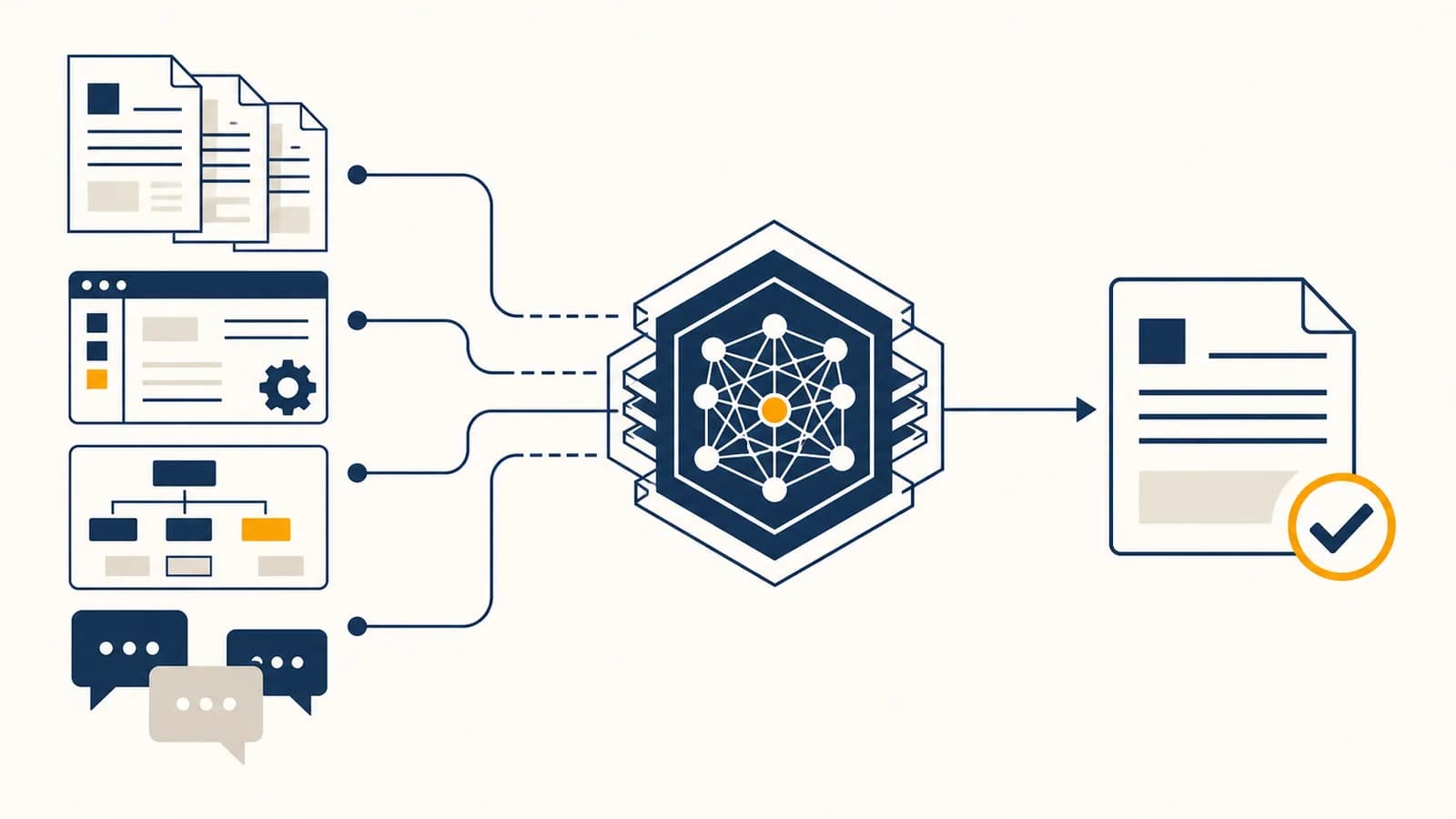
Context engineering is a software design practice that selects, structures, and updates the information an AI model receives, in the context of building reliable AI systems. In AI context engineering, developers manage an LLM context window with instructions, user messages, retrieved documents, tool results, examples, and memory. Prompt engineering improves a request. Context engineering designs the whole information supply around that request. The idea exists because a model can respond only to the information and capabilities available during its current run, while real tasks depend on facts stored elsewhere, rules that must persist, and results that arrive as work proceeds.
Imagine an assistant asked, “Can I refund order 1842?” The sentence is clear, but it is not enough. The assistant needs the company’s refund policy, the order record, the customer’s region, the current date, and perhaps permission to issue money. Context engineering is the work of supplying those pieces in a form the model can use without burying the decisive fact.
A model does not automatically know your current situation. If a fact lives in a database, a private document, a recent tool result, or an earlier conversation, the application must place that fact within reach.
What context engineering actually is
Context engineering is the design of the model’s working environment: what information enters, where it comes from, how it is ordered, how long it remains available, and what the application does when the available material is incomplete or contradictory.
The word context means everything the model can condition its next output on during an inference call. Depending on the system, that can include a system instruction, a conversation transcript, document excerpts, images, structured records, tool descriptions, tool outputs, and a requested output format. The model does not treat these as human memory. They are input data represented as tokens, processed together to predict the next token.
The word engineering matters because useful context rarely appears by accident. Software has to collect candidate information, reject irrelevant or unsafe material, arrange what remains, and fit it within technical and cost limits. It also needs to record which source supported an answer and handle cases in which no trustworthy source exists.
The application forwards the latest user message and hopes the model already has enough knowledge.
The application combines stable rules, relevant records, recent interaction state, and available actions before requesting an answer.
This practice joins several areas of computer science. Information retrieval finds useful records. Data structures represent them. Security controls access. Distributed systems fetch live state. Human interface design decides what to ask when information is missing. Testing checks whether the assembled input produces acceptable behavior.
How a context pipeline works
A context pipeline turns a user request into a bounded model input by interpreting the task, gathering authorized evidence, ranking that evidence, assembling instructions and data, calling the model, and checking the result before the application acts or replies.
A production system may repeat this cycle several times. An assistant first sees that it needs an order record. It calls an order tool. The application adds the returned record to the context. The model then sees that the item is damaged and requests the returns policy for damaged goods. Each tool result changes what the model knows and what it should do next.
Identify the likely task, required data, risk level, and missing fields. “Move my appointment” needs an appointment identity, a permitted calendar, and a new time.
Search documents, query databases, read conversation state, or expose tools. Access checks should occur before private data is returned.
Keep material that can change the answer. Remove duplicates, stale versions, navigation text, and unrelated history. Summarize only when the lost detail will not be needed later.
Separate instructions from quoted data, label sources, state the desired output shape, and preserve the user’s exact request. Clear boundaries help the model distinguish commands from evidence.
Ask the model to answer or choose an action. Then check citations, required fields, permissions, and business rules with ordinary code before accepting the result.
Consider a school course assistant answering, “What is due Friday?” A weak pipeline searches for the word Friday and pastes every match. A better one resolves the student’s course, reads the current assignment schedule, checks the school timezone, and returns the assignment title with its source. If two schedules disagree, it reports the conflict instead of choosing silently.
What belongs in a useful context
A useful context contains the smallest set of instructions, facts, examples, state, and capabilities needed to complete the current task correctly. Each item should have a reason to be present, a known source, and an appropriate lifetime.
| Context part | Job | Example | Typical lifetime |
|---|---|---|---|
| Instructions | Define behavior and limits | Never issue a refund without an order record | Many requests |
| User input | State the present goal | Refund order 1842 | Current task |
| Retrieved evidence | Supply outside facts | Refund policy section for damaged items | Current task |
| Working state | Track progress | Order found, identity check pending | Current workflow |
| Examples | Demonstrate a pattern | A correctly formatted refund decision | Many similar requests |
| Tool definitions | Describe available actions | Look up an order by identifier | While the tool is available |
| Tool results | Report live state | Order status: delivered | Until it becomes stale |
More material is not automatically better. An old return policy can compete with the active one. Ten nearly identical examples consume space while adding little information. A long conversation may contain an abandoned goal that distracts from the present task. Good selection increases signal density, the share of input that actually helps decide the next output.
If the available budget is 10,000 tokens and instructions, user input, tool definitions, and reserved output use 1,000, 500, 1,500, and 2,000 tokens, retrieved evidence can use at most 5,000 tokens.
This equation is an application budget, not a law of language models. It forces a useful accounting decision. Reserving output space prevents a system from filling the entire window with source text and leaving too little room for the answer. Different model interfaces count inputs in different ways, so the application should use the provider’s tokenizer or reported usage rather than guessing from word count.
Context engineering versus prompt engineering
Prompt engineering improves the wording and structure of instructions sent to a model. Context engineering includes that work but also controls retrieval, conversation state, tools, permissions, source freshness, token allocation, and the feedback loop around multiple model calls.
A prompt can say, “Use the current refund policy and cite it.” Context engineering answers the operational questions that sentence leaves open. Where is the policy stored? Which version is current? Is this employee allowed to view it? Which sections match the order? How is the source passed to the model? What happens if retrieval returns nothing?
Improve an instruction such as “Classify this ticket as billing, technical, or account access. Return JSON.”
Define the categories, fetch the customer plan, include recent ticket history, expose permitted support actions, validate the JSON, and prevent records from another customer entering the request.
The two practices work together. Precise instructions cannot repair missing evidence. Excellent retrieval cannot repair an instruction that asks for the wrong task. Many coding assistant workflows and their limits show this clearly: the model needs a clear request, but it also needs the relevant files, compiler errors, project conventions, and dependency versions.
How retrieved context supplies outside knowledge
Retrieved context supplies outside knowledge by searching an approved collection for material related to the request, ranking the matches, and inserting selected excerpts with source labels. The model answers from those excerpts instead of relying only on patterns learned during training.
A common design is retrieval augmented generation, often shortened to RAG. Documents are split into chunks. Each chunk receives searchable metadata, such as title, owner, date, access group, and document version. Some systems also compute an embedding, a numerical representation that places text with related meaning near each other in a high dimensional space.
At query time, the system can combine keyword search with embedding similarity. Keyword search is strong when exact terms matter, such as a product code. Semantic search can match related wording, such as “money back” with “refund.” A ranking stage can then consider relevance, authority, freshness, and access rights.
A mechanic asks an internal assistant for the tightening sequence on a specific engine. The search should filter by engine model and manual revision before ranking passages. A semantically similar instruction for another engine is dangerous context, even if the wording looks highly relevant.
Chunk size changes retrieval behavior. Tiny chunks may lose the condition attached to a rule. Huge chunks may contain many irrelevant sections. One practical strategy stores small searchable passages but expands a chosen passage to include its heading or neighboring paragraph. That preserves the local meaning without sending the entire manual.
Retrieved text must also be treated as data, not authority over the application. A web page or uploaded document can contain text such as “ignore previous instructions.” The system should mark document boundaries, restrict tools outside the model, and validate high impact actions. Telling the model to ignore malicious text helps, but software controls carry the actual security guarantee.
How context changes during an agent’s work
An agent’s context changes as the system records plans, tool requests, observations, intermediate results, errors, and completed actions. The application must preserve state that affects later decisions while discarding chatter and transient details that no longer help.
Suppose a coding agent is asked to fix a failing checkout test. It first receives the request, repository rules, and a file map. It reads the failing test, so that file enters context. It runs the test, adding the error output. It inspects the implementation, edits one condition, and runs the focused test again. The second result replaces the first as the best description of current state.
The model may have a long conversation transcript, but a transcript is a poor database. Stable instructions belong in versioned project files. Exact task state belongs in structured fields. Large command outputs can be stored outside the model and recalled only when needed. Readers building this kind of setup can see how repository instruction files guide AI agents across many separate tasks.
Summaries help when a workflow becomes long, but every summary is lossy. “The test failed because of tax” may omit that it fails only for a zero value coupon in one region. A sound system keeps exact artifacts available outside the context and places identifiers in the summary. If the detail becomes important, the agent can reopen the original test output or record.
How context engineering shows up in real work
Context engineering appears wherever an AI feature must combine a user’s request with private, current, or task specific information. It shapes support assistants, coding tools, research search, document review, scheduling, data analysis, and controlled business workflows.
Customer support uses policy plus account state
A support assistant needs more than a polite script. It needs the correct policy for the customer’s region, account status, recent contact history, and a list of permitted actions. The application may hide payment details that are unnecessary for the case. If identity has not been verified, it can withhold account tools and ask for the required check.
Software teams use code plus machine feedback
A coding assistant needs nearby definitions, project configuration, package versions, test failures, and style rules. Selecting only files with similar names can miss the interface that actually constrains a change. Compiler and test output provide grounded feedback. The assistant proposes code, the machine checks it, and the result becomes new context for the next attempt.
Analysts use schemas plus traceable data
An analyst asking “Which products lost sales?” needs table schemas, business definitions, date ranges, and permission scoped query tools. The phrase lost sales might mean lower revenue, fewer units, or missed demand caused by stockouts. A context pipeline can surface that ambiguity before writing a query, then attach the query and result to the explanation.
People meet it in ordinary decisions
A calendar assistant checking a meeting time needs timezone, working hours, travel blocks, and attendee availability. A study assistant needs the assigned edition and teacher’s rubric. A shopping helper needs location, constraints, and current inventory. In each case, the visible conversation is only the front edge of an information system.
The same logic explains many failures that look like weak intelligence. A model recommends an unavailable product because inventory was absent. It repeats a resolved bug because the old error remained prominent. It applies the wrong law because jurisdiction metadata was missing. Better context cannot guarantee a correct answer, but missing or misleading context makes a correct answer much less likely.
How teams test a context system
Teams test a context system by separating retrieval quality, context construction, model behavior, and final task outcomes. They use representative cases with known evidence, inspect failures by stage, and rerun the same evaluations whenever data, prompts, models, or tools change.
An end result alone cannot identify the cause. If an assistant gives the wrong leave policy, the search might have missed the right document. The right document might have been retrieved but cut off before the exception. Both versions might have appeared, with the obsolete one placed last. The model might have ignored clear evidence. The application might have displayed an unvalidated draft. Each failure needs a different fix.
| Layer | Question | Check |
|---|---|---|
| Retrieval | Did the needed source appear? | Compare returned source identifiers with a labeled expected set |
| Selection | Was the decisive passage preserved? | Inspect the final context, not only search results |
| Generation | Did the answer follow the evidence? | Check claims against cited passages and required format |
| Action | Was the proposed operation allowed? | Run deterministic permission and parameter checks |
| Outcome | Did the user’s task succeed? | Measure completion on realistic end to end cases |
A small evaluation set can begin with ordinary cases, missing information, conflicting sources, stale records, attempted instruction injection, long conversations, and denied permissions. Each case should specify what information is necessary, what information must stay hidden, and what acceptable behavior looks like. Exact wording need not match if the decision and evidence are correct.
Logging should make the pipeline inspectable without exposing secrets. Useful records include source identifiers, retrieval filters, document versions, token use, tool calls, validation results, and user approved actions. Sensitive fields can be removed or masked before logging. Teams also need retention rules, because a diagnostic log can become a second store of private context.
5 mistakes people make with context
Most context failures come from supplying too much material, supplying the wrong material, mixing data with instructions, preserving stale state, or trusting model output as authorization. These errors can make a capable model inconsistent, unsafe, expensive, or confidently wrong.
1. Filling the window because space is available
A large context window is capacity, not a target. Irrelevant text increases processing cost and creates more opportunities for distraction or conflict. Start with the evidence required for a decision. Add neighboring material when it supplies definitions, conditions, or exceptions. Reserve enough capacity for tool results and the final response.
2. Retrieving by similarity alone
The most similar passage is not always the governing one. A retired policy can resemble the query perfectly. Filter by permissions, product, jurisdiction, and effective date where those fields matter. Rank authoritative primary material above summaries, and show a conflict when two active sources disagree.
3. Treating document text as trusted instruction
Documents can contain malicious or accidental commands. Delimit quoted content, tell the model what role that content has, and enforce tool permissions outside the model. A customer email should be evidence about a request. It should never gain the authority to change system rules or expose another customer’s records.
Instruction hierarchy is not an access control system. Even a well instructed model can make mistakes. Code must decide which records can be fetched and which actions can execute.
4. Letting summaries replace the source of truth
A summary is useful working memory, but it can erase a number, condition, or unresolved disagreement. Keep links or identifiers for original artifacts. Refresh summaries after state changes. For financial, legal, medical, or other high impact decisions, reopen authoritative sources before acting.
5. Changing several layers without measuring them
If a team changes the model, prompt, retriever, chunking method, and tool descriptions at once, a better final score reveals little about cause. Hold most layers fixed, compare representative cases, and examine both quality and resource use. The related practice of tracking AI development costs and tradeoffs matters because longer inputs and repeated calls consume additional computation.
What a context window actually limits
A context window limits how much tokenized input and generated output a model can process in one call. It is temporary working space, not a guarantee that every included detail will be recalled equally well or a store of permanent memory.
Tokens are pieces of text determined by a tokenizer. One word may become one token or several, and punctuation and code also consume tokens. Images may be represented through their own input accounting. Because the response needs room too, an application cannot safely allocate the advertised capacity entirely to documents.
Position and structure can affect use. Important rules should be clear and consistently located. Evidence should carry headings and source labels. Repeated boilerplate should be removed. If the material cannot fit, the answer is rarely to cut characters blindly. Search can choose relevant passages, structured queries can fetch exact fields, and external storage can hold artifacts until needed.
How tools differ from context
Context is information already available to the model during a call, while a tool is a controlled capability the model can request. The tool’s description enters context, and its returned observation becomes new context for a later decision.
A database lookup tool is better than pasting an entire customer table. It limits the request to approved parameters and returns only the needed record. A calculator is better than asking a language model to imitate precise arithmetic. A test runner supplies machine checked evidence about code. Tools extend what the system can observe or do without treating the model itself as the database, calculator, or operating system.
The application remains responsible for control. It validates tool arguments, checks identity and authorization, limits side effects, handles timeouts, and records results. For an irreversible or high impact operation, it can require a human confirmation after showing the exact action. The model proposes; ordinary software decides what is permitted.
Can a smaller model succeed with better context?
A smaller model can often succeed when the task is narrow, the needed evidence is explicit, the output is constrained, and tools perform exact operations. Better context reduces avoidable uncertainty, but it cannot give a model reasoning abilities or input modes it lacks.
For example, classifying support tickets into five well defined categories may need only category definitions, a few difficult examples, and the ticket. A larger model given vague labels could perform worse. In contrast, a long investigation that requires reconciling subtle evidence may still exceed a smaller model’s ability even when retrieval is excellent.
Model choice and context design should be tested together on real cases. A sensible system can route routine tasks to a less costly model and difficult or high risk cases to a more capable one. The evaluation must include failures, latency, token use, and the cost of retries or human correction, not only the price of one call.
Context engineering turns AI into a computer science system
Context engineering turns a standalone model into one component of a larger computer science system. Retrieval, state, security, interfaces, tests, and feedback determine what the model can know and do, so improving the surrounding system often improves the result.
The practical habit is simple: when an AI answer fails, inspect the information path before rewriting the request. Ask which fact was needed, where that fact lived, why it was or was not selected, how its authority was marked, and what check should have caught the error. Those questions turn a vague complaint about intelligence into a problem that can be observed and repaired.
This topic connects directly to the wider set of computer science explanations, because context pipelines use the subject’s enduring ideas: representation, search, abstraction, access control, state, testing, and tradeoffs. Notice those parts the next time an assistant reads a file, calls a tool, remembers a preference, or admits that it lacks enough information.
The takeaway: Good context engineering gives a model the right evidence, rules, state, and capabilities at the right step, then uses software checks to keep the result grounded and permitted.