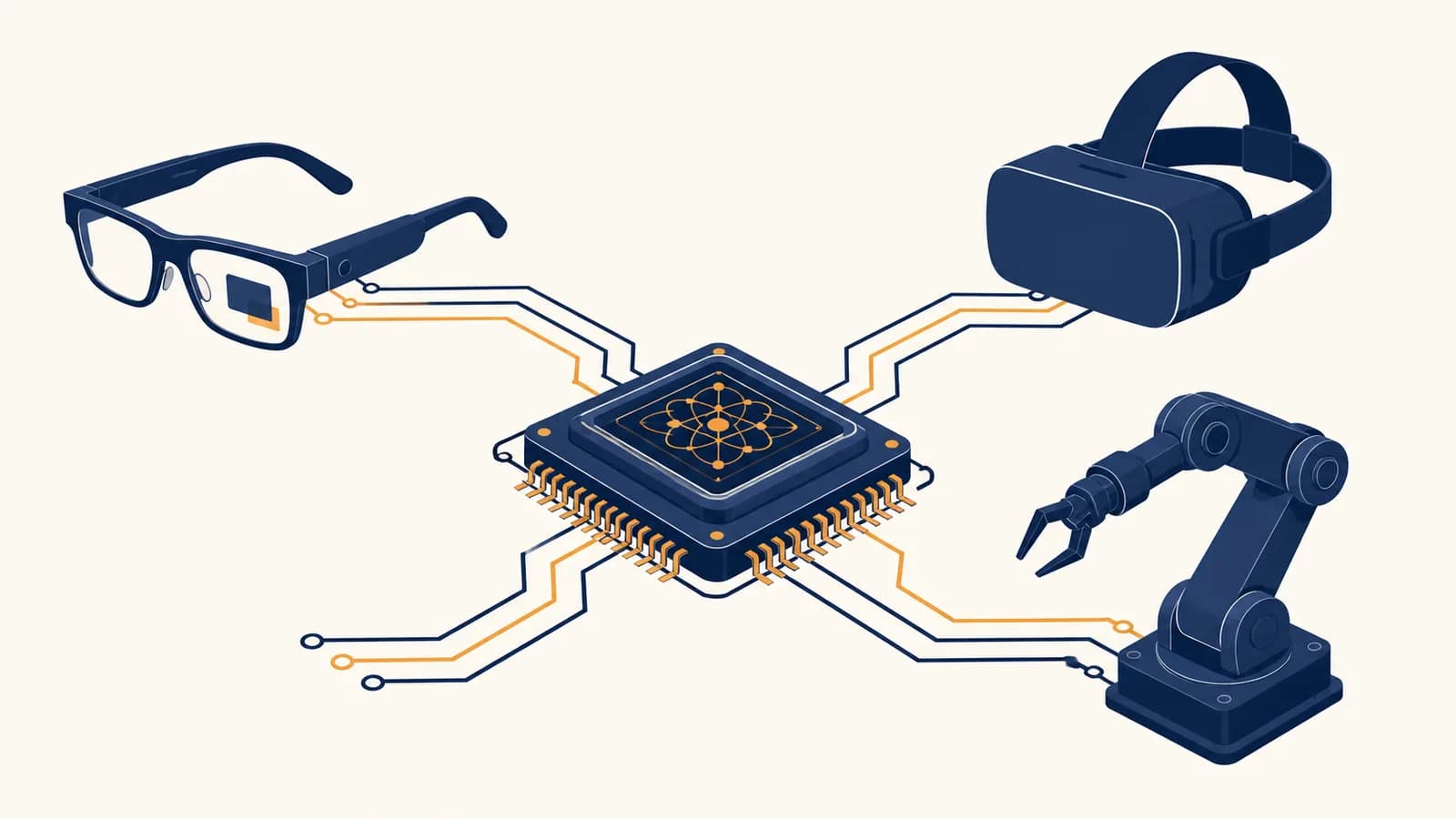
Emerging technology is a category of computing systems that turns new scientific capabilities into practical tools, in the context of computer science. Quantum computing, augmented reality, virtual reality, and robotics are major emerging technologies because they change how computers calculate, perceive, display information, and act in the physical world. People searching for future technology often also mean artificial intelligence, spatial computing, brain computer interfaces, and new kinds of hardware. These ideas exist to solve tasks that ordinary screens, processors, and software cannot handle well, or cannot handle at all.
What emerging technology actually is
Emerging technology is a working capability whose uses, costs, rules, and technical limits are still being discovered. It may already be sold or deployed, but engineers have not yet settled its dominant design, and society has not settled how it should be governed.
The word emerging describes a stage, not a promise. A robot arm on a car assembly line is established technology. A general purpose robot learning a household task from a demonstration is emerging. A flat phone display is established. Glasses that place stable, interactive graphics on a moving view of a room are still emerging.
A familiar technical design gains a faster chip, a different case, or another feature. The market changes, but the underlying computing model stays much the same.
A scientific or engineering change creates a new capability, such as coherent quantum operations, persistent spatial overlays, or machines that can sense and manipulate varied objects.
A useful test asks four questions. What can the system do that was previously impractical? Which scientific principle makes that possible? What prevents reliable large scale use? Who carries the risk if it fails? These questions separate a technical shift from a fashionable label.
Technologies also mature at different rates. A laboratory result proves possibility. A prototype proves that parts can work together. A product must survive heat, dust, poor connections, mistakes, repairs, and a price customers will pay. Deployment then reveals social problems that a laboratory cannot reproduce, such as surveillance, unequal access, or unclear responsibility.
What quantum computing actually is
Quantum computing is a method of computation that represents and transforms information with quantum systems called qubits. Its algorithms control amplitudes and interference so that measurement is more likely to return a useful answer to a carefully chosen problem.
An ordinary bit is read as 0 or 1. A qubit can be prepared in a quantum state described by amplitudes for 0 and 1. For one qubit, a simplified state is:
If and , repeated preparations and measurements produce 0 about one quarter of the time and 1 about three quarters of the time.
This does not mean a quantum computer simply tries every answer and reads them all. Measurement returns a limited classical result. The algorithm must arrange interference so that paths leading toward useful results reinforce one another while other paths tend to cancel.
Superposition stores amplitudes, not a list of readable answers
Superposition is a quantum state that combines basis possibilities through complex amplitudes. With two qubits, the basis states are 00, 01, 10, and 11. The state can assign an amplitude to each, but one measurement cannot print all four amplitudes.
Entanglement connects outcomes in a joint state
Entanglement is a relationship that cannot be described by giving each qubit a separate independent state. Two measured results can be correlated even though neither result was fixed in advance in the simple classical sense. Algorithms use these joint states as computational structure.
Interference changes which answers can appear
Quantum gates rotate and combine amplitudes. Because amplitudes have phase, they can add or cancel before measurement. A successful algorithm is a sequence of gates designed around that behavior. Quantum speedups are therefore problem specific, not an automatic property of every program.
A qubit is not a faster bit. Reading email, sorting a small list, and running a web page do not become magically faster when moved to quantum hardware. A quantum advantage requires an algorithm whose structure fits quantum operations.
Present machines also face noise. Qubits interact with their environment, gates introduce errors, and measurement is imperfect. Quantum error correction spreads one protected logical qubit across many physical qubits and repeatedly checks error information without directly copying an unknown quantum state. That overhead is one reason a useful fault tolerant machine is much harder to build than a small demonstration.
How a quantum program works
A quantum program prepares qubits, applies a planned circuit of quantum gates, measures the qubits, and repeats the circuit many times. A classical computer collects the outcomes and estimates a distribution that the programmer interprets as the answer.
Map the useful variables into qubits, gates, or an energy function. Poor encoding can erase any theoretical advantage through excessive setup work.
Reset the qubits, usually to a basis state such as all zeros, then use gates to create the required superposition and entanglement.
Apply the algorithm's gate sequence. Hardware control signals cause physical changes in superconducting circuits, trapped ions, photons, or another qubit platform.
Each run returns classical bits. Repetition estimates outcome frequencies and helps distinguish a signal from device noise and natural sampling variation.
Classical code aggregates measurements, tests candidate answers where possible, and reports uncertainty rather than treating one run as certain.
Consider a simple sampling example. Suppose a circuit produces the bit string 00 on 48 runs, 01 on 3, 10 on 1, and 11 on 48, for 100 runs total. The visible result is a distribution with 96 percent of observations split between 00 and 11. That pattern could be evidence of intended correlation, but a responsible experiment also runs calibration circuits and compares results with a model of noise.
Quantum computers are often proposed for simulating quantum chemistry and materials, certain optimization methods, and specialized algebraic tasks. A proposal is not the same as a practical advantage. Total runtime includes data loading, circuit repetitions, error handling, and verification. Engineers compare that full cost with the best classical method, not with a deliberately weak competitor.
What AR and VR actually are
Augmented reality adds computer generated content to a view of the physical environment, while virtual reality replaces most of that view with a generated scene. Both are forms of spatial computing because software must track position, orientation, scale, and time.
AR can appear through a phone camera or a see through headset. A label that stays attached to a real machine part is AR. VR typically uses an opaque headset, displays a separate image to each eye, and updates the scene as the head moves. Mixed reality is often used for AR systems in which digital objects understand surfaces, hide behind real objects, or respond to the room.
| System | What the user sees | Main tracking need | Typical use |
|---|---|---|---|
| AR | The physical environment plus an overlay | Align content with the camera and world | Repair guidance, navigation, product preview |
| VR | A mostly generated environment | Render the virtual camera from body motion | Simulation, training, games, design review |
| 360 degree video | Recorded imagery in every viewing direction | Follow head rotation, often without movement through space | Recorded tours and events |
The distinction matters to designers. AR must compete with sunlight, clutter, moving people, and uncertain surfaces. VR controls the scene but must keep the user's balance, hands, and physical safety in mind. A floating button can look convincing yet remain difficult to select if the system does not know exactly where the hand and eyes are.
How spatial computing keeps graphics attached to the world
Spatial computing combines cameras, motion sensors, tracking algorithms, a three dimensional scene model, and low latency rendering. It repeatedly estimates the device's pose, places digital objects in a shared coordinate system, and draws a corrected image for the current viewpoint.
Tracking often combines an inertial measurement unit with camera images. Gyroscopes detect rotation quickly but accumulate drift. Cameras can recognize how visual features move between frames, but they can struggle with blank walls, darkness, reflections, or repeated patterns. Sensor fusion uses each source to correct weaknesses in the other.
Pose tells the renderer where the viewer is
Pose is an object's position and orientation in a coordinate system. A headset estimates six degrees of freedom: movement along three axes and rotation around three axes. The renderer then computes what each eye should see from its slightly different viewpoint.
Mapping gives digital objects a stable address
Simultaneous localization and mapping, usually shortened to SLAM, estimates the device's location while building a map of surrounding features. If the estimate jumps, a virtual mug appears to slide across the real table. Stable AR depends on reducing that error over time.
Rendering must keep pace with motion
Motion to photon latency is the delay between physical movement and the updated image reaching the eye. Delayed or inconsistent updates break alignment and can contribute to discomfort. Systems predict near future head pose, simplify scenes, and render selected regions at different detail levels to meet a tight frame budget.
A technician looks at a pump through AR glasses. The system recognizes a marker, loads the correct service record, and anchors an arrow to a valve. If tracking uncertainty grows, the safe interface removes the arrow or asks for confirmation. A confident but misplaced instruction could direct the technician to the wrong part.
Spatial interfaces are also an interaction design problem. A hand may block a camera. Voice commands may fail in a loud factory. Eye tracking can reveal intent but also collect sensitive behavioral data. The design principles behind usable controls connect directly to making software fit human attention and action.
What robotics actually is
Robotics is the field that builds programmable machines able to sense an environment, compute an action, and produce physical change. A robot joins software to sensors and actuators, so a coding error can become motion, force, heat, or damage.
Not every automatic machine is a robot in the useful engineering sense. A basic toaster follows a fixed local control rule. A warehouse mobile robot estimates its location, detects obstacles, plans a route, and controls motors while conditions change. Autonomy comes in degrees. Some machines repeat a taught path, some accept goals, and some share control with a human.
These parts form a feedback loop. A wheel encoder reports rotation. The controller compares measured speed with target speed. It changes motor power, measures again, and corrects the remaining error. Feedback lets a robot respond to slopes, friction, battery voltage, and loads that an open loop command would miss.
If the target speed is 2 m/s, measured speed is 1.5 m/s, and , the controller produces control units.
A real controller may also respond to accumulated error and the rate of change, forming a PID controller. More advanced robots use model predictive control, sampling based planning, learned policies, or combinations of methods. The choice depends on timing, uncertainty, available computing power, and how dangerous a bad action would be.
How a robot turns a goal into motion
A robot converts a goal into motion by estimating its current state, planning a feasible action, commanding actuators, measuring the result, and correcting error. This loop runs repeatedly, with safety checks able to limit or stop motion.
Imagine a mobile robot asked to carry a bin across a warehouse. The phrase “go to packing station 4” is not a motor command. The machine must locate itself on a map, identify free space, choose a route, translate that route into wheel speeds, and revise the plan when a person steps into the aisle.
Combine sensor readings to estimate position, velocity, joint angles, battery condition, and nearby obstacles. The estimate includes uncertainty because sensors never reveal the world perfectly.
Search for a route or sequence of joint configurations that approaches the goal without crossing walls, exceeding motor limits, or entering restricted zones.
Convert the desired path into voltages, currents, valve positions, or other low level commands. Feedback corrects the difference between requested and measured motion.
Watch for a blocked path, slipping object, overheating motor, lost localization, or human entry. Stop, slow down, or request help according to the safety design.
Machine learning can improve perception and let robots acquire some behaviors from examples or rewards. It does not remove the rest of the stack. A learned vision model still feeds a planner or policy, and the output still reaches motors through control electronics. Engineers add limits around learned components because unusual lighting, objects, and human behavior can produce inputs absent from training data.
Robots show up in manufacturing, logistics, surgery, agriculture, scientific instruments, inspection, and disaster response. Each setting changes the acceptable failure. Dropping a practice block in a laboratory wastes a run. Misidentifying tissue during a medical procedure carries a far greater cost. Testing and human oversight must match the consequence.
Quantum computers versus classical computers
Quantum and classical computers process information through different physical models, but they usually work together. Classical machines manage input, control hardware, and verify results; quantum processors are proposed as specialized accelerators for algorithms that can exploit interference and entanglement.
A classical computer can simulate a small quantum system, but the general state description grows quickly with the number of qubits. Conversely, a quantum computer does not replace databases, operating systems, or ordinary arithmetic. Even a future fault tolerant system would sit inside a larger classical service.
Uses bits, logic gates, memory, and mature error control. It handles general software efficiently and offers predictable access to stored values.
Uses controlled quantum states and probabilistic measurement. Its possible advantage depends on the algorithm, noise level, error correction cost, and complete workload.
This specialized accelerator pattern already appears elsewhere. Graphics processors speed up parallel numerical operations but do not replace the computer that loads files and schedules programs. Emerging hardware often succeeds by joining an existing system, not by sweeping it away.
AR versus VR versus ordinary screens
AR preserves a view of the physical environment, VR substitutes a generated environment, and an ordinary screen keeps content inside a fixed rectangle. The best choice depends on whether the task needs physical context, controlled simulation, or simple access to information.
A maintenance overlay benefits from AR because the machine itself remains visible. Emergency training may benefit from VR because the system can reproduce hazardous events without creating the hazard. A timetable usually belongs on a phone or monitor because head tracking and three dimensional placement add cost without improving the task.
- Choose AR when information must align with real locations, tools, or objects.
- Choose VR when controlling the environment, scale, viewpoint, and repeatability improves practice or analysis.
- Choose a screen when text entry, reading, accessibility, price, battery life, or social comfort matters more than spatial presence.
How emerging technology shows up in work and daily decisions
Emerging technology appears as a tool inside a larger job, service, or purchasing decision. People meet it through simulation, assisted work, automated movement, security planning, and product claims, usually without needing to build the underlying hardware themselves.
A chemist may submit a small molecular experiment to a remote quantum processor while doing most analysis classically. An architect can walk through a building model in VR before construction. A field worker may receive AR instructions while keeping both hands available. A farmer may use a robot that follows crop rows and targets individual plants.
A school considers VR headsets for science lessons. The useful questions are not “Is VR futuristic?” They are: Does spatial interaction teach something a video cannot? Can every student use the device safely? Where are recordings and movement data stored? Who cleans, repairs, updates, and supports the hardware?
Those questions expose total system cost. A device requires software, charging, accounts, network access, physical space, training, maintenance, and a plan for replacement. If biometric or environmental data leave the device, policy matters too. The broader issue is explained in how technology changes control over personal data.
Jobs around these systems include electrical and mechanical engineering, device physics, computer vision, graphics programming, embedded software, control engineering, safety testing, industrial design, technical art, operations, and law. Few real products are made by one type of specialist. A headset needs optics and rendering. A robot needs mechanics and code. A quantum service needs physics, cryogenic or optical hardware, control systems, compilers, and error analysis.
News claims deserve the same system level check. Ask what was demonstrated, under which conditions, against which baseline, and with what failure rate. A robot video may show a selected successful run. A quantum result may solve a narrow benchmark with little commercial use. An AR demonstration may rely on a prepared room. None is automatically deceptive, but each has a boundary that the headline may omit.
What brain computer interfaces and smart materials actually are
Brain computer interfaces translate measured neural activity into computer commands or stimulation, while smart materials change properties in response to heat, voltage, light, stress, or another input. Both extend computing beyond keyboards, screens, and conventional rigid machines.
A brain computer interface begins with signals measured by electrodes or another sensor. Software filters noise, extracts features, and classifies an intended action or estimates a continuous value. An application then moves a cursor, selects a symbol, controls an assistive device, or provides feedback. Invasive sensors can be closer to neural activity but require medical procedures. Noninvasive sensors avoid surgery but receive weaker, mixed signals through tissue.
A decoder does not read a complete private thought like text from a file. It is trained for measurable patterns, specific tasks, and particular conditions. Performance can change as sensors move, attention shifts, or the body changes. Medical uses also require careful evidence, consent, security, and a plan for long term device support.
Smart materials can give machines softer and more adaptive bodies. Shape memory alloys can change shape with temperature. Electroactive materials deform under an electric field. Engineers combine such materials with sensing and control to make soft grippers, wearable devices, and small actuators. The material supplies behavior, while computation decides when and how to use it.
How emerging technology becomes established
The next successful technology is rarely identified by novelty alone. Strong candidates connect a real task to a repeatable capability, improve under realistic constraints, fit existing systems, and earn enough trust that people can adopt them without accepting hidden or unmanageable risks.
Start with a testable capability claim. “This robot sorts mixed objects” is better than “This robot understands warehouses.” Identify the operating conditions, then ask what happens outside them and whether failure is visible.
- Mechanism: What input is measured, what computation occurs, and what output changes?
- Baseline: What existing tool performs the same task, and how is the comparison measured?
- Scaling: What becomes harder with more users, qubits, robots, rooms, or data?
- Dependencies: Which networks, materials, suppliers, standards, and trained workers are required?
- Failure: Can the system detect uncertainty, stop safely, and recover?
- Governance: Who gives consent, receives benefits, pays costs, and answers for harm?
What should you learn before building emerging technology?
Start with programming, data structures, probability, linear algebra, computer architecture, and careful testing. Then add the domain science your project needs, such as quantum mechanics, geometry and graphics, electronics and control, or signal processing and neuroscience.
The foundations show up directly. Linear algebra describes quantum states, three dimensional transformations, robot kinematics, and signal models. Probability helps interpret noisy sensors and repeated quantum measurements. Algorithms determine search and planning costs. Operating systems and networks determine how a prototype becomes a dependable service.
Keep a test log. Record the input, conditions, expected result, observed result, and failure. Change one factor at a time. This habit matters more than using fashionable hardware because it turns an impressive effect into evidence that another person can inspect.
One person can experiment with simulators, development kits, public software libraries, and remote hardware access, but safe scope matters. Start with low energy, nonmedical, noncritical projects and treat claims from a simulation as different from results on physical hardware.
Command a small simulated robot to travel one metre. Record the final position across repeated runs with varied wheel slip. Add feedback, repeat the trials, and compare the spread of errors. The project teaches control, uncertainty, testing, and honest reporting without putting a physical machine near people.
Do not improvise projects involving mains electricity, powerful lasers, high pressure systems, strong actuators, implants, or medical interpretation. Use trained supervision and applicable safety rules. A project becomes more educational, not less, when its boundaries are explicit.
What risks and costs follow emerging systems?
Emerging systems create risk when uncertain software meets sensitive data, physical force, unequal power, or hard to reverse decisions. Safety therefore includes technical reliability, security, privacy, accessibility, labor effects, environmental cost, and clear responsibility for failure.
Risk controls should match the mechanism. A moving robot needs physical limits, guarded zones, emergency stops, fault detection, and tested recovery procedures. A headset needs local processing where practical, visible recording signals, limited retention, and access controls. A high consequence model needs monitoring and a human process for appeal or shutdown.
Ask who can stop the system. A safe design identifies the person or automatic condition that can pause motion, reject a result, disconnect a sensor, revoke access, or return to a known state.
The meaningful cost is the full cost of ownership, not the device price. It includes integration, software, training, facilities, energy, maintenance, security updates, downtime, data handling, specialist labor, and safe disposal or replacement. Cost is a risk when it causes maintenance or safety work to be skipped.
Quantum hardware may require extreme environmental control and specialized operation, so many users access it through cloud services. VR equipment needs usable floor space, device management, cleaning, support, and replacement parts. Robots require fixtures, guarding, programming, calibration, spare components, and changes to workflow.
A simple comparison can make hidden costs visible. If a robot saves 20 worker hours each week but requires 8 hours of supervision, 4 hours of maintenance, and 3 hours of data correction, its net time saving is 5 hours before downtime and training are counted. The arithmetic does not settle the decision, but it prevents the gross saving from being presented as the net benefit.
Which emerging technology will replace phones?
No current technology has established itself as a complete phone replacement. Headsets, voice systems, wearables, and neural interfaces each remove some phone interactions, but a replacement must also match the phone's portability, privacy options, battery life, social acceptance, and broad software support.
Replacement is usually the wrong model. Cameras did not eliminate text, and phones did not eliminate laptops. Devices divide work according to context. Glasses may handle navigation while a phone performs private typing. A watch may confirm a notification while a larger screen handles editing. The surrounding network and software account may matter more than which object is in the hand.
Five mistakes people make with emerging technology
The most common mistakes are treating a prototype as a product, confusing prediction with understanding, ignoring the surrounding system, hiding uncertainty, and assuming newer means better. Each mistake replaces an observable test with a story about the technology.
1. Calling a selected demonstration general intelligence
A demonstration shows performance under its recorded conditions. It may use a prepared environment, known objects, edited attempts, remote assistance, or a narrow task definition. Ask for the boundary conditions and failure cases before generalizing.
2. Treating confidence as correctness
A polished overlay, smooth robot motion, or precise numerical output can still be wrong. Interfaces should expose tracking quality, sensor uncertainty, and verification status where those facts affect a decision.
3. Comparing with a weak baseline
A new method earns attention by beating the best practical alternative on a relevant measure. A quantum algorithm should include setup and sampling costs. A robot should be compared with both manual work and simpler automation.
4. Forgetting the data trail
Spatial maps, voice recordings, gaze, workplace movements, and biological signals can reveal more than the immediate feature needs. Collecting less data, processing it locally, and setting deletion rules reduce exposure. Similar design questions appear in how distributed systems establish trust without a central middleman, where permanent records can conflict with later privacy needs.
5. Automating before defining responsibility
If a system fails, someone must recognize the failure and have authority to respond. “The algorithm decided” is not an accountability structure. Deployment needs named owners, escalation paths, logs, maintenance schedules, and a safe manual alternative.
Emerging technology makes computer science physical
Emerging technology shows that computer science is the design of representations, algorithms, interfaces, and controls that operate under real constraints. The next step is to trace one system all the way from sensor or input to computation, action, failure, and responsibility.
Choose a device around you and draw its pipeline. For AR, follow light into a camera, features into a pose estimate, coordinates into a renderer, and pixels to the display. For a robot, follow a goal through planning and motor control, then send sensor measurements back through the loop. For quantum computing, follow classical input into circuit preparation, gates, repeated measurement, and verification.
Then mark every assumption. What must stay calibrated? Which data can be wrong? How does the system report uncertainty? Who can interrupt it? This turns “future technology” into a set of mechanisms that can be tested and improved. It also shows how these ideas connect across the wider computer science curriculum, including algorithms, hardware, networking, security, and human centered design.
The takeaway: Judge an emerging technology by the complete loop it creates: what it senses or represents, how it computes, what it changes, how it fails, and who remains responsible. Build one small loop, measure it honestly, and you have started doing the work.