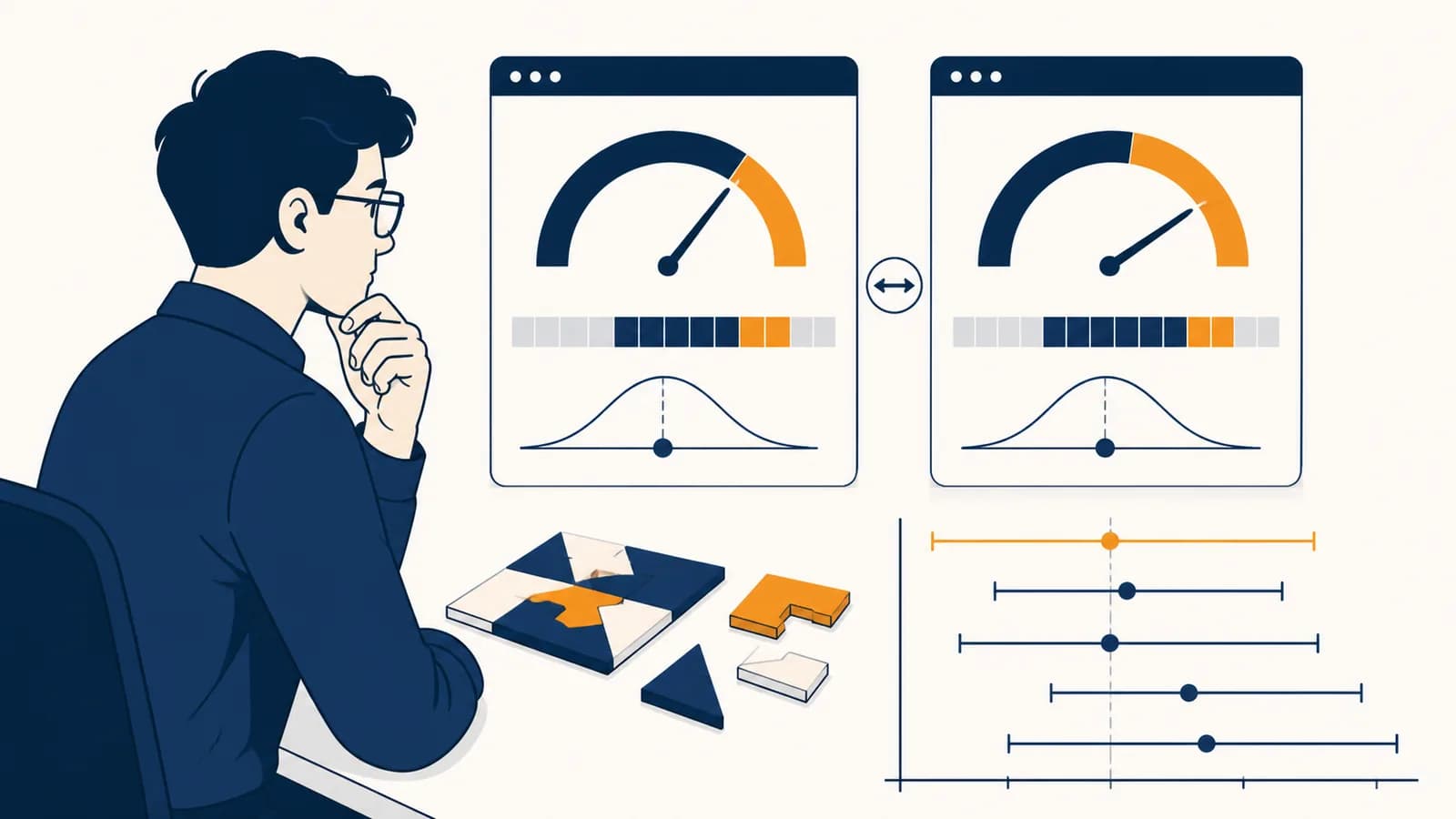
Most online IQ tests provide estimates, not dependable measurements
Most online IQ tests are not accurate enough to support a diagnosis, school placement, job decision, or fixed claim about intelligence. A careful test can give a rough indication of performance on certain reasoning tasks, but its score depends on the questions, comparison group, testing conditions, and scoring method.
An IQ score is meaningful only in relation to a particular test and a suitable group of people who took that test under standardized conditions. The number does not come directly from the count of correct answers. Test makers compare a raw score with results from a reference sample, usually separated by age, and place it on a scale.
Accuracy belongs to an interpretation. The professional Standards for Educational and Psychological Testing define validity in terms of evidence supporting a score interpretation for a proposed use. A quiz may be useful practice and still be unsuitable for a clinical decision.
This distinction explains why two websites can show different IQ scores after similar performances. They may use different items, time limits, reference samples, age adjustments, or conversion tables. One site may even turn a percentage correct into an “IQ” without a defensible norming study. Knowing what to inspect lets you separate a serious estimate from an entertainment score.
What does an IQ score actually measure?
An IQ score summarizes performance on a selected set of cognitive tasks compared with the performance of an age-based reference group. Depending on the test, those tasks may sample verbal reasoning, visual pattern solving, working memory, processing speed, or several of these abilities together.
Modern IQ scores are standardized scores. On a commonly used scale, the reference group has a mean of 100 and a standard deviation of 15. A score of 115 is therefore one standard deviation above that group’s mean. The scale describes relative performance; it is not a count of intelligence units inside a brain.
The conversion can be written with a standard score, usually called a z-score. If someone’s raw performance is 1.2 standard deviations above the reference mean, the common IQ scale converts it to 118.
Worked example: if , then .
This arithmetic is simple, but getting a trustworthy z-score is difficult. The test needs enough suitable questions and an appropriate reference sample. The sample must cover the people for whom the test is intended. Age matters because expected performance changes during development, and language or disability can affect access to a task without being the ability the task is meant to measure.
IQ also does not cover every useful human capacity. A battery may estimate certain kinds of reasoning well while saying little about persistence, practical knowledge, creativity, judgment, social understanding, or acquired expertise. It is better to read an IQ score as a summary of sampled test performance than as a complete ranking of a person.
Why can an online score look more precise than it is?
An online score can look exact because software returns a single number instantly, but the calculation may hide uncertainty at every stage. Random variation in item selection, attention, timing, device input, and the scoring model means that repeated measurements need not produce the same result.
Each arrow needs evidence. The answer key must reward the intended reasoning. The raw score must combine items sensibly. The norm comparison must use a relevant sample. The final scale must be reported honestly. A polished result screen proves none of these things. Learning how percentages turn counts into comparisons helps reveal why “80 percent correct” is not automatically an IQ of 120.
Testing specialists call consistency across repeated measurements reliability or precision. A test can lose reliability if it is very short, if many questions are nearly identical, or if small distractions alter performance. A reliable test is not automatically valid: a bathroom scale can consistently report the wrong weight, and a reasoning quiz can consistently measure a narrow skill that does not support the interpretation printed beside the result.
“Your IQ is 127” presents one exact value, as though the test located a fixed quantity with no uncertainty.
A score is an estimate from one sample of behavior. A defensible report gives a confidence interval and explains the test, reference group, conditions, and intended use.
The standard error of measurement shows how reliability affects uncertainty. Suppose a hypothetical IQ scale has a standard deviation of 15 and a reliability coefficient of 0.84. The calculation below gives a standard error of 6 points. This is an illustration, not a claim about any particular online test.
Worked example: . An approximate 95% interval around 118 is , or 106 to 130.
The interval is wide because measurement is imperfect. It does not say the person’s “true IQ” moves randomly through that entire range each day. It says the observed score has limited precision under the assumptions of the model. A professional report may calculate intervals differently, so its published interval should take priority over a shortcut.
What separates a sound test from an entertainment quiz?
A sound test states what it measures, who it was designed for, how it was standardized, how precise its scores are, and what evidence supports each intended use. An entertainment quiz usually supplies puzzles and a number but gives little technical information that could be checked independently.
Strong evidence does not require a paper booklet or a psychologist sitting in the room. A well-designed digital assessment can administer items consistently, control timing, select questions adaptively, and score responses accurately. The medium is not the main issue. The evidence and administration are.
- A defined construct: The developer explains which abilities the test samples and which conclusions the score supports.
- Relevant norms: The comparison group is large enough and matches the intended users in age and other relevant characteristics.
- Reliability evidence: The developer reports how consistent scores are across suitable replications, item sets, or testing occasions.
- Validity evidence: Studies test the proposed interpretation, including relationships with other measures and possible alternative explanations.
- Fair administration: Instructions, time limits, devices, accessibility arrangements, and scoring rules are controlled or accounted for.
- Uncertainty: Results include a confidence interval or another honest account of measurement precision.
Adaptive testing illustrates why hidden technical details matter. An adaptive system chooses a later question based on earlier answers. That can reduce wasted items, but the item bank and selection rules must work together. The route through a question bank affects which evidence reaches the scoring model.
A serious publisher should also explain score limits. If a quiz contains only easy items, it cannot distinguish reliably among people who answer nearly all of them correctly. This is a ceiling effect. A test made only of very difficult items creates the matching floor problem. An impressive extreme score may therefore be the least supported score on the page.
How do practice, cheating, and testing conditions change results?
Practice and testing conditions can change an online result because the score records performance during one administration, not ability in isolation. Familiar puzzles, leaked answers, interruptions, translation, fatigue, screen size, and timekeeping can all alter responses without representing the intended cognitive differences.
Many online quizzes reuse familiar matrix patterns, number sequences, and visual analogies. After enough exposure, a person learns common transformations such as rotation, alternation, addition, and subtraction of shapes. Improvement then mixes reasoning with specific puzzle knowledge. This is one reason secure professional tests protect their items.
Maya takes the same 20-item quiz on Monday and Saturday. Before the second attempt, she searches for explanations of missed item types. Her score rises. The new result shows better performance on that quiz, but it cannot separate general reasoning from memory, strategy learning, and repeated exposure.
Unsupervised testing adds identity and environment problems. A website may not know who completed the items, who offered help, which calculator or search tool was used, or whether a timer kept running during a connection failure. These details matter if the score is being used for entry, diagnosis, or selection. They matter much less if someone is solving puzzles for fun.
Language can also change the task. A verbal analogy may partly measure vocabulary learned at home or school. A translated question can become easier or harder if a word has no exact equivalent. Nonverbal tests reduce some language demands, but they do not become culture-free. Instructions, symbols, schooling, and experience with abstract diagrams still shape access.
Device design belongs in those conditions. A small phone screen can make a detailed matrix harder to inspect. A touch interface can produce accidental answers. Even accurate code only carries out the rules it receives, much as software interfaces pass structured requests and responses without judging whether the surrounding measurement is sensible.
Can two accurate IQ tests give different scores?
Two well-made IQ tests can give different scores because they sample different abilities, use different norm groups, and contain measurement error. The results should often be reasonably consistent, but they are not interchangeable labels, especially when a person has an uneven pattern of cognitive strengths.
Imagine one battery gives substantial weight to vocabulary and working memory, while another relies mostly on visual patterns. A bilingual test taker with strong spatial reasoning may show a different profile across them. Neither result has to be fraudulent. The tests may be asking related but distinct questions.
Scale names can mislead too. Some tests report percentiles, some report standard scores, and some use several index scores rather than one full-scale number. Mensa International notes that tests can use different numerical scales and bases qualification on performance at or above the 98th percentile on an approved test, not on one universal IQ number. It also states that its online IQ Challenge is practice and does not qualify a person for membership.
A percentile is a position in a comparison group, not a percentage of questions answered correctly. The 75th percentile means a score is at or above the scores of roughly 75 percent of that reference group. Reasoning about relative quantities and proportional comparisons makes the distinction easier to see.
Do not average scores from unrelated websites. A mean of 110 and 130 is arithmetically 120, but that average has no clear meaning if the sites used different tasks, scales, age rules, or comparison samples.
Disagreement becomes informative when a qualified examiner can inspect subtest patterns and the circumstances of testing. A single composite may hide a strong verbal score beside a weaker processing-speed score. Clinical interpretation uses the pattern, history, observations, and reason for referral. It does not treat the largest number as the final answer.
When is an online IQ test useful?
An online IQ test is useful when its purpose matches its evidence. It can offer puzzle practice, explain common reasoning formats, or provide a tentative estimate if the publisher documents sound norms and precision. It should not carry more weight than its design and administration support.
Purpose sets the required standard. A free quiz used for an enjoyable ten-minute challenge causes little harm if it labels itself honestly. A score used to decide special educational support, investigate cognitive change, document a disability, or make a legal claim needs far stronger evidence and controlled administration.
Practising unfamiliar puzzles, observing which item types feel easy or hard, or deciding if a formal assessment is worth discussing.
Diagnosing a condition, proving intellectual superiority, predicting a whole career, or making a high-stakes decision from an undocumented score.
Intelligence testing also sits inside the larger study of measurement and evidence. Probability explains uncertainty, statistics connects a score to a reference sample, and graphs expose distributions that a single number conceals. The mathematical foundations behind comparison and uncertainty are useful far beyond IQ tests, including medical screening, polling, and school assessment.
If the result raises a genuine concern about learning, memory, development, or a change after illness or injury, an online quiz is the wrong endpoint. A qualified psychologist can choose an age-appropriate instrument, provide necessary accommodations, observe how tasks are approached, and combine scores with relevant history. The assessment question should guide the test, not the other way around.
How can you check an online IQ test before trusting it?
Check the publisher’s claims, technical evidence, norms, administration, and result report before trusting an online IQ score. If you cannot learn who built the test, which population supplied the comparison data, or how uncertainty is reported, treat the number as entertainment rather than measurement.
Look for a precise statement such as practice, screening, research, or professional assessment. Be wary when one score is advertised as suitable for every purpose.
A named instrument, edition, developer, and contact point make the claim inspectable. A generic “certified IQ test” label does not.
Check how the sample was recruited, its age range, when data were collected, and whether the norms apply to you. Self-selected website visitors are not automatically a suitable population sample.
Technical terms should come with methods and results. A badge, testimonial, or unexplained claim of scientific accuracy is not evidence.
A responsible report identifies the scale, gives uncertainty, describes limits, and avoids turning one score into claims about personality, future wealth, or human value.
Enjoy a low-stakes quiz as a quiz. For a decision that affects education, treatment, work, or law, seek an appropriately qualified professional and a test accepted for that purpose.
Commercial behavior offers extra clues. A site that withholds the number until payment has still measured whatever it measured, but pressure tactics make its incentives relevant. Watch for countdown timers, guaranteed genius labels, fake scarcity, and certificates that imply official standing without naming an authority. None of these proves the score is wrong, but none supplies measurement evidence either.
Privacy deserves the same inspection. Cognitive responses, age, school history, and contact details can be sensitive. Read what the service stores, why it stores it, whether it shares data, and how deletion works. An accurate score would not excuse careless data handling.
A trustworthy score comes with limits
The best answer to “Are online IQ tests accurate?” is conditional. Some digital tests can measure selected cognitive abilities with useful precision, but most public quizzes do not reveal enough evidence to justify an exact IQ claim. Online delivery alone neither validates nor invalidates a test.
Judge the chain behind the number: suitable tasks, controlled administration, relevant norms, reliable scoring, validity evidence, and an honest report of uncertainty. Missing links weaken the interpretation. The greater the consequence of using the score, the stronger every link must be.
The takeaway: Treat an undocumented online IQ score as puzzle feedback. Treat a documented score as an estimate with a range. Use a professionally administered, purpose-appropriate assessment when the result could change a serious decision.
An IQ result can describe part of a person’s performance at a particular time. It cannot measure dignity, effort, curiosity, or every ability that matters in school and life. The most intelligent response to an impressive number is to ask how it was produced, what it supports, and where its limits begin.