An AI ops layer should come before client number two
An AI ops layer is a small operating system for freelance work: standard inputs, repeatable workflows, checked AI assistance, and records that make every job easier to run. Build it before adding a second client, and you can handle more work without relying on memory, scattered chats, or late-night recovery. By the end, you will know what belongs in a freelancer AI workflow, what should stay human, and how to test the system with work you already have.
The word ops means operations. It covers the unglamorous machinery around the service you sell: collecting a brief, planning tasks, finding source material, producing drafts, checking quality, sending updates, issuing invoices, and learning after delivery. A designer's visible output may be a brand identity. The operations layer is everything that lets the designer produce it on time and explain what happened.
AI belongs in that layer as a set of bounded tools, not as an invisible substitute for judgment. It can turn a call transcript into candidate requirements, compare a draft against a checklist, or prepare a status update from approved notes. The freelancer still decides what is true, useful, safe, and ready to send.
Your first client tests your craft. Your second client tests whether your way of working can survive two sets of deadlines, files, promises, and revisions at once.
This timing matters because client work creates state. State is the information needed to continue correctly: the latest approved scope, the current version, the next action, a promised date, and unresolved questions. With one client, your memory can disguise a weak system. With two, similar filenames, overlapping messages, and competing priorities expose it.
What does an AI ops layer actually contain?
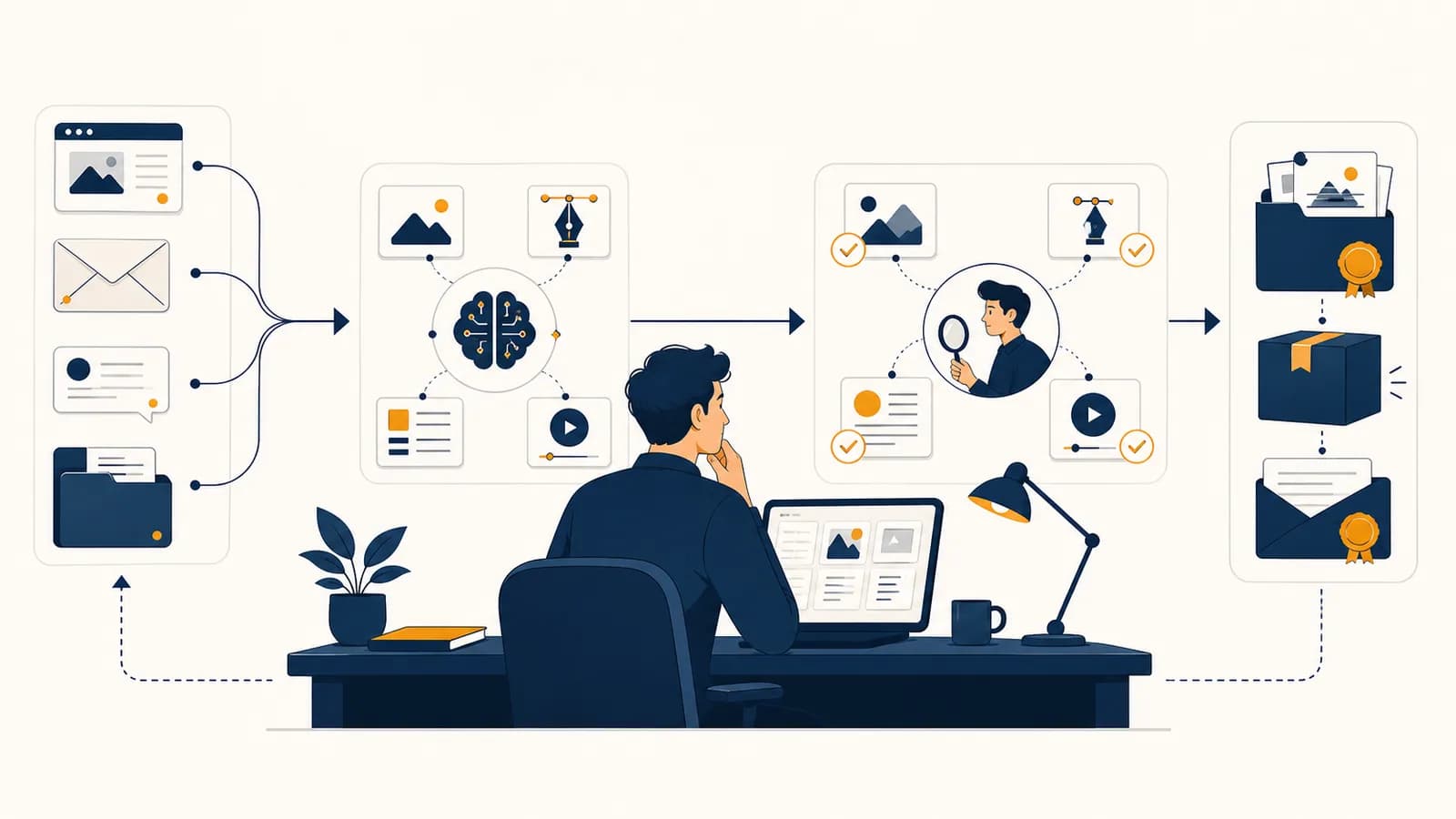
An AI ops layer contains a trusted record for each project, fixed stages for recurring work, reusable instructions for AI, quality checks, and a human approval point before consequential action. It is a workflow with AI inside it, not a collection of clever prompts.
The trusted record can be simple. A folder and a project document are enough if you maintain them. Each client record should show the agreed result, work included, work excluded, deadline, dependencies, decision history, current status, and next action. The tool matters less than the rule that one place is authoritative.
Those quantities are a proposed design, not survey results. One source of truth prevents competing versions. Five states are detailed enough to show progress without creating a management job. Two approval gates separate internal quality control from the client's decision that the contracted result has been delivered.
The stages form a pipeline:
Every arrow is a handoff. Define what must be true before work crosses it. A transcript becomes a structured brief only after names, dates, deliverables, and open questions are checked against the original conversation. A draft becomes a delivery only after factual, contractual, and presentation checks pass.
Why does a second client expose weak operations?
A second client creates coordination costs that grow faster than the visible workload. You now choose between competing tasks, preserve two separate contexts, track two feedback loops, and protect two sets of confidential information. The failure risk comes from switching and ambiguity, not only hours worked.
Imagine that each project has five active facts you must remember. One client gives you five facts. Two clients give you ten, but the work is not simply doubled. You must also decide which client gets attention first, which deadline can move, which asset belongs where, and whether a new request changes either agreement.
This is a basic queue. Tasks arrive at different times, take different amounts of effort, and may depend on client replies. If arrival is faster than completion for long enough, unfinished work accumulates. AI can shorten some service times, but it cannot repair a queue whose priorities and entry rules are undefined.
A freelance video editor receives footage from Client A at 09:00 and a revision request from Client B at 09:15. The editor starts A, switches to B after a message, then discovers B's request needs a missing logo file. Without a visible queue, both projects feel active while neither has a clear next action.
An ops layer converts that confusion into state. Client A is marked ready for rough cut. Client B is marked blocked by client asset, and a prepared request asks for the exact file. The editor can resume A without holding B's situation in working memory.
This is where school mathematics becomes practical. A capacity model can start as a linear relationship between jobs, hours, and available time. Real projects are messier, but even a simple model exposes wishful planning before it becomes a missed deadline.
Which tasks should AI handle, and which stay human?
AI should handle transformations that are repetitive, reversible, and easy to check. Humans should retain decisions involving truth, taste, promises, money, privacy, and professional responsibility. The dividing line is the cost of an undetected error, not how impressive the generated output looks.
Good AI tasks have a clear input and a testable output. Examples include extracting action items from supplied notes, converting a brief into a checklist, grouping feedback by deliverable, finding inconsistent terminology, and drafting a progress summary from project records. Each result can be compared with its source.
“Read this client conversation and run the project.” The instruction hides scope choices, priority rules, permissions, and the definition of done.
“List requested changes, quote the source sentence for each, flag conflicting requests, and leave owners and deadlines blank unless explicitly stated.”
The bounded version limits invention and makes review faster. Its output carries evidence. It also tells the model not to infer details that belong to a human decision. This approach uses ideas from how machines process and generate language: a model predicts plausible text from context, but plausibility is not proof that a client said something.
Keep humans at approval gates. Before sending a proposal, confirm the price, scope, dates, ownership terms, and assumptions. Before delivering creative or technical work, inspect it in the form the client will receive. Before putting confidential material into any service, check the contract, the service settings, and the client's permission.
A useful rule is reversibility. Renaming internal task labels is cheap to undo. Emailing the wrong client, publishing false information, or overwriting an approved file may not be. As consequences rise, require more direct evidence and a more deliberate human check.
How do you calculate whether the system creates capacity?
Measure the minutes removed from repeatable work, then subtract the time spent operating and checking the system. Capacity appears only when the net saving is positive and quality remains acceptable. Generated text is not saved time if correction takes longer than doing the task directly.
Use a small equation rather than a dramatic productivity claim. For one recurring task, multiply the time saved per occurrence by the number of occurrences, then subtract maintenance and review time.
If a manual update takes 20 minutes, an assisted update takes 8 minutes, the task occurs 8 times, review takes 24 minutes total, and system upkeep takes 12 minutes, then minutes.
Here, is the number of occurrences, is manual time per occurrence, is assisted time, is total review time, and is system upkeep. The worked values are invented inputs for visible arithmetic, not a claim about typical freelancers.
Time is only one constraint. Track errors that escape review, work returned for correction, and time spent waiting for missing information. A workflow that saves an hour but causes an avoidable revision has shifted cost rather than removed it. Record both speed and quality for several real repetitions before treating a process as dependable.
Capacity also has a hard boundary. Suppose you have 20 client hours available in a week and each project needs 12 hours. The demand is 24 hours, so the gap is hours. An ops layer must remove at least four hours from that week's work, reduce scope, or change the dates. No prompt can make incompatible quantities agree.
How can you build the first version in one client cycle?
Build the first version around one service you already deliver. Observe the work, record each handoff, choose one repetitive transformation for AI assistance, and add a check before client contact. The result should be small enough to use on the next live job.
List the input you need, the output you deliver, the number of revision rounds, the due date rule, and what counts as acceptance. Copy the agreed version into the project record.
During one project, note each action and wait. Include searching for files, clarifying requests, changing formats, checking output, and asking for approval. Hidden coordination work is still work.
Create an intake form or brief template that asks for the audience, desired result, constraints, source files, decision-maker, deadline, and examples. Allow “unknown” so clients do not invent answers.
Choose a repetitive conversion such as notes into candidate tasks. State the permitted source, required format, forbidden assumptions, and uncertainty rule. Save the instruction beside the workflow.
Use a checklist tied to the contract. Check names, facts, calculations, file versions, requested changes, and delivery format. Record who approved the result and when.
Compare manual and assisted time, note corrections, and remove steps that create more work than they save. Change one variable at a time so you know what caused the result.
Keep the first build deliberately plain. A text template, a task board, and a spreadsheet can expose the logic more clearly than a complicated automation. Software should follow a stable process. If you automate confusion, it moves faster and becomes harder to inspect.
Give files predictable names and keep raw inputs separate from generated work. A pattern such as client_project_deliverable_status_date makes meaning visible without opening the file. Use version history where available, and never let an AI tool write over the only approved copy.
Once the manual workflow holds together, selective automation becomes safer. The same discipline used in moving software from a prototype into reliable production applies here: define behavior, test failure cases, observe real use, and keep a recovery path.
What can go wrong even when the AI output looks good?
Fluent output can hide invented facts, lost constraints, privacy exposure, stale instructions, and confident misclassification. The danger is highest when a result looks finished enough to skip inspection. Good operations make the evidence, limits, and approval status visible beside the output.
Start with source traceability. If AI extracts requirements, keep each requirement linked to the email, transcript line, or signed document that supports it. If it drafts a claim, require a supplied source or mark the claim for research. Do not let generated summaries replace original records.
Next, control access. Client files may contain personal data, trade secrets, unpublished plans, account credentials, or material licensed for limited use. Send only what the task requires. Remove irrelevant sensitive details. Keep clients in separate workspaces, and review the data terms of any tool before uploading their material.
A polished answer is not an audit trail. If you cannot show where a requirement, fact, or approval came from, treat it as unverified.
Watch for prompt drift too. A reusable instruction may refer to an old offer, a former client's tone, or a superseded pricing rule. Store prompts like other working documents, with a purpose, owner, last test, and revision history. Test them against a normal case, a missing-input case, and a conflicting-input case.
Quality review should match the work. Code needs tests, security checks, and human review. Financial calculations need reproducible inputs and arithmetic. Design needs inspection at actual delivery sizes. Written work needs source checks, audience fit, and a search for unsupported claims. The broader computer science foundations behind reliable systems explain why checks, boundaries, and recovery matter beyond programming.
How do you know you are ready for another client?
You are ready when current work has visible state, predictable intake, explicit capacity, tested checks, and a recovery method. Readiness means a new project can enter without making existing promises invisible. It does not mean every task is automated or every hour is booked.
Run a short stress test before accepting the work. Pretend a new client sends an incomplete brief while the current client requests a revision. Can you show what happens next without relying on memory? Can you identify which promise has priority and why? Can you pause one project and resume it from its record?
Use acceptance criteria that can be observed:
- Every active project shows its stage, next action, owner, due date, and blocker.
- Each deliverable has a definition of done tied to the agreement.
- AI-assisted steps identify their source material and required review.
- Your capacity calculation includes production, communication, review, and administration.
- A client can reject or change an AI-assisted result through the normal revision process.
- You can recover the last approved version after a bad edit or tool failure.
Price and workload decisions become clearer when capacity is visible. A second client is not automatically better than deeper work for the first, a narrower offer, or protected learning time. Each option uses scarce hours differently. Consumer economics describes how choices change under budgets and constraints, and the same logic applies to a freelancer allocating time.
A small controlled system beats a large pile of prompts
The useful asset is not a prompt library. It is a controlled path from client input to accepted delivery, with evidence at each consequential step. Prompts can change. Tools can disappear. A clear process survives because you know what each step must receive, produce, and prove.
Begin with the job already on your desk. Create its trusted record, mark its current state, write the next action, and identify one repeated transformation. Give that transformation a bounded AI instruction and a human check. Measure what happens on the next occurrence, then keep, revise, or remove it.
That standard prevents a common mistake: adding AI activity while losing operational clarity. More generated documents, summaries, and task lists can create a second layer of clutter if none is authoritative. Every output needs a destination, a status, an owner, and a rule for deletion or retention.
Your ops layer is ready to grow when it reduces uncertainty for both sides. You know what to do next. The client knows what to provide and when to expect a decision. If a mistake occurs, you can find its source and recover. That is the foundation that lets a second client become additional business instead of additional confusion.
The takeaway: Build one visible, testable operating loop before adding another client. Use AI for bounded transformations, preserve human approval for consequential decisions, and measure saved time only after review and correction.