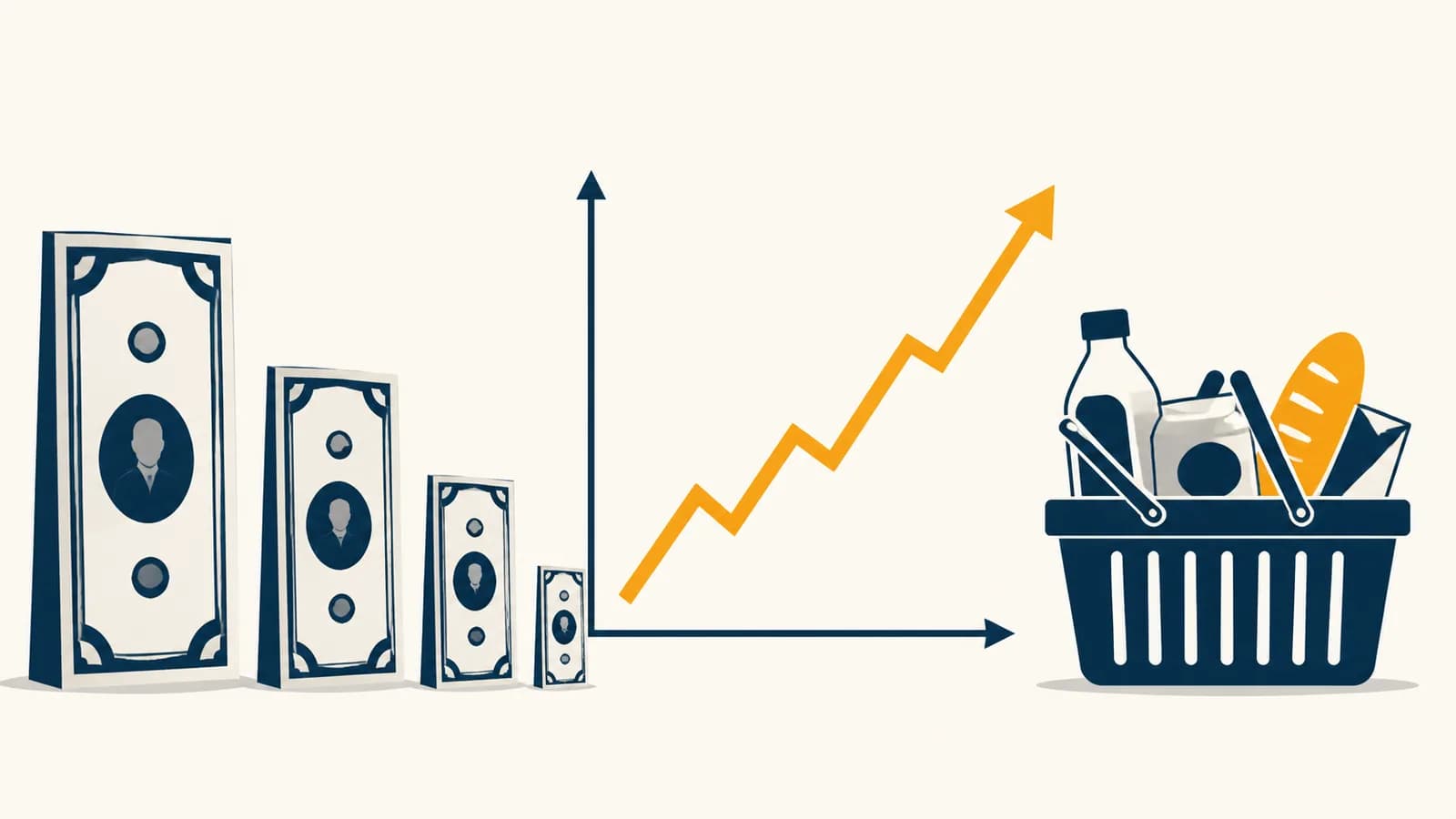
Inflation cuts the value of money you already earned
Inflation acts like a hidden tax on cash because rising prices reduce what each dollar can buy. It is not a legal tax, and no tax bill arrives. The loss appears at the shop, in the rent payment, and in every budget that buys less than before. To understand the math of inflation, track purchasing power rather than the number printed on a bank balance. You can then calculate the real value of savings, wages, and investment returns, and see exactly how much inflation is costing you.
Suppose you keep $1,000 in an account that pays no interest. If the prices of the things you buy rise by 5 percent, the account still displays $1,000. Yet the basket that once cost $1,000 now costs $1,050. Your money has lost part of its command over goods and services. That lost command is the economic burden people mean when they call inflation a hidden tax.
Inflation is not literally a tax. A government tax transfers money under tax law. Inflation reduces the purchasing power of money. The comparison describes the effect on holders of cash and fixed payments, not the legal mechanism.
The distinction matters. A normal tax usually names a rate, a taxable amount, and a recipient. Inflation has none of those features at the checkout. Its effect depends on what you own, what you owe, how your income changes, and what you buy. Two people can face the same national inflation rate and experience very different losses.
What does the inflation rate actually measure?
An inflation rate measures the percentage change in a price index over a stated period. A price index combines many prices into one weighted number, so it describes the movement of a representative basket rather than the price change of every product or household.
In the United States, the Bureau of Labor Statistics defines the Consumer Price Index, or CPI, as the average change over time in prices paid by consumers for a representative basket of goods and services. The basket covers categories such as housing, food, transportation, medical care, and education. Each category receives a weight based on spending patterns. Rent therefore affects the index more than a small item bought rarely.
The index level is not a dollar price. It is a measuring scale. Inflation between two dates comes from the percentage change in that scale. This is the same percentage reasoning used across practical Mathematics, where ratios let unlike quantities be compared on a common basis.
If an index rises from 200 to 210, the rate is .
The period must be stated. A monthly change compares one month with the previous month. A twelve month change compares a month with the same month one year earlier. An annual average compares the average index across one year with the average across another. These answers can differ without any of them being false.
How much purchasing power does inflation take?
Purchasing power after inflation equals the amount of money divided by the new price level relative to the old one. If prices rise, the loss in buying power is slightly smaller than the inflation rate because the new, higher price belongs in the denominator.
This is where quick mental arithmetic often slips. With 10 percent inflation, people often say that cash loses exactly 10 percent of its purchasing power. A basket that cost $100 now costs $110, so $100 buys of the old basket. That is about 90.91 percent, making the loss about 9.09 percent.
The general calculation uses an inflation rate written as a decimal. For example, 6 percent becomes . The result shows how much of the original basket the same sum of money can still purchase.
For $2,000 and 6 percent inflation: in starting period purchasing power.
In that worked example, the bank statement still says $2,000. Measured in what money bought at the start, its value is $1,886.79. The hidden loss is $113.21. This is an inflation loss, not a deduction from the account.
Why does inflation compound instead of simply adding?
Inflation compounds because each period's price increase applies to the price reached in the previous period. Repeated annual rates multiply together. Five years of 4 percent inflation therefore raise prices by more than 20 percent, even though adding the five rates gives 20.
Start with a basket costing $100. After one year at 4 percent inflation, it costs $104. The next 4 percent applies to $104, not $100. After five years, the basket costs about $121.67. The cumulative price increase is about 21.67 percent.
At 4 percent for five years: , rounded to the nearest cent.
The same method works when annual rates differ. Multiply one factor for each period. If inflation is 3 percent, then 7 percent, then 2 percent, the combined increase is not simply 12 percent.
Compounding also explains why a modest gap between wage growth and inflation matters over time. If pay rises 2 percent each year while prices rise 4 percent, the worker does not fall behind by only 2 dollars once. The ratio between pay and prices keeps changing every year.
Who pays the hidden tax first?
Inflation hurts people whose money income or asset value adjusts more slowly than prices. Cash holders, workers on fixed pay, recipients of unadjusted payments, and lenders receiving fixed dollars lose purchasing power unless interest or later adjustments make up the difference.
Cash is the clearest case. Currency pays no interest, so its nominal amount cannot grow to offset higher prices. A checking account with no interest behaves the same way. A savings account helps only if its return keeps pace after any taxes and fees.
Your balance rose from $5,000 to $5,150, a gain of 3 percent.
With 5 percent inflation, the balance buys less than $5,000 bought at the start.
The exact real return comes from dividing the growth of the money by the growth of prices. Subtracting inflation from the nominal return gives a useful estimate when both rates are small, but division gives the precise answer.
With a 3 percent nominal return and 5 percent inflation: , or about negative 1.90 percent.
Fixed wages can lose value in the same fashion. A worker receiving $20 an hour before and after a year of 5 percent inflation has a real hourly wage of about $19.05 in starting period dollars. If the wage rises to $21, the 5 percent raise exactly matches the 5 percent price increase before considering taxes or changes in the worker's actual spending.
A shop changes prices throughout the year but reviews employee pay every January. Workers bear the squeeze during the months between price rises and the pay review. Even if the later raise catches up, the timing created a real loss during the delay.
This timing problem is one reason inflation can redistribute purchasing power even if many contracts eventually adjust. Information, bargaining power, and contract dates determine who responds first. Cases where prices fail to convey the full costs imposed on others connect with the broader study of market failure and missing price signals, although inflation itself is an economy wide change in the price level.
Who can gain when the price level rises?
Borrowers with fixed rate debt can gain because they repay with dollars that buy less, especially when their income rises with prices. Lenders can lose for the same reason. The result depends on what inflation was expected when the interest rate was agreed.
Imagine a borrower owes $10,000 at a fixed rate. The contract fixes the number of dollars due, not the quantity of groceries those dollars can buy. If the general price level rises 10 percent before repayment, the principal has a real value of about $9,090.91 in starting period dollars. This does not erase the debt or interest, but it reduces the real burden of the fixed dollar amount.
Expected inflation often gets built into interest rates, wage negotiations, rents, and long term contracts. If both lender and borrower expect inflation, the lender can demand a higher nominal interest rate. An unexpected burst matters more because contracts were written for a different path of prices.
Governments can also be borrowers, so inflation can reduce the real value of fixed nominal public debt. Yet calling all inflation a deliberate tax collection scheme skips several steps. Inflation can arise from stronger total demand, disrupted supply, changes in production costs, monetary conditions, fiscal policy, or a combination. Policies such as legal caps do not remove scarcity; the mechanics of price ceilings and price floors show how shortages or surpluses can appear when prices are prevented from adjusting.
Why can your inflation rate differ from the headline?
A published inflation rate tracks an average basket for a broad population, while your budget has its own weights. Your personal rate will be higher or lower when you spend unusually large shares on categories whose prices move differently from the average.
The Bureau of Labor Statistics explicitly says a national CPI average seldom mirrors any one consumer's experience. A renter, a homeowner, a commuter, and a remote worker buy different combinations. Location matters. So do household size, health needs, and the ability to switch products.
Those bars are a constructed example, not a national statistic. If rent rises 8 percent while every other price stays unchanged, Household A's simplified personal inflation rate is 3.2 percent. Household B's is 1.6 percent. The difference comes entirely from budget weights.
For Household A: , or 3.2 percent.
Substitution complicates the picture. If beef becomes expensive, a household might buy more chicken. That choice can reduce the rise in the cost of its current basket, but it may also represent a sacrifice. The CPI uses methods designed to reflect some substitution within categories. It does not assume that every household can replace any costly item without loss.
Prices can also arrive through international channels. A tariff can raise the domestic cost of an imported product, while a disrupted shipping route can affect many inputs. Studying how trade barriers alter prices helps separate a change in one market from continuing inflation across the general price level.
How do you calculate your own inflation bill?
Build a personal index from purchases you make repeatedly, assign each category its share of your spending, and compare like with like across time. The result will be an estimate, but it can reveal which prices are actually changing your budget.
A good calculation uses quantities and quality carefully. Comparing a small packet last year with a large packet this year confuses size with price. A product that becomes smaller at the same sticker price has become more expensive per unit. Housing changes also need care because moving to a larger home changes both price and quantity.
Use several months of spending at each end if one unusual bill would distort the result.
Use categories such as housing, food, transport, health, and communication. Keep debt principal and transfers separate from consumption.
Compare the same quantity and similar quality. Divide each new price by its old price, then subtract one.
Multiply each category's price change by its share of your starting budget, then add the results.
Separate higher prices from buying more, buying better products, or adding a new expense.
Consider a simplified monthly budget with $1,000 for housing, $500 for food, and $500 for transport. The total is $2,000, so the starting weights are 50 percent, 25 percent, and 25 percent. If housing rises 6 percent, food 8 percent, and transport falls 4 percent, the weighted rate is 4 percent.
The new cost is , an increase of $80 a month for the same simplified basket.
A spreadsheet makes this easy, but the reasoning matters more than the software. Keep receipts or statements, record comparable units, and label dates. Do not treat the result as an official index. Treat it as a decision tool for pay discussions, savings targets, and changes to spending.
Real purchasing power is the number to protect
Inflation turns a stable looking dollar amount into a moving target. The practical response is to compare every important nominal number with the price change relevant to it. A raise should be tested against inflation. A savings rate should be tested after inflation. A future target should be increased for the likely future cost of the thing being purchased.
No single asset or contract guarantees protection in every period. Cash is useful for near term bills and emergencies even though inflation reduces its buying power. Investments can fluctuate or lose value. Debt can become easier in real terms, but variable rates and falling income can reverse that benefit. The right choice depends on timing, risk, and purpose.
The takeaway: Divide nominal money by the change in the price level to find real purchasing power. Inflation's hidden charge is the gap between the dollars you see and the goods and services those dollars can still buy.
The phrase "hidden tax" is useful only if it leads to the correct calculation. Inflation does not remove a fixed percentage from every person. It changes prices, contracts, and purchasing power through different channels. Once you measure the real value behind the printed number, the effect is no longer hidden.