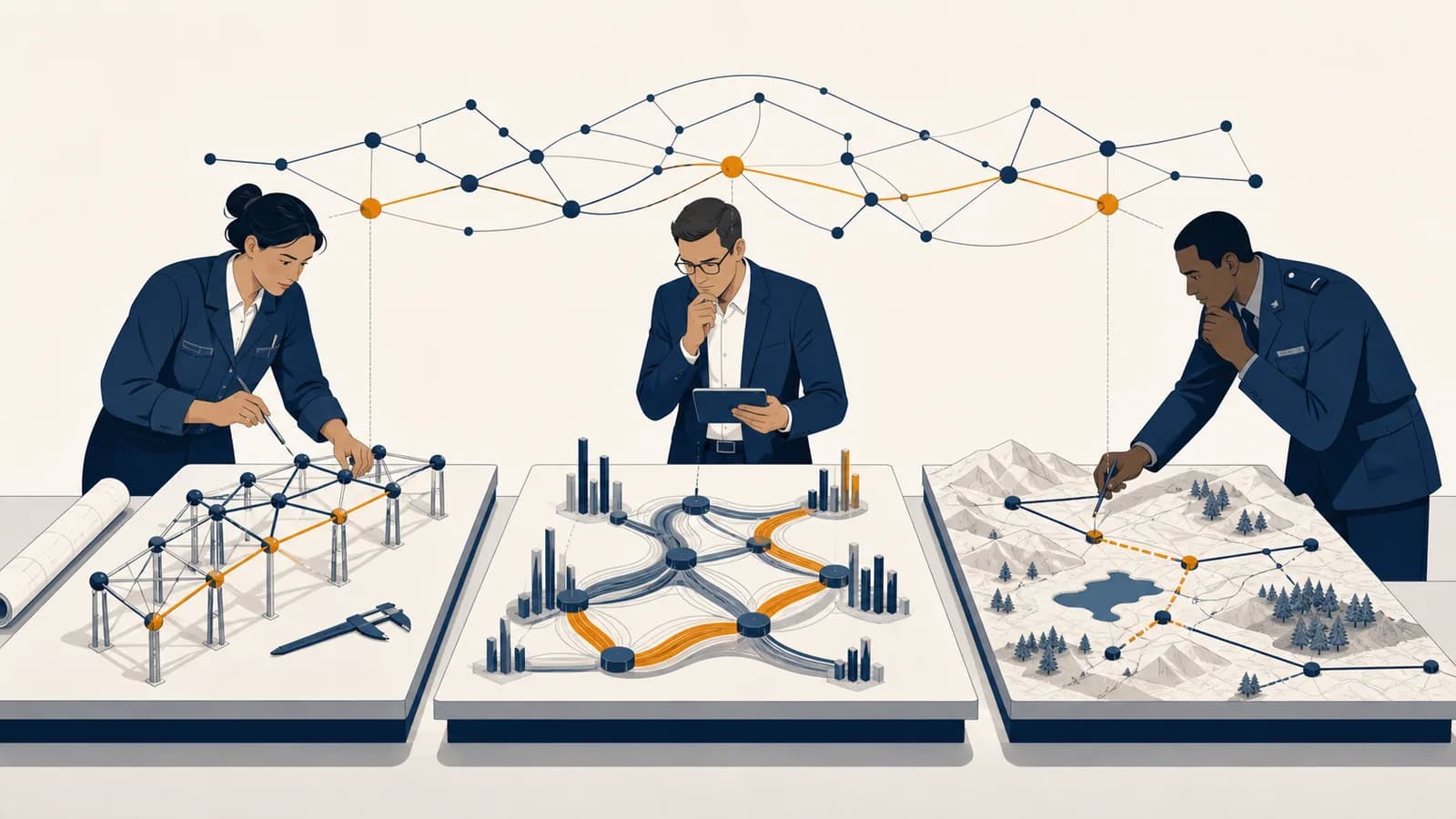
Mental models are working tools, not motivational slogans
A mental model is a simplified account of how something works, used to predict what will happen and choose what to do. Engineers, traders, and military planners depend on such models because reality is too detailed to examine all at once. You can identify useful models and test their limits before combining them, without mistaking a neat explanation for the world itself.
A map is the obvious example. It leaves out the smell of a street, the color of every door, and the exact shape of each tree. Those omissions are not defects if the map helps someone find a station. The same rule applies to a supply and demand curve, a circuit diagram, or a weather forecast. Each removes detail so that a useful relationship becomes visible.
"Think in systems" sounds impressive but gives no variables, causal links, or conditions that could prove it wrong.
A queue model predicts that, if customers arrive faster than staff can serve them, the line tends to grow. Its assumptions can be checked.
The difference is testability. A working model names important parts, shows how they affect one another, and implies an outcome. If the outcome repeatedly fails, the model must be changed or discarded. A slogan can survive any result because it never risked a prediction.
Some models are mathematical. Others are verbal or visual. A mechanic may picture fuel, air, compression, and ignition while diagnosing an engine. A lawyer may trace claim, evidence, rule, and counterargument. The useful feature is not a particular format. It is a compressed causal structure that supports a decision.
Why does every useful model leave something out?
A model must omit detail because attention, time, and measurement are limited. Its value comes from preserving the features that control the outcome while ignoring features that do not matter for the present task. The right omissions change with the question.
Imagine a bridge. A structural engineer estimating the load on a beam may model a truck as a downward force at a position. Its paint color disappears. For a camera system that identifies lane markings, the truck's shape and color may matter while its engine design does not. Neither model is the complete truck, and neither needs to be.
The map is not the territory. A model can be accurate enough for one decision and dangerously incomplete for another.
This is why arguments about whether a model is "true" can miss the useful question. Ask what task it serves, what variables it keeps, and what conditions make its omissions unsafe. A flat map is excellent for a city walk and poor for calculating a long flight path over a spherical Earth.
Scale also changes what matters. A model of one person's spending can track rent and food. A model of a national economy must include taxation, production, trade, and government borrowing. Studying how national debt changes over time requires distinctions between a yearly deficit and the accumulated debt, because collapsing them produces a bad forecast.
How do engineers turn models into safe decisions?
Engineers connect a model to measurable quantities, calculate an expected result, and then test the result against physical evidence. They also build in margins for uncertainty, variation, wear, and imperfect knowledge. A calculation begins the decision; inspection and testing complete it.
Consider a simply supported beam carrying a central load. A basic model can relate load to stress. Before trusting it, an engineer must ask whether the beam material is uniform, whether connections behave as assumed, and whether repeated loading could cause fatigue. A correct equation with false inputs still gives a false sense of precision.
If a material fails at 300 MPa and the allowed working stress is 100 MPa, the factor of safety is 3.
The factor does not mean the structure is guaranteed safe. The failure strength may vary between samples. Corrosion may remove material. Loads may be estimated badly. The model tells the engineer where the stated margin comes from, which makes its weaknesses easier to inspect.
Engineers often work through several representations of the same object. A sketch defines geometry. A free body diagram isolates forces. An equation predicts behavior. A prototype reveals effects the equations missed. Each representation catches different errors.
This loop also appears in software, medicine, and experimental science. The discipline lies in returning to observation. A model that worked on yesterday's loads, data, or patients may fail after the system changes. Keeping a record of predictions makes revision less dependent on memory and confidence.
How do traders think when the future cannot be known?
Traders use models to describe possible outcomes, their probabilities, and the size of gains or losses. A sound decision can lose money on one occasion, while a reckless decision can make money by luck. The process must therefore be judged across repeated choices.
Expected value is one model. Suppose a trade has a 40 percent chance of gaining $30 and a 60 percent chance of losing $10. The expected value is the probability weighted average of those outcomes. It does not predict the result of the next trade. It describes the average implied by the assumptions over many comparable trials.
For the example: per trade in expected value.
The arithmetic is easy. Estimating the probabilities is hard. Historical patterns may not repeat, transaction costs reduce returns, and a crowded strategy can alter the market it tries to exploit. This is a feedback system: traders act on models, their trades move prices, and the changed prices affect later decisions.
A trader has $1,000. One position can either gain 20 percent or lose 50 percent. Betting the whole account risks falling to $500, after which a 100 percent gain is needed to return to $1,000. Position size matters even when the opportunity looks favorable.
That recovery arithmetic reveals a second model: avoiding ruin matters more than maximizing the best possible single gain. A 50 percent loss and a 50 percent gain do not cancel. Starting with $1,000, the loss leaves $500, and the gain then produces $750.
Opportunity cost adds another layer. Money committed to one trade cannot fund another at the same moment. Formal comparison of costs and benefits helps separate visible cash flows from forgone alternatives. Good trading thought is less about certainty than about exposure, alternatives, and survival when the estimate is wrong.
How do generals model conflict without controlling the opponent?
Military planners model objectives, terrain, supply, time, information, and an opponent who is actively trying to defeat the plan. Their models must therefore include reaction and deception. A plan is useful when it guides adaptation, not when it assumes obedience from reality.
A route that looks shortest on a map may cross a river, expose vehicles to observation, or outrun fuel supplies. Geography is an active constraint. Relief affects movement, ports affect resupply, and settlement patterns affect roads and information. The broader study of how people and places interact explains why location shapes options rather than merely providing a backdrop.
One common planning idea is the center of gravity: the source of strength that lets an opponent continue. It might be a field force, an alliance, public support, or a supply network. Identifying it is a hypothesis, not a mystical insight. If attacking the supposed center does not weaken the opponent as predicted, the diagnosis was wrong.
Describe the condition to be achieved, not simply an action to perform.
Include terrain, time, supply, communications, friendly forces, and known opposing forces.
Ask what an intelligent opponent would do after seeing each move.
Choose observable signs that will trigger a change of plan.
The fourth step prevents a plan from becoming a script. If a bridge is destroyed, a unit arrives late, or intelligence proves false, commanders need preconsidered alternatives. The model becomes a branching structure tied to evidence.
Models of conflict also warn against treating one side as a machine with fixed responses. People learn. Organizations hide information. Political aims can change. Historical study of global connections and present challenges shows that trade, communication, public opinion, and alliances can shape a conflict far beyond the battlefield.
Which mental models transfer across fields?
The most transferable models describe patterns found in many systems: feedback, incentives, bottlenecks, compounding, opportunity cost, and second order effects. Transfer works only after the model's assumptions are checked against the actual system. A familiar pattern can prompt an investigation, but it cannot provide proof on its own.
Feedback occurs when an output returns as an input. A thermostat uses negative feedback: rising temperature causes the heating system to reduce its output. Social media popularity can create positive feedback: attention attracts more attention. Positive does not mean good, and negative does not mean bad. The terms describe whether a change amplifies or counteracts itself.
A bottleneck model asks which stage limits the whole process. If a bakery can mix dough for 200 loaves each hour but its oven can bake only 80, buying a faster mixer will not increase finished output. The oven is the present constraint. Once it is expanded, another stage may become the bottleneck.
Second order thinking asks what happens after the immediate result. A city adds a road to reduce congestion. The shorter travel time may encourage more people to drive or live farther away, which can fill the added capacity. The first effect is easier to see, but later behavior can weaken or reverse it. Lessons on the development of rural and urban areas make these linked changes concrete through land use, transport, employment, and migration.
Transfer becomes dangerous when surface similarity replaces mechanism. A company is not literally an organism, and a market is not literally a battlefield. Metaphors can suggest questions, but they do not supply evidence. The useful move is to translate the analogy into parts and causal links, then test each one.
How can a model fail even when it sounds intelligent?
A model fails when its assumptions do not fit the case, its inputs are poor, important variables are missing, or the system changes in response to the model. Elegant language can hide all four failures. Prediction records and disconfirming tests expose them.
Confirmation bias encourages people to notice evidence that agrees with a belief and explain away evidence that does not. Overfitting creates a related error: a model matches past observations, including accidental noise, but performs badly on new cases. This is a central problem in statistics and machine learning.
Write down a prediction before the outcome is known. Include a time frame, an expected range, and the observation that would count against the model. "Sales will improve" is too elastic. "Weekly unit sales will exceed the previous four week average during the two weeks after the price cut" can be checked.
Beware of survivorship bias. If someone studies only companies that became famous, the failed companies disappear from the sample. Their founders may have worked equally hard or followed similar strategies. Looking only at survivors can make common behavior appear to cause rare success.
Goodhart's law names another trap: once a measure becomes a target, people can improve the measure without improving the underlying goal. A school rewarded only for test scores may narrow teaching to tested material. A support center judged only by call length may end calls quickly while leaving problems unresolved. The metric was a useful signal until incentives changed its meaning.
Ask for the failure condition. If no possible observation could count against a claim, it is not functioning as a predictive model.
Confidence should track evidence, not fluency. A detailed diagram, technical vocabulary, or precise decimal can make a weak model look authoritative. Check where the inputs came from, how the model performed on new cases, and which alternatives were considered.
A small set of tested models beats a shelf of slogans
Mental models improve decisions when they are few enough to understand and explicit enough to test. A working set also needs enough variety for one model to challenge another. Build it around real problems, record predictions, inspect failures, and revise a model when evidence demands it.
Start with a decision you make repeatedly: planning study time, comparing purchases, estimating project work, or judging a news claim. Name the outcome. List the variables that could change it. Draw arrows showing possible causes. Then ask which observations would reveal that the diagram is wrong.
You think studying in one uninterrupted block improves recall. Predict how many questions you will answer correctly the next day. On a comparable topic, test shorter sessions separated by retrieval practice. Keep the question difficulty and total study time similar. The result will not settle every case, but it will give your model contact with evidence.
Use more than one model on decisions with serious consequences. Expected value can compare outcomes, but a ruin model asks whether one loss would end the activity. Incentives explain behavior, but a bottleneck model may show why motivated people still cannot raise output. Each model reveals a structure and casts a shadow.
Finally, keep the model proportional to the decision. Choosing lunch does not need a spreadsheet. Designing a bridge does. The aim is better judgment under limited information, not maximum intellectual decoration.
The takeaway: A mental model earns trust by making a mechanism clear and producing a checkable prediction. It must also admit the conditions under which it fails. Use it as a tool, test it against reality, and replace it when a better account explains more with fewer unsafe assumptions.