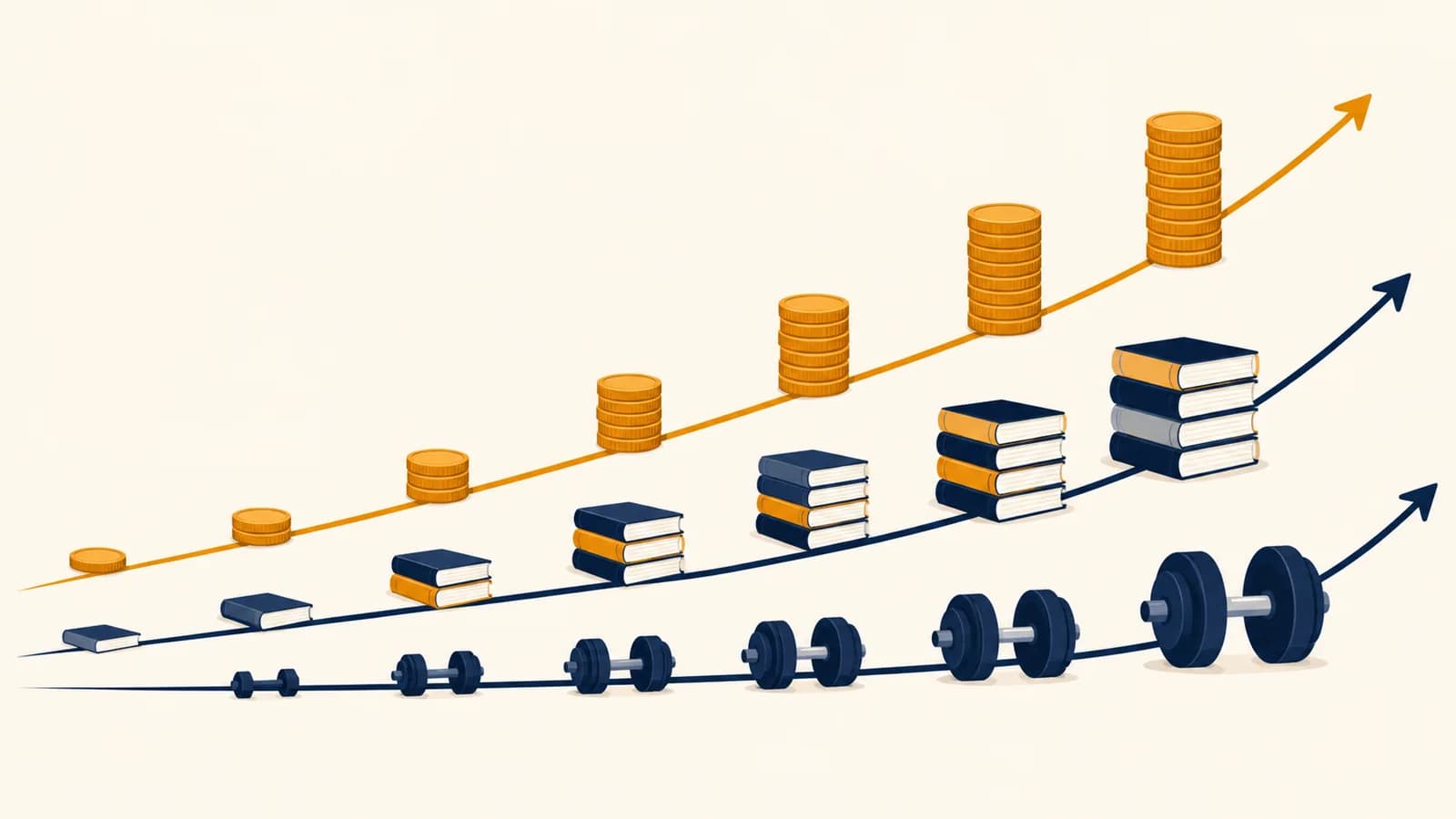
Compound growth turns small repeated gains into large differences
Compound growth happens when each improvement changes the base on which the next improvement is built. Compound interest is the financial version, but the same mathematics can describe skill practice, fitness training, and other repeated gains. By the end, you can calculate the pattern, compare it with linear growth, and judge when the model fits real life.
A bank account makes the mechanism easy to see. If interest remains in the account, the next interest payment is calculated on both the original deposit and the interest already added. The amount earned during each period therefore changes, even when the percentage rate stays fixed.
This feedback loop separates compounding from simple addition. If you learn five facts each day, the count rises by a fixed amount. If each thing you learn helps you understand and retain later material faster, the productive capacity behind the count has changed. That second pattern can compound.
Add the same amount each period. Ten extra units per month produces 10, 20, 30, then 40 extra units.
Multiply by the same factor each period. A 10% gain produces factors of 1.1, 1.21, 1.331, then 1.4641.
The distinction is mathematical, not motivational. Compounding requires the output of one round to affect a later round. Repetition alone is not enough. A habit creates compound-like results only if earlier work improves the base, the rate, or both.
How does the compound interest formula work?
The compound interest formula multiplies a starting amount by the same growth factor once for every period. The exponent counts how many times growth occurs. Change the starting amount, rate, or number of periods, and the formula shows exactly how the final amount changes.
If , , and , then , or 1,157.63 rounded to the nearest cent.
Here, is the principal or starting quantity, is the growth rate per period written as a decimal, is the number of periods, and is the final amount. A 5% rate becomes 0.05, so each period retains the existing 100% and adds 5%. The multiplier is therefore .
The exponent is repeated multiplication in compact form. Three periods mean . If percentages and decimal notation feel slippery, Fractions & Decimals supplies the arithmetic underneath rate calculations.
Notice that the gains are 50.00, then 52.50, then 55.13 after rounding. The percentage has not changed. The base has. Simple interest at 5% of the original 1,000 would add exactly 50 each period and reach 1,150 after three periods.
Why does time often matter more than a dramatic start?
Time matters because each additional period applies growth to every gain already retained. Starting larger always helps, but a modest rate repeated many times can create a larger multiplier than a high rate sustained briefly. The exponent makes duration an active part of the result.
Consider two checkable examples. One quantity grows by 20% for two periods, giving , a total gain of 44%. Another grows by 5% for ten periods, giving , a total gain of about 62.9%. The smaller rate wins because it has more rounds.
Rates must match periods. A monthly rate belongs with a count of months. An annual rate belongs with a count of years. Mixing them produces a polished-looking wrong answer.
Financial products often quote an annual rate while adding interest more frequently. If a nominal annual rate is split equally across compounding periods per year for years, the periodic rate is and the number of periods is .
At a nominal 12% annual rate compounded monthly for one year, the growth factor is .
The computed annual increase in that example is about 12.68%, not 12%, because each monthly addition joins the base for later months. This is arithmetic, not a promise about an available account or investment. Real products also involve fees, taxes, changing rates, and risk.
Growth models sit inside Mathematics because exponents, logarithms, graphs, and percentages describe the same structure from different angles. A graph makes the delayed effect visible: the curve may look almost straight early on, then bend upward as gains on past gains become noticeable.
Can learning really compound?
Learning can compound when earlier knowledge makes later learning faster, clearer, or more durable. Vocabulary helps a reader understand denser books. Arithmetic supports algebra. Familiar code patterns shorten debugging. The growth is not a fixed percentage, but the feedback mechanism is real.
Imagine learning web development. On the first day, every symbol is unfamiliar. Once headings, links, selectors, and the box model are familiar, a new page is not a collection of isolated facts. It attaches to a structure already in memory. Studying HTML & CSS: Building What People See therefore creates tools that can make the next project easier to understand.
You spend 30 minutes building a small page, then save a reusable navigation pattern and write down why it works. On the next page, you reuse the pattern, spot a layout error sooner, and spend the saved time learning responsive design. Earlier work has increased the value of the next session.
Three mechanisms produce this effect. First, stored knowledge reduces the number of new pieces that working memory must handle. Second, practice makes retrieval quicker. Third, useful artifacts such as notes, templates, flashcards, and solved examples remain available. Each mechanism changes what a later hour can accomplish.
Still, counting study hours with would pretend to know a stable rate that does not exist. Difficulty changes. Memory fades. Some practice methods work better than others. A more honest model tracks observable outputs: problems solved without help, recall after a delay, error types, or time needed for a comparable task.
Use the same kind of quiz, problem, or task so results can be compared.
An error log shows which missing idea is limiting later work.
Make a short explanation, worked example, or template that reduces future effort.
Delayed recall distinguishes available knowledge from a familiar-looking answer.
This method does not force learning into a bank-account metaphor. It checks for the relevant feedback: did yesterday's effort improve today's capacity? If the answer is no, more repetition may add hours without improving the learning system.
Does fitness follow the same curve?
Fitness can show compound-like feedback because training changes the body that performs the next session. Better technique, work capacity, and recovery habits can support later progress. Yet adaptation has limits, so a constant exponential curve is a poor long-term forecast for strength, speed, or endurance.
A beginner may improve quickly because several changes occur together. Movement becomes more coordinated. The chosen workload becomes less unfamiliar. Muscles and connective tissues receive a reason to adapt. Those changes can make later training more productive, provided the workload, food, and recovery are adequate.
Assume a lift, running speed, or training volume can rise by the same percentage forever.
Expect early improvement, slower gains as capacity rises, temporary plateaus, and setbacks that require adjustment.
The reason is biological rather than mathematical. Bodies face recovery limits, finite time, injury risk, and ceilings set partly by anatomy and prior training. Increasing a workout too fast can reduce the base for the next session through fatigue or injury. In that case the feedback loop runs backward.
A useful fitness record therefore includes context. Track the exercise, workload, technique quality, and recovery signals that matter to the activity. Compare similar sessions. The aim is not to manufacture a smooth upward curve. It is to discover which inputs lead to adaptation without creating costs that cancel the gain.
How does compounding build or destroy wealth?
Wealth compounds when returns remain invested and generate later returns, while debt compounds when unpaid interest joins the balance. The equation is symmetrical about who benefits. A positive growth rate helps the owner of an asset and hurts the borrower carrying an expanding obligation.
Suppose 2,000 grows at 6% per year for ten years with no deposits or withdrawals. The visible calculation is . The gain is about 1,581.70. This result is a worked example, not a prediction of market performance.
Now reverse the setting. If a 2,000 debt grows at 6% per year and no payment is made, the same calculation produces the same balance. The formula has no opinion about saving or borrowing. Contracts, cash flows, and ownership determine who receives the compounding gain.
Never confuse a model with a guarantee. A constant return makes examples easy to calculate. Actual investment values can rise or fall, rates can change, and fees or taxes can reduce what remains to compound.
Regular contributions add another moving part. If 100 is added at the end of every month, each deposit has a different amount of time to grow. The first deposit receives many periods; the last receives none before the final measurement. A spreadsheet can calculate the sequence row by row, which is often clearer than memorising another formula.
Money also depends on institutions and shared rules. Taxes, consumer protection, courts, currency, and infrastructure shape the conditions in which assets and debts exist. The economic idea of Public Goods helps explain why some foundations of exchange are funded collectively rather than bought separately by every participant.
What breaks the compound growth model?
The model breaks when the rate changes, gains are removed, the base has a ceiling, or one period does not affect the next in the assumed way. It is useful only when its assumptions resemble the process being measured. Real systems often need a piecewise or capped model.
Four checks expose most mistakes:
- Is there feedback? The result of one period must enter the base for another. Separate repetitions are not compounding.
- Is the rate stable enough? A fixed rate may summarize a short interval but fail across changing conditions.
- Are gains retained? Withdrawn interest, forgotten knowledge, and lost fitness no longer contribute to later growth.
- Is there a ceiling or cost? Limited time, market risk, fatigue, and physical capacity can bend or reverse the curve.
A 10% gain followed by a 10% loss gives , so the final amount is 1% below the start.
That gain-and-loss example shows why percentages cannot simply be added. After a rise from 100 to 110, a 10% loss is 11, not 10, because it acts on the new base. Returning from 90 to 100 similarly requires an increase of .
For learning and fitness, decay matters too. A simple model could apply a gain during practice and a retention factor afterward. If a skill rises by 8% during a period but only 95% of the result remains available, the combined multiplier is , a net increase of 2.6% for that modeled period.
Models earn trust by stating their boundaries. If the rate is an estimate, label it. If progress cannot exceed a practical limit, include that limit. If the system can suffer losses, show them. A less dramatic model that matches the mechanism is more useful than a smooth curve built on hidden assumptions.
How can you design a compounding system?
A compounding system retains useful gains, feeds them into later work, and measures results closely enough to correct errors. Start with a small repeatable action, preserve its output, and review the process at fixed intervals. Consistency matters because broken links interrupt the feedback loop.
Name what should grow: invested balance, accurately recalled material, completed projects, or a comparable training measure.
Reinvest returns, review knowledge, save reusable work, or schedule recovery so gains survive.
Check calculations, test recall, review code, or assess technique before errors become repeated habits.
Use observed results, not an attractive percentage, and expect the rate to change.
The best unit is one you can observe without pretending. A learner might count mixed problems answered correctly a week later. A programmer might measure comparable tasks completed with fewer defects. A saver can record contributions, fees, and account values separately. Each measure reveals a different part of the mechanism.
Environment can also alter the rate. A team that documents decisions saves later workers from repeating the same search. A workplace that punishes questions may preserve mistakes instead. Organizational culture shapes what people contribute, retain, and pass on.
Choose one skill and one weekly test. Record the starting result, complete a repeatable practice block, save one reusable note or example, then retest under similar conditions. After 12 weeks, examine the sequence. A rising score suggests growth; a rising rate of improvement would be stronger evidence of compound-like feedback.
Do not punish the system for producing uneven data. One poor week may reflect sleep, difficulty, or random variation. Look for a pattern across comparable observations, and change only one major input at a time when possible. Otherwise, improvement may be visible while its cause remains unknown.
Small gains become powerful when the feedback survives
Compound growth is not a slogan about patience. It is a specific structure: a result is retained, enters the next round, and changes what that round can produce. Money shows the arithmetic cleanly, while skills and fitness show both the value and limits of the analogy.
The formula gives a precise answer only when its inputs describe the system. For a fixed-rate account or a classroom calculation, that may be reasonable. For a body, a market, or a developing skill, rates move and ceilings appear. Use the equation as a model, then test its assumptions against evidence.
The takeaway: Protect the base, retain each useful gain, and make later work benefit from earlier work. Then measure the result honestly enough to see when growth is compounding, merely adding, slowing, or reversing.
A small action has no special power by itself. Its value depends on what remains afterward. Interest left invested can earn interest. Knowledge retrieved and connected can support harder knowledge. Training followed by adaptation can support harder training. Build the feedback loop, keep the arithmetic visible, and revise the model when reality stops matching it.