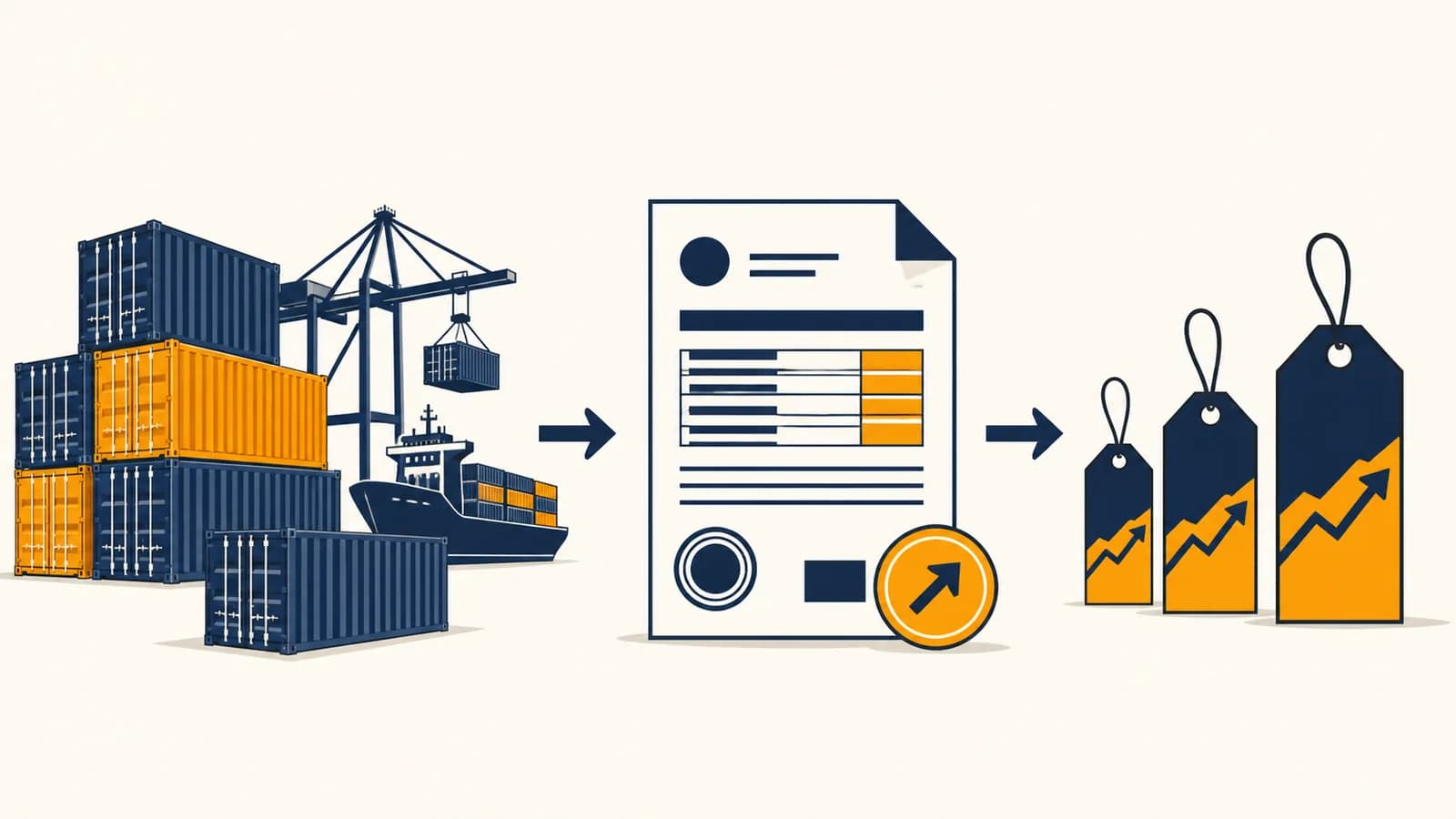
Trade and tariffs are economic systems and taxes that govern how goods and services cross borders, in the context of international economics. International trade lets buyers and sellers exchange products across countries, while a tariff adds a tax to specified imports. People searching for what tariffs are, how tariffs work, or who pays tariffs are usually asking about the same chain of events: a government charges an importer, the importer responds, and prices, profits, sourcing, and production may change. Trade exists because places differ in skills, resources, technology, and costs, so exchange can give people more choices than local production alone.
A tariff does not stop at a customs desk. Its effects can reach a factory choosing suppliers, a shop setting a price, a worker considering a new job, and a government deciding how to answer another country's policy. Those effects are real, but they are not automatic or identical in every market. The details depend on alternatives, contracts, exchange rates, and how quickly businesses and consumers can adjust.
What international trade actually is
International trade is the voluntary exchange of goods and services between buyers and sellers in different countries. Imports enter a country, exports leave it, and each transaction links a buyer's demand with a seller's ability to supply at an acceptable price.
A good becomes an import or an export according to the country whose viewpoint is being described. Coffee shipped from Brazil to Canada is a Brazilian export and a Canadian import. The physical shipment is the same. The label changes with the observer.
Trade includes visible goods such as grain, cars, medicine, and phones. It also includes services. A company can buy design work, insurance, software support, or an online course from a provider abroad without moving a container. Money usually moves in the opposite direction from the product or service, although credit and financial intermediaries can separate the timing.
The flow looks simple, but many businesses may take part. A manufacturer can sell to an exporter, which hires a carrier, which delivers to an importer, which sells through a distributor and a retailer. Banks handle payments. Insurers cover losses. Customs officials classify the product and check the required documents.
Trade also occurs inside products. A bicycle assembled in one country may use gears, tires, steel, design work, and shipping services from several others. Economists call this a global value chain. Counting only the country of final assembly can hide where the value was created and who bears a new trade cost.
How comparative advantage works
Comparative advantage means producing the good or service with the lower opportunity cost, then trading for other goods. It explains why exchange can benefit two parties even when one of them can produce every item with fewer resources than the other.
Suppose that in one day, Ana can either make 12 shirts or grow 6 crates of food. Ben can either make 4 shirts or grow 4 crates of food. Ana has an absolute advantage in both activities because she can produce more of either. Comparative advantage asks a different question: what must each person give up?
| Producer | One day's maximum | Cost of 1 food crate | Cost of 1 shirt |
|---|---|---|---|
| Ana | 12 shirts or 6 food crates | 2 shirts | 0.5 food crate |
| Ben | 4 shirts or 4 food crates | 1 shirt | 1 food crate |
Ana gives up two shirts for each food crate, while Ben gives up one. Ben therefore has the comparative advantage in food. Ana gives up half a food crate for each shirt, while Ben gives up a whole crate. Ana has the comparative advantage in shirts.
For Ana, the cost of one food crate is 12 shirts divided by 6 crates, or 2 shirts.
If Ana specializes more in shirts and Ben specializes more in food, they can trade at a rate between their opportunity costs. A price of 1.5 shirts per food crate lies between 1 and 2 shirts. Ben receives more than the one shirt he gives up to grow a crate. Ana pays fewer than the two shirts she would give up by growing that crate herself. Both can gain.
This model does not promise that every person gains from every trade agreement. It shows that total consumption possibilities can expand. Workers, owners, regions, and consumers can experience different gains and losses, especially while labor and investment move between industries. Improvements in how productivity raises output per input can also change comparative advantage over time.
What a tariff actually is
A tariff is a tax imposed by a government on a good as it crosses a national border, usually on imports. Customs authorities collect it from the importer of record according to the product's classification, declared value, origin, and applicable tariff rate.
Most discussions concern import tariffs. Export tariffs also exist, but they are less common. Governments can use tariffs to protect domestic producers, raise revenue, answer another country's restrictions, or gain bargaining pressure. Those aims can conflict. A tariff that sharply reduces imports may protect some producers but collect less revenue than expected.
An ad valorem tariff is a percentage of value
An ad valorem tariff is calculated as a percentage of the customs value. If an imported machine has a customs value of $20,000 and faces a 10 percent tariff, the border charge is $2,000. The calculation is visible and checkable.
Worked example: $20,000 times 0.10 equals a $2,000 tariff.
The customs value is governed by the importing country's rules. It may not match the final shop price, because retail markups, domestic transport, and other taxes can appear later. Customs classification matters too. Products receive codes, and different codes may face different rates.
A specific tariff is charged by physical unit
A specific tariff is a fixed charge per unit, such as a set amount per kilogram, liter, or item. Its burden as a percentage of price is larger for a cheap product than for an expensive product in the same unit category.
Imagine a tariff of $3 per item. On a $12 item, the charge equals 25 percent of the original value. On a $60 item, it equals 5 percent. A compound tariff combines a percentage charge with a charge per unit.
The legal payer and the economic bearer can differ. Customs collects the tariff from the importer, but the final cost may be divided among foreign sellers, importers, retailers, workers, and consumers through changes in prices and profits.
This distinction answers the common question, “Who pays tariffs?” The importer writes the payment to the government. Economic incidence asks whose real income falls after everyone changes prices and behavior. That second answer requires evidence about the market.
How a tariff works from border to price
A tariff raises the importer's cost at the border, after which businesses decide how much to absorb, pass forward, or avoid by changing suppliers. The response moves through contracts and supply chains before it reaches retail prices, production, employment, and government revenue.
The importer identifies the customs code, origin, and declared value. These facts determine which trade rule and rate apply.
Customs applies the tariff. The importer of record owes the government before or as the goods enter domestic commerce.
The importer may accept a smaller margin, seek a lower foreign price, raise its selling price, redesign the product, or switch suppliers.
Households and firms may keep buying, buy less, choose a domestic substitute, or delay the purchase.
Protected domestic firms may expand, while firms using tariffed inputs may face higher costs. Investment and hiring respond over time.
Consider an importer that buys a blender abroad for $40, incurs $5 in shipping and related costs, and previously sold it to a retailer for $55. For simplicity, suppose a new 25 percent tariff applies to the $40 customs value. The tariff is $10. If nothing else changes, the importer's cost rises from $45 to $55.
The importer has several choices. It could keep the $55 selling price and lose its $10 gross margin on this simplified transaction. It could charge the retailer $65 and try to preserve that margin. It could persuade the foreign producer to cut the factory price. It could accept a smaller margin while the retailer also accepts less. It might source a different blender from a country outside the measure. Real outcomes often combine these responses.
A local appliance shop raises the blender's price by $6, not the full $10 tariff. That does not mean the tariff cost vanished. The importer, foreign supplier, or retailer may be absorbing the remaining $4 through a lower margin or price.
The speed of adjustment matters. A firm locked into a one year supply contract cannot instantly move production. A retailer with inventory bought before the tariff may delay a price change. Later shipments can produce a clearer effect. Currency movements can offset or add to the price change, making a simple before and after comparison misleading.
Free trade versus protectionism
Free trade reduces government barriers to cross border exchange, while protectionism uses tariffs, quotas, subsidies, or rules to favor domestic activity. The disagreement concerns how to weigh lower prices and specialization against security, adjustment costs, bargaining power, and distributional effects.
Competition can lower prices, increase variety, spread technology, and let resources move toward activities with lower opportunity costs. Exporters also gain access to larger markets.
Temporary or targeted barriers may support a new industry, preserve capacity judged necessary for security, answer unfair trade practices, or slow a damaging local adjustment.
Neither side gets every desired outcome at once. Protection can help a domestic producer competing with imports, but buyers pay more or accept fewer options. If that producer uses imported components, a tariff on inputs can hurt it. Lower barriers help consumers and firms that import, but exposed workers and towns can face concentrated losses that broad national gains do not repair by themselves.
The infant industry argument says a young domestic industry may need temporary protection until it learns, scales, and competes. The difficult parts are selecting an industry with real potential, preventing political favoritism, and ending support when the stated period expires. Protection can otherwise preserve high costs instead of creating competitive strength.
National security arguments focus on dependable access to goods such as defense equipment, energy equipment, food, or medicine. The economic question is not simply “imports or no imports.” Policymakers can compare stockpiles, multiple foreign sources, domestic capacity, subsidies, purchasing contracts, and tariffs. Each tool places costs and risks in different locations.
Governments also use product standards, licensing requirements, procurement rules, and subsidies. Some rules protect health or safety and apply to domestic and foreign products alike. Others can function as trade barriers through their design or administration. The name of a policy is not enough to reveal its economic effect.
How tariffs change winners, losers, and total surplus
A tariff usually helps protected domestic producers and gives revenue to the government, while hurting domestic consumers and import using firms. In the standard competitive model for a small country, consumer losses exceed the combined gains, creating deadweight loss for the economy.
Start with a country that can buy a product at a world price below its domestic no trade price. At that lower price, domestic consumers demand more and domestic firms supply less. Imports fill the gap. A tariff lifts the domestic price above the world price if it is passed through.
At the higher price, domestic producers sell more and may earn greater producer surplus. Consumers buy less and pay more for the units they still purchase. The government collects the tariff rate multiplied by the quantity imported. Imports shrink because domestic supply rises while domestic demand falls.
The deadweight loss has two main sources. First, higher cost domestic production replaces some lower cost imports. Second, some buyers stop purchasing even though the product's value to them exceeded the world resource cost. The tariff blocks trades that would have created surplus.
A large country may be able to push down the foreign export price by reducing its demand, improving its terms of trade. That possible gain complicates the simple small country model. It does not create a free benefit. Other countries may retaliate, market power may be weak, and the tariff still distorts production and consumption.
Distribution also matters. A modest average effect can conceal a severe loss for a particular factory or town. Conversely, protection for a small industry can impose a thin cost across millions of buyers. Economic analysis should report both total effects and where they fall. Some consequences resemble the cases where market outcomes miss wider social costs or benefits, but a painful outcome alone does not prove a market failure.
How trade shows up in jobs, firms, and household budgets
Trade appears in everyday life through product prices, available varieties, export orders, supply chains, wages, and job changes. Its benefits are often spread across many purchases, while its costs can be concentrated in a particular occupation, employer, or region.
A household meets trade through prices and choice
Imported clothes, foods, electronics, and vehicles make trade visible, but domestic goods can contain imported inputs too. A locally baked loaf may rely on foreign machinery. A domestic car may contain parts that crossed borders several times. A tariff on an input can therefore affect an item labeled as locally made.
Lower import prices increase a household's purchasing power because the same income buys more. A price increase does the reverse. The burden differs by spending pattern. A tariff on a basic product can take a larger share of a low income household's budget if that household spends more of its income on the product.
A firm meets trade on both sides of its accounts
A business can be an importer and an exporter at the same time. It may buy foreign components, assemble a product domestically, and sell the finished item overseas. A tariff on its input raises costs. A foreign tariff on its finished product makes it harder to sell abroad.
A furniture maker can buy domestic hinges for $5 each or imported hinges for $4.40. A tariff adds $0.80 to the imported hinge, lifting its border cost to $5.20. The firm may switch suppliers, negotiate, redesign the cabinet, raise its price, or accept less profit.
The domestic hinge maker may gain orders. The furniture maker faces a higher input cost. If foreign furniture producers can still buy hinges for $4.40, the domestic furniture maker may lose export competitiveness. A policy that protects one stage of production can expose another.
A worker meets trade through changing labor demand
Export growth can increase demand for workers in expanding industries. Import competition can reduce demand in industries that lose sales. New jobs are not necessarily in the same town, require the same skills, or arrive at the same time as lost jobs. Moving and retraining involve real costs.
Technology, consumer taste, recessions, exchange rates, and domestic competition also change employment. A factory closure during a period of rising imports does not by itself prove that trade was the sole cause. Analysts compare timing, product exposure, costs, and changes in competing regions to separate causes.
How trade policy shows up in government and the news
Trade policy appears in customs schedules, trade agreements, investigations, sanctions, subsidy disputes, and retaliation. A careful news reader identifies the product, rate, legal payer, trading partners, start date, exemptions, and likely responses before judging the headline claim.
A government announcing “tariffs on $1 billion of goods” is naming the value of imports covered, not necessarily the tax revenue it will collect. If the average applicable rate were 10 percent and imports did not change, the arithmetic would suggest at most $100 million before complications. Imports usually do change, and rates can differ across products.
Covered trade is not tariff revenue. Revenue equals the tariff charged on goods that actually enter. Exemptions, changed sourcing, lower import quantities, classification decisions, and collection timing can all alter the result.
Retaliation is another link in the mechanism. If Country A taxes imports from Country B, Country B may tax exports that matter politically or economically to Country A. Exporters then face weaker foreign demand. The first country's consumers can pay more for imports while its exporters lose sales, so both sides can incur costs.
Trade agreements set rules for tariffs and other barriers among participating countries. They may reduce rates only for goods that satisfy rules of origin. Those rules determine where enough of a product was made to qualify. Simply shipping a product through a member country does not normally change its origin.
Tariff revenue enters the public budget, but it must be compared with wider effects rather than treated as free money. A reader studying how government revenue and spending create deficits or surpluses can place customs receipts alongside income taxes, sales taxes, borrowing, and expenditure.
How exchange rates and trade balances differ from tariffs
Exchange rates set the price of one currency in another, and the trade balance compares exports with imports over a period. Tariffs can influence both indirectly, but neither an exchange rate nor a trade deficit is itself a tariff or proof of unfair trade.
A currency change can amplify or offset a tariff
Suppose a foreign item costs 100 units of foreign currency. At an exchange rate of 2 domestic currency units per foreign unit, its price is 200 domestic units before shipping and tax. If the domestic currency strengthens so that one foreign unit costs 1.8 domestic units, the same item costs 180 domestic units.
A 10 percent tariff on a customs value of 180 adds 18, bringing the simplified cost to 198. In this example, currency appreciation more than offsets the tariff relative to the original cost of 200. If the domestic currency weakens instead, the exchange rate and tariff can push in the same direction.
A trade deficit is paired with financial flows
A trade deficit occurs when a country imports more goods and services than it exports during the measured period. It does not mean the country receives products without giving anything in return. Payments, asset purchases, lending, and other international financial transactions complete the accounts.
Tariffs can reduce targeted imports, but they do not mechanically erase an overall trade deficit. Consumers may switch to imports from another country. Exchange rates can move. National saving and investment patterns can sustain net borrowing from abroad. A bilateral deficit with one partner also says little by itself about the gains from individual trades.
A country with a trade deficit must be losing because money leaves and goods enter.
The country receives goods and services, while foreigners receive claims such as currency, debt, shares, or other assets. Evaluating the result requires examining what was bought, how flows are financed, and future obligations.
Trade balances can still signal questions worth asking. Persistent borrowing may finance productive investment or unsustainable consumption. A commodity exporter may see its balance swing with world prices. The balance is an accounting result that needs context, not a scoreboard that automatically identifies a winner.
Four mistakes people make with tariffs
Most tariff errors come from confusing the legal payment with the economic burden, ignoring supply chain responses, treating trade balances as scores, or assuming every person shares the national average effect. Each mistake skips a link in the causal chain.
1. Saying the foreign government pays the tariff
The importing country's customs authority charges the importer of record. A foreign producer may bear part of the economic cost if it cuts its price to keep the business, but that response is different from sending the tariff payment to the importing government.
2. Adding the tariff rate directly to every shop price
A 20 percent tariff on customs value does not guarantee a 20 percent rise on the retail tag. The tariff may apply to only part of the final value. Firms can adjust margins, suppliers, product designs, and prices. Domestic competitors may also change their prices even though they pay no tariff.
3. Treating exports as wins and imports as losses
Exports earn income for sellers, while imports give buyers goods, services, and productive inputs. People work and produce partly so they can consume. A policy that expands exports but makes useful inputs much more expensive can carry a hidden cost.
4. Assuming a national gain helps everyone
Trade can increase total real income while leaving some workers and owners worse off. The reverse error also occurs: a visible factory loss does not prove the country as a whole lost. Sound analysis examines total surplus, distribution, adjustment time, and available support for displaced people.
This sentence is a compact test for any claim. Ask which price changes, who first sees it, what substitutes exist, and how long adjustment takes. A prediction without those links is an opinion, not a worked economic mechanism.
How can you judge a tariff proposal?
A tariff proposal should be judged by its stated goal, product scope, expected incidence, available substitutes, likely retaliation, duration, and alternatives. The best tool depends on the problem, so analysis must compare the proposal with realistic options rather than with doing nothing forever.
Start by stating the goal in measurable terms. “Protect jobs” is vague. “Maintain enough domestic capacity to supply a specified essential product during a disruption” can be tested. Then identify who uses the targeted imports. A consumer good and an industrial input create different chains of costs.
- Scope: Which customs codes, countries, and product values are covered?
- Incidence: Which sellers or buyers have enough bargaining power to shift the cost?
- Substitution: Can firms change suppliers, materials, or designs, and how quickly?
- Domestic response: Is spare production capacity available, or would expansion require years of investment?
- Foreign response: Which exporters might face retaliation?
- Administration: Can customs enforce classifications and origin rules without excessive delay or avoidance?
- Exit rule: What evidence would cause the tariff to expire, expand, or be replaced?
Compare the tariff with other tools. Worker assistance targets people hurt by adjustment. A production subsidy targets domestic output but requires public spending. A stockpile targets emergency availability. Competition policy may address domestic market power. Negotiation may remove a foreign restriction. Each choice has costs, enforcement problems, and distributional effects.
Evidence should be revisited after implementation. Import volume may fall because of the tariff, a recession, or a product cycle. Domestic output may rise without employment rising if firms automate. Prices may respond slowly because older contracts remain active. Good evaluation separates these effects as far as the available data allow.
Trade makes economic choices visible
Trade and tariffs show economics as a study of choices under constraints: opportunity cost explains specialization, supply and demand explain price responses, and incentives explain adaptation. Following one product across a border connects household decisions, business strategy, public finance, and international relations.
The most useful habit is to trace a policy through people and prices. Identify the legal payer. Calculate the first cost. Follow possible changes in margins, sourcing, production, and consumption. Then separate the total effect from its distribution across groups and across time.
The takeaway: A tariff is collected at the border, but its economic burden is decided throughout the market. To understand any trade claim, follow the cost, the alternatives, and the responses.
The next time a tariff appears in a headline or on a business invoice, write down the imported product, tariff base, rate, first payer, substitutes, and likely response. That short chain turns a political slogan into an economic question you can test. See how this fits into economics as a whole to connect the same method to markets, employment, inflation, growth, and public policy.