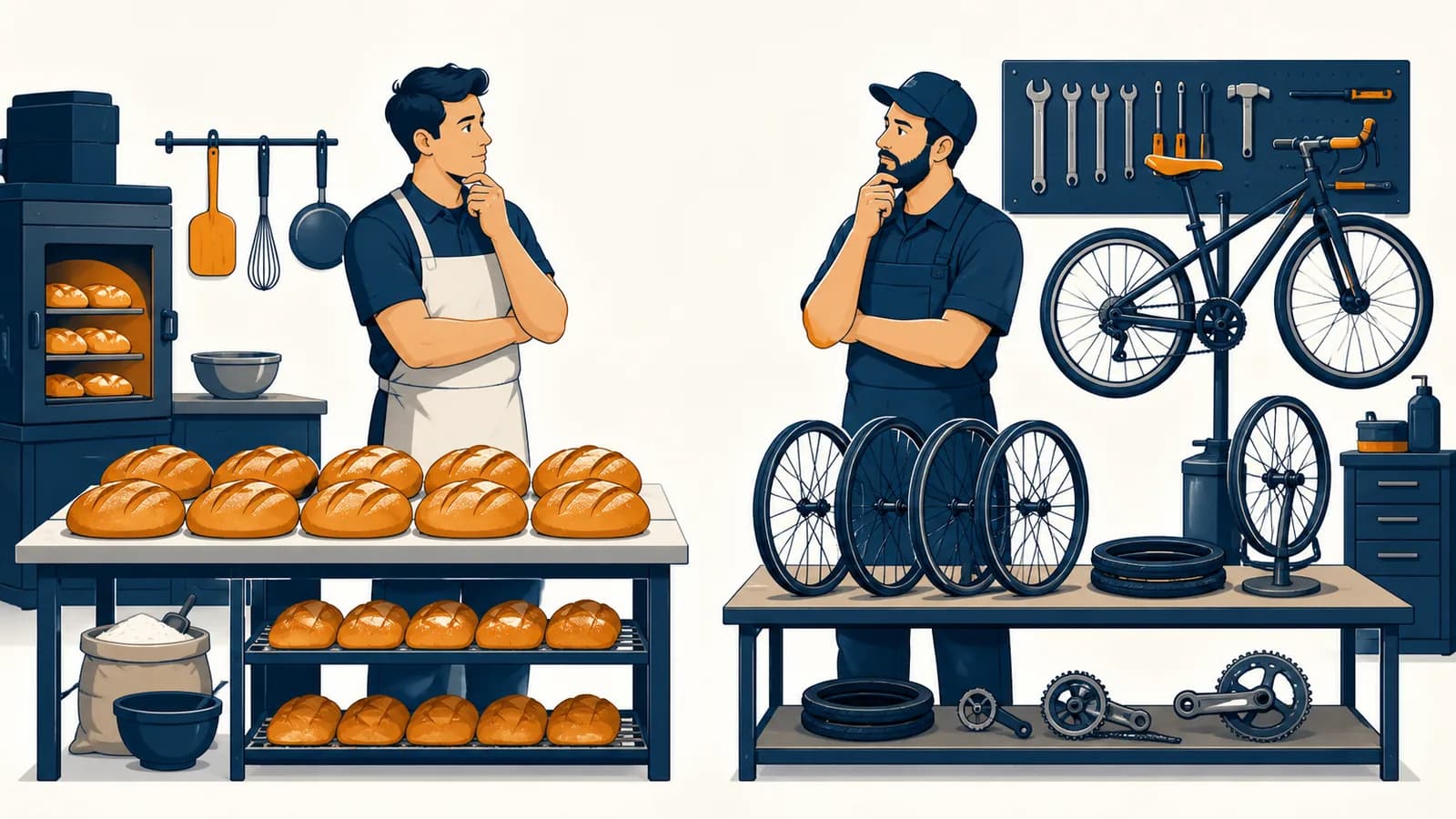
Comparative advantage is an economic principle that identifies who can produce a good or service at the lowest opportunity cost, in the context of specialization and trade. A comparative advantage exists even when one person, business, or country is less productive at everything. The test is not who uses fewer hours or resources. It is who gives up less of the next best alternative. This idea exists because scarce time, workers, land, and machines force choices, and those choices can make exchange beneficial to both sides.
Suppose Rosa and Amir can each spend a working day making bread or repairing bicycles. Rosa can bake 12 loaves or repair 6 bicycles. Amir can bake 8 loaves or repair 2 bicycles. Rosa produces more of both, yet it does not follow that she should do both. The opportunity costs reveal a useful division of work.
What comparative advantage actually is
Comparative advantage is the ability to produce something by giving up less of another valuable output than another producer would give up. It compares trade-offs, not total skill, speed, wages, natural resources, or the amount produced in an hour.
Every producer faces a production limit. In the bread and bicycle example, Rosa can trade one activity for the other at a steady rate. If she uses all her day on bread, she makes 12 loaves. If she shifts enough time to repair one bicycle, she gives up 2 loaves. Her opportunity cost of one bicycle is therefore 2 loaves.
Amir gives up 4 loaves for every bicycle he repairs because his full-day alternatives are 8 loaves or 2 bicycles. Repairing one bicycle uses half his day, during which he could have baked 4 loaves. Rosa has the lower opportunity cost in bicycle repair. She has the comparative advantage in bicycles.
The calculation reverses for bread. Rosa gives up half a bicycle for one loaf because 6 bicycles divided by 12 loaves equals 0.5 bicycle per loaf. Amir gives up one quarter of a bicycle for one loaf because 2 divided by 8 equals 0.25. Amir has the comparative advantage in bread.
The pair of advantages must split this way in a two-person, two-good example if their trade-offs differ. The producer with the lower opportunity cost of bicycles necessarily has the higher opportunity cost of bread. Comparative advantage is comparative because it depends on another option and another producer, not on an isolated performance score.
Lowest opportunity cost wins the comparison. Ask what must be sacrificed to make one more unit. Do not ask only who can make the most units.
How opportunity cost works
Opportunity cost measures the value of the best alternative sacrificed by a choice. For comparative advantage, express that sacrifice in units of the other product, then compare the same cost across producers. The smaller sacrifice identifies the comparative advantage.
Opportunity cost is a ratio. If a workshop can make either 30 tables or 90 chairs with the same workers and machines, then one table costs 3 chairs. The reciprocal is also useful: one chair costs one third of a table. Units matter because “3” alone does not say what was lost.
For the workshop, .
A reliable calculation follows the same sequence each time. It works for output tables, hours per task, or a production possibilities diagram, as long as the available resources and time period are comparable.
State what the same resources could produce. A cost cannot be calculated unless the forgone alternative is clear.
Compare outputs made with the same worker-hours, land, equipment, or other limiting input.
Divide the amount forgone by the amount gained. Attach units, such as chairs per table.
Compare each producer's chairs per table, not one producer's chairs per table with another producer's tables per chair.
The producer with the lower opportunity cost has the comparative advantage in that output.
Tables that give hours per unit require careful interpretation. Imagine Jo needs 2 hours for a haircut and 6 hours for a bicycle tune-up. Lee needs 3 hours for a haircut and 12 hours for a tune-up. For Jo, one tune-up takes the time of 3 haircuts. For Lee, one tune-up takes the time of 4 haircuts. Jo gives up fewer haircuts and has the comparative advantage in tune-ups.
For haircuts, use the reciprocal costs. Jo gives up one third of a tune-up per haircut. Lee gives up one quarter. Lee has the comparative advantage in haircuts, although Lee takes longer at both tasks. Converting hours into forgone output exposes the trade-off that raw speed hides.
A production possibilities curve presents the same calculation as a graph. One output sits on the horizontal axis and another on the vertical axis. Points on the boundary show the maximum combinations available with current resources and technology. Moving along the boundary gains one output and sacrifices some of the other. The slope measures that sacrifice, so its absolute value is an opportunity cost.
A straight boundary represents constant opportunity cost. If every additional table always costs 3 chairs, the slope does not change. A bowed boundary represents increasing opportunity cost. The first tables may be made by workers and tools that switch easily from chairs, while later tables require resources much better suited to chair production. The cost rises as production moves farther toward tables.
Points inside the boundary indicate unused resources or inefficient organization. Moving toward the boundary can increase one output without reducing the other, so opportunity cost may appear to be zero during that improvement. Points outside the boundary are not currently attainable. Trade can allow consumption at a point outside one producer's own production boundary, but it does not let that producer manufacture outside the boundary with unchanged resources.
How specialization creates gains from trade
Specialization creates gains when each producer shifts resources toward the output with the lower opportunity cost, raises combined production, and trades at an exchange rate between their costs. Both can then consume beyond what their separate production choices allowed.
Return to Rosa and Amir. Without specialization, suppose Rosa spends half her day on each task and produces 6 loaves and 3 bicycle repairs. Amir also splits his day and produces 4 loaves and 1 repair. Together they produce 10 loaves and 4 repairs.
Now let Rosa use her day on bicycle repairs and Amir use his day on bread. Rosa produces 6 repairs, while Amir produces 8 loaves. Compared with the split-day result, the pair has 2 fewer loaves but 2 more repairs. Since Rosa can convert each repair into 2 loaves, she can reduce repair work by one and bake 2 loaves. Combined output becomes 10 loaves and 5 repairs. The same two working days now produce one extra repair.
Extra output creates the possibility of a gain. It does not automatically decide who receives it. A trade price must leave both producers at least as well off as producing the item themselves.
Suppose Amir gives Rosa 3 loaves for one bicycle repair. Rosa receives 3 loaves for work that costs her 2 loaves, so she gains the equivalent of 1 loaf. Amir gets a repair for 3 loaves even though doing it himself would cost 4 loaves, so he also saves the equivalent of 1 loaf. Their different internal costs create room for a mutually acceptable exchange.
The quotation describes a change in allocation, not magic. Rosa's repair skill and Amir's baking skill have not improved. They spend more time where their relative trade-offs are favorable. Specialization can also bring practice, scale, and better tools, but those are additional sources of productivity, not the comparative advantage mechanism itself.
Consumption preferences decide how much specialization makes sense. If Rosa and Amir want only a few repairs but many loaves, Rosa will not spend her full day repairing bicycles merely because her relative cost is lower. Once the desired repairs are complete, her next best use of time may be baking. Comparative advantage predicts the direction of a useful shift, while demand helps determine its size.
Specialization also creates coordination costs. The pair must agree on quality, timing, and payment. If Amir delivers bread after Rosa needs it, or if Rosa's repairs do not meet an agreed standard, the calculated gain may disappear. Repeated exchange often produces contracts, inspection routines, reputations, and common measurements because these arrangements make the promised gains more dependable.
Comparative advantage versus absolute advantage
Absolute advantage means producing more with the same resources, while comparative advantage means sacrificing less of another output. A producer can hold the absolute advantage in every activity but cannot hold the comparative advantage in every activity when relative opportunity costs differ.
Compare productivity directly. Rosa makes 12 loaves to Amir's 8, and repairs 6 bicycles to Amir's 2. Rosa has the absolute advantage in both.
Compare forgone alternatives. Rosa gives up fewer loaves per repair, while Amir gives up fewer repairs per loaf. Each has one comparative advantage.
The distinction explains why a highly capable lawyer might hire someone to format documents. Suppose the lawyer can complete a legal analysis in one hour or format four documents in that hour. An assistant can complete the analysis in four hours or format two documents in one hour. The lawyer is faster at both tasks.
Yet the lawyer's cost of formatting one document is one quarter of a legal analysis. The assistant's cost is one eighth of an analysis because the assistant completes half an analysis in two hours while formatting four documents in the same time. The assistant has the comparative advantage in formatting. Assigning that work to the assistant protects more analysis time, even though the lawyer could format each document faster.
This conclusion depends on relevant alternatives. If there is no additional legal work to do, the lawyer's released hour may have little value. If document formatting contains sensitive judgments that only the lawyer can make, the tasks are not truly equivalent. Comparative advantage organizes the stated options; it does not repair a badly defined comparison.
How terms of trade divide the gains
Terms of trade are the rate at which one good or service exchanges for another. Both sides can gain when that rate lies strictly between their opportunity costs, although bargaining power, transport costs, taxes, and risk affect the final division.
Rosa's cost of one repair is 2 loaves. Amir's cost is 4 loaves. A price between 2 and 4 loaves per repair can benefit both. At 3 loaves, they split the potential gain evenly in this simple example. At 2.5 loaves, Rosa gains 0.5 loaf relative to her cost and Amir saves 1.5 loaves relative to his own production cost.
A price of 3 loaves per repair is above Rosa's cost and below Amir's cost.
At exactly 2 loaves, Rosa is indifferent in the stripped-down model because the payment only covers what she gives up. At exactly 4 loaves, Amir is indifferent because buying costs the same as doing the repair. Outside the range, one side would reject the trade unless another benefit changes the calculation.
Money prices often hide these ratios. A freelance designer compares the fee for a logo with the paid work displaced by taking the project. A client compares that fee with the staff time and delayed projects required to make the logo internally. A deal becomes possible when the fee sits between those reservation values.
A gain for both sides does not imply an equal gain. Comparative advantage identifies a possible surplus. Contracts, market competition, institutions, and bargaining determine who captures it.
Costs of exchange narrow the beneficial range. If transporting one repaired bicycle consumes the equivalent of 1 loaf, a 3-loaf price may no longer leave the same total surplus. Search time, insurance, border procedures, quality checks, and contract enforcement can have the same effect. Some theoretically beneficial trades do not happen because transaction costs absorb the gap between opportunity costs.
How comparative advantage shows up in jobs and businesses
In workplaces, comparative advantage guides task assignment, outsourcing, scheduling, and investment by comparing what each use of scarce staff time displaces. The best performer should not automatically handle every task, especially when that person's alternative work has greater value.
A clinic has one nurse and one administrator. Both can enter appointment data, and the nurse enters it faster. Only the nurse can give vaccinations. During a busy vaccination session, assigning data entry to the administrator may treat more patients because the nurse's opportunity cost of typing is forgone clinical care.
The clinic should still consider accuracy, legal scope, fatigue, and patient safety. The lesson is not to chase the cheapest wage. It is to measure the whole forgone alternative. An administrator who needs repeated corrections may impose more nursing time than the original task. A good comparison includes quality and coordination, not just minutes.
Businesses use the same logic when deciding whether to make an input or buy it. A bakery may know how to design a website, but every day spent coding is a day not spent testing recipes, serving customers, or negotiating with suppliers. A web studio may build the site at a lower opportunity cost because its staff would otherwise postpone another site rather than stop baking bread.
Outsourcing can fail when the external supplier has hidden costs, weak quality control, or access to sensitive information. It can also create dependency on a small number of sellers. The analysis of how concentrated markets shape prices and choices matters because a supplier with market power may claim much of the surplus or change prices after a buyer has become dependent.
People also apply comparative advantage without using the name. Housemates divide cooking, shopping, cleaning, and repairs according to preferences and trade-offs. A person who cooks faster may still take the shopping task if cooking forces them to abandon paid work while another housemate has flexible time. Fairness can require rotating unpleasant tasks or compensating the person who does them. Efficiency alone does not settle a household agreement.
Career choices involve a longer horizon. Someone may have a comparative advantage in accounting because their alternative career would use their abilities less effectively. Training, new software, health, and family responsibilities can change the relevant opportunity costs. Comparative advantage is not a permanent label attached to a person. Education and investment can create new capabilities and new alternatives.
Managers can test a proposed division of labor by asking what happens to total completed work, not simply how busy each employee looks. If a senior engineer spends an hour fixing a printer, the visible result is a working printer. The hidden cost may be an hour of system design that no other employee can perform. A technician may take longer on the printer yet preserve more total output because the technician gives up work that others can cover.
The same logic can support cross-training. Extreme specialization can leave a team unable to function when one person is absent. Teaching a second employee to perform a task may reduce output during training, but it lowers the future cost of illness, turnover, or sudden demand. The decision compares present production with resilience, another valuable alternative that must be counted.
How comparative advantage shows up in international trade
In international trade, comparative advantage predicts patterns of specialization from differences in relative costs across countries. Climate, skills, technology, infrastructure, institutions, and available resources shape those costs, while shipping barriers and policy influence which potential trades actually occur.
Imagine Northland can use a fixed bundle of resources to make either 100 tonnes of grain or 50 machines. Southland can make either 60 tonnes of grain or 10 machines. Northland has an absolute advantage in both. Its cost of one machine is 2 tonnes of grain, while Southland's is 6 tonnes. Northland has the comparative advantage in machines.
The grain calculation reverses. Northland gives up half a machine for one tonne of grain. Southland gives up one sixth of a machine. Southland has the comparative advantage in grain. A machine price between 2 and 6 tonnes of grain creates room for trade, before transport and other costs.
| Producer | Maximum grain | Maximum machines | Cost of one machine | Comparative advantage |
|---|---|---|---|---|
| Northland | 100 tonnes | 50 | 2 tonnes of grain | Machines |
| Southland | 60 tonnes | 10 | 6 tonnes of grain | Grain |
Real countries produce thousands of outputs with many inputs, so economists estimate relative costs through prices, productivity, wages, resource availability, and trade patterns. Exchange rates matter because they translate costs into comparable money values. Supply chains also divide a product into stages. Design, components, assembly, shipping, marketing, and repair can each locate where their relative costs are lower.
An exchange rate can change which trades are profitable without immediately changing physical productivity. If a country's currency becomes more expensive relative to its trading partners, foreign buyers must give up more of their currency for its products. Some exports may lose buyers, while imported machines become cheaper for domestic firms. Over time, investment and worker movement can change the underlying production possibilities as well as the money comparison.
Comparative advantage can exist within a single industry. Two countries may both export cars because they specialize in different sizes, features, components, or price ranges. Firms also trade intermediate inputs with one another before a final product reaches a buyer. A label naming the country of final assembly therefore reveals only one stage of a much longer production chain.
Trade can support development by expanding markets and allowing imported machinery, knowledge, and intermediate goods. It can also lock an economy into low-paid or unstable exports if skills and infrastructure do not improve. The wider questions covered by how economies escape poverty and build productive capacity show why present comparative advantage is a starting condition, not a development plan.
Government policy changes opportunity costs. Education can enlarge the supply of skilled workers. Ports can reduce shipping time. Research support can produce new techniques. Taxes, subsidies, tariffs, and regulations can make some production privately attractive even when its social costs differ. Policies may pursue security, learning, environmental protection, or bargaining goals as well as immediate output.
This creates a distinction between current and potential comparative advantage. Current advantage describes trade-offs with today's workers, equipment, and institutions. Potential advantage asks how those trade-offs could change after investment. A country that exports raw crops may build food-processing skills, cold storage, and quality-testing systems so that more valuable stages become feasible. The investment has an opportunity cost now, but it may create better alternatives later.
Protection does not automatically create that change. A sheltered industry may learn and reduce costs, or it may remain expensive because competition is weak. A serious policy assessment identifies a specific learning mechanism, a time limit, the cost to buyers and taxpayers, and a way to judge results. Comparative advantage can evolve, but saying so does not make every attempt to direct it successful.
Can one country have comparative advantage in everything?
One country cannot have the lower opportunity cost in every good in the simplest two-country, two-good model when trade-offs differ. It may have absolute advantage in everything, but the reciprocal opportunity cost relationships divide comparative advantage between the countries.
Use the Northland example. Northland's low machine cost, 2 tonnes of grain, comes with a high grain cost, half a machine per tonne. Southland's high machine cost, 6 tonnes of grain, comes with a low grain cost, one sixth of a machine per tonne. The two ratios are reciprocals within each country.
With many countries and goods, the wording requires more care. A country can have a low relative cost in many products, and another country may not be the best producer of any widely traded final product. Still, trade decisions occur at particular margins. A country can export components, services, seasonal output, or specialized varieties for which its relative cost is favorable.
Observed trade does not perfectly reveal underlying advantage. Tariffs, sanctions, subsidies, colonial history, exchange rates, transport networks, and multinational company decisions shape the pattern. A country may also choose not to export an item because domestic demand is strong. Comparative advantage describes relative production costs under specified conditions, not a complete forecast of every shipment.
Does trade always make everyone better off?
Trade can increase total available income or output without making every person better off. Consumers, exporting firms, and mobile workers may gain, while import-competing workers and communities may face lower wages, job loss, or falling asset values.
The basic model compares two producers as if each were a single person. A country is not a single person. It contains workers with different skills, owners of different assets, consumers with different budgets, and governments that collect and spend revenue. A national gain can coexist with severe local losses.
Suppose imported shirts become cheaper. Buyers keep more of their income, and businesses using fabric may lower costs. At the same time, workers at a domestic shirt factory may lose jobs. A displaced worker cannot instantly become a software engineer or move to another region. Training takes time, relocation costs money, and new wages may be lower.
Different opportunity costs can create a total gain that is large enough, in principle, to leave both trading sides better off.
The people who gain will compensate those who lose, adjustment will be quick, working conditions are fair, or environmental damage is included in prices.
Distribution is therefore a separate economic and political question. Taxes, social insurance, retraining, regional investment, labor standards, and bargaining institutions influence the outcome. The study of how income and wealth are distributed helps distinguish a larger total from a fair allocation of that total.
National security and resilience also matter. Relying on a single foreign supplier may look efficient during normal conditions but become costly during war, disaster, or political conflict. Stockpiles, multiple suppliers, and some domestic capacity act like insurance. Their cost is visible in higher current spending; their benefit appears when disruption occurs.
Environmental costs can overturn a private calculation. If a product's price excludes pollution, habitat damage, or greenhouse gas emissions, the observed opportunity cost is incomplete. Trade may move production to places with weaker rules rather than places with genuinely lower social cost. Comparative advantage remains a useful method, but the analyst must put the right costs into it.
Do technology and wages erase comparative advantage?
Technology and wages change comparative advantage rather than erase it. New tools alter productivity by different amounts across tasks, while wages affect money costs. The resulting trade pattern depends on relative unit costs, transport, quality, exchange rates, and available alternatives.
A machine that doubles output in one industry but leaves another unchanged shifts opportunity costs toward the improved industry. Training can have the same effect. If other countries adopt the technology, the advantage may narrow. Firms respond by changing products, processes, suppliers, and worker skills.
Low wages alone do not guarantee low production cost. A worker paid half as much but producing one third as much has a higher labor cost per unit, before considering materials, energy, defects, or shipping. High-wage economies can export successfully when productivity, infrastructure, reliability, or specialized knowledge offsets pay.
A worker paid 24 currency units per hour who makes 6 units has a labor cost of 4 currency units per product.
Automation can remove some tasks and create others. It may lower the opportunity cost of producing a good domestically, but it can also make foreign suppliers more productive. The relevant question remains comparative: how much of other valuable output must each option sacrifice now?
Four mistakes people make with comparative advantage
Most errors come from comparing output instead of trade-offs, reversing a ratio, assuming specialization must be complete, or treating an efficiency result as a verdict about fairness. Each mistake changes what the model actually says.
1. Picking the producer with the largest output
Largest output identifies absolute advantage, not comparative advantage. Rosa makes more bread and repairs more bicycles, yet Amir has the comparative advantage in bread because each loaf costs him only one quarter of a repair instead of Rosa's one half.
2. Flipping units halfway through the comparison
A comparison must keep the same numerator and denominator. Rosa's 2 loaves per repair cannot be compared directly with Amir's one quarter of a repair per loaf. Convert both to loaves per repair, or both to repairs per loaf, before choosing the lower cost.
3. Assuming specialization must be complete
Complete specialization is a result of simple models with constant costs and suitable demand. Real producers often make several outputs because opportunity costs rise, demand is limited, trade is risky, or resources cannot switch tasks easily. Comparative advantage can guide partial changes at the margin.
4. Treating efficiency as a complete policy answer
A higher total does not answer who gains, who loses, which risks are acceptable, or which rights must be protected. Comparative advantage supplies one part of the analysis. Public policy must also consider distribution, market power, public costs, security, and adjustment.
The takeaway: Calculate what each choice gives up, compare the same units, and then ask how trade costs and the distribution of gains change the result.
Comparative advantage turns scarcity into a testable choice
Comparative advantage connects scarcity, opportunity cost, production, prices, and trade through one testable comparison. It explains how different trade-offs can support cooperation, while leaving distribution, resilience, market power, and social costs open for further analysis.
The method fits economics as a whole because it starts with limited resources and competing uses. A choice is expensive when it sacrifices a valuable alternative, even if no money changes hands. Specialization is attractive when it moves work toward lower sacrifices. Exchange is attractive when its price falls between those sacrifices.
That chain also shows the limits of the model. Bad data produce a bad comparison. Prices can omit pollution or unpaid care. Workers cannot always move without cost. Powerful buyers or sellers can capture most of a gain. Public action may be needed where market prices do not reflect all social costs and benefits.
To use the idea, choose a decision you can observe: two chores, two products, two suppliers, or two uses of an hour. Write the maximum output under each option. Calculate the opportunity costs with units attached. Identify the lower cost, then test whether quality, risk, transaction costs, and fairness change the decision.
Notice also how the answer changes when one fact changes. Give one worker better software, add an hour of travel to an outside supplier, or place a cost on pollution. Recalculate the ratios instead of defending the original choice. The model is most useful as a repeatable method for comparing alternatives, not as a slogan in favor of any fixed pattern of work or trade.
Comparative advantage does not tell a person or country what it is destined to do. Capabilities change through learning, investment, institutions, and technology. It gives a disciplined snapshot of current trade-offs. For the broader framework around those choices, see the economics guides on scarcity, markets, policy, and growth.