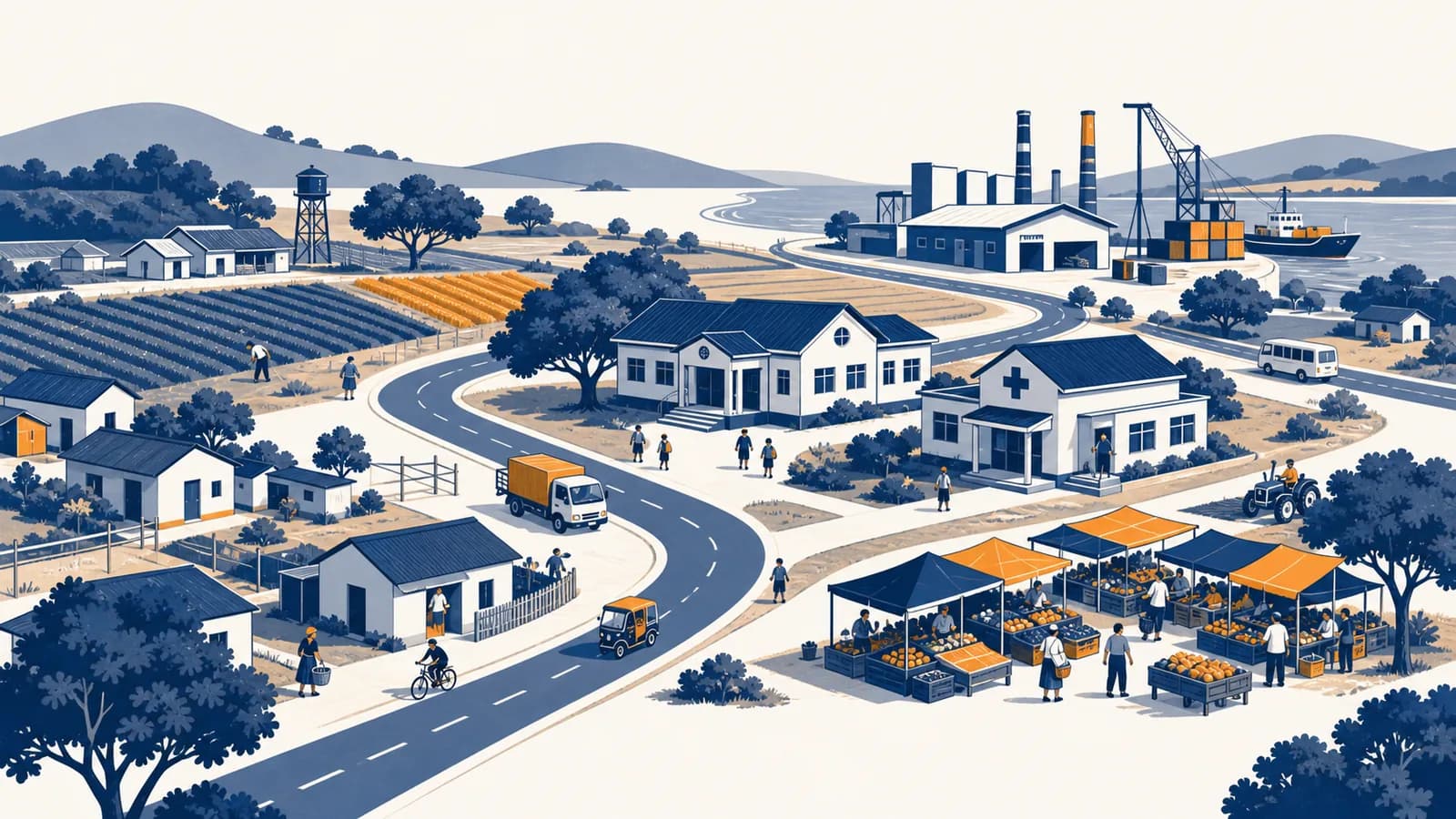
Poverty and economic development is a field of study that explains why people lack the resources for a decent standard of living and how economies can expand their capabilities, incomes, and opportunities over time, in the context of economics. Poverty can mean low income, unmet basic needs, or exclusion from choices that others can make. Economic development means lasting improvements in living conditions, not simply more money changing hands. The field exists because production and income can grow without reaching everyone, while poor health, weak infrastructure, and unequal access to education can stop people from contributing to growth.
Imagine two families with the same weekly cash income. One lives near a free clinic, a reliable bus route, clean water, and a good school. The other pays for drinking water, loses work hours reaching a distant clinic, and cannot depend on electricity. Their incomes match, but their real opportunities do not. Development economics studies that gap, asks what causes it, and tests which changes actually improve people's lives.
What poverty actually is
Poverty is a condition in which a person or household lacks enough resources to meet a defined standard of living. The definition depends on the standard used, the prices people face, household needs, and whether the measure counts income alone or direct deprivations.
An absolute poverty line sets a minimum level of resources intended to represent basic needs. A household is counted as poor if its measured income or consumption falls below that line. A relative poverty line moves with the typical income in a society. It identifies people whose resources are far below the social norm, even if they can meet some basic physical needs.
Compares resources with a fixed basic-needs standard that is updated for prices. It is useful for tracking severe material hardship over time.
Compares resources with the income or living standard common in the same society. It is useful for examining exclusion and inequality.
Income is not the only possible resource measure. Many economists prefer household consumption, the value of food, housing, services, and other goods actually used. Consumption may change less than income from month to month because families save, borrow, receive gifts, or use crops they grew themselves. Yet consumption surveys can miss shared public services and unpaid care work.
Poverty can also be multidimensional. A child may live in a household above an income line but still lack safe water or regular schooling. A multidimensional measure selects several deprivations, sets a cutoff for each, and combines them according to stated weights. The result depends on those choices, so a responsible report shows the indicators and cutoffs rather than treating the final index as a natural fact.
A poverty line is a measuring rule, not a wall in real life. A household one unit above the line can face almost the same hardship as one unit below it.
How poverty measurement works
Poverty measurement works by choosing a welfare indicator, adjusting it so households can be compared, setting a poverty threshold, and summarizing how many people fall short and by how much. Each choice answers a different question and can change the result.
A survey may record income, consumption, or direct access to necessities. Researchers must decide how to value home-grown food, housing, public services, and transfers.
Resources are divided across household members, often with adjustments for different needs and shared costs. Prices must also be adjusted across places and dates.
The selected poverty line is compared with each person's or household's adjusted resources. This identifies who is below the chosen standard.
The headcount ratio shows prevalence. The poverty gap shows the average distance below the line and therefore adds information about depth.
The simplest statistic is the headcount ratio. If 18 people in a surveyed group of 100 live below the line, the ratio is 18 divided by 100, or 18 percent. It treats every poor person equally, however far below the line each person is.
If 18 of 100 people are below the line, , or 18 percent.
The poverty gap records how far each poor person's resources fall below the line, expresses that shortfall as a fraction of the line, and averages it across the full population. Suppose the line is 100 units. In a population of four, two people have 80 and 60 units while two are above the line. Their normalized gaps are 0.20, 0.40, 0, and 0. The average gap is 0.15. This does not mean a payment equal to 15 percent of the line would automatically end poverty, since delivering aid has costs and behavior or prices may change. It does show that the group's total measured shortfall equals 15 percent of the poverty line per person.
Absolute poverty versus relative poverty
Absolute poverty asks whether resources meet a basic minimum, while relative poverty asks how far a person falls below the living standard common around them. Neither measure cancels the other because material survival and social participation are different questions.
Consider a country where every household's real income doubles and prices do not change. With a fixed absolute line, many households may move above poverty. If the relative line is set as a constant share of median income, it also doubles. The relative poverty rate could remain unchanged if the whole income distribution doubles proportionally.
This difference explains why two accurate reports can describe apparently conflicting trends. One may say severe material poverty fell. Another may say relative poverty stayed level. The first reports progress against a fixed standard. The second reports that the distance between low-income households and the middle of society did not narrow.
A headline says poverty rose after prices increased. Check whether the line was adjusted for inflation, whether income is measured before or after taxes and benefits, and whether the unit is a person or a household. Those details can change both the level and the trend.
Price changes deserve special care. How inflation changes purchasing power explains why a household can receive more money yet afford fewer goods. If food prices rise faster than other prices, a general inflation adjustment may understate the pressure on families whose budgets are dominated by food.
What economic development actually is
Economic development is a sustained expansion of people's material living standards and practical capabilities, supported by changes in productivity, institutions, health, education, infrastructure, and economic structure. Growth in output can contribute to development, but output alone does not define it.
Economic growth usually means an increase in real output or real output per person. Development asks broader questions. Are children surviving and learning? Can workers reach productive jobs? Do homes have sanitation and reliable energy? Can people start firms, enforce contracts, obtain credit, and participate in public decisions? These outcomes are related to income, but none follows automatically from a larger national total.
The arrows can run in both directions. Higher income can fund better nutrition and schooling. Better health and schooling can raise future productivity. Reliable tax revenue can finance roads and clinics; those services can make firms and workers more productive, expanding the future tax base. Development often accelerates when several parts reinforce one another.
The national accounts still matter. What GDP measures and leaves out shows how economists total marketed production and why unpaid work, distribution, environmental damage, and many quality changes require separate evidence. GDP per person is useful as one instrument on a dashboard, not the whole dashboard.
How productivity turns into development
Productivity turns into development when workers and firms produce more valuable output per unit of labor or other input, then households and public institutions convert part of the resulting income into nutrition, security, services, skills, and further productive investment.
Productivity can rise because a farmer gains irrigation and improved storage, a factory reorganizes its workflow, a nurse receives a reliable medicine supply, or a transport network connects sellers with a larger market. The mechanism is specific: fewer crops spoil, machines sit idle for less time, treatment succeeds more often, or workers specialize because trade reaches more customers.
A paved road cuts the time and vehicle damage involved in reaching town. Traders can offer farmers a better farm-gate price because transport costs fall. More buyers may enter, reducing one trader's bargaining power. Farmers may then invest in crops that would have spoiled on the old route. The road helps only if it remains usable, markets are accessible, and producers can respond.
Extra output does not guarantee broad improvement. Owners may keep most of the gain. A government may collect little tax, spend poorly, or exclude certain districts. A new mine can raise exports while creating few local jobs and polluting water. Economists therefore trace who receives income, who bears costs, which public services improve, and whether the productive change can last.
Every development choice has an alternative use. Funding a rural road may mean postponing an urban hospital upgrade. How economists compare sacrificed alternatives gives the logic for judging that tradeoff. The right comparison is not a project's benefits against zero. It is the project's net benefits against the best feasible alternative.
If ten workers raise weekly real output from 500 to 650 units, output per worker rises from 50 to 65 units.
The arithmetic identifies a gain, but explanation requires more. Did workers gain better tools, work longer hours, or shift toward a higher-value product? Did quality change? Were natural resources depleted? Development analysis connects the ratio to the production process and to the people affected.
How poverty and development reinforce themselves
Poverty can reproduce itself when low resources today reduce tomorrow's earning capacity, while development can accelerate when rising resources support further investment. These feedback processes depend on household constraints, market access, public institutions, and exposure to shocks, so their causes must be tested.
A worker paid by the day may delay treatment because the clinic fee and lost wage are unaffordable. The illness worsens, causing more missed work and a larger bill. A farmer without savings may use a low-yield crop because failure would be disastrous, even though a riskier crop has a higher average return. A talented student may leave school because the household needs income immediately. Each choice can be sensible under severe constraints while producing a worse long-run result.
Credit and insurance markets could break these loops, but they often work poorly where information is limited and courts are costly. A bank cannot easily observe a borrower's effort or seize collateral that does not exist. An insurer may struggle to verify a crop loss that affected an entire region. Interest rates then rise, coverage disappears, or lenders ration loans.
Not all persistent poverty is a self-contained trap. Low wages may reflect discrimination, land rules, conflict, weak demand, or geographic isolation. A temporary transfer helps if the binding constraint is a one-time shortage. It may have little lasting effect if a school has no teachers or a monopoly controls access to the market. Diagnosis comes before policy.
Institutions and markets set the rules for development
Institutions and markets shape development by setting the rules for ownership, exchange, public authority, competition, and collective action. They influence which investments are safe, who can enter an occupation, how disputes are settled, and whether public resources produce usable services.
An institution is not only a government office. It includes formal laws and informal rules, such as inheritance customs, business norms, and community systems for sharing water. Secure rights can encourage investment because a household expects to keep the benefits. Yet security for one group can mean exclusion for another, especially when formal titles replace overlapping customary rights.
Markets coordinate millions of choices through prices, but a market can fail to produce an efficient or fair result. Education creates benefits beyond the student. Pollution imposes costs on people outside a transaction. A lender knows less than a borrower about repayment risk. A single buyer may dictate wages in an isolated town. These mechanisms justify possible action, but they do not prove that any proposed action will work.
Private decisions leave gains unrealized or impose outside costs because of information problems, external effects, market power, or missing markets.
Public action wastes resources or favors connected groups because officials lack information, face weak accountability, or respond to distorted incentives.
Good policy compares imperfect alternatives. A fertilizer subsidy may raise use but benefit larger farms most. Public distribution may reach remote farmers but suffer theft or late delivery. Cash support may preserve choice but fail if local supply is fixed and prices jump. Design, administration, and local conditions determine the result.
How poverty policy shows up in real decisions
Poverty policy appears in decisions about cash transfers, taxes, schools, clinics, housing, transport, labor rules, credit, and disaster protection. Each policy changes resources or incentives through a distinct channel, so evaluation must track delivery, behavior, prices, and final living conditions.
Cash and in-kind support solve different problems
Cash transfers increase a household's purchasing power, while in-kind programs provide a selected good or service directly. Cash preserves choice and is usually simpler to compare across uses. Direct provision can make sense when markets are absent, supply quality is hard to judge, or society wants to guarantee access to a particular service.
Targeting support to households below a cutoff saves funds in theory, but measurement is imperfect. Some eligible people are excluded because they lack documents or have irregular income. Some ineligible people are included because records are old or income is hidden. A universal program reduces screening errors but pays people who do not need support, so its cost and tax financing must be considered.
Public services change both welfare and production
A vaccination program directly protects health and can reduce missed school and work. A clean-water system reduces time spent collecting water and exposure to disease. A school meal can relieve hunger now while helping a student attend and concentrate. These programs affect present well-being and future productive capacity through separate channels.
Jobs policy must follow labor demand
Training raises employment only when people learn useful skills and employers demand them. A course can have high completion and still produce no earnings gain. Public works can provide temporary income and build assets, but the work schedule, wage, location, and quality of construction decide who participates and what remains afterward.
Delivery is part of the policy. A benefit that arrives after the hungry season, a clinic without medicine, or a loan that requires an unobtainable document is different from the program described on paper.
Evidence should test a causal chain
A sound evaluation asks whether the program reached people, changed the expected intermediate behavior, and improved the final outcome. Random assignment can estimate a causal effect in some settings. Natural experiments, phased rollouts, comparison groups, interviews, administrative records, and cost analysis can answer other parts. A result from one place is evidence, not a universal law.
Poverty appears in jobs, news, and daily life
Poverty appears outside school whenever wages, prices, time, location, health, or public services restrict real choices. It is visible in a household budget, a loan decision, a city zoning dispute, a company supply chain, and a news claim about growth.
A social worker encounters eligibility thresholds and missing documentation. A public-health team maps where travel time prevents clinic use. A bank officer considers income volatility and collateral. A transport planner estimates which neighborhoods gain access to jobs. A journalist checks whether a reported fall in poverty reflects higher real resources, a revised poverty line, or a changed survey.
In that arithmetic example, counting only the 12 paid hours hides the five unpaid hours needed to reach and wait for work. Childcare, unsafe travel, unpredictable shifts, and the risk of losing another benefit can further change the real return. This is why economists examine constraints around a choice rather than assuming that an available job is accessible.
Businesses meet development questions in hiring, pricing, procurement, and site selection. A company can create wages and training, but it can also shift pollution or risk onto workers with little bargaining power. Supply-chain audits therefore need evidence about pay, hours, safety, worker voice, and subcontracting, not a single label such as “job creation.”
At home, poverty economics helps explain why buying a small quantity at a high unit price can be rational when cash, storage, or transport is limited. It also explains why a late fee can trigger more fees when income timing is unstable. What looks like poor planning may be the cost of having no financial buffer.
Four mistakes people make with development
Four common mistakes are treating one poverty line as a complete description, equating GDP growth with development, blaming constrained people for costly choices, and judging a policy by intentions or averages alone. Each mistake hides a mechanism that changes the conclusion.
1. Treating everyone below a line as equally poor
The headcount identifies how many people cross a threshold, not the depth of their shortfall. A policy could give a small payment to those just below the line and reduce the headcount while leaving the poorest households unchanged. Report the poverty gap and distribution alongside the count.
2. Equating more GDP with broad development
Output can rise in an industry that employs few people, sends profits abroad, or causes unpriced damage. Ask how real income per person changed, how gains were distributed, which services improved, and which costs were omitted. Growth can fund development, but the conversion requires institutions and choices.
3. Calling expensive choices irrational
A household may buy food daily because it lacks a refrigerator, reject a distant job because transport is unreliable, or avoid a productive investment because failure threatens its home. Add the missing constraints before judging the choice. Removing one constraint can change behavior without a lecture.
4. Judging policy by enrollment or an average effect
Enrollment shows use, not success. An average effect can also conceal different outcomes by gender, disability, region, initial income, or exposure to conflict. Examine final outcomes, costs, unintended effects, and who gained. Then compare the program with a realistic alternative use of the same resources.
Can growth reduce poverty without reducing inequality?
Growth can reduce absolute poverty while inequality stays constant or rises if low-income households receive enough real income to cross a fixed poverty line. The distribution of gains still matters because it determines the speed, reach, and political durability of poverty reduction.
Suppose four incomes are 20, 40, 80, and 160 units, with an absolute line of 50. Now every income doubles to 40, 80, 160, and 320. One of the two initially poor people crosses the line, so absolute poverty falls. The proportional gaps between incomes remain the same, so a scale-invariant inequality measure need not change.
If the top income instead grows much faster, the lowest income can still rise above the fixed line while inequality increases. That is not a contradiction. Poverty measures the shortfall from a standard; inequality measures dispersion across the distribution. Policy debates become clearer when speakers name which outcome they mean.
Does foreign aid cause development?
Foreign aid can finance useful goods, services, knowledge, or emergency relief, but it does not cause development by itself. Its effect depends on the problem addressed, recipient priorities, delivery system, local capacity, political incentives, time horizon, and alternative funding uses.
Aid for vaccines faces a different causal chain from budget support or a power station. The first needs supply, cold storage, trained staff, trust, and access. The second depends on public financial systems and political accountability. The third requires maintenance, a working grid, suitable pricing, and firms or homes able to connect.
Emergency aid may be successful because it prevents hunger or disease during a crisis, even if it does not raise long-run productivity. Development aid needs a longer test: did local organizations gain the ability and finance to continue the service? A project can deliver immediate benefits while creating dependency on imported parts, or it can transfer skills and fit an existing system. The label “aid” reveals none of this.
Is poverty mainly about money?
Poverty is partly about money because income buys food, shelter, transport, and choice, but it is also about services, time, security, rights, health, and power. Money measures many options well, while direct indicators reveal needs that markets or household totals can hide.
Cash cannot buy clean water if no safe supply exists. A household income total does not show whether one member controls the money. A person with a disability may face extra costs to reach the same standard of living. Someone living under threat of eviction may have adequate current consumption but little security.
This does not make income irrelevant. It means analysts should match measures to decisions. Cash income may be best for setting a tax credit. Travel time and clinic staffing matter for health access. Learning assessments matter for education quality. Food intake and growth measures can reveal nutrition problems. A good dashboard stays small enough to interpret and broad enough to catch the main deprivations.
The takeaway: Poverty is a shortage of real options produced by resources, prices, services, risks, and rules. Economic development expands those options through higher productivity and broader access, but every claimed improvement should be checked against who gained, by how much, and at what cost.
Development economics connects choices to living standards
Development economics connects household choices, market incentives, public institutions, and national production to changes in living standards. It asks where a constraint enters the chain, what response it causes, and which evidence would show that a proposed remedy worked.
The subject is useful because the same headline outcome can come from different mechanisms. Low school attendance might reflect fees, travel danger, poor teaching, illness, household labor needs, or doubt that education will lead to work. Each cause suggests a different response. Building more classrooms will not solve every one.
When you see a claim that a country, city, or household is “developing,” look for the nouns and verbs behind it. Which incomes rose? Which prices changed? Who gained reliable water, safer work, useful skills, or more control over time? Then ask what was sacrificed and whether the change can continue. Those questions connect this topic with the wider study of economic choices and systems, and they turn a broad promise into something that can be measured and tested.