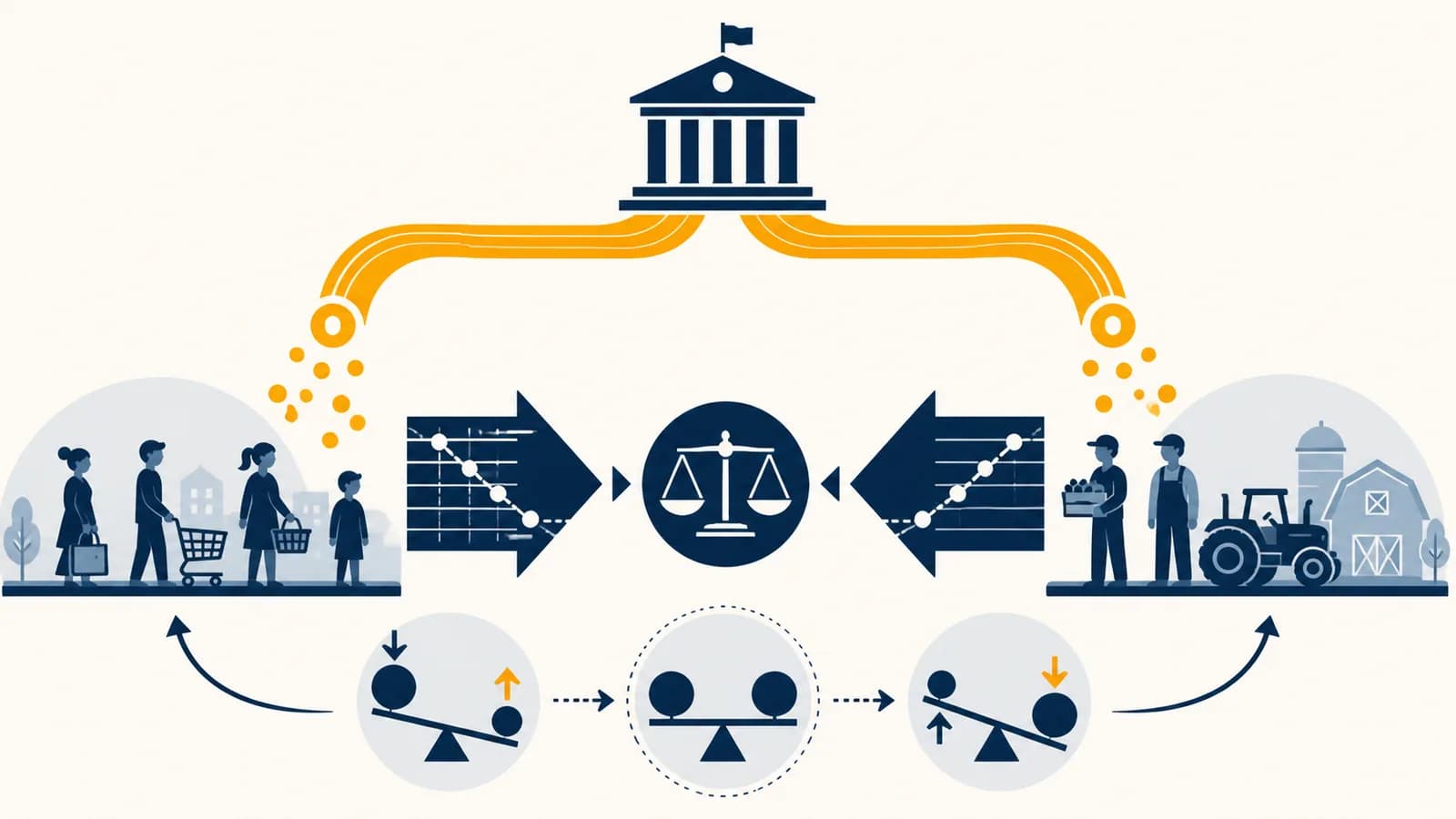
A subsidy is a government benefit that lowers a cost, raises an income, or encourages an activity, in the context of economic policy. A subsidy can be a cash payment, tax reduction, cheap loan, price guarantee, or government service. In supply and demand, it changes the price faced by buyers or sellers and usually increases the quantity traded. Governments use subsidies because markets can underprovide useful activities, because elected officials want to protect certain incomes, or because policy makers want faster change than an unassisted market would produce.
A bus fare discount, a grant for installing insulation, a payment to a farmer, and a tax credit for research can all be subsidies. The recipient named on the form is not necessarily the person who gains most. Prices adjust, production changes, and some of the benefit can pass to workers, landlords, suppliers, or customers. That chain of effects is what makes subsidies an economics problem rather than simply free money.
What a subsidy actually is
A subsidy is any government policy that gives a selected activity an economic advantage by reducing its private cost or increasing its private return. The advantage may appear as money paid out, tax not collected, risk absorbed, or a service supplied below cost.
The word describes a function, not one particular form. A government may send a producer a payment for every unit sold. It may let a household subtract part of an eligible purchase from its tax bill. It may guarantee a loan, allowing a borrower to obtain a lower interest rate because the government accepts some risk. It may also buy a product at a guaranteed minimum price or provide inputs such as training, insurance, land, or infrastructure on favorable terms.
Economists often separate producer subsidies from consumer subsidies. That classification tells us who receives the first payment or discount. It does not settle who keeps the final benefit. A grant sent to a child care provider may support the provider's income, lower the fee paid by parents, raise staff wages, or produce some mixture of all three.
A subsidy also has a boundary. A general rule available to every business, such as ordinary deduction of business expenses, is less selective than a special credit for one industry. Analysts may disagree about where the normal tax system ends and a tax subsidy begins. A clear analysis therefore names the policy, the eligible group, the benefit, and the comparison being used.
How a per-unit subsidy works
A per-unit subsidy creates a gap between the price a buyer pays and the amount a seller receives. Because each sale now brings extra value, buyers demand more, sellers supply more, or both; the market moves to a new equilibrium with a larger quantity.
The unit might be one kilowatt-hour of renewable electricity, one bus trip, one vaccine dose, or one hectare managed in a specified way. Rules determine which transactions count.
If the subsidy is paid to sellers, the amount received equals the buyer's price plus the subsidy. If it is paid to buyers, their net cost equals the seller's price minus the subsidy.
A lower effective price attracts buyers. A higher effective return attracts sellers. The degree of response depends on available substitutes, spare capacity, time, and other costs.
The posted price may rise or fall, but the buyer's net price and seller's net receipt remain separated by the subsidy for every qualifying unit.
Suppose a bicycle repair normally costs $60. A city offers customers a $20 voucher that repair shops can redeem. More customers now seek repairs. If shops have limited appointment slots, they may raise the posted price to $68. The customer pays $48 after the voucher, while the shop receives $68. The customer gains $12 relative to the original $60 price, and the shop gains $8. The $20 benefit has been divided through a price change.
If the buyer pays and the subsidy is , the seller receives .
The payment route does not erase the wedge. Sending the voucher money to the shop instead of the customer changes the paperwork, but not the basic market mechanism. Legal rules matter for access and administration; supply and demand determine how the economic benefit is shared.
How a subsidy changes price and quantity
A subsidy normally lowers the buyer's effective price, raises the seller's effective return, and increases the quantity exchanged. On a supply and demand diagram, it shifts the relevant curve by the subsidy amount, creating a new equilibrium and a cost to government.
In the standard competitive model, a producer subsidy lowers the marginal cost that firms must cover from customers. The supply curve shifts downward by the amount paid per unit. At the old quantity, sellers are willing to accept a lower market price because the subsidy supplies the missing revenue. Competition then carries the market toward a larger quantity.
Consider a simplified market in which monthly demand is and supply is . Without a subsidy, buyers and sellers face the same price. Setting demand equal to supply gives , so the price is $60 and the quantity is 40.
Now add a $20 subsidy per unit. Sellers receive . Equilibrium requires . The buyer price becomes $50, the seller receives $70, and quantity rises to 50. Buyers gain $10 per unit and sellers gain $10 per unit in this deliberately symmetric example.
With a $20 subsidy and 50 eligible units, expenditure is .
The final cost can rise for two reasons: the payment per unit may be large, and the subsidy itself may bring more units into the program. A budget estimate based only on last year's quantity can therefore be too low. Quantity caps, fixed appropriations, and declining payment rates are ways to limit this uncertainty.
Who actually receives the benefit?
The economic benefit goes to the side of the market that changes its quantity less when price changes. This is subsidy incidence: the less price-responsive side can claim more of the subsidy through a more favorable price, regardless of who receives the government payment.
Price responsiveness is measured by elasticity. If housing supply cannot expand quickly, a rent subsidy may increase tenants' purchasing power while also allowing rents to rise. Landlords can capture part of the benefit because the number of homes changes little in the short run. If repair shops can easily add hours and competitors, by contrast, a repair voucher is more likely to reduce customers' net prices.
The same reasoning applies to producer aid. A wage subsidy paid to employers might raise worker pay, reduce employer labor costs, increase employment, or combine these effects. The outcome depends on how readily workers enter the labor market and how readily employers change hiring. The guide to how demand and supply respond to price gives the tool used to predict this division.
The person or organization named by law, such as a buyer who claims a credit or a producer who redeems a voucher.
Anyone whose price, income, asset value, or opportunity changes after the market adjusts. There may be several beneficiaries.
Time changes incidence. Supply that is fixed this month may expand over several years. A training subsidy could initially raise the wages of already qualified trainers because places are scarce. Later, new training firms and instructors may enter, increasing capacity and passing more of the benefit to students. Any claim about who gains should therefore state the time period.
Follow the price, not the cheque. The legal recipient tells you where public money enters. Changes in prices and quantities tell you where its value ends up.
Asset prices add another route. If a subsidy is expected to continue, ownership of an eligible asset may become more valuable. Future support can be capitalized into the selling price of farmland, a taxi licence, or specialized equipment. A later buyer may pay for the expected subsidy in advance, leaving much of the gain with the owner who sells.
Subsidies versus price controls
A subsidy changes incentives by adding public money or another benefit to a transaction, while a price control directly limits the price that may be charged or paid. Both can make a good appear cheaper, but they create different shortages, costs, and enforcement problems.
Suppose the market price of a bus trip is $4. A $1 passenger subsidy lets the operator still receive $4 while the passenger pays $3. If demand rises, the operator has a reason to add service because each eligible passenger still brings revenue. Government must fund the $1 difference.
A price ceiling of $3 instead forbids a higher fare. It lowers the passenger's legal price without automatically replacing the operator's lost dollar. If the operator cannot cover the service's marginal cost, it may reduce routes, frequency, or maintenance. A government can combine a price ceiling with an operating subsidy, but those are two distinct policies with two distinct effects.
Creates a gap between the buyer's cost and seller's receipt. It usually increases quantity, requires funding, and can be limited by eligibility rules.
Sets a legal maximum or minimum price. If binding, it can prevent the market from clearing and require rationing, purchasing, or enforcement.
A subsidy is also different from a government purchase. If a government pays a laboratory to test public water samples for government use, it is buying a service. If it pays part of every household's private test fee to encourage more testing, it is subsidizing household purchases. Real programs may contain both elements, so the purpose and the buyer matter.
How subsidies show up in bills, purchases, and work
People encounter subsidies as discounted prices, tax credits, subsidized loans, employer reimbursements, public services, and eligibility rules. The benefit may be visible on a receipt, arrive months later through a tax return, or remain hidden inside a provider's lower cost.
A household compares two heaters. One costs $1,800 and has no credit. An efficient model costs $2,200 and qualifies for a $600 credit. If the household can claim the full amount, its net purchase cost is $1,600. The efficient model becomes $200 cheaper before future energy use is considered.
This example shows why timing and eligibility matter. A point-of-sale rebate reduces the amount needed today. A refundable tax credit can produce a payment even when the claimant owes little tax, subject to the program's rules. A nonrefundable credit can only reduce tax liability, so a household with insufficient liability may not receive its full stated value. Two policies with the same headline amount can therefore reach different people.
At work, a subsidy may affect hiring or training without appearing on a pay slip. A government might reimburse an employer for part of an apprentice's wage or training cost. The employer faces a lower initial cost and may create a place that otherwise looked too risky. The apprentice gains work experience, while the employer may keep part of the benefit through lower net labor cost.
Loans can carry a subsidy through interest or risk. If government guarantees repayment to a lender after a qualifying default, the lender may offer credit at a lower rate or to a riskier borrower. The subsidy is not the whole loan principal. It is the economic value of the guarantee, including expected losses and financing effects, compared with an equivalent unguaranteed loan.
Public transport, education, health care, energy, food, housing, and cultural institutions may all receive support. The useful question is not simply, “Is this subsidized?” Ask what an unsubsidized user would pay, who covers the gap, which action earns support, and what happens when more people respond.
How subsidies show up in jobs, labs, news, and law
Outside household budgets, subsidies appear in business plans, research grants, trade disputes, legislation, and news about industrial policy. Analysts trace eligibility, market responses, public cost, and measurable outcomes rather than treating the announced payment as the complete effect.
Businesses treat a subsidy as one input to a decision
A firm's managers compare expected revenue with labor, materials, finance, compliance, and opportunity costs. An investment credit can turn a project with a small expected loss into one with a small expected profit. It can also reward a project the firm already planned to complete. Economists call that second case inframarginal support: public money changes the recipient's finances but not its action.
Good program design tries to influence the margin, meaning the borderline decision. Competitive applications, evidence of additional activity, time limits, and payments tied to verified output can reduce payments for business as usual. Each safeguard adds administration and may discourage genuine applicants, so there is a tradeoff between precise targeting and simple access.
Laboratories use subsidies to support spillover-producing research
Research can create knowledge that other firms and scientists use without paying the original inventor for every benefit. Because the private return may be below the total social return, firms may invest less than society would prefer. Grants and research tax credits try to narrow that gap. This logic resembles the problem explained in how shared benefits can be underprovided, although not every research result is a pure public good.
A grant reviewer still needs to ask what would happen without support. Funding the best proposal may produce valuable science but add little if that work had another willing funder. Supporting an uncertain early experiment can create more additional research, but it also carries a higher chance of failure. Failure alone does not prove poor design because experiments are meant to test uncertain ideas.
News reports often mix announced value with actual cost
An announcement may state the maximum size of a program, the value available over many years, or the amount conditional on future investment. Actual public cost may be smaller if fewer applicants qualify. It may be larger if participation is uncapped and demand exceeds forecasts. Read the unit, time period, conditions, and payment trigger before comparing two announcements.
Law turns a policy aim into eligibility tests
Legislation and regulations specify who qualifies, which expenses count, when claims expire, and what evidence recipients must retain. Tiny definitions can redirect large amounts of behavior. If a clean energy credit applies only after equipment begins operating, firms may race to complete projects. If it depends on domestic content, firms may change suppliers as well as energy technology.
Trade law adds another layer because one country's producer support can affect competitors abroad. A subsidy that expands exports may lower world prices, help foreign consumers, and harm unsubsidized foreign producers. Trade disputes therefore examine both the form of support and its effect on competition.
How governments decide whether a subsidy is worthwhile
Governments assess a subsidy by comparing all social benefits with all social costs, including behavior that changes, behavior that would have happened anyway, administration, distribution, and the cost of raising funds. A high participation rate alone does not show success.
The strongest economic case usually begins with a market failure. Pollution imposes costs on people outside a transaction. Education, vaccination, and research can create benefits beyond the buyer. Credit markets may struggle to price a new technology with little history. A carefully designed subsidy can move private incentives toward wider social value.
Count benefits and costs caused by the policy, not every activity associated with recipients.
Suppose a $300 insulation rebate causes work that avoids $240 worth of energy production costs and prevents $140 of pollution damage. Ignore other effects for this small example. The gross social benefit is $380. If installation uses $250 of labor and materials that could have produced something else, net social benefit is $130. The $300 government payment is mainly a transfer between taxpayers and the household, though the administration and tax collection needed to fund it can create additional real costs.
This distinction prevents double counting. Adding the household's $300 rebate to its $240 energy saving would treat transferred money as newly created wealth. The subsidy changes who pays and can cause a useful action, but the cheque itself is not a new machine, skill, or saved unit of energy.
Jobs are a cost as well as a benefit. Employment can help workers gain income and experience, but labor used by a subsidized project is unavailable for another activity. Count genuine gains such as reduced unemployment or better matching, not every wage payment as free value.
Distribution is a separate test. A policy can produce a positive total benefit while directing gains toward high-income owners. Another can be costly in aggregate yet be defended as emergency relief for people facing sudden hardship. Economic evaluation makes these goals explicit. It does not pretend that efficiency alone chooses the policy.
Evaluation should compare recipients with a credible estimate of what would have happened without the program. A before-and-after rise is weak evidence if prices, technology, or unrelated laws changed at the same time. Phase-ins, eligibility cutoffs, pilot programs, and matched comparison groups can help isolate the subsidy effect.
How subsidies are paid for
Subsidies are financed through taxes, borrowing, reduced spending elsewhere, or revenue from another policy. Even a tax credit that never appears as a cash outlay lowers government revenue, so its opportunity cost belongs in the budget and in the economic analysis.
A direct grant appears as expenditure. A tax credit often appears as reduced revenue, sometimes called a tax expenditure. A loan guarantee may cost little at first but expose the government to future claims. A price guarantee can create a contingent liability: no payment is needed while market prices stay high, but public cost rises if prices fall below the guarantee.
Borrowing can spread cash payments across time, but it does not make resources free. Interest and repayment enter later budgets. Persistent programs can therefore connect to how public revenue and spending create deficits or surpluses. The exact budget effect depends on accounting rules, take-up, timing, and any extra tax revenue caused by added activity.
A town offers 2,000 transit passes with a subsidy of $15 per pass. If every pass is claimed, the direct payment is . If administration costs $4,000, the recorded program outlay is $34,000 before considering any changes in fare revenue or taxes.
Opportunity cost asks what the same public funds could have accomplished elsewhere. A dollar used for a broad fuel subsidy cannot simultaneously pay for a targeted transport credit, road repair, debt interest, or lower taxes. Budget debate is therefore part of subsidy analysis, not an afterthought.
What happens when a subsidy ends?
When a subsidy ends, the price wedge closes, effective costs rise for the previously supported side, and quantity usually falls toward the unsubsidized level. The speed and disruption depend on notice, contracts, investments made under the policy, and available alternatives.
A temporary purchase credit may bring future sales forward. Buyers rush to qualify before the deadline, producing a spike followed by a dip. That pattern does not mean every subsidized sale was newly created. Some transactions simply changed date. An evaluator should examine a long enough period to detect this timing shift.
Long-running support can shape factories, land values, skills, and borrowing. Sudden removal may strand specialized equipment or leave households with commitments they made under the old rules. Gradual phaseouts reduce shock and allow adjustment, but they can also prolong weak programs and invite lobbying for extensions.
A credible exit rule can improve decisions at the start. Policy makers can set a date, a spending cap, a trigger based on market conditions, or a payment that declines as costs fall. Reviews should test outcomes, not simply confirm that money was distributed according to the rules.
Can a subsidy lower inflation?
A subsidy can lower the measured price of a targeted good for a time, but it does not automatically reduce economy-wide inflation. Its broader effect depends on funding, supply response, demand, duration, and how much the subsidized item weighs in the price index.
If government pays part of household electricity bills, the price recorded for households may fall while the policy lasts. Taxpayers or future taxpayers still finance the gap. If electricity supply cannot increase, extra purchasing power may put upward pressure elsewhere or raise the subsidy budget. If support finances new generation or efficiency, it may expand supply and reduce cost pressure later.
Inflation is a continuing rise in the general price level, not a single item's price change. A one-time subsidy can create a one-time reduction in a measured index, followed by a rise when support expires. Monetary conditions, wages, expectations, exchange rates, and productive capacity still influence the wider path. The question requires a time horizon and a funding mechanism, not a simple yes or no.
Four mistakes people make with subsidies
Four common mistakes are treating the legal recipient as the final beneficiary, treating every subsidized action as additional, ignoring public cost, and assuming a good goal guarantees a good program. Each mistake disappears when prices, alternatives, and changed behavior are traced carefully.
1. The named recipient keeps the whole benefit
A landlord may capture part of a tenant subsidy through higher rent. Customers may capture part of a producer subsidy through lower prices. Workers and suppliers can also gain. Incidence depends on responsiveness and time, so the application form cannot answer the distribution question.
2. Every supported purchase was caused by the subsidy
Some recipients would have made the same choice without help. If 100 households claim a credit but 70 would have bought the product anyway, only 30 purchases are additional in this simplified example. Dividing total spending by all 100 purchases understates the public cost per additional purchase.
3. A lower checkout price means no one bears the cost
The gap is paid through the public budget, accepted as risk, or shifted to another group. That may be justified, but it must be counted. A clear statement names the payer, the timing, and the alternative use of funds.
4. A worthy objective makes any subsidy effective
Support for clean air can still reward activity that would happen anyway. Aid for housing can raise rents where construction is blocked. Research support can be captured by firms that relabel ordinary spending. Goals must be matched with eligibility, market capacity, monitoring, and an exit rule.
The takeaway: Judge a subsidy by the behavior it changes, the people who ultimately gain, the real resources it uses, and the result compared with a credible no-policy alternative.
Subsidies turn public goals into changed incentives
Subsidies connect public choices to individual decisions by changing relative costs and returns. Their effects belong to economics as a whole: scarcity limits the budget, elasticity divides the benefit, opportunity cost identifies what is displaced, and evidence tests the promised result.
The next time a subsidy appears in a bill, advertisement, job offer, or news report, write down five items: the eligible action, the payment per unit, the buyer's net price, the seller's net receipt, and the funding source. Then ask how quantity changes and which side can adjust least.
That short audit separates the policy's name from its mechanism. It also links subsidies to the wider set of economics concepts used in real decisions. A subsidy can correct a gap between private and social value, redistribute income, accelerate investment, or protect an industry. Only prices, quantities, costs, and a comparison with the alternative reveal which job it is actually doing.