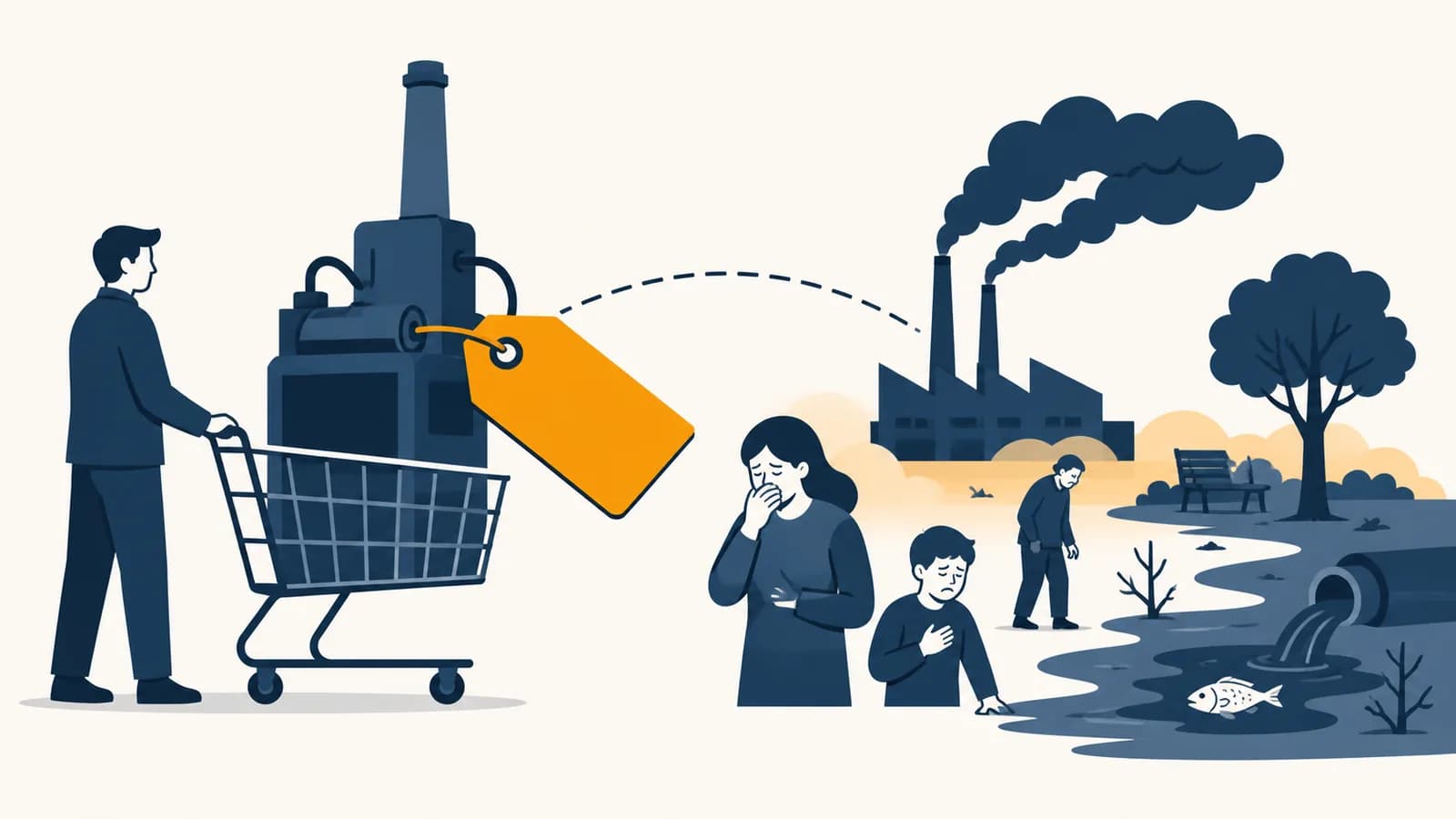
Market failure is an economic condition that prevents voluntary exchange from producing the most efficient allocation of resources, in the context of markets and social welfare. The meaning of market failure is not that a shop closes or a company loses money. It means market prices and private decisions leave some social costs or benefits uncounted. Externalities, public goods, information asymmetry, common resources, and market power are the main causes. The idea exists because a price can guide buyers and sellers well only when it reflects the full effects of their choices.
What market failure actually is
Market failure occurs when the quantity produced or consumed in a market differs from the quantity that would maximize total social surplus. The failure lies in the incentive system: private decision-makers face prices that do not represent every cost and benefit their actions create.
A competitive market performs a coordinating job. A buyer compares the benefit of one more unit with its price. A seller compares that price with the cost of producing one more unit. Trades continue while both sides expect to gain. Under strict conditions, this process moves resources toward uses where they create more value.
The word failure identifies a gap between two outcomes. The market outcome is what self-interested buyers and sellers choose. The socially efficient outcome is the quantity at which the benefit of one more unit to everyone equals the cost of that unit to everyone. Those can differ even if every participant is informed, rational, and obeying the law.
A restaurant earns less revenue than it spends and closes. Resources can then move to uses customers value more. This may be painful, but it is not automatically market failure.
A factory's price excludes smoke damage borne by nearby residents. Buyers purchase more of its product than they would if the full social cost appeared in the price.
Efficiency is not a claim that everyone likes the result. An efficient allocation can still leave income distributed very unevenly. It can also be legal, stable, and unpopular. Market failure is therefore a specific diagnosis about lost gains from a different allocation, not a general name for any economic problem.
How an efficient market works
An efficient competitive market aligns private incentives with social value. Buyers reveal marginal benefit through willingness to pay, sellers reveal marginal cost through willingness to accept, and the price coordinates exchange until the last unit's benefit equals the resources used to produce it.
Marginal means the effect of one additional unit. Economists focus on marginal values because the choice is usually not between producing everything and producing nothing. It is between producing the next loaf, the next bus ride, or the next unit of electricity and stopping where production already stands.
Production is efficient where marginal social benefit, MSB, equals marginal social cost, MSC.
Suppose the tenth bicycle ride of the day gives a rider a benefit valued at $9 and uses electricity and equipment worth $6. That ride adds $3 to total surplus. Suppose an eleventh ride brings a $5 benefit but costs $6 to provide. Producing the eleventh ride would reduce total surplus by $1. Ten rides is efficient in this simplified example.
A market can find that point only under demanding conditions. Property rights must be reasonably clear. Buyers and sellers need useful information. No participant can control the price. The effects of production and consumption must fall on the people making the trade. Goods must also be excludable and rival enough for sellers to charge users. The standard model of how prices coordinate buyers and sellers shows the benchmark. Market failure explains what happens when one of its assumptions breaks.
If private values equal social values, the market quantity can be efficient. If a third party bears a cost, useful information is hidden, or access cannot be restricted, the flow loses information. The market still produces an answer, but its answer can be too high, too low, or poorly matched to users.
How externalities work
An externality exists when a production or consumption decision affects someone who is not part of the transaction and no payment captures that effect. A negative externality creates an unpriced cost, while a positive externality creates an uncompensated benefit.
Consider a laundry that releases dirty water into a river. The owner pays for workers, machines, soap, and electricity. If the owner does not pay for damage downstream, the business's private cost is lower than the full social cost. Its service can therefore look cheaper than it truly is to society.
If one wash has a marginal private cost of $7 and causes $3 of downstream harm, its marginal social cost is $10.
The laundry and its customer compare the price with the $7 private cost, not the $10 social cost. Some washes valued at $8 or $9 go ahead. Each seems beneficial to the participants, yet each destroys social surplus because its full cost exceeds its benefit. The result is overproduction.
A resident, worker, taxpayer, or future user experiences a cost or benefit without choosing the transaction.
The buyer's payment does not rise to cover the external cost, or the seller's revenue does not rise to reward the external benefit.
Decision-makers act on marginal private cost and benefit, while the efficient quantity depends on marginal social cost and benefit.
Negative externalities usually make the quantity too high. Positive externalities usually make it too low.
A positive externality reverses the direction. A person who gets vaccinated may reduce infection risk for other people as well as gaining personal protection. If those other benefits are not rewarded, the private willingness to pay is below the social benefit. Some beneficial vaccinations do not occur, so consumption is lower than the efficient level.
External does not mean distant. The effect can fall on a next-door neighbor. It is external because that person stands outside the bargain, not because the effect occurs far away.
Externalities can also come from consumption rather than production. A loud party imposes noise on neighbors. Careful home maintenance can protect adjoining property values. What matters is not the activity's category but the missing feedback between the affected person and the decision-maker.
How public goods and common resources fail
Public goods are non-rival and non-excludable, while common resources are rival but difficult to exclude people from using. Both weaken ordinary pricing: public goods invite free riding, and common resources invite overuse because each user ignores part of the cost imposed on others.
A good is rival if one person's use leaves less for someone else. It is excludable if a provider can stop a nonpayer from using it. These two properties predict which incentive problem appears.
| Type of good | Rival? | Excludable? | Typical market issue |
|---|---|---|---|
| Private good, such as a sandwich | Yes | Yes | Ordinary sale can work |
| Club good, such as a quiet toll road | No, until crowded | Yes | Access price can fund provision |
| Common resource, such as fish in open water | Yes | No | Users can take too much |
| Public good, such as a flood warning signal | No | No | Users can avoid paying |
With a public good, a person may hope others will pay while still expecting to receive the benefit. If many people reason that way, voluntary payments can be too small to fund the efficient amount. This is the free-rider problem. It does not prove that nobody will contribute. It predicts that the payment mechanism tends to understate total demand.
A coastal neighborhood wants a warning siren. Once installed, one resident hearing it does not prevent anyone else from hearing it, and excluding households that did not donate would be impractical. Each household can wait for others to fund the siren. The project may remain unfunded even when the combined benefit exceeds its cost.
A common resource creates a different incentive. Imagine an open grazing field. One herder gains nearly all the value from adding another animal, while the resulting loss of grass is spread across every herder. Each person has a reason to add animals even when the combined herd is already damaging the field. Individual choices are understandable, but their sum depletes the resource.
Technology and law can change a good's classification. Encryption can make digital content excludable. A gate can make a road excludable. A road that is non-rival at midnight may become rival during congestion. Public-good status is therefore about the practical properties of access and use, not a permanent label attached to an object.
How information gaps and market power distort choices
Information asymmetry distorts a market when one side knows facts the other cannot reliably observe, while market power distorts it when a buyer or seller can influence price. Both block mutually beneficial trades or change quantity away from the competitive level.
Hidden information changes who enters a market
Adverse selection occurs before an agreement because one side knows more about its type or risk. Suppose used-car owners know their cars' condition but buyers cannot distinguish reliable cars from defective ones. Buyers offer a price based on average expected quality. Owners of good cars may refuse that price, lowering the average quality of cars left for sale. Buyers then reduce their offers again. Useful trades disappear.
Hidden action changes behavior after an agreement
Moral hazard occurs after an agreement because protection changes incentives and some actions are hard to monitor. A fully insured driver may take less care because the insurer pays much of the financial loss from damage. Deductibles, monitoring, and contract conditions exist partly to keep some consequences with the decision-maker.
Market power restricts mutually beneficial exchange
A monopoly is a single seller protected from close competition by barriers such as control of an essential input, legal exclusivity, or very high entry costs. Instead of accepting a market price, the seller can raise price by restricting output. Units for which buyers' willingness to pay exceeds production cost may go unsold. That lost surplus is called deadweight loss.
A trade may fail because a buyer cannot tell a safe product from a dangerous one or cannot observe later behavior. Better signals, warranties, disclosure, and monitoring may help.
A trade may fail because one participant can set unfavorable terms without losing enough business. Entry, competition rules, or price regulation may help.
The problems can interact. A dominant platform may know more than users about how it ranks products. A lender may lack information about a borrower while also holding bargaining power. Correct diagnosis matters because disclosure does little to fix a physical entry barrier, and adding competitors does not automatically reveal a product's hidden safety defects.
Market failure versus an unfair outcome
Market failure concerns efficiency, while unfairness concerns how income, opportunity, risk, or power is distributed. An outcome can be efficient but unequal, or inefficient but relatively equal. Public policy often addresses both, but the evidence and remedy for each question are different.
Suppose a scarce concert ticket goes to the person willing to pay the most. If that person values it most highly, the exchange can be efficient under the market's existing distribution of income. Yet many people may judge the result unfair because ability to pay depends on wealth. Efficiency alone does not settle that moral and political judgment.
Now suppose a factory pollutes a low-income neighborhood. This case can contain both problems. Pollution is inefficient if the unpriced harm pushes output above the socially efficient quantity. The unequal concentration of harm is a distributional issue. A pollution charge might improve efficiency while still leaving the same residents exposed, so compensation or location rules may also be considered.
Economists often separate positive analysis, which predicts consequences, from normative analysis, which evaluates what ought to happen. The predicted effect of a tax on emissions is a positive question. The acceptable distribution of its costs is a normative question. Values enter policy, but clear mechanisms keep the disagreement honest.
Recession, unemployment, and unstable prices are also not automatically instances of the specific microeconomic failures discussed here. They may involve coordination failures or other macroeconomic mechanisms. The distinction helps connect this topic to the wider set of economics explanations without turning market failure into a name for every unwanted outcome.
How governments respond to market failure
Governments can change incentives, set quantities, provide goods, define rights, require information, or protect competition. A sound response targets the mechanism that created the failure and compares the expected gain with administrative costs, enforcement limits, side effects, and the risk of government failure.
No single policy fits every failure. A price instrument can make an external cost visible. A standard can prohibit especially harmful behavior. Public provision can solve a funding problem. Disclosure can reduce hidden information. Competition law can restrict conduct that protects market power.
Taxes and subsidies change private payoffs
A corrective tax places a charge on an activity with a negative externality. In the ideal textbook case, the charge equals the marginal external cost at the efficient quantity. The decision-maker then faces the full social cost and reduces the activity whenever its private benefit is smaller. A payment for positive spillovers works in the opposite direction. The page on how subsidies change costs and incentives develops that second mechanism.
A customer values one wash at $9. Without the charge it occurs; with the $3 charge it does not, because its $10 social cost exceeds its value.
The exact external cost is often difficult to measure. Harm can vary by place, time, and person. A uniform charge is simpler but less precise. Policy design therefore uses estimates, monitoring, and adjustment rather than pretending that a complicated social cost is known perfectly.
Rules and permits control harmful quantities
A regulation may cap emissions per machine, ban a toxic input, or require safety equipment. Tradable permits set a total quantity and allow firms to exchange permission. Firms with low reduction costs cut more and sell permits; firms with high reduction costs buy permits. The cap controls the total while trading can reduce the cost of meeting it.
Public provision and public finance address free riding
Government can collect taxes and fund goods such as street lighting, basic research, or warning systems. Compulsory finance prevents each beneficiary from waiting for others to pay. The hard questions then move into collective decision-making: how much to provide, which design to choose, and how to judge benefits that do not have market prices.
Disclosure and competition policy target different barriers
Ingredient labels, standardized financial statements, inspections, and warranties can make quality easier to judge. Rules against collusion or exclusionary conduct can preserve entry and rivalry. Some industries with large fixed networks may remain concentrated, so regulators may instead oversee price, service quality, and access.
Correction is not costless. A policy can improve the targeted market and still waste resources through poor measurement, complicated compliance, weak enforcement, or political favoritism.
The practical test is comparative. Analysts estimate what happens without intervention, what each realistic policy would change, who responds, and what implementation consumes. The best feasible choice may leave some failure in place because removing the final unit of harm costs more than that unit of harm creates.
How market failure shows up in daily decisions
Market failure appears whenever personal prices omit effects on other people, shared resources lack enforceable limits, quality is hard to inspect, or a provider faces weak competition. Commuting, buying insurance, choosing online services, and disposing of waste can all contain these mechanisms.
A driver enters a busy road and considers fuel, time, and vehicle wear. The driver also slows many other vehicles by a small amount, but usually pays no price that changes with the delay imposed. If every driver ignores that added congestion, the road receives more trips at the busiest time than is socially efficient.
Congestion pricing tries to attach a price to that delay. Its effect depends on how drivers respond. Some change travel time, use another route, share a vehicle, take public transport, or pay and continue. The size of those responses is the subject of how responsiveness to price is measured. Revenue use and access for people with low incomes remain separate distributional questions.
Insurance markets show information asymmetry in familiar form. An insurer asks about risk because customers know details of their health, property, or behavior that the insurer cannot see. Customers worry that the insurer knows more about exclusions and claim procedures. Applications, deductibles, waiting periods, inspections, and regulated disclosures are attempts to manage those information gaps, though each can create burdens of its own.
Online platforms mix several mechanisms. A service can be inexpensive because each additional digital user costs little to serve. It can also become more useful as more people join, a network effect that rewards scale. Strong scale advantages can then make entry hard. At the same time, users may not understand how personal data will be combined, sold, or used to rank content. Low money prices do not prove an absence of social cost.
Waste disposal creates an external-cost problem if households can dump refuse without bearing cleanup or health costs. Charging by volume can improve incentives, yet a high disposal charge may encourage illegal dumping if enforcement is weak. The response to one incentive changes another behavior. Good analysis follows the full chain rather than stopping at the first intended effect.
A useful habit is to inspect the incentive before blaming motives. Drivers who create congestion need not be selfish. Fishers who deplete a stock may be protecting their income before someone else takes the fish. A market failure often makes individually sensible actions combine into a socially costly result.
Four mistakes people make with market failure
Four common errors are treating every bad outcome as market failure, assuming intervention automatically improves matters, counting only visible money costs, and ignoring behavior after a rule changes. Each error skips a comparison needed to identify the efficient and feasible response.
1. Calling every failed company a market failure
A company can fail because customers prefer another product or because its costs exceed the value it creates. Exit can release workers, buildings, and equipment for better uses. To diagnose market failure, identify a missing price, information problem, shared-resource problem, or source of market power.
2. Treating a market failure as proof that any policy will work
Diagnosis does not select a remedy by itself. A regulator may lack information about firms' true costs. A subsidy may reward activity that would have happened anyway. A rule may be captured by the firms it oversees. Compare specific alternatives, including limited action, rather than comparing an imperfect market with an imaginary perfect government.
3. Counting money paid but not opportunity cost
Social cost includes the value of resources used elsewhere, even if no money changes hands. Time lost in traffic is a real cost. So is clean air used as a disposal sink. Conversely, a tax payment transfers purchasing power to government and is not itself the same as the pollution damage or the resources used to administer the tax.
4. Assuming behavior stays fixed after incentives change
People substitute, innovate, hide activity, or reorganize contracts. A charge on peak driving may move trips to another time. Required warranties may raise product prices. Emission limits may encourage cleaner technology. These responses are often the mechanism of the policy, not noise around it, so analysis must include them.
Can private agreements fix externalities?
Private bargaining can correct an externality when rights are clear, the affected group is small, negotiation is cheap, and agreements can be enforced. Bargaining becomes difficult when thousands of people are affected, harm is uncertain, or participants can hold out for special treatment.
Suppose one bakery's early delivery truck wakes one neighboring household. If the household has an enforceable right to quiet, the bakery may pay for permission or buy a quieter truck. If the bakery has the right to make noise, the household may offer to help fund the quieter truck. When bargaining is easy, the parties have a reason to choose the solution whose benefit exceeds its cost.
Rights still matter for distribution because they determine who pays whom. Transaction costs matter for efficiency because finding affected people, proving harm, negotiating terms, and enforcing promises all consume resources. Air pollution across a large region cannot usually be solved by arranging a separate contract between every emitter and every person breathing the air.
Is government failure the opposite of market failure?
Government failure is a policy outcome in which public decisions waste resources or reduce welfare because officials face limited information, weak incentives, administrative constraints, or political pressure. It is not the logical opposite of market failure, since both can exist in the same activity.
A regulator may know that pollution causes harm but not know each factory's reduction cost. Voters may have little reason to study a technical rule because one vote rarely changes it. A concentrated industry may lobby intensely while costs are spread thinly across households. An agency may also pursue measurable targets that imperfectly represent its actual purpose.
These limits do not prove that private markets always do better. They change the comparison. The relevant choices may be an imperfect tax, a rough emissions rule, negotiated agreements, or continued unpriced pollution. Economics asks which available institution is likely to produce the greatest net benefit under real information and enforcement limits.
Market failure makes incentives visible
Market failure connects individual choice to social outcomes by showing exactly where private prices stop carrying useful information. The concept earns its value when it helps identify the missing cost, benefit, information, access rule, or competitive pressure and supports a comparison of real remedies.
The next time a price looks surprisingly low, ask what is absent from it. When a shared service is underfunded, inspect who can receive it without paying. When a resource is crowded or depleted, check who bears the cost of one more use. When a market offers few choices, look for barriers that protect existing providers.
Then trace the marginal decision. Name the person choosing, the extra unit, the private payoff, and the effects on everyone else. Estimate direction before chasing precision: is the market producing too much, too little, or the wrong quality? That sequence turns a broad complaint into an economic explanation that can be tested.
The takeaway: Markets coordinate well when private incentives reflect social costs and benefits. Market failure marks a specific break in that link, and economics supplies a disciplined way to compare repair, regulation, public provision, private bargaining, and informed restraint.