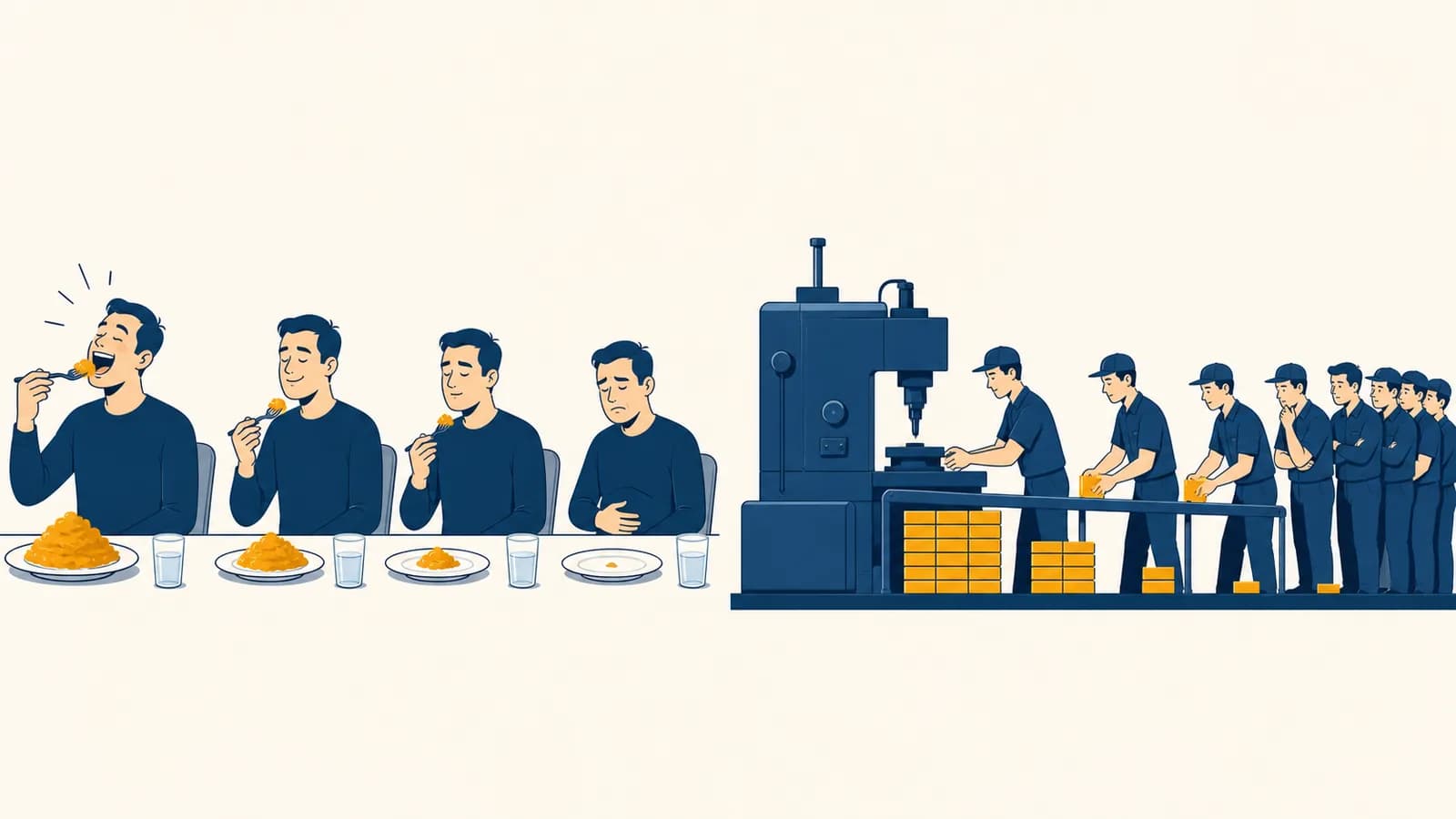
Marginal utility is an economic measure that describes the extra satisfaction or benefit gained from consuming one additional unit of a good or service, in the context of consumer choice. The law of diminishing marginal utility says that this extra benefit usually falls as a person consumes more within a given period. Diminishing returns is a related but different idea about production: adding more of one input eventually produces smaller extra gains when other inputs stay fixed. These ideas exist because choices happen at the margin, where one more item, hour, or dollar can change a decision.
What marginal utility actually is
Marginal utility is the change in a person's total utility caused by consuming one more unit. It concerns the next unit, not the value of everything already consumed, and it depends on the person's circumstances, preferences, and available alternatives.
Economists use utility as a compact name for the satisfaction, benefit, or preference fulfillment a person gets from a choice. Utility need not mean pleasure in a narrow sense. A bus pass can provide utility because it gets someone to work. Insurance can provide utility by reducing exposure to a large loss. A quiet hour can provide utility because it allows sleep.
The word marginal means additional. If eating a second slice of pizza raises a student's total satisfaction from 18 utility units to 28, the marginal utility of that second slice is 10 utility units. Those made-up units are a way to display the logic. They are not readings from a satisfaction meter.
If total utility rises from 18 to 28 when quantity rises from 1 to 2, then utility units per slice.
Here, is total utility and is quantity consumed. For whole items, the change in quantity is often one, so marginal utility is simply the difference between two neighboring total utility values. For divisible goods, such as electricity or fuel, economists can describe marginal utility for a very small change instead.
Marginal does not mean unimportant. It means the effect of the next small change. The next dose of medicine, hour of sleep, or glass of water can have very high marginal utility.
Marginal utility is personal and conditional. A sandwich can have high marginal utility for someone who missed lunch and low marginal utility for someone who just ate. The physical sandwich has not changed. The person's starting position has.
How diminishing marginal utility works
Diminishing marginal utility works because repeated units satisfy the most pressing parts of a want first. As consumption rises during a relevant period, later units usually add less satisfaction than earlier ones, while total utility may still continue to rise.
Suppose Maya comes home hungry and eats identical tacos. The following values are a worked example, not measured psychological data. They make the pattern visible.
| Tacos eaten | Total utility | Marginal utility of the next taco |
|---|---|---|
| 0 | 0 | |
| 1 | 30 | 30 |
| 2 | 52 | 22 |
| 3 | 66 | 14 |
| 4 | 72 | 6 |
| 5 | 72 | 0 |
| 6 | 67 | -5 |
The first taco adds 30 units because hunger is strong. The fourth still helps, but only by 6. The fifth adds nothing. The sixth makes Maya uncomfortable, so its marginal utility is negative. Total utility reaches its maximum where marginal utility becomes zero. It falls once marginal utility turns negative.
Ask about one consumer, one defined good, and a period such as a meal, a day, or a billing month. Changing any of these can change the pattern.
List how total satisfaction changes as units are added. The values can be illustrative if the goal is to understand the mechanism.
Each difference is the marginal utility of that added unit. A falling sequence shows diminishing marginal utility.
Zero marks a local peak in total utility. A negative value means the extra unit reduces total satisfaction.
The time period matters because wants can renew. The marginal utility of a first glass of water after exercise may be high. A second glass immediately afterward may add less. The first glass the next morning can be valuable again. Diminishing marginal utility does not say a good permanently loses value after someone consumes it once.
How economists represent marginal utility with numbers and curves
Economists represent marginal utility as the slope of a total utility relationship. A positive but falling slope means total utility is increasing at a decreasing rate. A zero slope marks a maximum, and a negative slope means another unit lowers total utility.
On a graph, quantity goes on the horizontal axis. Total utility can go on the vertical axis of one graph, while marginal utility goes on the vertical axis of another. In the taco example, the total utility curve rises quickly, then flattens, then bends downward. The marginal utility curve slopes downward through the listed values.
These utility numbers are ordinal in much of modern consumer theory. Ordinal utility ranks bundles, such as preferring bundle A to bundle B, without claiming that the feeling can be measured in stable physical units. Introductory exercises often use cardinal-looking utility numbers because subtraction makes the marginal pattern easy to calculate. The numbers model a ranking and a change, not a chemical quantity in the brain.
A downward marginal utility curve is a model, not a law of physics. It isolates a common response while holding relevant conditions steady. If quality changes, new information arrives, or units combine into a set, the observed pattern can differ. Careful analysis states what counts as a unit and what remains fixed.
Total utility versus marginal utility
Total utility is the satisfaction from all units consumed, while marginal utility is the satisfaction added by the next unit. Total utility can rise even as marginal utility falls, provided the marginal utility remains positive. The two move differently because one is a level and the other is a change.
Answers, “How much benefit do all consumed units provide together?” It adds each unit's marginal utility and reaches a peak when the next unit adds zero.
Answers, “How much benefit does one additional unit provide?” It may fall while the total continues rising, then reach zero or become negative.
Think about filling a bathtub. The water level resembles a total, while the amount added by each bucket resembles a marginal change. If each new bucket contains less water than the previous bucket, the level still rises, only more slowly. A positive marginal amount increases the total regardless of whether that marginal amount is getting smaller.
The arithmetic makes this exact. If marginal utilities are 30, 22, 14, and 6, total utility after four units is . Every added unit through the fourth raises the total. Diminishing means the increments shrink. It does not mean the total shrinks.
The same distinction appears throughout economics. Wealth is a stock, while income over a period is a flow. Total cost is a level, while marginal cost is the change caused by producing one more unit. Mixing up levels and changes leads to incorrect results even when every calculation is correct.
Diminishing marginal utility versus diminishing returns
Diminishing marginal utility concerns the extra satisfaction a consumer receives, while diminishing marginal returns concerns the extra output a producer receives from another unit of a variable input. Both describe falling additions, but they involve different decision makers, quantities, and causes.
| Question | Diminishing marginal utility | Diminishing marginal returns |
|---|---|---|
| Side of the market | Consumption | Production |
| What is added? | One unit of a good or service | One unit of a variable input, such as labor |
| What extra result falls? | Satisfaction or benefit | Physical output |
| What is held fixed? | Tastes, period, unit quality, and other relevant conditions | At least one production input, such as floor space or machinery |
| Typical reason | The most urgent wants are met first | The fixed input becomes crowded or limiting |
Consider a small bakery with one oven. A second worker may raise output sharply because tasks can be divided. A third still increases output. Eventually, extra workers wait for the same oven or obstruct one another. Output can keep rising, but each added worker produces a smaller increase than the worker before. That is diminishing marginal returns to labor, assuming the oven and other fixed inputs do not change.
A customer gets less extra satisfaction from each additional dumpling. In the kitchen, another cook adds less extra output once the counters and burners are crowded. The first is diminishing marginal utility. The second is diminishing marginal returns.
Diminishing returns is not the same as negative returns. If daily output rises from 100 meals to 118 after another worker is added, and then to 130 after one more worker, the second worker in this sequence adds 18 meals and the next adds 12. Marginal returns have diminished, but total output still rises. Negative marginal returns begin only if another worker causes total output to fall.
How marginal utility works in consumer choice
Consumer choice uses marginal utility to compare the extra benefit of each possible purchase with its price. A budget is allocated efficiently when moving one dollar between goods cannot produce more utility, assuming divisible goods, stable preferences, and ordinary interior choices.
Price matters because a dollar can buy different quantities of different goods. Comparing the marginal utility of one apple with the marginal utility of one movie ticket is incomplete if their prices differ. The useful comparison is marginal utility per dollar.
If the next snack gives 12 utility units for $3 and the next game gives 15 for $5, their utility per dollar is and . The snack gives more modeled benefit per dollar at that moment.
Suppose Kai has already bought several snacks but no entertainment. As more snacks are consumed, their marginal utility falls. At some point, the next game may offer more utility per dollar. Kai shifts spending until the ratios are equal, or until a constraint such as indivisibility or a zero quantity prevents exact equality.
This condition does not claim that people calculate utility units in a store. It describes the tradeoff behind an observed choice. A buyer may use habit, a rough feeling, or a quick comparison. The model asks what pattern would be consistent with the buyer making the best available use of a limited budget.
Income already spent is not the deciding margin. A good purchase asks what the next dollar can do now. Money that cannot be recovered is a sunk cost and should not make an unwanted extra unit more useful.
For a fuller account of preferences, budget lines, and bundles, see how consumer choice theory models preferences and budgets. Marginal utility supplies one useful language for the local tradeoffs within that broader model.
How marginal utility shows up in prices, subscriptions, and daily decisions
Marginal utility appears whenever a person asks if one more unit is worth its opportunity cost. Prices, subscription tiers, refill sizes, overtime hours, storage plans, and time choices all turn on the value of the next increment, not the average value of earlier units.
A seller can charge different prices for successive blocks
Block pricing changes the price attached to additional units, often because buyers value early and late units differently or because costs and policy goals differ across quantities. An electricity tariff, for example, can place usage into blocks with separate prices. The tariff itself does not measure utility, but it changes the comparison between marginal utility and marginal price.
A coffee shop uses a simpler version when a larger drink costs less per millilitre than a small one. The buyer should not compare average prices alone. The relevant question is what the extra volume adds to satisfaction and what the upgrade costs. A cheap extra portion is wasteful if its marginal utility is zero or negative.
A subscription separates access from extra use
A flat subscription makes the money price of one more use appear to be zero after the fee is paid. Time, attention, travel, and congestion can still create opportunity costs. The next streamed episode might have low marginal utility even though it adds no charge to the bill.
A gym membership costs the same this month regardless of today's visit. Going today is sensible only if the expected benefit of this visit exceeds the value of the time, effort, and travel required. Past monthly fees do not raise today's marginal benefit.
Usage limits and premium tiers also reveal marginal thinking. A person may value the first few gigabytes of cloud storage enough to pay a monthly fee, yet place little value on a much larger tier. A business buyer with large files can have a very different marginal valuation for the same extra storage.
Time has diminishing marginal value in a single activity
The first focused study hour before an exam may correct major gaps. A fifth uninterrupted hour may produce less learning because fatigue rises and the remaining gaps are narrower. This resembles diminishing marginal benefit, although changing fatigue means the conditions are not perfectly fixed.
The response is not always to stop early. Compare the marginal benefit of another study hour with its marginal cost, including lost sleep or work time. If the extra benefit still exceeds the cost, continuing can make sense even while the benefit is diminishing.
How diminishing returns shows up in farms, offices, and labor markets
Diminishing returns appears when more of one production input is combined with fixed inputs. Once the fixed equipment, land, or coordination capacity becomes a bottleneck, each additional unit of the variable input adds less output, which affects hiring, scheduling, and production costs.
Imagine a greenhouse with a fixed floor area. Adding workers can initially raise output more than proportionally because people specialize in watering, inspecting, and packing. Later, paths become crowded and each worker has fewer plants and tools to work with. The marginal product of labor begins to fall.
The tray figures are an arithmetic illustration. They show total output rising by 46 trays while marginal output falls from 20 to 16 to 10. If each worker receives the same hourly wage, the labor cost per extra tray rises as marginal product falls. This link helps explain why a firm's marginal cost often rises over part of its output range.
The fixed condition defines the short run in production theory. It does not mean a set number of calendar days. It means at least one input cannot be adjusted for the decision being studied. In the long run, the greenhouse can add space, tools, or automation, changing the production relationship and moving the bottleneck.
Managers meet this idea in software teams too, although output is harder to count. Adding developers to a project without adding clear tasks, review capacity, or communication structure can create coordination costs. The mechanism is a constrained system, not a claim that a particular worker lacks skill.
Hiring decisions combine marginal product with wages and the value of output. The page on how wages and hiring operate in labor markets develops those links between workers, firms, pay, and employment.
Five mistakes people make with marginal utility and diminishing returns
The most common mistakes confuse a falling addition with a falling total, treat utility as an objective property, ignore what is held fixed, merge consumption with production, or assume a pattern must hold for every unit. Each error changes the actual claim being tested.
1. “Diminishing” means total utility is falling
Diminishing marginal utility means the increase in total utility becomes smaller. If total utility moves from 30 to 52 to 66, it is still rising. Its increases are 22 and then 14, so the marginal utility is falling. Total utility falls only after marginal utility becomes negative.
2. Utility belongs to the product itself
Utility describes a relationship between a person and an option under particular conditions. Water has different marginal utility for a hiker with an empty bottle and a person beside a safe tap. Advertising, information, expectations, and available substitutes can also alter the relationship.
3. The two diminishing laws are interchangeable
A consumer's falling satisfaction from tacos says nothing by itself about a kitchen's extra output from another cook. Diminishing marginal utility helps model demand and choice. Diminishing marginal returns helps model production and cost. Similar graph shapes do not make the variables identical.
4. Diminishing returns means a firm should never add the input
A firm can rationally hire within the diminishing returns region. The relevant comparison is the value of the worker's extra output against the worker's extra cost. A positive but smaller addition may still be profitable. Stopping merely because the marginal product has begun to fall would ignore price and cost.
5. The pattern needs no conditions
Units must be comparable and relevant conditions must be specified. The second shoe has more marginal utility than the first if one shoe alone is nearly useless. A collector may value a missing final item highly. Network access can become more useful as more contacts join. These cases do not make marginal reasoning useless. They show that the good was defined too narrowly or that other conditions changed.
This sentence applies to both sides of the topic. A fourth taco can add less satisfaction and still be wanted. A fourth worker can add less output and still earn more for the firm than the wage costs.
Can marginal utility rise, become zero, or turn negative?
Marginal utility can rise when units complement one another, reach zero when another unit adds no benefit, and turn negative when excess consumption creates harm or inconvenience. Diminishing marginal utility is a common conditional pattern, not a guarantee for every sequence.
Complementarity can produce an increasing margin over a limited range. One battery may be useless for a device that requires two, while the second battery makes the device work. The second battery has higher marginal utility because it completes a pair. The right unit of analysis might be a two-battery set.
Learning can also have thresholds. The first lesson in a coding language may provide little practical ability. Several connected lessons can make it possible to build a working program, raising the marginal benefit of a later lesson. Eventually, fatigue or mastery of the basic material may make additional lessons less valuable.
Zero marginal utility means indifference to one extra unit under the specified conditions. It does not mean the good as a whole has no value. Negative marginal utility means the extra unit makes the person worse off, as with food past fullness or another notification during focused work.
For the same person, comparable units, a defined period, and stable surrounding conditions, later units add less utility.
Every later unit of every good must add less utility, regardless of combinations, time, learning, quality, or changing circumstances.
Good economic reasoning tests the assumptions before applying the curve. If marginal utility rises, ask if the units are complements, if the good has changed, or if earlier consumption changed the usefulness of later consumption. The exception can identify the mechanism.
How marginal utility helps explain the water and diamond puzzle
The water and diamond puzzle separates total usefulness from marginal valuation. Water provides enormous total benefit, but in places where it is abundant the next unit may have low marginal utility. Diamonds are less useful overall, yet scarcity can make an additional unit highly valued.
The puzzle is associated with classical discussions of value: why can a necessity sell cheaply while a nonessential gem sells dearly? Marginal analysis answers by focusing on the unit currently available for exchange. Market price reflects choices at the margin under scarcity, not a ranking of each good's total importance to human life.
Suppose a household has enough safe water for drinking, cooking, and washing. One extra litre might be used on a garden or left unused, so its marginal utility is modest. If safe water becomes scarce during an emergency, the next litre moves toward an urgent use and its marginal utility rises. The substance is the same. Availability and the use displaced are different.
Scarcity changes the next use. Abundant units are assigned to lower-priority uses. Remove units, and the remaining margin moves toward drinking and other high-priority uses.
This explanation does not say marginal utility alone sets every market price. Supply conditions, production costs, market structure, income, expectations, and rules also matter. A person's willingness to pay is also limited by ability to pay. Market demand aggregates choices made by many people whose circumstances differ.
Private marginal utility can also miss effects on other people. A driver may value one more trip without bearing all pollution or congestion costs. The explanation of how externalities move costs or benefits onto other people shows why private and social margins can point to different choices.
Marginal analysis turns broad wants into testable choices
Marginal utility and diminishing returns connect consumer behavior, production, demand, and cost by asking one disciplined question: what changes if one more unit is added? The answer becomes useful when the unit, time period, alternatives, and fixed conditions are stated clearly.
Notice the next real decision that involves “one more.” It might be another hour of work, another item in a cart, another employee on a shift, or another monthly subscription. Name the extra benefit, the extra cost, and the resource that could be used elsewhere. Then check if the marginal benefit is falling, and if it still exceeds the marginal cost.
The takeaway: Diminishing marginal utility explains why later units often satisfy less urgent wants. Diminishing marginal returns explains why a fixed production constraint eventually limits extra output. Neither says the total must immediately fall.
This habit is central to the wider set of economics explanations because economics studies choices under scarcity. Totals describe where a person or firm stands. Margins show which direction a next step moves them, and by how much.