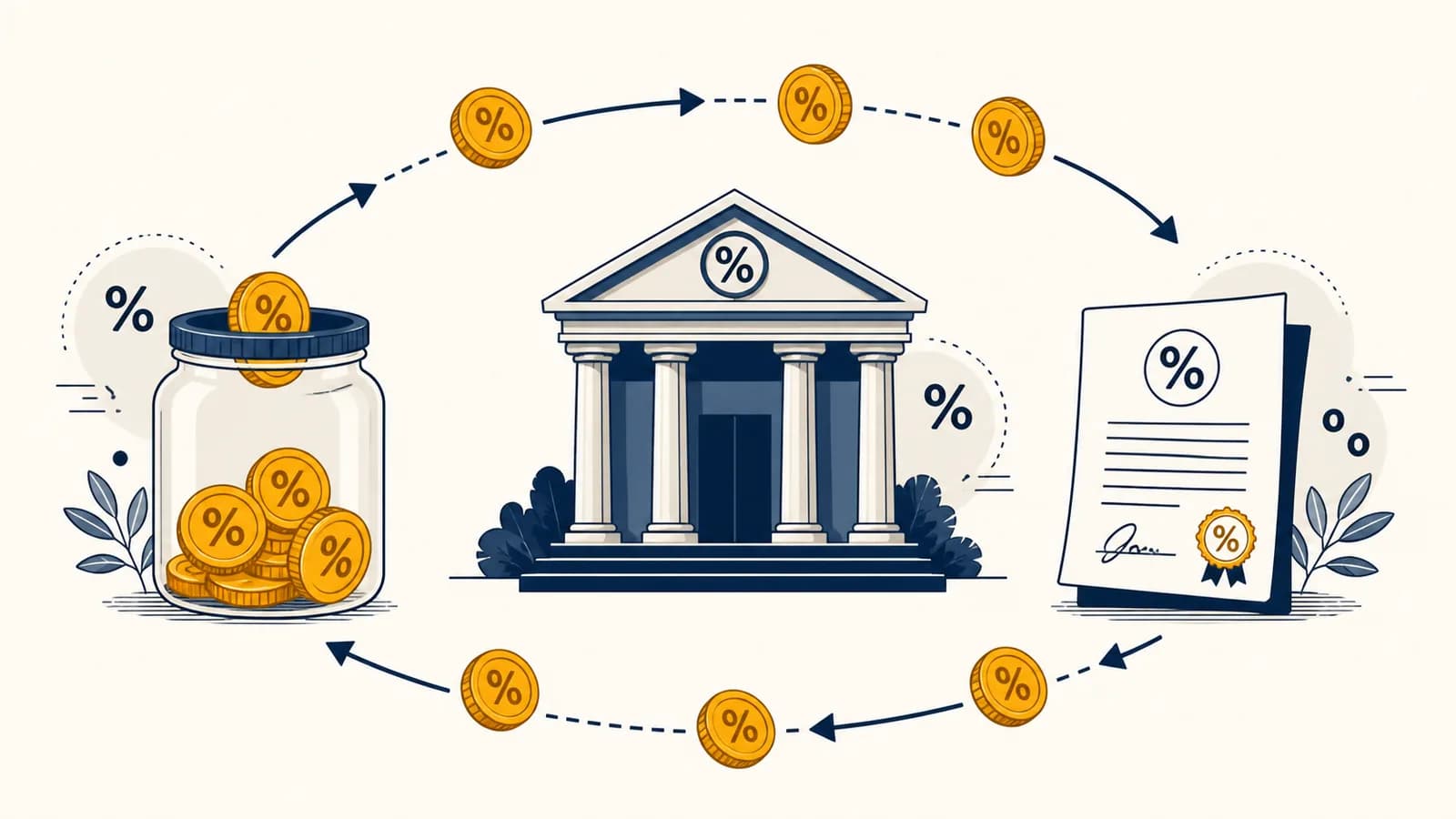
An interest rate is a price that measures the cost of borrowing money or the reward for saving it, in the context of finance and economics. A rate is usually stated as a percentage of a sum of money for a period, often one year. People searching for “what is an interest rate,” “how do interest rates work,” or “interest rate meaning” are asking about this price. Interest exists because money available now can be used now, while repayment or access comes later, and time, inflation, and the risk of nonpayment all have value.
A rate looks small because it is written as a percentage, but it affects a stream of payments across time. It can decide the monthly cost of a mortgage, the growth of a savings account, the price of a bond, and which business projects are profitable. To interpret any quoted rate, you need to know what amount it applies to, how long it applies, whether it compounds, and which fees sit outside it.
What an interest rate actually is
An interest rate states the interest charged or earned during a period as a proportion of the principal, which is the original amount borrowed or saved. A rate therefore connects three things: money, time, and the terms of an agreement.
If you borrow $1,000 for one year at a simple annual rate of 6%, the principal is $1,000, the rate is 0.06, and the interest is $60. You repay $1,060. The calculation is visible:
For $1,000 at 6% a year for one year, , so the interest is $60.
Here, is interest, is principal, is the annual rate written as a decimal, and is time in years. The formula is a model of simple interest. Many real accounts use compound interest instead, and many loans collect payments during the term, so their balances do not remain fixed.
A percentage needs a base and a period. “5% interest” is incomplete unless you know 5% of what balance, over what time, under what compounding and fee rules.
The rate is a price, but it is not quoted in dollars because loan sizes differ. A $60 charge on $1,000 and a $600 charge on $10,000 are both 6% of the principal. The percentage makes contracts of different sizes easier to compare. It does not make their dollar costs equal.
How interest works over time
Interest works by applying a periodic rate to a balance, then either paying the interest out or adding it to that balance. If added interest earns later interest, the account compounds and growth accelerates with time.
The contract defines which balance receives the rate. It might be the original principal, the unpaid loan balance, or the current account balance.
An annual rate must be converted if interest is calculated monthly or daily. The contract also states how often calculation and compounding occur.
Multiply the relevant balance by the periodic rate. On a loan, this is a cost. In a deposit account, it is income.
Add unpaid interest, subtract loan payments, or include deposits and withdrawals. The new balance becomes the base for the next calculation.
Suppose $1,000 earns 5% once a year and all interest stays in the account. After year one, the balance is $1,050. In year two, the 5% applies to $1,050, producing $52.50, so the balance becomes $1,102.50. The extra $2.50 compared with two years of simple interest is interest earned on earlier interest.
With annual compounding, , so the balance is $1,102.50 after two years.
In this formula, is the final amount, is the number of compounding periods per year, and the other letters keep their earlier meanings. More frequent compounding raises the effective return slightly when the stated rate and all other terms are unchanged.
Loans add another moving part: payments reduce the balance. In a typical fixed payment loan, each payment covers the interest charged since the previous payment and then reduces principal. Early payments often contain more interest because the unpaid balance is larger. Later payments contain more principal because the balance has fallen.
This sequence explains why sending extra money specifically toward principal can reduce later interest, if the contract allows it without a penalty. A smaller next balance creates a smaller next interest charge. The effect repeats through the remaining term.
Nominal interest rates versus real interest rates
A nominal interest rate measures growth in units of money, while a real interest rate adjusts that growth for changes in purchasing power. Inflation can make a positive nominal return a negative real return if prices rise faster than the account grows.
Imagine a savings balance grows by 5% during a year while the prices of the goods you buy rise by 3%. Your dollar balance grows 5%, but the amount of goods it can buy grows by roughly 2%. That approximate difference is useful for quick reasoning.
The percentage printed on the contract or account statement. It tells you how the number of dollars changes before adjusting for inflation.
The change in purchasing power. It compares the growth of money with the growth of the relevant price level.
The exact relation uses growth factors rather than simple subtraction:
If the nominal rate is 5% and inflation is 3%, , so the real rate is about 1.94%.
The symbol represents the inflation rate for the same period. The inflation measure also matters. A broad consumer price index may not match the price changes faced by a particular household. Real interest is therefore an economic comparison, not an extra payment shown on a bank statement.
This distinction is central to household planning and economic policy. A central bank may raise nominal rates, but the effect on saving and borrowing incentives depends partly on what people expect inflation to do. The mechanism belongs within how monetary policy influences spending and prices.
Annual percentage rate versus annual percentage yield
Annual percentage rate usually expresses a yearly borrowing rate and may include specified loan charges, while annual percentage yield expresses a yearly deposit return including compounding. The labels answer different questions, so APR and APY should not be substituted for each other.
Suppose a deposit advertises a 12% nominal annual rate, compounded monthly. The monthly rate is 1%. A $1,000 balance becomes , or about $1,126.83 after one year. The APY is therefore about 12.68%, because the $126.83 gain is 12.683% of the original $1,000.
| Measure | Main use | What it tells you | What to check |
|---|---|---|---|
| Stated annual rate | Loans or deposits | The quoted rate before translating compounding into a one year result | Compounding frequency and balance rules |
| APR | Borrowing | A standardized annualized cost measure under applicable disclosure rules | Which fees are included and whether the rate can change |
| APY | Saving | The percentage a balance would earn in one year with compounding | Balance requirements, changing rates, and withdrawal conditions |
Legal definitions of APR differ by country and product, so the disclosure document controls. Even a standardized APR may not capture every practical cost, such as a late fee that occurs only if a payment is missed. For a loan, compare the APR, required payment, total repayment under the stated schedule, rate adjustment rules, and penalties together.
A low monthly rate can hide a high annual cost. Never multiply or compare rates until their periods and compounding rules match.
Credit card statements illustrate the problem. Interest may be calculated from an average daily balance using a daily periodic rate, while the account advertises an annual rate. A grace period may prevent purchase interest if the statement balance is paid by the due date. Cash advances and missed payments can follow different rules. The exact contract matters more than the large number printed in an advertisement.
How lenders set the rate offered to one borrower
A lender sets an offered rate by combining its own funding cost with expected losses, operating costs, capital requirements, contract features, and a profit margin. The final quote also reflects competition and the lender's estimate of that specific borrower's risk.
A bank does not simply lend one saver’s labeled dollars to one borrower. It manages pools of deposits, wholesale funding, reserves, loans, securities, capital, and liquidity. Each source and use of funds has a cost or expected return. A new loan must make economic sense within that balance sheet.
Credit history can affect the risk estimate because it records how a person has handled earlier obligations. Income and existing debts affect the estimated ability to pay. Collateral can reduce the lender's possible loss, although repossession is costly and never makes repayment risk disappear. A longer fixed rate also shifts more interest rate risk to the lender because market rates may change while the contract rate stays fixed.
One loan offers 7% with a $400 required fee. Another offers 7.3% with no fee. The first is not automatically cheaper. The answer depends on the amount borrowed, the repayment schedule, which fee enters the APR, and how long you keep the loan.
Comparison requires cash flows, not a single printed percentage. Write down every amount received and every amount paid on its date. For simple choices, total cost and monthly affordability may be enough. For contracts with different timing, economists compare present values or calculate an effective rate that makes the cash flows comparable.
How central bank rates reach households and businesses
A central bank directly controls or targets a short term policy rate within its monetary system. Changes then pass through financial markets, bank funding costs, exchange rates, asset prices, and expectations, influencing many retail rates without fixing each one.
The transmission is a chain, not a command sent to every lender. If short term market funding becomes more expensive, banks often raise rates on some new loans. Savers may demand better deposit returns. Investors reprice bonds because newly available returns have changed. Currency demand may shift. These reactions affect spending, investment, hiring, and prices with delays.
The pass through is incomplete. A fixed mortgage signed years ago may not change at all. A variable rate loan may reset after a specified date. A bank with plentiful deposits may react differently from one that depends on market funding. Risk premiums can rise even while a policy rate falls, leaving a risky borrower with a higher quote.
Government decisions operate through a different channel. Taxing, spending, and borrowing can change total demand and the supply of government debt, as explained in how fiscal policy changes economic activity. Monetary and fiscal actions can reinforce or offset each other, but an interest rate is not itself a tax rate or a government spending program.
Central banks usually focus on short term conditions, while mortgages and business investment often depend on longer term rates. Those longer rates reflect expected future short rates, inflation expectations, and compensation for risk and time. A cut in today’s policy rate therefore does not guarantee an equal cut in every ten year or thirty year loan quote.
Fixed rates versus variable rates
A fixed rate stays unchanged for the contract's defined period, while a variable rate can reset according to a stated benchmark and margin. Fixed rates buy payment certainty; variable rates transfer more future rate risk to the borrower.
The contract rate does not respond to market movements during the fixed period. Refinancing may be possible, but it is a new transaction with its own approval, costs, and terms.
The contract specifies a benchmark, a margin, reset dates, and often a floor or cap. The payment or loan term may change when the rate resets.
Consider a $10,000 balance with interest calculated simply for this illustration. At 6%, one year of interest on an unchanged balance would be $600. At 8%, it would be $800. A two percentage point rise is a rise of two percentage points, but it is a one third increase in the annual interest charge because $800 is one third more than $600.
The better contract depends on risk capacity as well as the starting quote. A household with little room in its budget may value a stable payment. A borrower planning to repay soon may be more willing to accept resets. Before choosing, test the payment at the contract's cap or at a meaningfully higher rate, not only at the introductory rate.
A promotional rate adds another clock. It can be fixed for an initial window and then become variable. Read the post promotion formula and the balance transfer or origination fee. A zero rate does not mean a zero cost if a separate fee is charged.
How interest rates show up in saving, loans, and bonds
Interest rates appear as income to savers, costs to borrowers, and discount rates in asset pricing. The same market change can help one side of a contract while hurting the other, depending on timing and whether rates are fixed.
Saving accounts reward delayed spending
A deposit rate is the price a financial institution pays for the use of deposited funds under the account terms. A higher APY grows a balance faster, but access rules, insurance eligibility, fees, minimum balances, and rate changes also affect the account's usefulness.
If $2,000 remains in an account with a fixed 4% APY for one year, it grows by $80 to $2,080. If a $10 monthly fee applies for all twelve months, $120 of fees would exceed that interest. This is why a rate comparison without account conditions can produce the wrong choice.
Loans move future income into the present
A loan lets a borrower use money now in exchange for scheduled future payments. Interest compensates the lender for time and risk, while the borrower pays for earlier access to a house, education, vehicle, inventory, or other purchase.
For a business, the rate helps set a hurdle. A project expected to return less than its financing cost may destroy value, although estimates are uncertain and financing cost is not the only consideration. Higher rates can cause firms to postpone equipment, buildings, and hiring. Those decisions connect interest rates with how labor markets determine jobs and pay.
Bond prices move opposite to market yields
A conventional fixed rate bond promises specified cash payments. When market yields rise, the price of an existing bond usually falls because its fixed payments must become cheaper to offer a competitive return. When yields fall, those fixed payments become more valuable.
A bond will pay $1,050 one year from now. If buyers require a 5% annual return, , so its present value is $1,000. If buyers instead require 10%, , so its present value is about $954.55.
This inverse price relation surprises people because the promised dollar payment did not change. The comparison changed. Once new investments offer a higher yield, an old fixed payment must sell at a lower price to produce that yield. Longer dated bonds are generally more sensitive because more of their value arrives farther in the future.
How discounting turns a future payment into a present value
Discounting converts money received in the future into an equivalent value today by dividing by an interest based growth factor. A higher discount rate assigns a lower present value to the same fixed future payment.
At 5%, , so $1,000 received in two years has a present value of about $907.03.
The logic is reversible. If $907.03 can earn 5% annually for two years, it grows to $1,000, apart from rounding. Present value therefore gives a common date on which to compare cash flows. It does not claim that a future payment is unimportant. It states what amount today could grow into that payment at the chosen rate.
The difficult choice is often the discount rate. A safe promised payment and a speculative business forecast should not automatically use the same rate. Inflation, default risk, liquidity, and opportunity cost can all affect the appropriate comparison. Analysts test several rates to see how much a decision depends on one assumption.
Governments use discounting when evaluating long lived projects. Companies use it for factories and software. Courts and insurers may use it when valuing payment streams. Households use the same reasoning, even without the formula, when choosing between cash now and installments later.
Can an interest rate be zero or negative?
An interest rate can be zero, and some market or policy rates can be negative. A negative rate means the contractual future amount is lower than the relevant present balance, though fees, storage costs, safety, and institutional rules shape why anyone accepts it.
At zero interest, $1,000 today exchanges for $1,000 at the end of the stated period. With a negative rate, a lender may accept receiving slightly less. This can occur when a very safe asset provides security or liquidity that investors value, or when holding and moving physical cash would be costly or impractical.
Negative policy rates do not imply that every household is paid to take a loan. Retail lenders still face operating costs and credit risk, and deposit rates may stop near zero because customers can switch to cash or other assets. Different rates in the financial system can therefore sit on opposite sides of zero at the same time.
How fast can interest make debt or savings double?
Compound interest doubles a balance when repeated percentage growth accumulates to 100%, but the time is not found by simply doubling the annual rate. The exact doubling time depends on the rate and compounding frequency.
With annual compounding at rate , solve . Taking logarithms gives:
At 8%, , so the exact doubling time is about 9.01 years.
The “Rule of 72” gives a quick estimate: divide 72 by the annual percentage rate. At 8%, it estimates 9 years, close to the exact result. It is a mental shortcut, not a contract calculation. Changing rates, fees, taxes, deposits, withdrawals, and payment schedules can all alter an actual doubling time.
Five mistakes people make with interest rates
Most interest rate errors come from comparing unlike periods, ignoring compounding or fees, confusing percentage points with percent changes, overlooking inflation, or treating a variable rate as permanent. Each error can be prevented with a short calculation or contract check.
1. Comparing a monthly rate directly with an annual rate
Rates must cover the same time span before they can be compared. A 1% monthly rate is not a 1% annual rate. With monthly compounding and no other changes, it produces an effective annual rate of , about 12.68%.
2. Looking at the rate but ignoring the cash fees
Fees change the amount actually received or repaid. A $1,000 loan with $100 withheld at origination gives the borrower only $900, even if repayment is calculated from $1,000. The effective cost must be based on the dated cash flows, not the headline rate alone.
3. Confusing percentage points with percent change
A rise from 4% to 6% is an increase of 2 percentage points. Relative to the old rate, it is a 50% increase because . Both statements can be correct, but they answer different questions.
4. Treating a nominal gain as a purchasing power gain
A balance can grow while buying less. Compare the account's effective return with inflation over the same period, then consider tax and fees if they apply to your decision. The number on the statement records money, not the quantity of goods that money can buy.
5. Assuming today's variable rate will last
A variable rate is a formula, not a promise that the opening payment will continue. Read the benchmark, margin, reset interval, floor, cap, and introductory period. Calculate an affordable higher rate before signing, using the loan's actual balance and schedule.
The takeaway: Translate every rate into dated cash flows. Identify the balance, period, compounding, fees, inflation, and reset rule before deciding that one percentage is better than another.
Interest rates coordinate choices across the economy
Interest rates connect present choices with future resources across economics. They influence saving, borrowing, investment, asset prices, exchange rates, employment, and inflation because every delayed payment requires a way to compare value across time.
The common mechanism is opportunity cost. Money used for one purpose cannot be used elsewhere at the same moment. A market interest rate provides one visible benchmark for that tradeoff. It helps households decide how much to save, firms decide which investments can cover their financing costs, and investors compare cash flows arriving on different dates.
No single rate describes the whole economy. Policy rates, government bond yields, mortgage rates, credit card rates, deposit APYs, and business loan rates differ because their terms and risks differ. Their movements still carry information about expected inflation, demand for credit, confidence, and the supply of funds.
To see the concept operating outside a textbook, inspect one bank statement or loan disclosure. Find the balance used for interest, convert the rate to the calculation period, locate every fee, and trace one payment into interest and principal. Then place that contract beside the broader set of economics explanations and ask which choices would change if its rate rose by two percentage points. That is how a small percentage becomes observable economic behavior.